

jd1923
-
Posts
3,893 -
Joined
-
Last visited
-
Days Won
316
Posts posted by jd1923
-
-
52 minutes ago, dbp05ret said:
My main concern is when I unscrew the hose pictured in the blue circle. It is on there very tight. I have tried to unscrew by hand and it won't budge.
Two things...
Be certain as to where it is leaking. Is the water coming out from the threads to the hose? If so, what @Ollie-Haus wrote is likely the simple reason. And given the threads are crossed could be a reason why it's on so tight.
Many of us have had a similar leak but not from the hose threads. Instead it leaked in the plastic molding to which the hose connects. Run more water while looking to be sure of the specific location of the leak. If it is cracked above the hose connection you will need a new assembly:
https://itcshopnow.com/products/exterior-shower
Either way you can pull the shower assembly out from the hull. When standing outside disconnecting these hose(s) a simple task vs. hunched over the basement with one hand in there. This link should take you to where I installed a new shower assembly. Notice there is ample slack to work these connections from the outside. Remove the 4 screws and some caulk.
-
 1
-
-
2 hours ago, Against The Wind said:
I don’t know if upgrading your mattress is considered a mod or not but I would like to seek your valued opinion...
Yeah, I believe you chose the right place that a custom mattress is a Mod!.
I've read several positive comments on our Forum re this brand mattress.
They came with when we purchased our Oliver used 3 years ago. Therefore, I do not know the full history, how old they were at the time. Whether there were choices for firmness. If new when the hull was born would make them 7 years old at the time.
They were WAY too soft for me. My wife was OK with them. At my 6'2" height with 220+ LBS, I felt like I would sink into the foam, it would limit my movement and it got hot.
We replaced ours after only a few nights use. We went with Brooklyn Beddings at RVmattress.com and purchased a 30x75" Dearfoam Essential which I believe is comparable to the CopperFlex Essential today. This product became a little too firm even though we went with the 12" height advertised as medium firmness (but too tall if you like to sit on them). It's impossible know firmness when you are ordering online.
We opened a corner on each, measured and trimmed a radius using an insulation knife. Tacked the corners back together and the mattress cover holds it all nicely together.
I'm happier with a mattress a little firm which let's me sit up to watch TV. Too soft made me struggle with the bedding and was difficult getting in and out of those little 30" mattresses. Just my take, some feedback for your decision.
-
4 hours ago, Dean and Mary said:
Most voltage drop calculations focus on maximum current, but the Orion's charging current changes significantly as it transitions between bulk, absorption, and float stages.
After some on-the-road use, you'll find that all that matters in a DC-DC charger is that it turns on to BULK charge and gives you 40 to 50Ah for every hour towing.
Absorption and float are final charging modes used to bring SOC up to 100%. BTW, this was a lot more important for LA batteries vs. LiFePO4. Our solar charger will bring SOC up to 100% when parked at home. When traveling we are most often between 50% to 80% SOC, so the Orion is almost always in bulk charging mode when towing.
My goal is tow a half day and add 200 Ah to battery SOC for when we get to our next campsite! 😎
-
1
-
-
Has anybody gotten a reply from OTT @Aaron Wolters after emailing a picture?
-
5 hours ago, FloraFauna said:
Absolutely agree! I would like to see rubber bushings in there and am contemplating my options to add a bit of shock/vibration absorbing/dampening.
15 hours ago, Geronimo John said:How many trailers have this very same issue and don't have a clue about? I for one have never checked my Suburban hot water heater's attachment.
Our Suburban 6-gal HWH has a foam insulated casing and does not have hold-down straps. I'm uncertain in how it is secured besides the many screws holding the exterior plate, and the water and LP lines and electric.
Our Suburban furnace was replaced by OTT in 2020 with an Atwood model. First owner brought it in during 2018 complaining about excessive noise. When they didn't fix the noise, he brought it back in 2020, the service ticket ordered the replacement furnace.
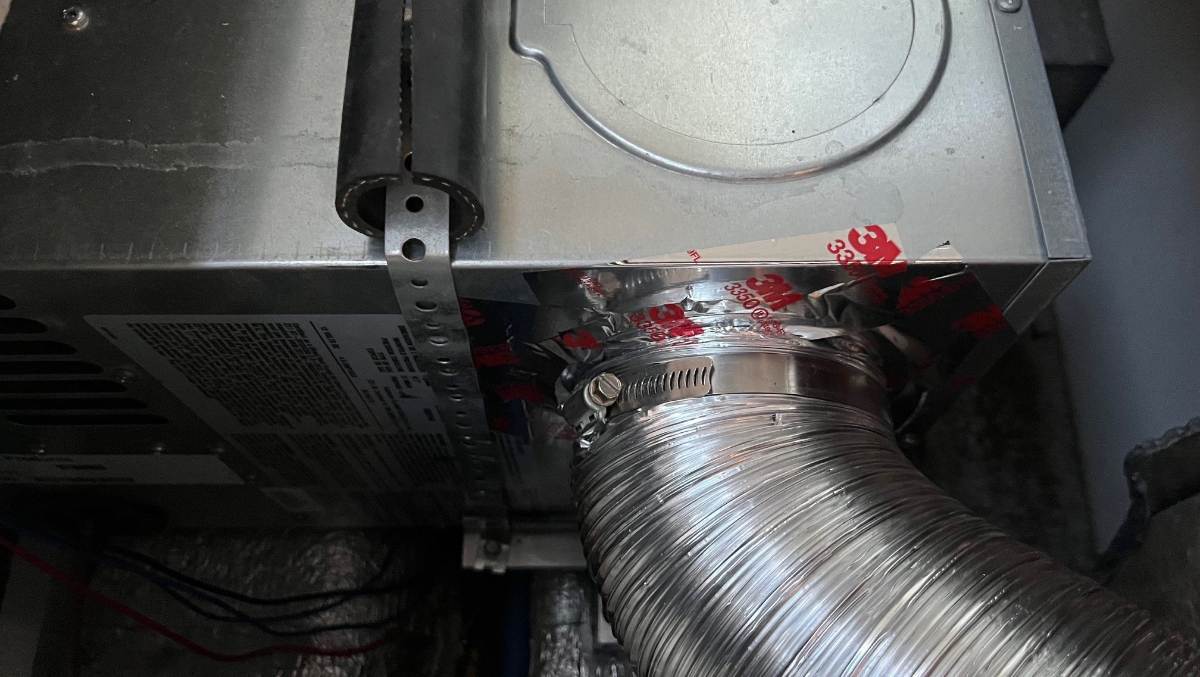
I remembered this picture I had. It shows the furnace with the same kind of strapping holding it down to the platform below. The strapping was always a little loose and I put the section of heater hose on it years ago to add some cushion.

-
2
-
-
51 minutes ago, Dean and Mary said:
John, I completely agree with what you're saying, and I've given this a great deal of thought.
And I agree with everything you wrote in these posts.
”The tables” re voltage drop and real world measurements are showing the tables are (engineered on purpose) to be conservative.
Maybe you already purchased the Orion 50 and if so perhaps it could be returned. I believe with 1/0 wire installed you can exceed 50A. I’m in the 40s in the Orion 50A with only 4 AWG and the Orion 70A could be getting over 60A.
At the same time, I truly understand if you’re about done with sourcing parts, the hardest, longest part of any DIY effort!😎
-
1 hour ago, FloraFauna said:
I am debating in my head whether locking it down to the bottom with angles in the corners as you suggest OR would it be better to have a slight flexibility?
Depends on what you have to work with, how far you can reach under and around it. I’d like it bolted down sitting on rubber bushings vs floating with only a pipe strap keeping it from bouncing down the highway!
What a LAZY installation! An on-demand heater doesn’t have the 6 gallons/50 LBS additional weight so they figured, “let’s just hang it.” And “Figured” is a polite word for lack of installation procedure. Shows the state of “professional installations” in the trades today! 🤣
I'm pretty sure our water heater is sitting on the floor. It’s wrapped in a foam casing, so it’s hard to tell.
i understand what GJ is stating, but I’ve never received a company email re a safety warning in 3 years except the one time when they mounted a Bulldog receiver not 7K rated on one hull (was Bulldog’s fault for mis labeling their product).
They’re not going to give you repair advice. You got this! 😎
-
2
-
-
On 11/6/2026 at 8:51 AM, Dean and Mary said:
I have decided to use 1/0 AWG for my Orion 50 amp installation.
I went with 4 AWG for cost reasons and the fact the Orion 50 terminals take 4 AWG max.
I spent $95 for 65 ft. Today this costs $145. Also today 85 ft of 1/0 costs $354!
https://www.amazon.com/TEMCo-WC0180-50-Welding-Battery-Copper/dp/B00LIB4JP2/?th=1 These prices are generally even higher from other suppliers.I understand the EE calculations for a 50A load and wire gauge and length considerations. And I truly understand how important this can be in residential, commercial and industrial installations. Voltage drop can be an issue with electronics and some discerning appliances but honestly isn't it a lesser consideration for a battery charger? These DC-DC chargers can accept input voltage from 9V to 17V.
Does it truly matter that an alternator producing 13.8V at the low end (13.8-14.2V is our range) with a 0.5V voltage drop, still delivering 42A at 13.3V? You lose potential but your not hurting anything given the drop is not causing excessive heat in the charger and wiring.
If you're going to spend $200 more in wire gauge, I strongly suggest you spend ONLY another $67 to upgrade to the Orion XS 70A. With 1/0 wire, after you leave the EE calculations and worries to the side, you'll find in application you'll likely get 60A from the Orion XS 70A. You can always limit the Input Current to any value on any Orion charger model.
https://invertersrus.com/product/ori121221040/
It also has built-in cooling fans for the little extra money, but our 50A barely gets warm at all running on under-sized wire, go figure! 😎
4 hours ago, Snackchaser said:Oh, the Anderson connectors only accept up to #4 wire, so a short pigtail might be needed to connect heavier cable. This only adds negligible voltage drop.
Geoff mentioned this first re the Orion terminals and here re the Andersens. Yes, both are 4 AWG. In the Andersen SB175 lug designed for 4 AWG, the opening is actually a little larger, but the Orion has a tight fit with 4 AWG.
Instead of adding pigtail cables, wouldn't it be a simpler the strip the 1/0 wire and then trim the copper strands down in size to fit the terminals? The pigtails adds more cost, more resistance in connections and additional points of failure. I imagine trimming the wire size would not be "to code" but it's the way I would do it for simplicity.
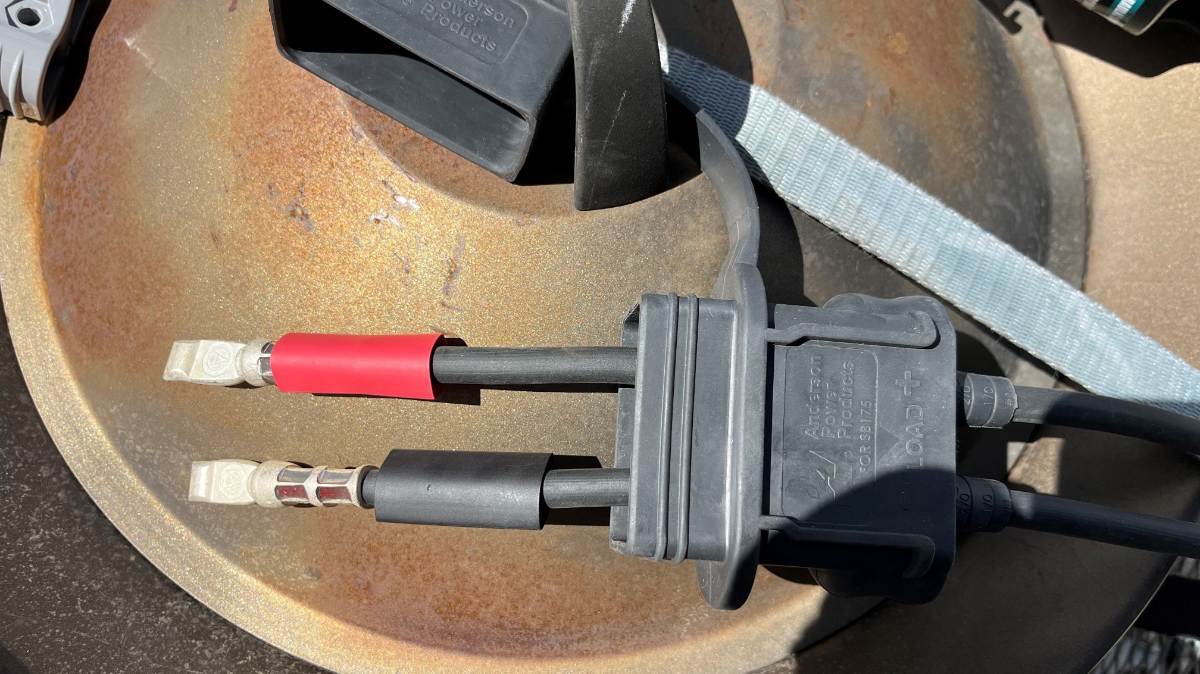
Heat shrink the Andersen poles as I showed above and certainly buy the "environmental boots" (also pictured above). You need two parts, both Source and Load side boots
https://powerwerx.com/anderson-36036p1-sb175-environmental-boot-source
https://powerwerx.com/anderson-36037p1-sb175-environmental-boot-load -
18 hours ago, FloraFauna said:
I found the strap holding the Truma water heater had broken on both sides in very symmetrical locations.
OTT certainly used the wrong material. Is the Truma heater currently hanging by the faceplate only? Better materials must be used for this application. This strapping material is for hanging pipe without a strength rating at only 28-gauge. Don't buy this stuff:
Go with Simpson Strong-Ties made in the USA. You could mount two hard corners with straights or use their Coiled Strap. This item is 16ga and should be extremely strong. I have a coil of their lighter 22ga. I doubled the ends at mount points and used it to strap our inverter against the basement wall. The 22ga might be strong enough for this case but I promise the 16ga will be harder to bend but would never fail. They have an array of thicknesses, chose from 12, 14, 16, 18, 20, 22 gauges. The lightest 22ga is thicker, wider and stronger than what OTT installed. Buy this instead:
-
3
-
-
2 hours ago, Dean and Mary said:
There is little benefit to having the Orion enabled while boondocking for a week, even though it is disconnected from the tow vehicle.
I leave all of our Victron products on all the time. I have breakers for everything under the dinette seat, didn't want extra switches. I'm not saying this is the right way.
We also leave our Outside Courtesy Lights on 24x7 (rodent deterrent). Everything on we burn about 1.75A. About 1A for the MP2, 0.25A for the lights and 0.5A for all other electronics ON or on standby. The rooftop solar replenishes this much even on cloudy days.
The last thing you want is to be towing down the highway and think, "oops, I forgot to turn on the Orion!" I've read here about some turning off their LevelMate to save batteries. Same thing, you're backing into a campsite and realize the LevelMate is OFF, bummer.
We have the PRO model hardwired, always ON. I also have our Victron MPPT SC always ON. It's for the suitcase solar that we rarely use but when I plug in the solar cables it wakes up the SC. Am I hurting the SC leaving it on standby? IDK, but ours has been ON for two years now.
Our hull has a power switch for the rear camera. This would be another circuit where just when you need it, it would be OFF! I never used the cameras anyway and have since removed them.
Geoff has posts where he added timers to some of his devices, allowing the time-out to switch power off. Lot's of good solutions and things to think through before the installation.
-
6 hours ago, Snackchaser said:
just settings that are tight for idle charging.
DONE - SOLVED - Yay! I hope Bob gets theirs working asap! So glad I took time to add those screenshots. Geoff read them and had the answer. I understand most of it but it's confusing!
Turns out I had the Engine Shutdown Detection at the default settings (see pic, left frame). I had adjusted the battery charge settings but nothing else. Not sure why it was running better, then not, since looking back at my pics during installation I'm pretty sure now the Orion was always at these defaults.
Taking into consideration what Geoff wrote and the YouTube video, I set mine to Standard Alternator and then when I changed individual voltage settings it's then called User-Defined. The new settings chosen are also pictured (center frame).
She's running better than ever! Before I was getting about 42A when towing. Now I'm getting that at idle. I held the pedal to bring the diesel idle up at 1600 RPM and the Orion moved up to a 46A output.
For some reason (?) the Input Voltage shown on the app is the same number as the selected Shutdown Voltage. It was 13.1V, now 12.8V and I changed it to 12.7V it did the same thing. Then I set it back to 12.8V.
The Klein clamp ammeter showed the same numbers as the app. I measured all three 4 AWG wires at the Orion. I found Input Amps - Output Amps was equal to the approx 4A reading for the Orion Ground Wire. The 4A must be the current the Orion is using in doing the work of the DC-DC charger.
The Orion 50A charger during tests today and yesterday got just slightly warm to the touch. I could leave my hand completely over it for as long as I wanted.
Yes, @Geronimo John and others might want to upgrade to the 50A given your 30A charger is truly getting hot!
-
 1
-
-
3 hours ago, Snackchaser said:
Your screenshots show the input sitting at about 13.1 V, which is exactly the Orion’s default engine shutdown voltage for a smart alternator.
Thanks, Geoff. I'll hook up again soon to check settings and tweak the numbers. Installation was March of 2025 and I just checked my write-up where unfortunately I didn't document anything on the Orion XS configuration.
To learn more about this I just watched a few YouTubes. This one was the most thorough. @Olive2Roam should check this too as there is a Smart Alternator setting and he discusses how they can run very low voltage.
Also discussed in the video is having an ignition wire connection (hot only when key is in ON position) to the switch on the Orion. This might be the perfect fix for a smart alternator so that engine shut-off detection can be turned off. This is hardwire engine ON detection which means running a light gauge ignition wire from TV to TT, having another connection at the rear bumper.
Strange how Bob's setup and mine were running just fine for a year or so and then not. Did Victron notify us and we both uploaded a firmware change that reset settings to factory defaults? It shouldn't do that but I'll soon note my current settings.
-
2
-
-
Hooked up the Orion 50A DC-DC charger today at idle on our property. It created a 30A output, most of the time, which is the good number at idle (40A+ when towing). However, it freaked out twice in the first 30 minutes while I was testing/watching the app on-n-off for about 90 minutes.
Truck running at idle, voltage at the battery AND at the Andersen DC-DC connection at the bumper (while disconnected from the Oliver) were both exactly 13.56V. I'm thinking you need a load to show voltage drop, but I'm just the installer. 🤠
So, I started the hot water heater, on inverter pulling 120A to bring batteries to some lower SOC to pull amps/needing a charge!
The picture below shows the Victron Connect app for the Orion 50, 4 screenshots side-by-side, and note the change in frame #3, all over a 5 minute period of time. I noticed this behavioral pattern twice in just the first 15 minutes. The second time, the Orion went into the OFF (not charging) position, all on its own for just a minute or two.
It's difficult to watch the app and take other readings, but later I had the Klein ammeter, clamped around the 4 AWG B+ at the battery. It read 28.9A with very little variation at all for the 10 minutes I was looking.
BTW re temperature? It was 60F in the cabin. Hand touch on the Orion 50 was barely warmer, not enough heat to warm my hand.
I'm now thinking my connections are fine. I'm going to contact Nations Starters to test the alternator. More likely it's the Victron Orion acting up. I had a Victron 15A MPPT SC fail twice already. More, later...

-
1
-
-
On 11/4/2026 at 1:29 PM, Snackchaser said:
The Victron is a different design, but not necessarily better. In this case, when the Xantrex trips, it’s warning us there could be a problem. A Victron with default settings would keep running while a bad connection heats up...
I'd rather an inverter shut down ONLY when there is a problem and have performance in carrying a load when there isn't an issue.
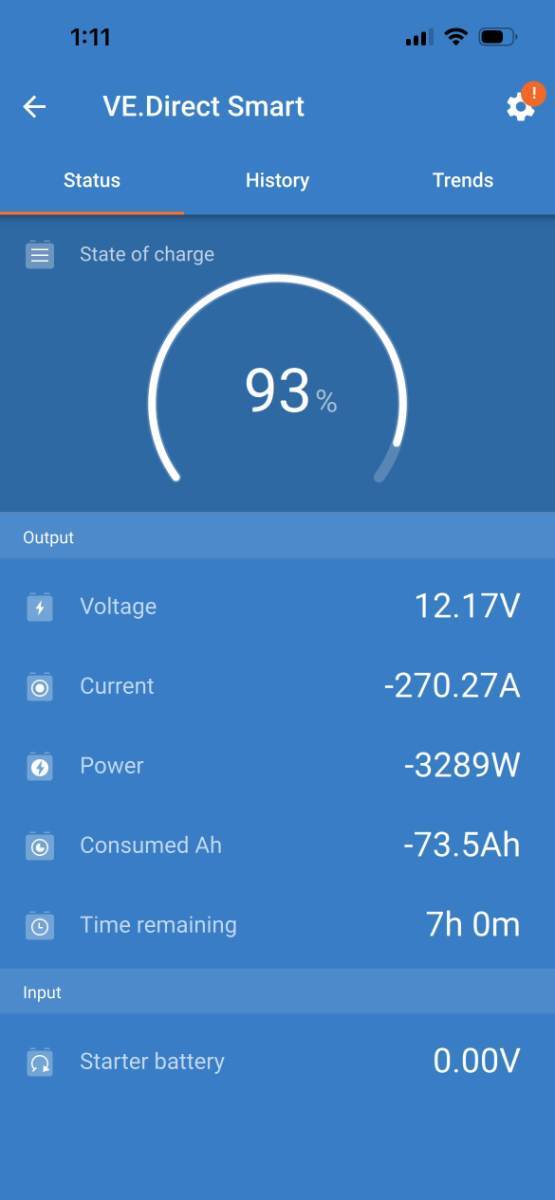
Was running our DC-DC charger today, so I turned on the water heater to create a load. Then just to see the inverter at capacity, I set the Emeril Air Fryer at 400F and kicked it ON too! The screen shot shows both running without error messages or shutdown; -270A net for -3290W on the 3KVA (2400W) Victron Multiplus II. Voltage was down to 12.17V where just the minute before the test it was 13.53V.
Pretty cool the Victron Multiplus II can produce power without overloading at near 150% of its advertised spec. No worries, go ahead and run two major appliances when needed. 😎
-
27 minutes ago, Steve Morris said:
I'm all Makita, but either Dewalt or Milwaukee were the only quality choices. I looked at battery adaptors to use my batteries on either brand. But the Dewalt kit with case, battery, and charger was only $30 more than the bare tool. So I went that route.
We're a Dewalt house which made adding the bare tool an easy addition. You will enjoy the ease of use, no more contortions to hand pump both TV and TT.
31 minutes ago, Steve Morris said:My fitting is 1/4-28 SAE-LT, so the next size up is either an M7 or a self-tapping M8.
I would try the M7 first. 7mm converts to .276" which is 10% over 1/4" easy tap without drilling. The 8mm (.315") is a big step up requiring the correct drill size and tap. (I'm starting to love the convert function on the iPhone calculator!)
-
1
-
-
2 hours ago, Dean and Mary said:
The real question is what changed between when it was working correctly and when it started behaving differently. I'm sure you'll track down the cause and let everyone know what you find. My guess is that it's a connection-related issue, possibly something as simple as a poor connection between the tow vehicle and the trailer. Are you using an Anderson connector? I have had wires work loose in what I thought was a good crimp on the Anderson lugs.
Exactly, thanks Dean. I just checked my Oliver travel and maintenance spreadsheets to see if there was something I did/worked on or changed recently. All I did mod-wise was add courtesy lights front and rear and replace a couple of drawer slides. On the truck I restored the A/C system, new compressor-condenser-dryer and charged the R134A. All that work was right where the DC-DC cable comes to the battery and where I wired extra battery connections to alternator and ground. These connections were tight with a recent tug test but I need to run electrical tests.
I installed the oversized Andersen SB175 connectors with 4 AWG crimps (see pic) with a BIG TEMCo hydraulic crimper. They should be good on both sides, but I'll check.
Suddenly I'm itching to work on this. All I have to do to start is back the truck to the Oliver, connect the Andersen, and take a few amp and volt readings. Step #2 read through all Geoff's comments for testing again, NP! 🤣
-
1 hour ago, Geronimo John said:
Very likely as you have the 50 amp version. Those of us with the 30 amp.... another story.
Yeah, the 30A Orion has the large heat sink (cooling fins), similar to my Victron 30A MPPT SC (on left in pic). The 50A Orion (on right) is half the size without the need for cooling fins. I’ll have to check temp on the SC next time I use suitcase solar. 🤠
Keep in mind these two devices would never be used at the same time, so when towing only the Orion 50A can create heat in the entire front basement area and some air is moving through when towing. I still cannot see heat build-up unless something is broken. It worked fine for a long time.
,
-
1
-
-
1 hour ago, Geronimo John said:
JD:
Do you always remove the cushions and hatch to allow the heat out so as to keep the Orion fully in play?
GJ
🤣 Wow, I would never would think of doing so! Stop for lunch, gotta fix the cushions, done eating put them back, no, no not happenin'.
We keep our Oliver ready to camp whether parked or towing like we're camping. Nothing left open, no straps holding things in place or anything requiring additional setup and tear-down. I won't have that, no half measures, just fix the issue.
Personally, I don't believe it's a heat issue, but I will mount a Ruuvi temp sensor next time to eliminate this variable from consideration. I'll also check heat on the 4 AWG.
We did not have a DC-DC charging issue for 90 days and 18 months. Not during June of 2025 while traveling 4700 miles to the Midwest in humid 90F weather. We had this issue only recently while traveling to SW CO this September with highs in the 70s. The basement at the inverter recorded a high of 84F. My bet, not heat related.
-
1 hour ago, Steve Morris said:
Greasing the zerk fittings today with a Milwaukee M18 grease gun with Lock n Lube 90° adaptor. As it finished, the zerk fitting came out of the EZ Flex casting. When we tried screwing it back in, it just slid into the hole, like the hole was oversized. I'm guessing the pressure of the battery grease gun pushed it out, but there were no chips from threads peeling out. This was my first experience with a battery grease gun.
Has anyone seen this happen? What's the fix? That's going to be a PITA if I have to pull the EZ Flex out to tap oversize or replace. I'm half considering trying a press-in of the next larger metric size zerk as a Mickey Mouse repair.
Thoughts?Hey Steve, first off this is nothing to do with your new grease gun! Love a power grease gun! 😎
Zerk grease fittings when screwed in are held in place by just 2 threads. They can easily strip after greasing a few times. I had one strip just before I replaced our axles/springs last year.
Your current fittings sb 6mm (.236"). I know they are on Dexter wet bolts, so likely the same on the EZ Flex. Replace your Zerks, not with a metric size but with the SAE 1/4"x28 size.
Two methods...
1) Also get a 1/4"x28 tap to get the new threads right.
2) Just push/thread in a new 1/4" Zerk into place to form new threads, then throw out that piece and lightly thread in a new 1/4"x28 Zerk.
Choice #1 would be the correct method. Choice #2 has worked for me several times in a pinch-
2
-
-
7 hours ago, larcat said:
Thanks for the thoughts and experience here...
I'm really liking the idea and specs of the ecoflow system. Only reservations I have are longevity and continued availability and support.
You're welcome. Lot's of experience here and an endless array of camping/traveling styles in our community!
"Reservations I would have" is how long can you run the 48V Houghton A/C? How many 48V Amps it pulls will determine how many hours you can run the A/C unplugged. But there's only a few of us with the goal of running A/C unplugged and so far (others are close!) I'm the only one on the Forum who has run A/C a full 5 days 24x7 unplugged!
The daytime highs were low 90s using only 40A on average (60A max) and we have cool nights when the Chill Cube barely sips amps (amps based on 12VDC). But overall, it takes quite a robust system to run A/C on batteries!
We have 900 Ah Epoch batteries. The Apex has one 48V 100 Ah battery which translates to 400 Ah in 12VDC. I would need two of these batteries. Can you fit another in the rear basement area? 🤣 Who will be the first Apex owner to do that?
-
3 hours ago, Steph and Dud B said:
It's possible your SOC is out of calibration. Have you ever run the batteries all the way down to shutoff then recharged them to full?
Is this safe, Dudley? I’ve never let ours run much below 20% SOC or in the teens. I always thought bringing SOC to 100% and adding Float charge for another 24 hours should calibrate SOC% at 100%.
-
4 hours ago, carpenter said:
I went to use the convection oven on microwave setting to warm up my coffee this morning and it will only run for 30 seconds or so before the xantrex beeps and throws code 1. The draw on the microwave should not exceed the available charge in the battery to run for 1 minutes to warm up coffee. I made sure to turn off all other items…
There must be 10+ threads in the last two years on the 3KW Xantrex shutting down and I’m not saying search vs. posting. Please everybody always feel free to ask any question! 😎
It’s usually something re low voltage cutout. Likely you need to run through setup configuration to lower this number. Experienced Xantrex owners may chime in otherwise, search for ‘Xantrex’ from the forum home page and you should find instructions for changing this parameter.
Also 50% SOC is not LOW with LiFePO4 batteries! We have a Victron inverter with 900 Ah. The Victron allows for this, since we can run our A/C AND the microwave (oven) with SOC <20%!
Both the inverter and batteries have low voltage cutoff protection. I’ve never read here re Lithionics cutting out. The Victron inverter never cuts out. There are only Xantrex cutoff issues.
Also it’s not your microwave given it runs long when plugged into shore power.
Check your Xantrex manual and their Tech Support if necessary.
-
3
-
-
14 hours ago, larcat said:
All Oliver has to do is provide an easy way to route the cable out...
On a fully optioned unit, all three of those ports are filled (roof, awning, awning.) On a not fully optioned one, one or two ports are free.
I can drill the door to the battery compartment with some sort of gland or port, which will provide easy routing up to the ecoflow head unit, but shouldn't have to.
I wouldn't expect OTT to route the cable not knowing customers' future needs. They learned that lesson with Zamp ports a few years ago. And I wouldn't want them drilling more holes into my hull. This is custom work and routing a suitcase solar can work many different ways. They have standard interior wiring to connect to the awnings when purchasing that option. All that’s needed is a simple connector port and wiring given the ECOFLOW has these solar input terminals.
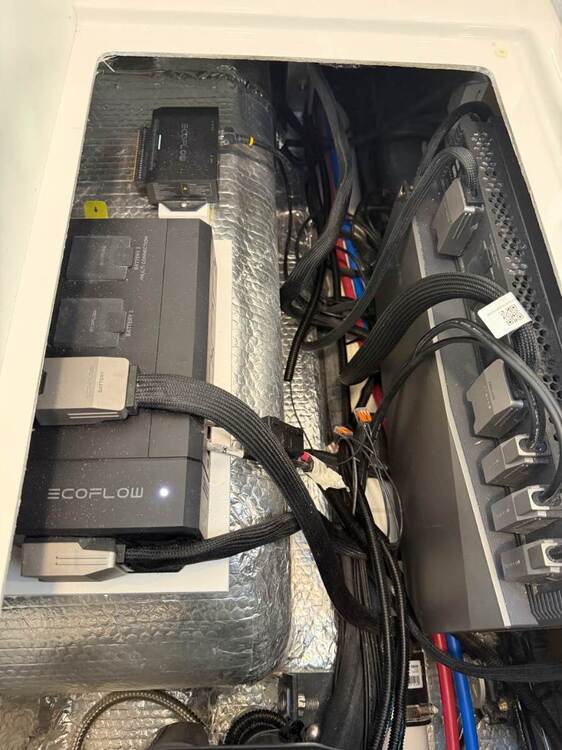
The Ecoflow is under the street side bed (copied photo from other Apex thread). You haven't had your head in the basement of an Oliver yet, but trust me having mine down there for toooo MANY hours and the Apex and Elite hulls are basically the same. Wiring can very easily be run the full length of the streetside basement. Up to the doghouse is a just little more work. There are also ways to wire to the curbside, the easiest being stringing wire around the rear of the basement.
Please don't "drill the door to the battery compartment!" You'll likely be sorry later, since there are far better locations. Give it some time after your delivery to think about it.
We've camped 200 overnights in 3 years, with 65% of our stays unplugged (spreadsheet data). I've only setup suitcase solar about 8 days (4%). We did truly need it last trip which was a first. Additional solar is only needed for long boondocking, like going to max the 14-day BLM limit! Most of our stays are 1-3 days at one campsite, so DC-DC charging is generally what's needed! 😎
I like these ECOFLOW terminals. Through the years, some OTT wiring has loosened/crusted up over time causing issues. These look to be rock solid!
-
Thanks Geoff @Snackchaser, Lots here to get started and of course I'll keep our community posted.
BTW, we were running A/C on inverter, but not while towing this time.
Never thought heat would be a leading issue. The basement near the MP2 has seen 104F at highest, more often 80-90F. The Orion is under the rear dinette seat, a lot of air up there and nothing else producing heat while towing. Fall temps in the 70s.
Next time out is not coming soon, but I'll fix a Ruuvi sensor directly to the Orion. Testing at idle on our property likely would not produce much heat, but I'll hit the Orion with my IR temp gun after an hour idling to see.
My alternator is a built Nations brand HD alternator. I wouldn't think 2 years later it's the issue but yes, it should be tested.
We just got a week of unprecedented HEAVY rains. Much of AZ had flooded. We are safe on high ground, but I have weeks of some repair and yardwork to do first. I should take some time later in the year to work on this. Thanks again.
-
3
-



DC to DC troubleshooting
in Mechanical & Technical Tips
Posted · Edited by jd1923
The screen below clearly shows the Orion DC-DC charger is OFF (left frame). When you click on the message, "Why is the charger off?" you get 3 reasons.
In the setup, I clicked the app toggle Charger enabled to OFF, the option Geoff had mentioned which is given in see reason #3. Notice the warning message when using the app switch to disable charging (middle frame).
As soon as the TV ignition key is turned OFF reason #8 will appear since the engine detection will immediately show <12.9V (configurable). A sitting lead acid starter battery in good condition should read about 12.6V.
Reason #1 is Low Input Voltage which occurs as soon as you physically disconnect the DC-DC cables at the Andersen terminal at the bumper. You can see that looking at the first screen where it shows 13.5V on house batteries and 0.0V on the starter battery since is is disconnected (OFF reasons in right frame).
If I needed a 4th method to turn OFF the Orion, e.g. for servicing the system, I would throw the 60A breaker under the dinette seat which connects the Orion charging output to the main positive bus. When both the breaker AND the Andersen connector are OPEN the Orion will have no possible voltage on either end, so will be fully powered down.
Gosh, if a 5th way to ensure the Orion is OFF is truly needed, please add the switch at the hitch or within arms length under the doghouse. If I had to climb back into the cabin just ONCE to turn the Orion ON when we're packed and ready to tow, it would be the last time. I would delete that switch leg asap. 🤣
But that's just me, keep it simple. BTW, the switch for our LiFePO4 batteries is a 1/2" wrench to the main ground wire. It works every time, no added resistance, no additional points of failure! 😎