Search the Community
Showing results for 'Generator box'.
-
@katanapilot I've got my Dometic removed and I'm not seeing that E5 error with my furnace running. I did have a freeze sensor on mine that I still have connected to the relay box (currently just hanging in the air). I removed it from the coils before taking the unit out. Not sure why you didn't have a freeze sensor on yours? Also, I seem to have a slightly different thermostat in that it doesn't support bluetooth. Weird that we have a few different components when our Ollies were built fairly close together. Two additional question if you don't mind... 1. How did you safely remove that black compressor relay from the circuit board? 2. Have you tested with a 2K generator by chance? Wondering about needing the EasyStart. Thanks!
-
 My opinion is that if all the water lines have water in them, something may freeze. If you can get to a Walmart or any RV store ASAP, buy a winterization hand pump and a couple of gallons of RV pink antifreeze. Pump six ounces of antifreeze through each of the FOUR outside ports. That should be enough to get you through a couple of cold nights. Keep the hot water heater going, or you must bypass and drain it completely. If you can’t find the antifreeze and pump locally, and have access to an air compressor and adapter air fitting, you can screw that on and use 60 psi air to blow those lines out. It is not nearly as safe and reliable, but better than leaving them full. Worst case, if you are at a campground, beg a neighbor or the camp host to help you use his pump and antifreeze, and repay him for the AF, and thank him heartily. You need to know how to do this stuff, if you don’t take these minimal steps it may result in broken parts and an expensive repair bill. Especially if you run out of propane or the furnace fails at midnight..... Ideally you should be plugged in and have an electric backup box heater handy, just in case. Boondocking with no shore power is more risky, unless you also have a generator you can fire up to run that heater.... Opening up a few access panels will help with distributing heat underneath them, tho that won’t be needed if the furnace is going. Make sure at least one of your propane tanks is completely full, you will go through a lot more gas than you are used to using. John Davies Spokane WA
-
We added a locking cross-bed tool box to our pickup. It's actually one that sits down in the bed, flush with the bed rails (not resting on top of them. It's roomy enough to carry our BBQ grill, portable generator, fuel and a small propane tank in it as well as other gear that we don't want to worry about "walking off".
-
We’ve never regretted buying the larger generator. I’m all about overkill and it never fails to supply what power we need. Yeah, it’s heavy, but I have an overhead hoist to remove and replace all the stuff I can’t, or don’t choose, to manage alone (generator, tool box in truck and propane tanks.
-
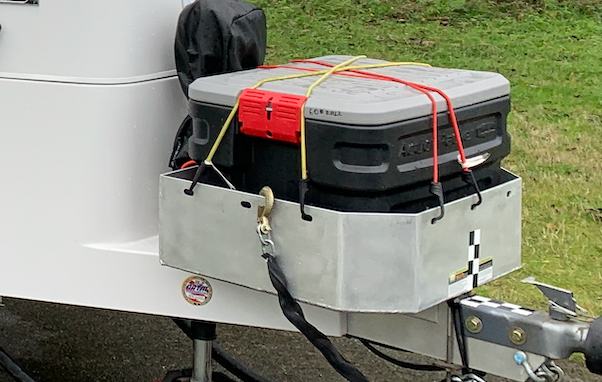
Sorry for the delay, we keep the generator in the back of truck as we don't always need it at each campsite. I am able to chain it up if needed while running. We keep a Rubbermaid Roughneck tote in the Tongue Box. It holds all our chocks, blocks and tools for hitching & unhitching. I fits in with a bit of room around the edges...which is where we stow the bungee's when we're camping.

-
Yeah the vibration/noise transfer alone makes me doubt I'd ever be tempted to try it. There's also the issue that if you are following the safety instructions for your generator I think you'll likely find you shouldn't have its exhaust vent running that close to the solid sided walls of the current factory offered tongue storage box. I don't have experience with the Oliver but with our camper van (which is white but less well insulated - particularly the single pane windows which run all around the van) we've always been fine if we can find some shade and then run the roof vent fan during any driving breaks. But then we also rarely end up in 100+ temperatures - the one time I can recall doing so (driving from the Grand Canyon to the Bay Area in early June 2016) I just pushed on through rather than taking breaks between Needles and Barstow-ish. In fact my first break after that section was around dusk well north of Bakersfield as it was just a nasty hot day everywhere. I was sweating while having dinner in the van at a rest stop but I survived. My sales rep used the "the soft start etc. is great for taking AC'd breaks in the middle of hot driving days!" line but it was not at all a motivator for me.
-

Generator for 2021 and beyond
Ray and Susan Huff replied to Ray and Susan Huff's topic in Mechanical & Technical Tips
We found a tool box deep enough . . . . . . . Now we just need a generator! -

Generator for 2021 and beyond
mjrendon replied to Ray and Susan Huff's topic in Mechanical & Technical Tips
I also have the Honda 2200i (non-companion, non-Bluetooth model) and use this to connect to the front power port with the generator on the tongue box. The Honda is very light and relatively quiet. I have also been impressed with all of the add-ons that are available for these Honda units and I am considering a propane conversion. Link
-

Actual size of opening in outside storage compartment
Geronimo John replied to Trainman's topic in General Discussion
@Trainman & Hobo: Last year I was in your position. I spent a lot of time looking for options that would fit in the basement. Basically there were none. The realistic options appear to be: Carry the BBQ in your tow vehicle (Not good as I was using a 4.7L Sequoia TV) Transport it in the shower (Not ideal from several perspectives) Get the box and transport it there (Not good as I use the box for generator fuel, dunage and chalks) So I ran 2018 with no BBQ. But I resolved the issue for 2019. I replaced my under-powered Toyota 4.7L Sequoia with a F-150. BBQ problem resolved! Sorry for the bad news. -
(1) We understand from the Oliver brochure that we received at an RV show that the Oliver comes with three 110-volt outlets and one 12-volt outlet. Is 110-volt current supplied to the 110-volt outlets at all times or just when the trailer is hooked up to shore power or to a generator? From what I understand, this would require a built-in current inverter to provide 110-volt AC from the 12-volt DC of the batteries. Does the Oliver come with an inverter? If not, have you added one, in order to use the 110-volt outlets? If you desire additional points for power, Oliver will accommodate. I have five 110v ac outlets (4 inside, 1 outside) and five 12v dc outlets (4 inside, 1 outside) Without shore power connected to the trailer you will only have dc power available from the battery(s) unless you opted for the add-on inverter, which will then power up your 110 outlets. I use the Coleman 2000w Power Inverter which turns battery 12v into 120v ac. Just because you have ac available, don’t think it’s an endless pit of power . . . the percentage of the drain on the batteries depends on the overall energy storage capacity of the battery selection you made. Also, initial start load may be higher than running load and you inverter will shut off if you exceed its capabilities. Multiply: AMPS X 120 (AC voltage) = WATTS Your battery pack can be replenished through solar power, from your TV’s alternator as you move along down the road, from a portable generator, or from plugging into shore power. (2) Does the Sound and Video package (LCD TV, DVD/CD player, AM/FM radio, etc.) run on 110-volt AC or on 12-volt DC? 12v dc (3) Additional 12-volt outlets are available as an option. Would you find that useful? I added one near the galley for my coffee maker, one under the small dinette, and one in the main walkway just before the full sized bed on the passenger side. They are not that expensive an add-on and the convenience factor is well worth it. (4) Does the "convection oven/microwave" described in the Oliver brochure require shore power or generator power? If so, how many watts does it draw? Does convection operation require more power than microwave itself? If so, how much? An correctly sized generator or shore power will be required unless you've got one heckuva humongous battery/inverter setup. They call it a Microwave Oven & Grill – It will brown your food as you microwave it, or you can grill thinner slices of meat such as steaks, chops, kebabs, sausage, pieces of chicken or sandwiches. (Not useful for a whole chicken or the Thanksgiving Turkey!) Manual says Microwave/Grill output power is 1000w. Doesn’t show consumption – you may not be able to simultaneously run you’re a/C and this at the same time without shore power or one very stout generator. (5) Similarly, the 13.5 KBTU A/C unit would seem to require quite a lot of power to start. Have you run it with a generator? In particular, have you used the Yamaha EF2400iS successfully? Don’t know, I downsized my A/C unit to the Coleman 9200 btu unit. I uses 900-1100 watts for cooling and max cooling draws 8.0 amps. I run it easily with my Honda 2000w generator. Given the insulation of the Oliver and the relatively small cubic feet to cool I believe it will be up to the task. “Doing the numbers” I will not try the A/C and microwave at the same time without shore power. If I need to use the microwave, I’ll power down the A/C for those few minutes . . . (6) I understand that a "generator quick connect" may be available for the Oliver as an option. Can you tell me what that is and what the advantage would be in having one? The quick connect is a connection on the tongue where you can keep a power cord going from your generator . . . it is pre-wired into the trailers electrical system with all of the safety bells & whistles in place. If shore power quits, simply hit the start button on your generator and your powered up without the having to move cables in the rain or the middle of the night. LP Gas System: (7) I understand that 30-pound LP tanks and regulators are available as an upgrade. That sounds like it would allow one to go for quite a while longer without having to get a refill. Would there be any downside? The reason I ask that is that sometimes I have found that something that seems like it could only be for the better may present problems that would not be considered until they actually show up. Downside – heavier to lift to take for refilling / more weight on the tongue (mine is still very respectable for my TV) / you lose a small bit of empty space you might have used to place hoses & such. Upside – more flexibility for boondocking - the equivalent of adding a third 20 lb bottle! more time between refills to work on you upper body strength to get ready for the refill lift . . . (8) I understand that there is a "gas line quick connect" available as an option. Can you tell me what this is and what the advantage would be in having one? It runs from the trailer’s propane tanks to the rear bumper and is accessible on the street side by folding down the bumper. With the right hose connection from your grill you can connect directly to your on board propane source . . . gives you lotsa gas and precludes you from having to purchase and lug extra propane tanks for grilling. Phew! I see Mountainborn just posted his answers. I'll send this one anyway and let his response do the last two about towing . . . Steve, feel free to call me tonight if this has spurred on additional questions. CarolAnn . . . As I was getting ready to enter this new world of Rving, I went to the local big-box book store and picked up “Rving Basics” by Bill & Jan Moeller ISBN 0-07-042779-8. I have found it most useful – it covers systems / towing / campsites & hookups / and a myriad of other things. I take it with me for reference.
-

Shore power cord and receptacle
KarenLukens replied to John E Davies's topic in Mechanical & Technical Tips
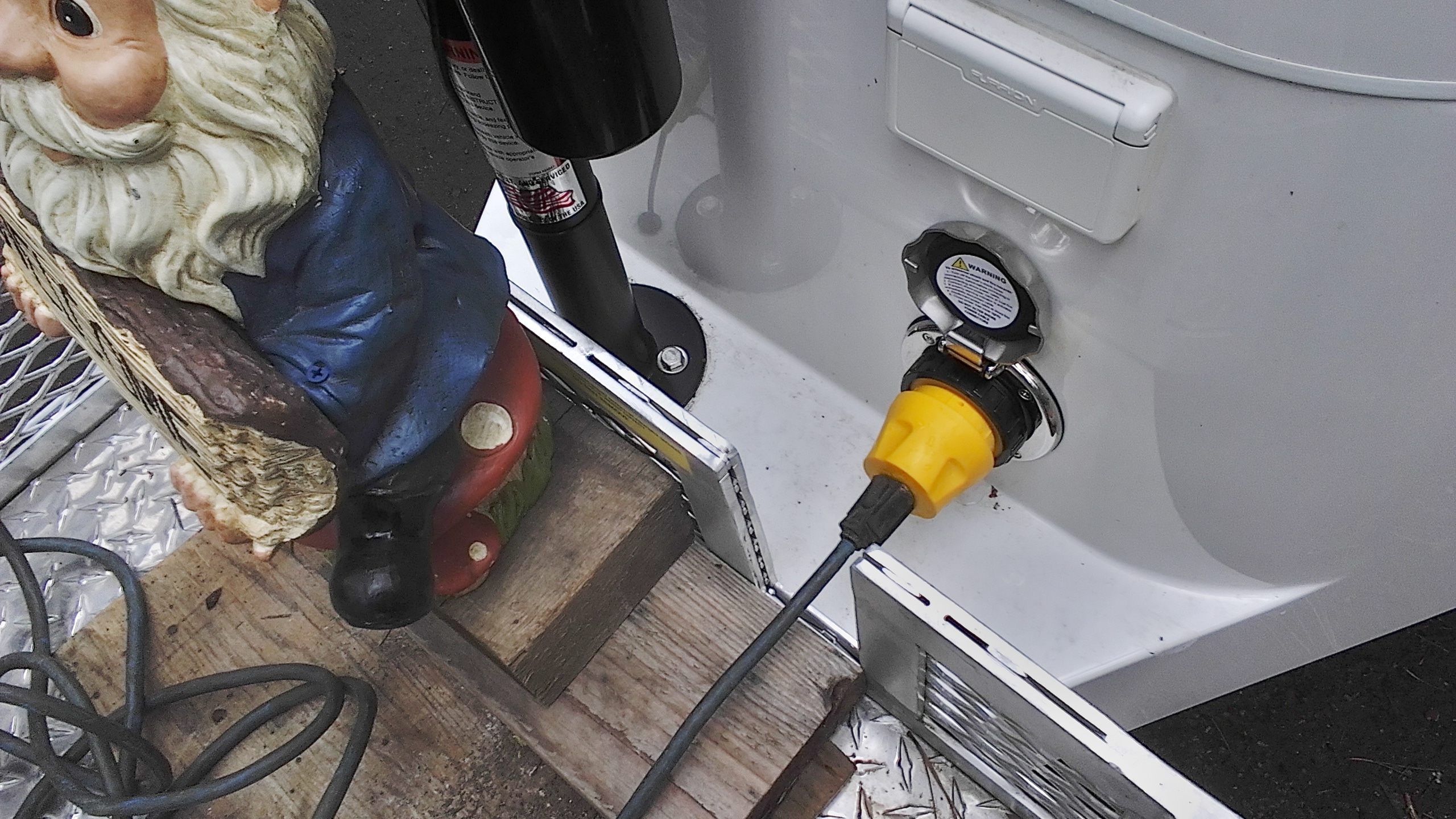
You don't need a pigtail, just a long enough 20amp cord to reach the generator. They do provide a 30amp x 3' twistlock pigtail also when you buy the generator box for the front and this adapter works best for me. It's simply plug & play :) Either plug it into the outlet and run a short cord or from the 3' pigtail - straight into the generator. Like you, I don't want my 25' cord to walk away. https://www.amazon.com/ALEKO-L15-30-Electrical-Locking-Connector/dp/B01CO5FXJQ/ref=pd_sim_60_4?_encoding=UTF8&pd_rd_i=B01CO5FXJQ&pd_rd_r=C3Y05J7R70QWS2W94JKG&pd_rd_w=DMY8d&pd_rd_wg=f4pv8&psc=1&refRID=C3Y05J7R70QWS2W94JKG
-
 Thanks to all for EVERYTHING. Someone said they wanted to know if I had taken possession of the new (2021) Ram 1500 4x4 Hemi Rebel with the tow package included. I do have it. First new vehicle in about 20 years. So much cool tech. I do web dev, among other things, but man, this is automotive, not web, and this is blowing my mind. I had no clue car tech was this advanced. (Ah, so many things "can" go wrong. 27 computer modules or something.) But, it has heads-up display, it's badass looking, I LOVE the height of it and have NO trouble getting in and out, and I love the power of the V8 (which I was used to), and the nav and the even disembodied voice coming at me. I like that it makes tacos and shoots them out the glove box at me on voice command. (Well, it seems like it could.) All of it. So much to learn. For those just joining us, I'll be towing an Elite 1 (late Jan deliv) and this is my Tow Vehicle. There are many like it but this one is mine. I am attaching a pic of it parked next to my nabe's SUV, which my Rebel looks like it could eat -- as a snack. Snarf! Here is the door sticker for your Truck Nerdz. And I could not be more excited. I love this thing! LOVE IT. Married it and had its babies LOVE IT. My dog LOVES it. Dogs and trucks, trucks and dogs. YAAAAAAHHHS. The sales guy at OTT is still telling me to get the Anderson. I am calling tomorrow to discuss this further while there is still time. FYI. Also shopping for a generator that will fit in Ollie "basket" option (or in whatever one buys to cover the back of a Ram 1500 Rebel securely) and which has a propane option. Still so much to learn, obviously. Overwhelming at times, but thank you all again!
-
AC power in trailer via shore power on Xantrex only
Ray and Susan Huff replied to Ray Kimsey's topic in General Discussion
The low voltage threshold in our camper van, with Progressive Industries on board surge protection and 1000w /Xantrex inverter, was 104v. A real annoyance; perhaps this was the cause of the premature failure of our RV batteries. I understand the reason for low-voltage: to protect the system from a sudden spike in voltage that could occur after a low-voltage event, such as a brown out followed by resurgence of power. Our home has a whole house surge protector between the incoming power line and the meter box. It has never tripped during the oft occurring intermittent power fluctuations when tree debris falls on the incoming power source (I thought that was the job of the transformer). Perhaps this device is more sophisticated and steps up the voltage when power blips off then back on again repeatedly? I can see where a GFI outlet could be problematic: we have one in our kitchen that tests fine for GFI and ground, but a hand mixer trips it immediately. One thing we did notice, with the PI surge protector was: if we plugged the van into a poorly grounded outlet or with an electrical cord that had no ground wire, the device would cut power, sending a GF error code (E4?), as it should. After remedying the situation, it would take several attempts to connect power with a good outlet and grounded power cord, before the power would stay on; almost like it took a while to clear the error code. I would be curious to see how the OP's (RK) trailer reacts when plugged in to generator power. -
I am not a cold weather camper, but I want to throw in a caution about RV appliances in general. They are nowhere as reliable (or efficient) as home units - always have some sort of backup heat available in case the furnace quits or you run out of gas. The latter does happen even to an experienced RVer. A nearly empty bottle may not have enough gas pressure to work well in arctic temps, keep them topped up. I would feel safe with a generator and a small 1500 w electric box (forced air) heater, which stores away nicely in a cabinet or on a closet shelf. The generator is something you should definitely have anyway, for charging on a dim overcast winter day or when your panels are blocked by shade or snow..... I am not averse to winter camping, I just don’t want to cosmetically wreck my Ollie from caustic road deicers ... if I lived in a southern state I would be out there now. John Davies Spokane WA
-
I have just started looking at inverter generators and was wondering how often owners have needed to use them for charging batteries, run AC or electric appliances, Honda and Yamaha are the most popular but 2020 consumer reports recommends the DEWALT DXGNI2200 or RYOBI 2300. Having owned Honda cars and motorcycles I know they are very reliable and have good warranties but also command a premium price. The recommended models are $599 and $629 at the big box stores. Our camping style is dry camping at state and national parks and we plan to spend a winter in AZ in the future. The trailer we have on ordered will have solar and the 4 AGM batteries as well as the 2000 Watt inverter. Also for around the same price is a 200 Watt portable suitcase panel which may be an option. Feel free to share your thoughts and experiences.
-
Yea it raises up and drives smooth though. We packed camping gear for the trip out, the Honda 2000i is in the back along with the cool box, tools, chairs, sleeping bags, 8 gallons of water, kitchen sink..... A... Well no kitchen sink this time :) Then the box up top is packed tight. Once we get home, half of it is coming out. I didn't know what to expect, so I have a bunch of tools that I've had to use for simple mods, then we have a bunch of empty clothes bags, pillow bags, the car is stuffed. It even has the back cushions for the king bed/ sofa in there that we won't use. At home we have all of the lights, propane fireplace, cook stove, griddle, pizza oven, etc... And everything has its p!ace when we finally get setup at home. It has a 600lb tongue capacity, but I'll probably put on a weight distribution hitch of some kind later for a 4000watt generator to fill the gen box. The Anderson hitch wouldn't fit on this car.
-
 Here you go! I have found the generator or cargo box extremely useful. I am very happy we added it as an option.
-
Most of that is true, but also largely countered by the original cost. $4000 is a lot, and while I think they work well for me, I don't know if I would recommend them to everyone. It's a question of relative benefit - yes they're better in many respects, but you have to think hard about how much those things really matter to you. I do question whether the LifeBlues are easier to maintain. I think my Battleborns are, to a certain degree. When I get back from a trip, I just have to charge them and turn off the solar. But I do have to check them every three weeks or so, since I leave a few electronics on, and turn the solar on for a few days to charge the batteries back up. Is that easier than AGM? A little, I think - certainly not enough on it's own to justify the expense. But it looks to me like the LifeBlues may even be a bit more difficult to maintain. You'll have to disconnect and check them like I do, but you also have to discharge them to 50% after each trip. But worse, if you think it's going to get over 100° in the battery box, which is definitely a possibility anywhere in the south if you leave your trailer in the sun, you have to remove them and store them inside? That's not easier, and I wonder what effect that has on your warranty. I mean, it's easily possible that they could get over 100° without you even knowing it, and if the BMS keeps track of that, do you lose your warranty? As far as bluetooth battery monitoring goes, you can add that to any battery bank for $150, so that's nice to have but easily gotten otherwise. And arguably there's an advantage to having a separate monitor. I also think that the longer life / lower lifetime cost is overstated. I can get 4 AGM T105s for $250 each, or a quarter of the price. So, the math is the same. And increased resale? Perhaps, but you also paid a lot more up front and I doubt if you'd get that back. As far as the solar credit goes, the battery is irrelevant to that. You can take the credit on your AGM upgrade as well, but of course is does soften the blow of the higher cost. It's well established that you can take it, so you'll have to explain what you mean by the jury being out. The truth I that unless you're a regular boondocker, I don't see the cost benefit working out. And for me, not buying a generator was not only the primary drive for going lithium, it also had a big effect on making the cost worthwhile - that's a $1000 swing in the numbers.
-
I don't like the rooftop units for all the reasons already stated. Plus, they take so much power that a 2000 watt generator won't run them. That's OK because I don't expect I'll ever want to run the AC on my Genny, but still. If, I was ever going to change mine I'd go to a window unit. The obvious place in my Elite ll is under the dinette seat closest to the bathroom. That cabinet is the right size and not very good for storage without modification anyway. The AC could sit in a specially designed box and it's faceplate would be on the side of the seat, facing the door. It's back would be arranged to draw and expel it's cooling air to external grills. No pullout and nothing sticking out ever. Just two grills. If I needed access to any equipment or valves in that compartment, the AC could be set on drawer slides to pull it into the room for access. And, of course, the lift off hatch under the cushion would give some access too, as well as making the installation much easier. The problems are that the rooftop unit is already there with it's big hole and the lower location would require going through two hulls and designing the special vented box arrangement. On the plus side: No roof top air! And the wiring would be fairly easy as the power comes in near there. It would only draw about 800 watts or so and run on the genny if needed. I sort of wish mine had no AC now so that I would be more motivated to do this modification. Window units don't have to go in a window. Lil Snoozy uses a window unit and they put it in a box on the rear of the trailer. Another interesting choice would be to see if a mini-split compressor/condenser unit could be squeezed in behind the propane tanks. It would have to be a small one, but we only need about 8,000 BTUs or so. The tanks could pretty easily be moved forward a couple inches to help. ScubaRX just designed a nice storage area there and posted his work under "Mods of the Outlaw Oliver".
-
All great picks. We did the Navigator L for a while and it did a great job - it is the fancy version of the Expedition Max . The L/MAX get a 28 gallon tank and the smaller versions get 23 gallons. The nice thing about an SUV, is your payload is all for payload. With a truck, you have to spend some payload on a cap/tonneau cover first. The only time it didn't feel good is with "M+S rated" all season in a blizzard with high wind. Once I had the actual Blizzak snow tires on, things felt way better. We now pull with a truck as someone _really_ wanted my Navigator. Life has changed for me and I no longer need to go to the airport as much, and then COVID happened so I don't go at all, so we went with a much bigger truck. Upsides for the truck for towing is you don't hear the hitch receiver clanking around, so it's quieter. Also, propane/gasoline runs are less sketchy with a truck bed. Also, while the Oliver is narrow enough that the Navigator mirrors could see past it, I do love the tow mirrors now. Ram's online guide will diverge from the sticker. I haven't towed with the Q7, but we had 2010 Touareg Diesel that turned some of the best towing mileage I have seen (22 mpg with an enclosed car hauler). I think we saw around $30k of warranty work as each computer box on it died over the course of a year - I suspect because the dealer killed the battery at one point and didn't jump it correctly. While on the road, there are a lot more GM/Ford/Chevy dealers than VW group. If it were me and I could wait, I'd look at what a 2021 F150 Ecoboost looks like in terms of payload and price once optioned out the way I want it. Maybe even take a look at the hybrid version. If Titan brings their 40/48 gallon tanks to the 2021, combined with the onboard generator, that'd be pretty appealing.
-
Our current truck is an F350 Super Duty Crew with long bed. I'm not sure we will keep the long bed to tow the Oliver. When purchased it was a tow vehicle for a 5th-wheel as well as a work truck. Now we have a motorhome, so don't need the tow capacity and the long-bed crew cab makes a lot of vehicle to get around towing a 23' Oliver. I do like your suggestion of a toolbox. We used to haul the bikes with fork mounts in the bed of the pickup, but we had to remove the wheels and stow them in the back seat. This is why we got the 1UP bike rack, which is so much easier. But, I'm talking about two things now. Securing the generator and how to haul the bikes. One thought I have had is mounting a 2" receiver in the bed of the pickup so we could use the 1UP rack to secure the bikes in the bed. Haven't measured to see if this would work, just thinking outside the box.
-
Thanks. I would prefer to carry the generator in the pickup. If we can't come up with a way to use our 1UP bike rack on an Oliver, we will need to haul our bikes in the pickup, so a bed cover is not an option. One possibility is to secure it, along with the bikes, with a bike locking cable. I'm also thinking, some sort of case that we could secure to the bed, but also remove and stow it in the pickup backseat when we are away off hiking, or something. I like your cardboard box idea 😉
-
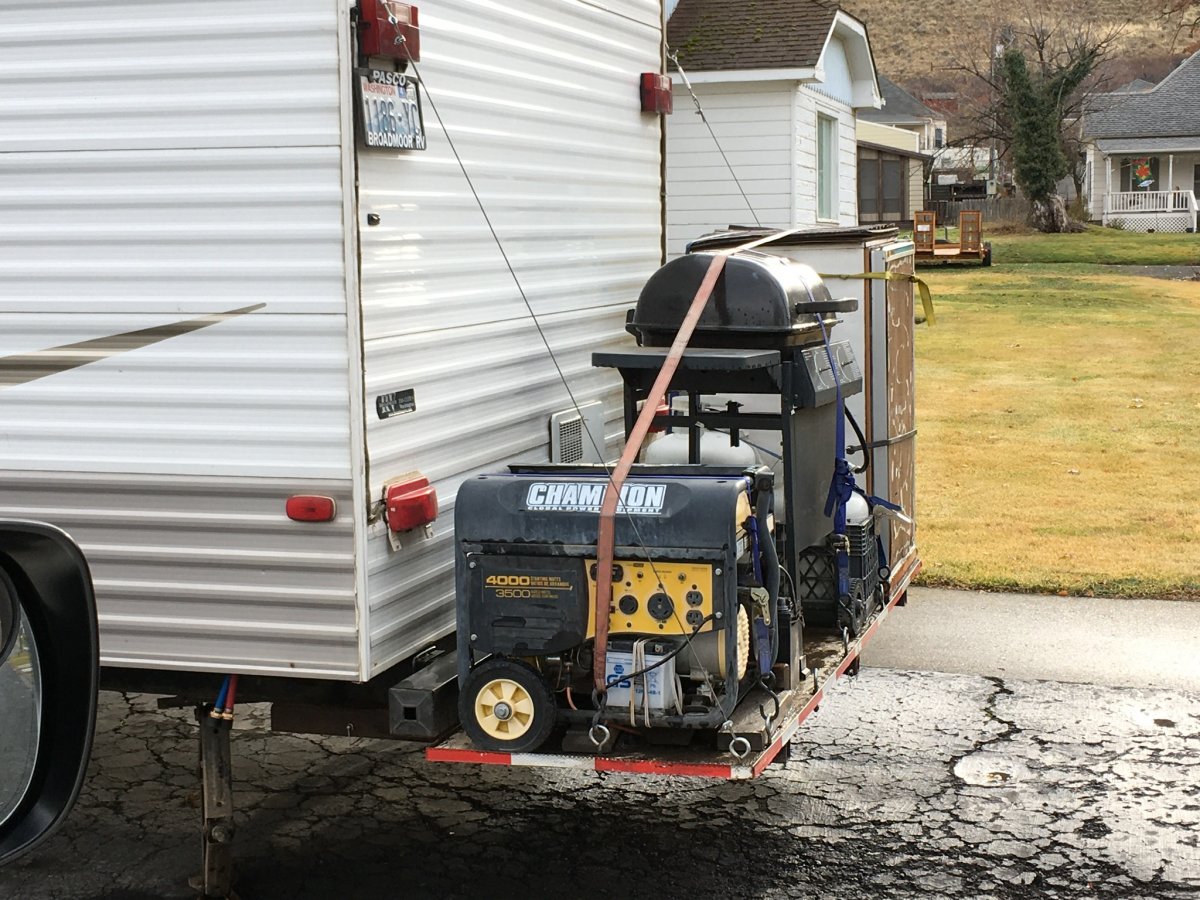
I encountered this stick and staple tandem axle trailer and was impressed with the rear bumper rack. It appears to be attached to the frame and has three steel support bars. I am not sure how much weight is there... the generator with battery is probably about 100 pounds. A couple of full propane bottles, a home sized bbq grill, a big box full of unknown gear..... Any guesses on how much total weight, and what effect it has on the tongue weight? I especially like the cheap open style hardware store eyebolts ( with a working load of 150 pounds, if that) and the dinky steel cables going up to the trailer corner uprights..... which are probably 2x2” pine. And the small sun rotted straps holding everything down. At least he used a lot of them. Yikes. John Davies Spokane WA
-
Share and Enjoy !0Shares0 0 The Ultimate Act of Rebellion There are a lot of different ways to enjoy the outdoors. Boondocking also knowns as Free Camping is one of those ways that allow you to fully experience life outside of the big city on your own terms. There's something attractive about being all by yourself, out on the open road, dependent on no one and nothing. Disconnected living in a time where everything is connected can be considered the ultimate act of rebellion. Yet we need disconnection sometimes. Boondocking allows you to disconnect and unwind, leaving behind the things that tether you to the real world and freeing your mind and body to explore nature the way it's meant to be explored. But how exactly do you boondock across America? This guide will help you on your journey as you explore the highways and byways that make up the US. What is Boondocking? In short, boondocking can be described as the art of camping in an RV or Travel Trailer without a hookup. The apparent downside to boondocking is that you lose any sort of connection or electricity supply to your RV. On the upside, however, that lack of a leash means that you aren't restrained to civilization of any kind. It gives you the freedom to roam as you please. Some of the views we've found while boondocking are hidden gems that no one would even consider looking for. These locations aren't usually covered as popular destinations because they're so far away from where people regularly visit. That's the true beauty of boondocking. Being all alone, dependent on yourself, and not having to worry about anyone else being close to you. You must be responsible while boondocking, though. You need to have a checklist of the things that you need to carry with you, and everything that you take to a site, you need to carry with you when you leave. Unfortunately, not all campers engaged in boondocking think the same way, and sometimes you'll come across the leavings of someone else who used a site in the past. The only thing you can do is to promise yourself that you won't be like them. In recent years, boondocking has become quite popular with campers. It can be quite cost-effective and allows you to a lot more freedom for your travels. Being disconnected from the rest of the world also has its perks. Overall, boondocking is something that anyone who enjoys camping should try at least once to see if it appeals to them. Types of Boondocking Boondocking isn't just limited to a single kind of camping. You might hear the term "dry camping" when talking about these visits. There's no difference between the two conditions. However, within the field of dry camping, you will notice several different subtypes, namely: Overnight Stay Overnight stays happen when you're driving across a region and just want to pull up and park for the night. Several businesses provide parking to overnighting RVs, although some do have a cost attached to them. Walmart parking lots specifically have provisions for RVers intending to overnight. Other businesses might offer a similar courtesy to visitors. It's definitely better than having to shell out $50 for a single parking spot! There's also the opportunity to borrow a parking spot from a friend you might have. It's very likely, depending on how much the friend likes you, that it'll be a free parking spot, and you might even be able to stay longer than a single night, depending. There are entire communities of people dedicated to the practice, which has garnered the nickname "Moochdocking." A few landowners have even allowed visitors to park on their land for free, but it's always essential to consult nearby owners before just pulling up on their spread to park for the night. Scheduled and Developed Campsites Campgrounds that are operated by federal, state, county, or municipal authorities are great locations for staying for a short amount of time. These spots are the best for boondock campers who aren't entirely into the lifestyle yet but want to give it a try. In many of these developed campsites, there's a limit on the maximum stay time. While some of these sites might be free, a few of them have fees attached to entering, parking, or using hookups for your RV. Several of them operate on a reservation basis, while others use the first-come-first-served methodology. Many campsites come with amenities such as fire rings, grills, picnic tables, and other things that might be necessary for a proper camping trip. Because of how easily accessible and close to amenities they are, these sites tend to fill up quickly during holiday weekends. It would be in your best interest to book ahead to ensure you get the best sites. Primitive or Rustic Campsites These are the ones you'll encounter most often in your boondocking travels. They're the roughest living and are situated quite far from civilization. For newcomers to the idea of boondocking, taking on these sites might be an exciting thought, but you could quickly find yourself out of your depth. These sites are perfect for those who have been boondocking for a while. Even campers who have a little bit of experience in roughing it while camping might enjoy them. There are no amenities, and there's usually no one else for quite some distance. You'll usually find these camping spots on federal lands within forest reserves or wildlife areas. National parks also fall into this category. Usually, when you set up camp in these spots, you can spend some time exploring the area you're in. More often than not, there will be a lot of trails you can trek through. It's by exploring like this that you find the fantastic, breathtaking views that boondock campers crave. If you ever wondered precisely how beautiful nature gets, this is the best way to experience it yourself. Benefits of Boondocking Boondocking is for adventurous souls longing to see the world. The age of explorers is long past, but that doesn't mean there isn't anything in nature left to discover. However, while it's a beautiful experience, many people considering boondocking have concerns about its safety and security. If you camp responsibly, this becomes less of an issue. There are several reasons why you might want to consider boondocking as a camping option, including: Affordability Boondocking usually costs nothing, aside from the money you pay to fill up your gas tank and buy your supplies. Even developed campgrounds that have an attached fee don't usually run you more than $10 to $20 a night. If you're more into roughing it, then those developed campsites are not worth the money. It would be easier to find dispersed camping at a free site and enjoy it on your own. In the case of RV owners, parks that cater to those vehicles have steadily increased their prices over time. As a result, boondocking would save a lot of money over a year. If you're an RV owner, you should definitely consider it as an alternative to pay-to-camp spots. Breathtaking Sights It's one thing to pay for an experience and enjoy it, but it's another to discover a spot all by yourself. Many dispersed campgrounds exist near the edges of lakes or along the banks of rivers. Some of them are located along cliffs or plateaus. Tourist brochures can't reproduce the views from these locations, so you have to go and see them yourself. Their uniqueness is what attracts people to them. Finding a spot that takes your breath away in a national park, or along the edge of a bluff as the world unfurls like a tapestry at your feet is one of the most life-changing experiences you will ever have. The potential downside is that you'll always want to discover more. Solitude We are social creatures, but too much socializing can leave us bored with a need to recharge. The isolation you get from boondocking is unmatched. You don't need to worry about ever interacting with another human being for as long as you're out there. It's truly a unique feeling being that far away from the hustle of humanity that you're likely to find in cities or towns. Because of the variety in campgrounds, you can choose a site that has neighbors nearby if you prefer being closer to people. For those of us who like our alone-time, there are wide open spaces that we can lose ourselves in with little worry about running into another person. Losing Yourself in Nature You get a particular appreciation for nature as a boondock camper. RVing usually helps you reconnect to the world around you uniquely. By setting up camp far away from civilization, you get to appreciate nature in a completely different way. When you lay down that first night in the middle of the wilds, switch off your lights and realize how many stars adorn the night sky that you just don't see when you're in a town or a city is when it hits you how much you're missing out on. Nature might be all around us, but scarce few of us take the time to appreciate our surroundings. Finding Boondocking Sites We've outlined several of the best free campsites for boondock travel trailers, campers and RVers in different parts of the country. However, boondocking sites aren't necessarily campgrounds. Aside from the suggestions we've mentioned, there are a few distinct sources that you could look to for your boondocking needs: Forestry Sites The US Forest Service or the Bureau of Land Management (BLM) usually have spots in national forests set aside for campers. Calling ahead helps you to know if you need a permit to camp on those sites if there's a fee attached, and what the maximum stay time is at the park or forest. Contact information for each department is available on their websites. Bureau of Land ManagementNational Forests and National GrasslandsFish and Wildlife Services Some government-owned lands like (BLM) will require you to pick up a camping pass and may have restrictions on the length of stays permitted. Membership Clubs A new development that is probably long overdue in the camping world is the idea of a membership camping site. Landowners can offer up spare space on their properties for RVers to take a few nights to explore the area. Membership to the sites like these is affordable and well worth it if you plan to be boondocking for a while. Additionally, if you're a member of some organizations such as the Elks, parking lots for those lodges might accommodate members for overnight stays. Consulting the chapter's secretary may offer more insight into leveraging these options. Store Parking Lots Any port will do in a storm. When you're passing through a civilized area, and you need to stop for the night, the cost of an RV park will probably be expensive. However, you can always choose the free option and park in the parking lot of a big-box store like Walmart. Companies such as Costco, Menards, and even Cracker Barrel offer free overnight parking for RVers, but the accommodation differs by location. Some require you to register with the administration before parking. Consulting the store's staff might clue you in to where you're allowed to park and stay. Places That Should be Avoided In any locale, there are a few places that you ought to be aware of that are no-go areas. Whether because the residents aren't particularly friendly to visitors or the location is a crime hotspot, there are a few warning signs that the experienced boondock camper will notice immediately. A few of the elements to consider when you're picking a spot to stay are: In populated areas, What looks like a deserted spot during the day might get very busy at night. If you don't know anyone locally, ask around to find out if that spot is one you should be staying in. If staying at a place that trucks are likely to be present, be courteous. Truckers can be territorial, and it's better that you didn't put yourself in harm's way over a parking spot. Boondocking is about privacy, security, and solitude. If you notice a space for your RV to squeeze between two others, you might want to avoid that spot since it will probably annoy your neighbors. Federal lands are available for all to use, but the onus is on your to ensure that the road can handle your vehicle's size and weight class. Doing research beforehand as to whether the route can manage your rig will save you some moments of anxiety on the way to your campsite. On private lands, make sure the landowner knows you're there and has explicitly permitted you to stay. If they haven't, then you have no right to be on that spot. Many boondocking campsites have a limit on how long campers are allowed to stay. Make sure you know if there's a maximum stay-time for that particular campsite. If you require a permit to camp at that location, you should also be aware of where you can get it and how much it costs (if anything). Knowledge about your camping site is the most important thing for a boondock camper. Essentials for Boondocking Responsibly By now, you should be excited to head out on the open road and discover what America has to offer you. Not so fast, pilgrim. You're forgetting one crucial detail, one that many new boondock campers overlook. Generally, you can survive out in the wilderness while camping comfortably enough once you have three main things: Water, Food, and Electricity. These are what you'd call your essentials. Obtaining them isn't horribly painful, but being prepared is vital to your survival and the ability to remain out in the wilds for as long as possible. See our guide Tips To Keep In Mind When Traveling Water In most commercial RVs, there are usually three tanks for water storage. One is a freshwater tank (for potable water), one is a grey water tank (for wastewater from sinks and the shower), and one is the black water tank (for excrement). Larger containers translate to a longer time that the RV can remain self-sufficient. Eventually, however, you're going to have to head to a dump station and refill your potable water. There are a lot of ways you can preserve water out on the road including Flushing your toilets lessKeep your dishwashing to once a dayNavy showers - use running water only when necessary while showering There's no hard-and-fast rule for what you should do to conserve water. Each V's water flow situation is different. The only accurate way to figure out what the limits of your water storage situation are and how long you can go before a dump is by trial and error. The better you are at conserving water, the longer you can stay out in the boondocks. Food Meal planning is among the most vital skills to have when boondocking. Stocking up on groceries might only happen once in a while, so knowing what you need during your one grocery trip before heading out into the wilderness is essential. If you're planning on heading far from civilization, you won't have the option of dropping into the nearest 7-11 to restock. Just like in real life, having a shopping list that references your meal preparation schedule can help you keep costs to a minimum. Additionally, depending on what your RV comes with and what amenities you might have, using tinned goods and ready-to-eat meals might be an option you can look at exploring. If you're not much of a wilderness chef, these will at least ensure that you have something you can eat, even when you're too tired or busy to rustle up some dinner. Your food, like everything else out here, is your responsibility. Knowing what you can cook and eat and how long before you need to get supplies is an essential step in evolving your boondocking. Electricity As much as we'd like to throw out all the trappings of the world, it's a sad consequence that we need electricity for a lot of things. RVs typically run on two separate electrical systems. There's a 120-volt power supply that's akin to the power distribution in your home (AC). There's also a 12-volt supply that runs off batteries (DC). If your RV is of the driving type, there's yet another electrical system that helps to operate the vehicle. For isolation, this power system is separate from either of the other two. You can think about that one as the auto-electrical system in a car. If you're going to be off-grid, you obviously won't have any hookups for your RV to connect to. Typically, in the past, generators have been used to power RVs while out in the boondocks. The upside is that, as long as you have fuel, generators can run indefinitely when you need them to. The downside is that they can be loud, and that might end up driving the wildlife away and disturbing your neighbors. Generators can plug directly into an RV and power the entire rig as well as recharge the batteries. When you switch off the generator, the cells take over the supply of power. Solar power is becoming more accessible, but it suffers from a few hurdles that make it unreliable. Panels can't generate enough power on cloudy days, and they are not very efficient in catching energy even when you are out in bright sunlight. Generators are still the best option, even with their downsides. The demand for power that each RV has differs by what's connected to its electrical system. Figuring out how much battery power it will take to run your rig, and for how long, is a trial-and-error errand. Ideally, you should do this before you set out to boondock so you'd have a baseline for operation. Don't Be Afraid to Try Boondocking, just like camping, is about your planning and managerial skills. You need to plot your course to get to your campground, know how long you're spending there, and where you'll be getting supplies and dumps from. The fun part of the trip is getting into the great outdoors with the most minimal comforts of home with you. Boondocking is one of the last great adventures we have as explorers of our own country. There's no better way to discover the secret gems of America than to boondock across it. See more guides on tips for boondocking in a travel trailer or RV. If Boondocking sounds a little too much for you, see our guide on finding the best RV parks. Share and Enjoy !0Shares0 0 The post Boondocking Across America appeared first on Oliver Travel Trailers. View the Full Article
-
- 2
-

-

-
Yeah, I wanted a compressor fridge too. Oh well. It sounds like most folks are happy enough with the propane fridge. I'll just keep mine until it dies then replace with compressor. I was interested in this Atwood AC because I'm concerned about being able to run the AC off a generator at altitude (5000-8000). Due to my family's situation most of our big trips will be during the summer and it does get hot here even at those elevations. I was hoping to get by with a Honda 2000i (or 2200i) but after converting to propane I'm not sure it'd have enough oomph. So at this point I'm looking at the Champion 3400 dual-fuel generator which runs on propane out of the box. Taking into consideration reduced power due to altitude, temperature, and propane, that Champion plus the easy start should run it no problem. Will your CU do a written pre-approval? From my understanding that's all Oliver needs to get you through production.