
DanielBoondock
-
Posts
264 -
Joined
-
Last visited
-
Days Won
7
Everything posted by DanielBoondock
-

Made in USA leaf springs
DanielBoondock replied to Mountainman198's topic in Mechanical & Technical Tips
Dunno, what do you think?
-
Made in USA leaf springs
DanielBoondock replied to Mountainman198's topic in Mechanical & Technical Tips
Agree, not sure how much I believe the hype. Shocks have a simple job, have been around forever, hard to believe it can be improved that much. Anyhow at $40 each its a cheap upgrade Good to hear. I get a little (non problematic) side waddle. It’s the porpoising thats annoying, if that goes away I’ll be happy. -
Made in USA leaf springs
DanielBoondock replied to Mountainman198's topic in Mechanical & Technical Tips
4k and soon to be 6k. But why? Why not? They’re redoing the suspension so it’s certainly the right time for it. Plus those Bulldogs look so much more coooooooollllllll 🙂 The bigger thing is I largely went with Oliver because I just don’t want to deal with problems. I’m a retiring engineer dammit, I don’t need to keep fixing bad designs and issues! 😅I could get some more milage out of this suspension but if I believe that it is undersized then there’s no reason to wait … FWIW here’s what Google thinks about the two, but granted we (or at least I) don’t know what if any differences there are with Bulldogs HD and these light duty trailer shocks -
Made in USA leaf springs
DanielBoondock replied to Mountainman198's topic in Mechanical & Technical Tips
On the Bulldog shocks Alcan didn’t want to order them (I got the feeling like they’re just about the leaf springs and didn’t want to be bothered), so I did so from advice on this thread from 4trucks. Note they don’t carry them in stock but have to come from a warehouse which adds delay, it was maybe a month all told to get them. -
True Induction Stove Top will not turn on
DanielBoondock replied to Lamar's topic in Mechanical & Technical Tips
If you like that you gotta try regenerative braking at 0.5 trailer gain! I’ll pull 130 kW silently on the regen and bring you to a full stop, it’s nuts. I have to lower the regen to the moderate level as the high level is too much. Big batter == more regen capability basically. Anyhow yeah the first gen trucks like Lightning, CT and Rivian aren’t for towing, but these second gen Sierra + Silverado are pretty hard to beat as a camping companion. Power is the one thing I don’t worry about boondocking. I’ve talked about it before but I haven’t mapped a trip yet that doesn’t have charging close enough for these trucks. The only vampire I notice is the WIFI (TP-Link travel router), slowly but surely it’ll eat at the battery and heat up the attic, even on Eco. Not a problem with all these kWh really but its’ annoying, I turn it off at night. I wifi hotspot mooching and tether my unlimited plan phone for the family otherwise. -
Main battery switching, a different approach
DanielBoondock replied to Snackchaser's topic in Ollie Modifications
Yeah cutoff switches, the solar pokes into the cabinet but the inverter is on the main layout panel under the bed. Stuff under the beds makes sense - I was wondering with the double hull how you’d access everything but it works great, except when you need to get to them! I’m fine with the electrical, that’s a rare interaction, but the water valves are super annoying. Why didn’t they put a Nautilus panel or the like just under the curb bed? Your motorized valve solution is cool. -
Main battery switching, a different approach
DanielBoondock replied to Snackchaser's topic in Ollie Modifications
The inverter, the solar is up in the street side cabinet -
Main battery switching, a different approach
DanielBoondock replied to Snackchaser's topic in Ollie Modifications
This mod is awesome but I’d go KISS with a simple switch too. It’s very useful for troubleshooting, in fact on my maiden voyage I ran into trouble with my Xantrex and Oliver support wanted me to isolate the battery by taking the leads off. I wasn’t too happy about that - they’re torqued and I didn’t have the proper wrench with me, and maybe not the right sized sockets anyhow. Pretty crude just pulling those leads … fortunately I quickly realized that these Lithionics I got have the built in power switches. So easy, but not everybody has a built in cutoff. The ‘26’s already have two master rotary cutoffs, one for solar and the other for the inverter. Odd they didn’t do one for the battery -
True Induction Stove Top will not turn on
DanielBoondock replied to Lamar's topic in Mechanical & Technical Tips
I know - I’m an EV guy so my brain thinks in kWh. I do continue it here since the truck is the main power source off park, so for example “if I’m at 79 SOC (State of Charge) of 220 kWh, then taking 8kWh for the trailer leaves me 169 kWh or 75% of the battery, which is at 1.3 mi/kWh 219 miles which is fine to get back to civilization … Yeah your right it’s 640 Ah I was misremembering, 7ish or 9ish kWh or something … -
True Induction Stove Top will not turn on
DanielBoondock replied to Lamar's topic in Mechanical & Technical Tips
Great minds think alike - I have this one for cooking outside https://www.amazon.com/dp/B07G9YKPQC Stainless is nice but most is I like that its fine if it rains, don’t ask me how I know. Also it’s got .5 increments so is finer grained control than the interior stove Hm? Not sure what you mean either … I’m just saying that the cooktops have a specified input power they can spend however they want. For the home Bosch the electrician used the wire gauge and breaker size required for installation and obviously same here. So the induction is sized to that, but they can use that power however it wants. The Bosch has a boost mode which is super crazy fast for boiling water, less than a minute for a full pot. I forget how much it is, 6-9kW I think? Anyhow that can only be used with the other burners at a much lower power, so it basically hogs the input. The Oliver induction is much the same. I can use the main burner on 10, and the secondary on 1 or 2 IIRC. Or I can use the secondary on 8 (max), and the main on 3. So clearly, 11 is the maximum level (the engineer must have seen Spinal Tap), and the onboard PLC lets you spread that across two burners in this way. Now the burner could be sized bigger, say 2.5 kW, and (without doing the math) say that allows both burners on full. OK fine, but now that would only sell to RV’s with 3k inverters which isn’t as common as 2k. Even on shore power we only have a 30A input which still limits. Don’t know what this means, everybody is limited to 30A on shore, and on battery are limited by the inverter and battery. With my stock dual Lithionics 9kWh batteries and the Xantrex 3k I always have to be mindful of power while cooking. On battery I can do two things at once usually, but no AC. On shore I can do AC and cook, one or two things but still have to be careful. From the factory they incorrectly set the low voltage cutoff of the Xantrex at 11.3 IIRC. By accident I found that out, it’s supposed to be 12.1. At the previous value I could easily run two things at once on battery. At the correct 12.1 I have to be much more careful and run more like 1.5 appliances simultaneously. Making it more interesting I’ve got 10 kW off my truck if you can believe that. 7kW off the bed power sockets, and I have a ~3kW dongle which goes off the charge port in a ‘reverse power’ configuration. I think it’s using the onboard Level II AC inverter backwards for that. Anyhow this dongle has a TT-30 socket - they must have done it for the campers, so I can plug the trailer into mobile ‘shore power’. But it’s limited to 25A not 30A, so have to be a bit more careful. Buuuuuuut, if it really mattered, I could also go off the bed power (using an adapter for 240V), or just run the outdoor induction off one of the 120V, or whatever. tl/dr … -
True Induction Stove Top will not turn on
DanielBoondock replied to Lamar's topic in Mechanical & Technical Tips
My Bosch induction at home doesn’t. The burners have a boost setting but you can’t use them simultaneously. This is normal for induction ranges. It’s normal for most electrical appliances too and houses. Try running all your house lines at absolute full bore and see how fast you start tripping breakers. IIRC the national code specifies 80% continuous and non simultaneous use. Which is why total breaker ratings can add up to more than the panel can technically handle (200A typically). But you guys are still thinking in gas terms, electrical doesn’t work that way. But it doesn’t matter, induction is faster and more efficient than gas so you don’t need full simultaneous use. To answer your question specifically I don’t know as I’d have to have the circuit or block diagram of the cooktop to answer, or maybe they talk about it in the manual. Moot point as it’s pretty obvious. Another take, this is just the same as why I can’t use AC, wave and cooktop simultaneously. Making electrical support full simultaneous use is too expensive and not necessary. -
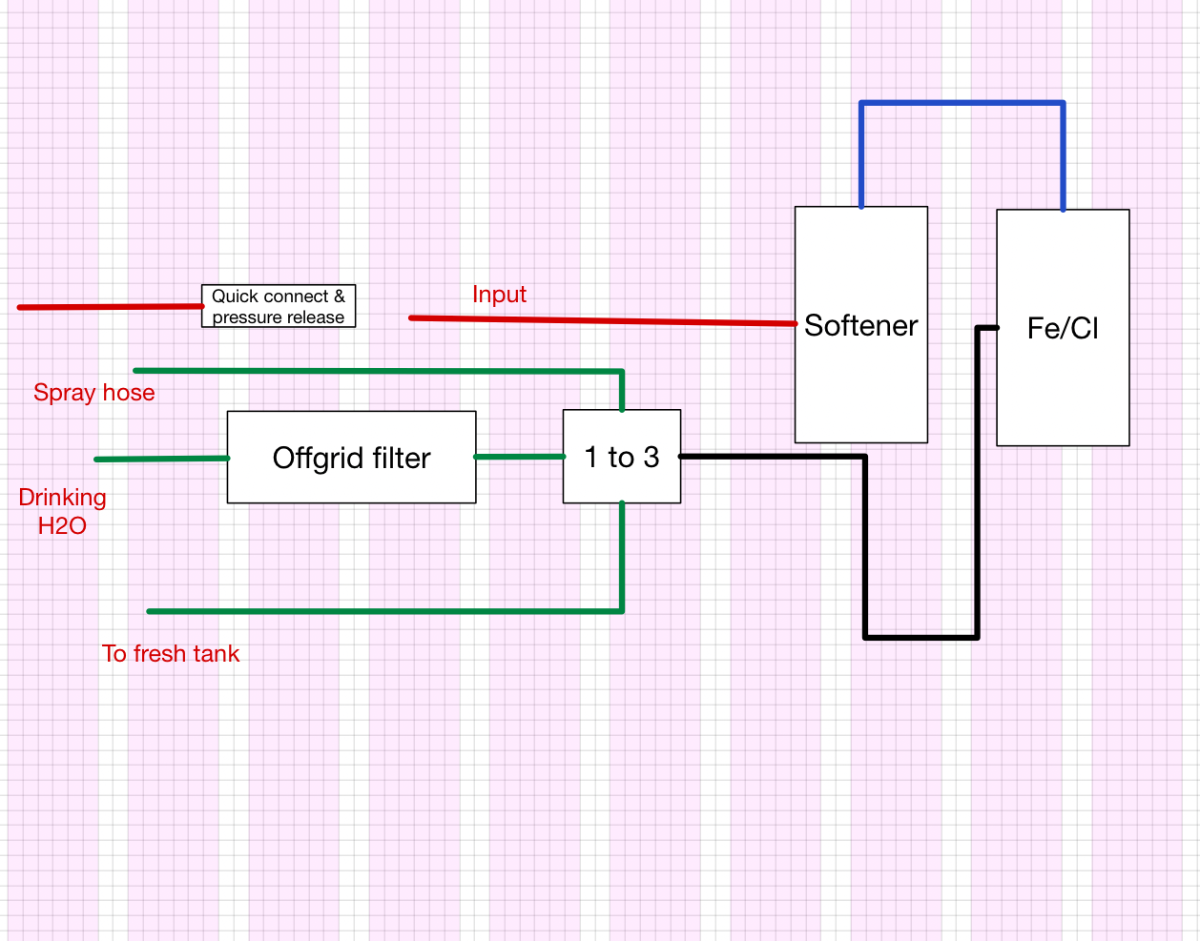
OK the filterification of the Oliver is done and tested. Just need a little padding/bracing, I think a foam pad between the tanks is all I need. It’s so tight in there they’re already pretty secure. Here’s a block diagram of what I ended up with The reasoning is that all this filtering greatly reduces water pressure and slows the fill basically. I don’t need the Offgrid Filter (down to .5 u paper filters + UV sterilize) for the fresh water tank, just the softening is sufficient. So I have a loose “To fresh tank” quick connect line when filling, just three easy connections for waterpoint and to tank, just using the softener/Fe I open the offgrid line and snake the hose into a 5 gallon drinking water tank to fill that up. Plus power - I need to get a 12V cig output into the basement The third is for spraying off the truck + trailer. Softened so that ideally it leaves no water spots I don’t know how this worked out but somehow, with the water tanks taking up that back space (leaving room to toss dirty clothes around them) I seem to have more storage overall. I’ll take it though
-
True Induction Stove Top will not turn on
DanielBoondock replied to Lamar's topic in Mechanical & Technical Tips
Thanks that’s clear now. They use a different stove for the 2k LEI. The LEII has a two burner with different capacities. Yours is definitely wired to the inverter and is broken if it won’t turn on. More information on the LEII stove for the interested … I think part of the confusion comes from thinking of this as propane which is just a passive line from the tank. So you get whatever the tank can supply, basically full capacity. The induction, as a 120V electrical appliance has all the same caveats as the rest of the 120V system which is really easy to overload. For example, with my 3k system the stove itself does not allow me to use both burners on full simultaneously. You can set power level (1-10) or temperture, I think in terms of PL. The left bigger one goes to 10, the right to 8. But if I set the 10 to max, then start ramping up the smaller 8 burner, at some point around 4 it’ll start to drop the level of the other burner. You get load balancing between the two. With yours though clearly it’s just a broken unit. -
Made in USA leaf springs
DanielBoondock replied to Mountainman198's topic in Mechanical & Technical Tips
He seemed unsure about it when I pushed on the point. I think he was thinking about the difference between a true D35 and D52. It would be very unusual for Dexter to gimp the brakes specially I think as it would complicate inventory. Easier/cheaper to take a stock D52, ship it with the stock 1750’s and just print a new label. OK so with this new 2026 axels I’ve got, I’m having them just upgrade the springs, and I’m bringing Bulldogs with me to replace the stock shocks. They mentioned D rings, those will get replaced it sounds like, but the EZ flex and the rest of it will get reused as-is -
Made in USA leaf springs
DanielBoondock replied to Mountainman198's topic in Mechanical & Technical Tips
I have D52s rated 3500, the guy at Alcan claimed these were somewhat different than D52s rated 5200 - the brakes when I questioned him. Not sure I believe it. -
Second choice was opening the hatch under the bed and possibly raising the bed some way to make a space. I’ve got Froli installed plus the condensation mats which might be enough, if I opened a hole in them. Fortunately this works better and makes good use of the space. I rearranged everything last night and like it better than before If this didn’t work I was going with that approach Good to know thanks! Yeah I was leaning in that direction, why use city water at all when you only need to fill the tank every couple days? Good tips … OK yeah with your encouragement this is a go - it’s already basically done. I just need to brace the tanks, maybe I’ll get the Blutech mounting frames or something else. Final bit is I just need some power, right now it has a 120V adapter but it’s 12V so I’ll go that route. For the time being I’ll use a small portable power bank.
-
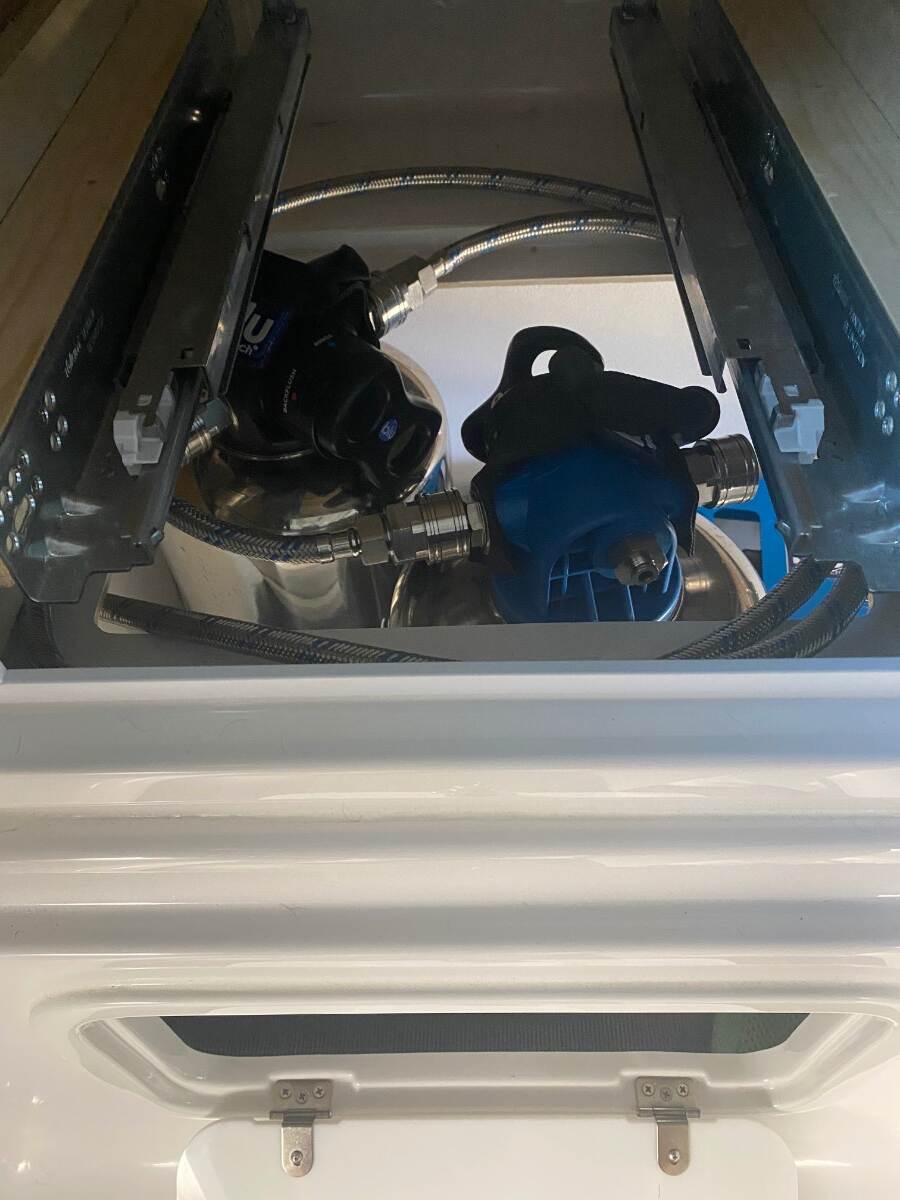
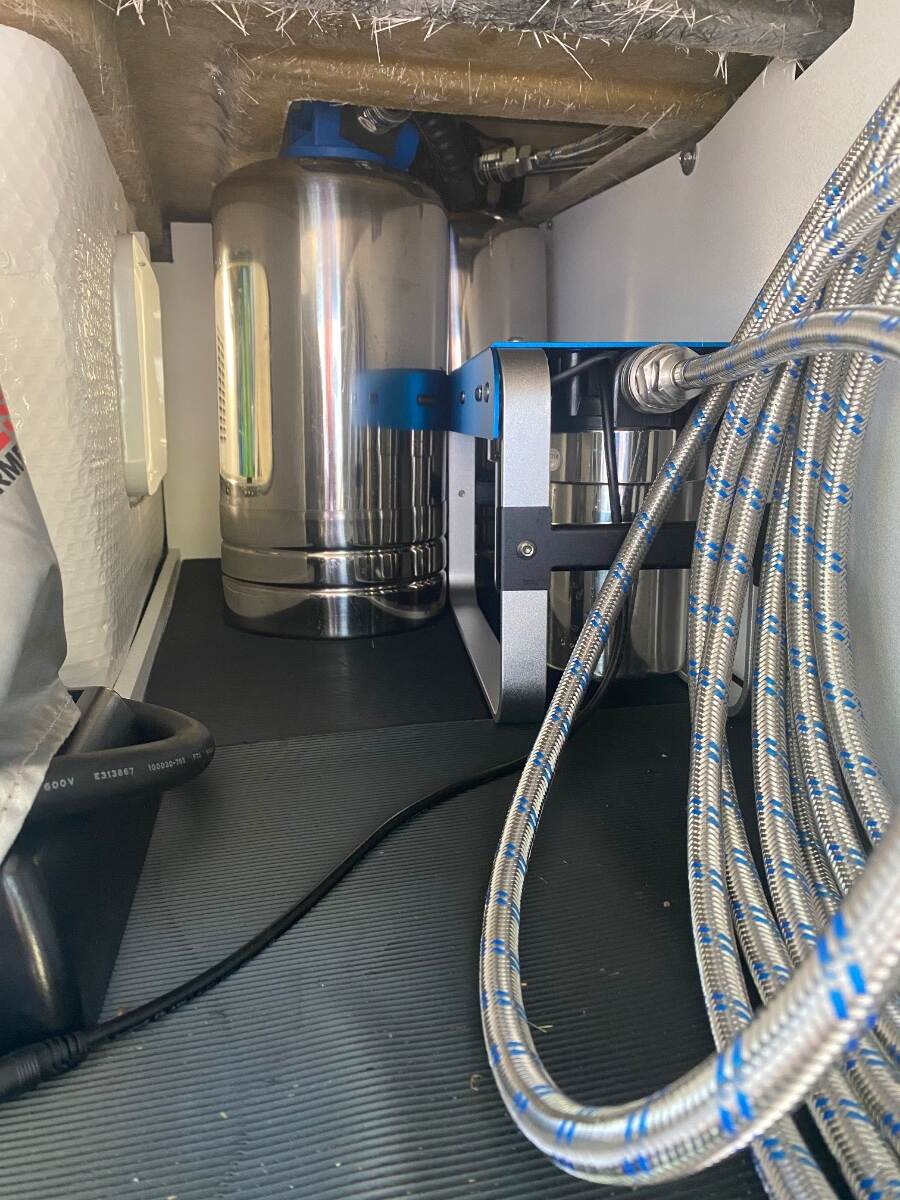
Proof of concept; onboard (inboard?) water conditioning and filtering. The problem has been the water softener and iron filter. So far it’s all be a modular system I move around. A pain but flexible. I gave up on putting the tanks onboard as they’re a bit too tall for any of the storage. But poking around I found that the panel under the bedside drawer is just sitting there so … Pros All contained nicely Puts weight in the back near the wheels (I’ve got plenty in front) Always set up so just takes two hookups, one from the faucet and two to the back water input. For waterpoint boondocking (e.g. national parks) I haven’t used it. Too much to futz with pulled off at some waterpoint and usually blocking the road. Since it’s permanent those hoses won’t kink, they’re a pain as they want to kink up if you use them modular Easy to access the valves for backwashing and regenerating by just taking the drawer out which is easy It just works out nicely with the lines having the right amount of coil Cons Not so great for city water. Unless I jack into the line internally I have to keep the hatch open which isn’t optimal But that’s fine, just use the tank and pump until/if I decide to make it more permanent Takes up the back storage But that’s odd storage anyhow, I finally settled on putting a folding chair and table there, plus dirty laundry shoved through the interior hatch. And now this frees up that storage elsewhere. The tanks have been knocking about, mainly in the truck. The main filter has been in the Sea Biscuit back storage, but now I can put the chairs and whatnot there And … that’s it? I’ll sit with this a few days but I think I like it and will start to make it permanent 👍
-
Truma Aqua Go filter failed
DanielBoondock replied to Patriot's topic in Mechanical & Technical Tips
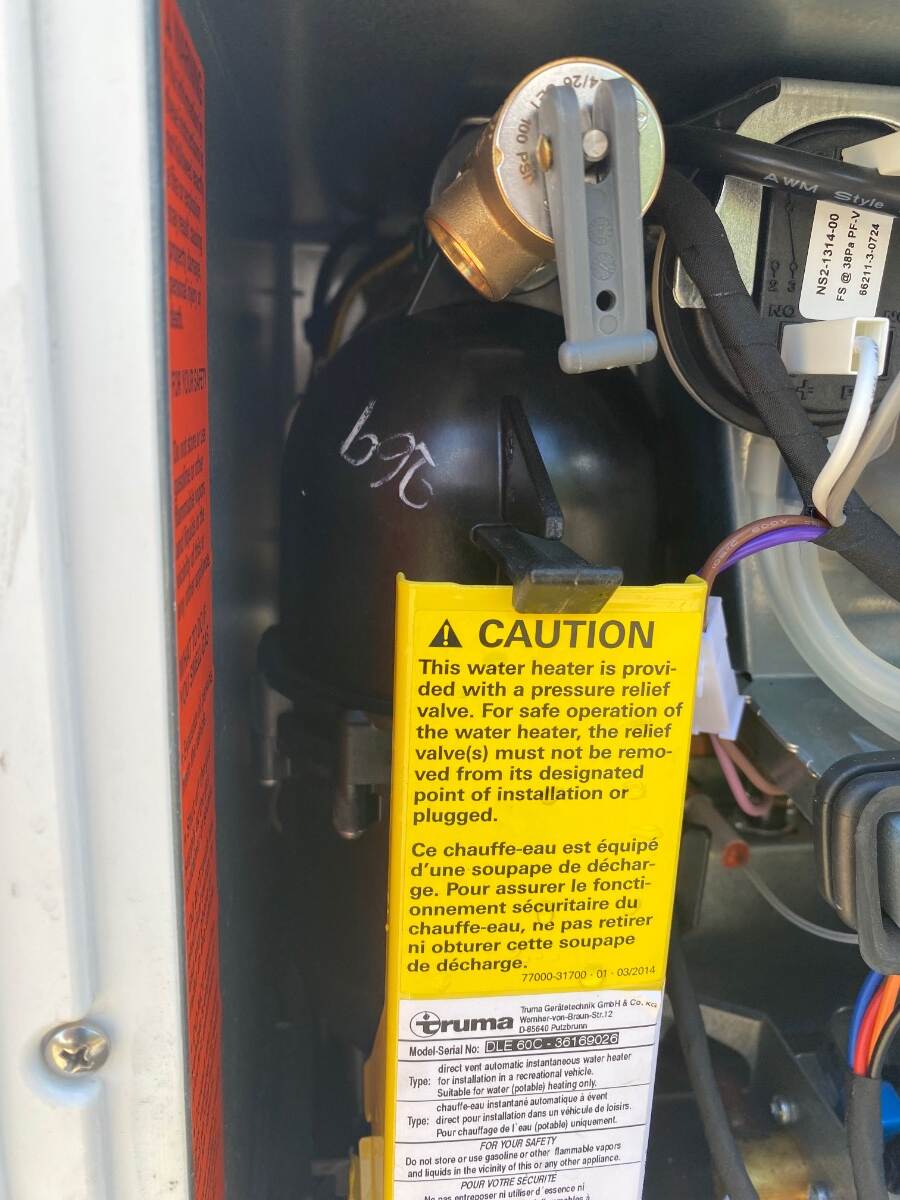
Cool this all makes sense. If I understand it now, the regular brass valve is for hot over pressure, and the plastic sacrificial filter/rupture disk is to protect against freezing over pressure. Smart design -
Truma Aqua Go filter failed
DanielBoondock replied to Patriot's topic in Mechanical & Technical Tips
Great comments thanks. This part is interesting because it does have a standard over pressure valve just above the filter housing. Do older Trumas not have this? Otherwise great tip about the antifreeze unit, I had it in there full time
-
True Induction Stove Top will not turn on
DanielBoondock replied to Lamar's topic in Mechanical & Technical Tips
Not sure of the exact situation from the information given, but here’s some commentary Using the induction on battery The induction will only pull full 1.8kW when both burners are on full power. The smaller one is limited to 8/10 vs 10/10 of the bigger to meet this spec. With my 3k inverter and the max lithium I can only use both at full power by themselves, no microwave or other high power devices typically at the same time because tripping the 3k is easily possible. But you have a 2k, the reason you can’t get full use out of the 2k is twofold I believe. One is code (for buildings) limits you to I think 80% of full spec for wiring. It depends on various factors like if it’s in conduit or whatnot. But the idea is there’s a difference between continuous high draw and momentary. EV’s for example, if say drawing 32A Level II charging at home overnight, will actually draw close to 32A for hours. Household wiring and sockets aren’t meant for that and will usually overheat, so they have different specifications. But maybe the wiring is rated for full use, as I do get full power on both while on shore. Two, inverters never seem to give the full rated spec, I think they leave margin for spikes. Again 80% is typical from my experience. Seems like if I get close to 3k it’ll freak. Finally there’s the phantom steady state draw from the rest of the camper, so the inverter needs margin for that. All told, an induction cooktop is much like an EV in that when it wants 1.8kW it will draw a full 1.8k until changed. That’s a high load/high stress situation for a camper. So it’s not surprising that a 2k inverter may not support both burners on full. I rarely to never use both mine on full with my 3k, it’s too easy to trip! I use the main burner on full, and if I need to simultaneously use the second one for say boiling some water, I just do it at a lower setting and it takes a little longer. But who cares? Induction is way faster than gas any day of the week so it takes about as long as gas. Breaker The LEII has a 15A dedicated breaker for the stove as you’d expect Stove top not doing anything If there’s zero response from the stovetop - pressing on (which uses no power) doesn’t turn it on than this is a problem. Most likely issue is a tripped breaker. Induction is definitely 120V not 12V feed. Anyhow the induction is a game changer IMO. No toxic gas danger, no condensation from the propane burning, no fire risk, faster, cleaner and better. But you have to know how to work with it as it’s a very high power device. I don’t think it’s a deficiency that the 2k won’t support full power on both burners, that’s ‘by design’. it’s the same reason you can’t run AC, wave and stove at the same time. You pay for the inverter size you wanted. So I wouldn’t worry about that, even at a reduced setting it’s still going to boil water faster than propane. -
Made in USA leaf springs
DanielBoondock replied to Mountainman198's topic in Mechanical & Technical Tips
No worries, thanks yeah I did get clued into that trick. Worked great, the suspension quieted right down. Still a little creaky, suspecting the leaves are rubbing or maybe there’s a bit of grease missing somewhere. I noticed on the Alcan page they smartly put poly rub pads on the end of the leaves to avoid this. Well we’ll be in the neighborhood this summertime (roughly) so I set up an appointment to get fitted at Alcan. Full hog five leaf, who am I to argue with them? And I was thinking about when camping we’re going over weight anyhow with all the tanks and people in it. Plus I generally agree with having some extra margin and IIRC Alcan believes 20% is the right amount so OK. -
Portable solar panel with legacy elite 2 platinum package
DanielBoondock replied to Brian H.'s topic in General Discussion
Looks like you also got a branded cover add-on too. That’s nice, I need to get a cover -
It’s just a normal roller shade, nothing unique to Oliver, so doing a general web search on roller shades might help. Mine are working fine but I think (remembering to when I’ve used them before) if it’s kinda stuck just pull down to the bottom of the window to reset the mechanism. Regarding “the others retract to at least 3/4 of the way up” - I think you mean they leave 1/4 hanging when fully retracted? That’s not right, all of mine only leave an inch or two of the shade hanging. Anyhow so far been trouble free for me. The design has been around forever, seems like an early 20th century invention, anyhow should be easy to work with. No, interesting it has an even longer history
-
Portable solar panel with legacy elite 2 platinum package
DanielBoondock replied to Brian H.'s topic in General Discussion
… another idea, hard mount regular panels to the bed rails on the trick if you’re configured like that, and have that charge an Ecoflow. So top off the Ecoflow pro and use that to top off the house. That’s exactly what I do boondocking using the 220 kWh traction battery, minus the solar -
Portable solar panel with legacy elite 2 platinum package
DanielBoondock replied to Brian H.'s topic in General Discussion
Don’t need it myself since I drive electric, but if I wasn’t I still I doubt I’d do it. A lot of bother, have to be around so sticky fingers doesn’t walk off with it, and as @jd1923 sez it’s just more stuff, and big clumsy stuff too. Getting this rig pared down to the essentials has been a major project. I’d do this instead Try to optimize the roof solar charging opportunities if possible Possibly upgrade the house batteries (you have a recent vintage but don’t know what you’ve got on board) Most likely would be to instead get a backup source, it’s awfully handy to just charge off the truck one way or another Ecoflow Delta Pro has a TT-30 plug so you can top off the house batteries directly Or just get one of the 120V regular versions and find some creative uses of it My 2c … Sells how, do they have a web store? Not coming up with anything …