
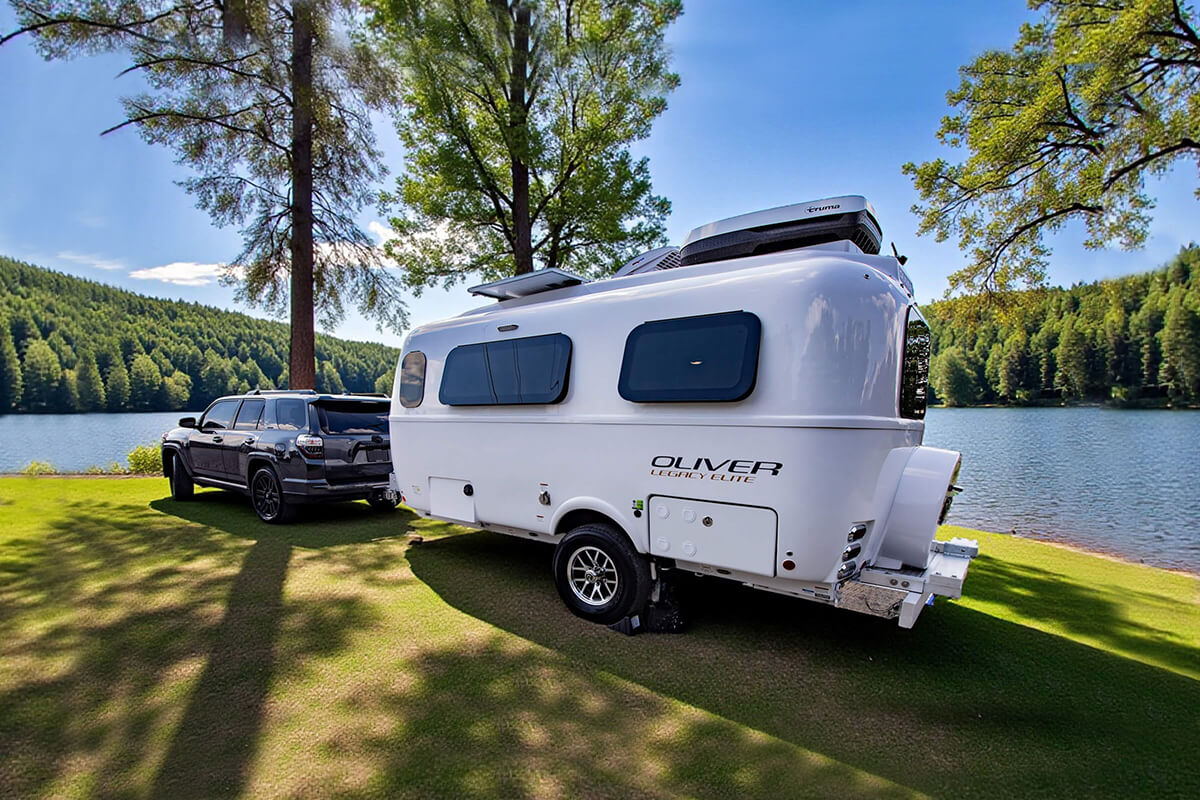
Airstream alternatives What to compare before you buy a small trailer
Most people who find this page are cross-shopping a compact aluminum trailer against a fiberglass one. The differences that matter are in how the shell is made, and they are easier to judge once you know what to look at.
Three ways to build a small trailer
Compact trailers are built one of three ways, and the method decides most of what you will live with. None of this is a judgment on any brand. It is just how each one goes together.
Riveted aluminum
Aluminum panels fastened over a frame with rivets. It is the oldest approach still in volume production and the reason those trailers look the way they do.
The wall has rivets and panel seams by design. That is inherent to the method rather than a flaw in it.
Panels on a frame
Flat wall, roof and floor panels laminated and then fastened to a frame, usually aluminum or wood. It is the fastest method to build and the most common at every price point.
Everywhere two panels meet there is a sealed joint, which is the part of the trailer that gets maintained over its life.
Molded fiberglass shells
Oliver molds four fiberglass shells, two inner and two outer, and bonds them into one structure with insulation and an air gap between the layers.
The wall itself has no panel seams, the tanks and plumbing run inside the structure instead of under the floor, and nothing structural is wood.
Why the method shows up more at 18 feet
A small trailer has nowhere to hide its construction. There is no basement to bury the plumbing in and no spare length to absorb a compromise. The wall thickness shows, the galley layout shows, and where the tanks sit shows.
That is the argument for spending the money on the shell rather than on square footage. It is also the reason the same construction question matters less on a forty-foot trailer than it does here.

The Legacy Elite, by the numbers
These are Oliver's own figures for the Legacy Elite. Every manufacturer publishes theirs, and they change by model year, so take these to whatever else you are looking at and compare like for like.
The Legacy Elite is fully booked
Every 2026 production slot has been reserved. If you are shopping now, the Legacy Elite II is the one you can actually order, and it carries the same shell construction on a longer twin-axle chassis.
Tank capacities, options and current pricing are on the model pages and the full build sheet comparison, which is kept current with the factory. Anything quoted secondhand, here or anywhere else, is worth checking against the source before you decide on it.
Seven things worth comparing
Ask these of every trailer on your list, Oliver included. The answers are on each manufacturer's own spec page, which is where they should come from.
-
How is the wall built, and where are the joints?
Riveted, panel-and-frame, or molded. Ask where two pieces meet, because that is the part you maintain. It is a fair question to ask Oliver too.
-
Where do the tanks and plumbing run?
Inside the structure or slung under the floor. This decides how the trailer behaves in the cold and how exposed the plumbing is on a rough road.
-
What is the tongue weight, not just the dry weight?
Dry weight tells you whether your vehicle can pull it. Tongue weight and your payload tell you whether it can carry it, and that is the number people get caught by.
-
What is standard, and what is a package?
Two base prices are not comparable until you know what each one includes. Price the trailer you would actually order, with the options you would actually tick.
-
What does the warranty cover, and for how long?
Read the structure term separately from the components term. Oliver publishes five years on the body and chassis, two years on Oliver-made components, one year on third-party parts. Ask every brand for the same three numbers.
-
Can you get one, and when?
Small builders run limited production. The 2026 Legacy Elite is fully booked. Ask about the queue before you fall for a floor plan.
-
What does the used market look like at ten years?
Search ten-year-old listings for every brand you are considering and set them against the original price. It takes ten minutes and it is the only version of this answer you should trust.
Nobody should buy a trailer on a comparison table, including this one. Go and stand in each of them, put a tape measure on the bed, and open the bathroom door. The list above is what to check once you are there.
Three next steps, depending on where you are
Every Oliver is built to order in Hohenwald, Tennessee and sold factory outlet direct, so there is no dealer between you and the answer to a question.
Get the real numbers
The full build sheet lists every specification, package and price across the current lineup, kept current with the factory. It is the version to compare against, not a summary.
See the Build SheetStand in it first
Book a free factory tour and walk the floor where the shells are laid up and bonded. You can also find an owner near you who will show you theirs.
See an OliverThe one you can get
The 2026 Legacy Elite is fully booked. The Legacy Elite II carries the same shell construction on a longer twin-axle chassis, and slots are still open.
Legacy Elite IIIf you are cross-shopping and want a straight answer on how an Oliver differs from something specific, ask. The people who build them are the ones who answer.