
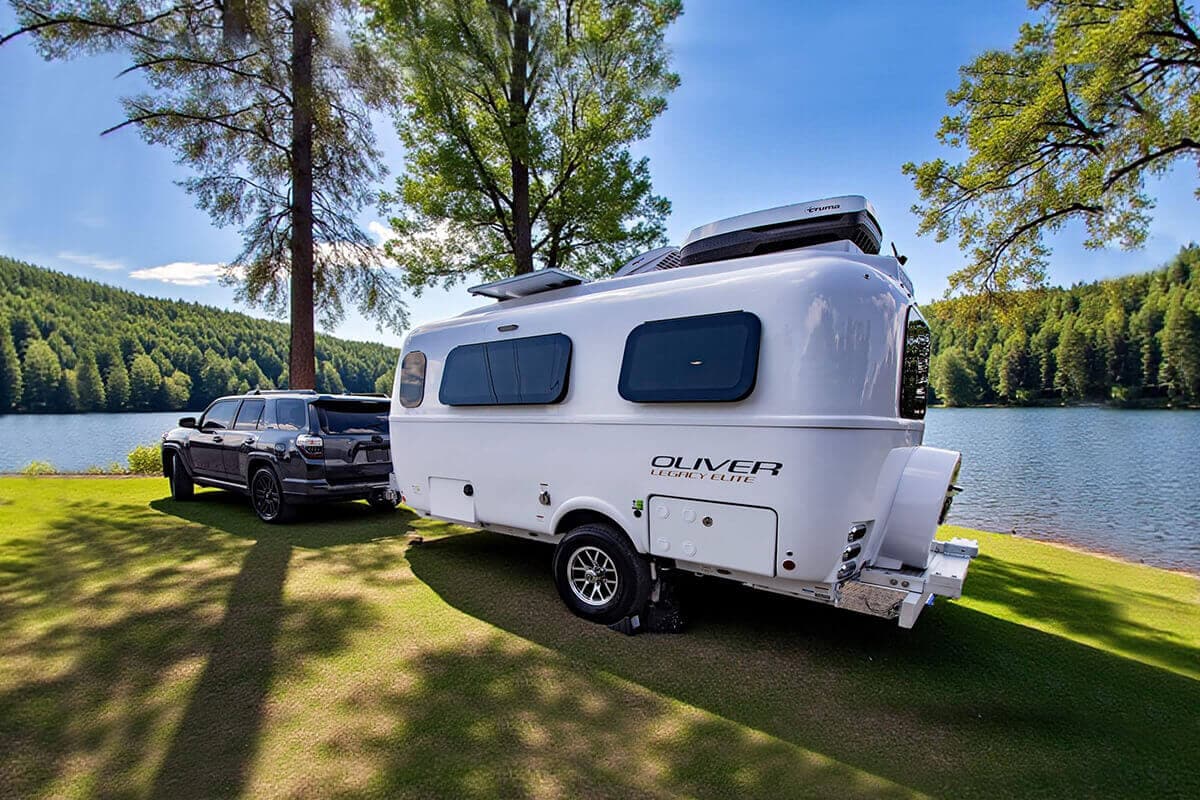
Picking an RV camper company comes down to four things: build quality, warranty terms, resale value, and whether the company will still be around in ten years. We ranked ten manufacturers against those criteria. Oliver leads on the first two, with a molded fiberglass shell built for four-season use and a five-year body and chassis warranty against the one to two years most of this list publishes. The other two are worth checking yourself, and this page shows you where to look.
Top 10 RV Camper Companies
1. Oliver Travel Trailers
Hand-built in Hohenwald, Tennessee since 2007. Three models: the brand new Apex X23 at 24′, Legacy Elite at 18’5″ and the Legacy Elite II at 24′. All three are built from four molded fiberglass shells, two inner and two outer, bonded into one structure with insulation and an air gap between the layers.
- Build: double-hull fiberglass, aluminum frame, four-season capable
- Models: Apex X23, Legacy Elite (18’5″), Legacy Elite II (24′)
- Price range: $85,000 to $113,000 for 2027 builds
- Warranty: 5 years body and chassis, 2 years Oliver components, 1 year third-party
- Best for: couples and small families who want a trailer that lasts decades
- Production: small batch, hand-built, Legacy Elite is currently booked through 2026 and the 2027 Apex and Legacy Elite II are still filling up fast.
See the Oliver lineup or read why owners stay loyal for decades.
2. Airstream
Strong brand recognition and good resale. A riveted aluminum body has seams and fasteners where a molded fiberglass shell has neither, which is the core construction difference between the two.
- Build: riveted aluminum monocoque
- Price range: $40,000 to $180,000
- Best for: buyers prioritizing brand recognition and aesthetics
3. Grand Design
Indiana-built travel trailers and fifth wheels with a reputation for solid warranty support. Wood-framed construction with aluminum cladding, which is a large part of how the price stays competitive.
- Build: wood-framed, aluminum-clad
- Price range: $25,000 to $100,000
- Best for: families who want spacious floor plans at a mid-range price
4. Winnebago
One of the oldest and most recognized RV brands in North America. Wide product range from compact Class B vans to motorhomes and travel trailers. Construction and price vary considerably from one line to the next.
- Build: varies by line, mostly wood-framed
- Price range: $30,000 to $200,000
- Best for: first-time buyers and motorhome shoppers
5. Jayco
Family-owned since 1968, now part of Thor Industries. Wide model range covering travel trailers, fifth wheels, and motorhomes.
- Build: wood-framed, aluminum or fiberglass siding depending on line
- Price range: $20,000 to $120,000
- Best for: buyers who want a wide model selection
6. Tiffin Motorhomes
Class A motorhome specialist based in Alabama, acquired by Thor in 2020. Strong owner community and good factory support.
- Build: Class A motorhome chassis
- Price range: $150,000 to $500,000
- Best for: motorhome buyers in the $200K+ tier
7. Newmar
Class A motorhome maker based in Indiana, also part of Winnebago Industries. Known for finish quality at the upper end of the motorhome market.
- Build: Class A motorhome chassis
- Price range: $200,000 to $600,000
- Best for: full-time motorhome buyers
8. Entegra Coach
Class A motorhome line owned by Jayco/Thor. Mid-to-upper tier finishes and a wide range of floor plans.
- Build: Class A motorhome chassis
- Price range: $100,000 to $400,000
- Best for: motorhome buyers in the mid-luxury tier
9. Keystone RV
Owned by Thor Industries, Keystone makes affordable travel trailers and fifth wheels at high volume, at the lowest entry prices on this list.
- Build: wood-framed, mass-produced
- Price range: $20,000 to $80,000
- Best for: budget-conscious family camping
10. Forest River
One of the largest RV manufacturers in North America with dozens of brand sub-divisions including Coachmen, Palomino, and Cherokee. Volume-focused, with construction and specification varying widely from one sub-brand to the next.
- Build: varies by sub-brand, mostly wood-framed
- Price range: $15,000 to $150,000
- Best for: buyers shopping primarily on price
What Oliver does differently
Most of the trailers on this list are built by fastening panels to a frame. It is a fast method and it keeps the price down, and it means every place two panels meet is a sealed joint.
Oliver builds the other way around. Four molded fiberglass shells, two inner and two outer, bonded into one structure with insulation and an air gap between the layers. The tanks and the plumbing run inside that structure instead of hanging under the floor, and nothing structural is wood.
The trade-off is volume. Oliver builds roughly 100 trailers a year by hand. The mass-market manufacturers build that many before lunch.
How to choose the right RV camper company
Four questions to answer before signing anything:
- How long do you plan to keep it? The longer you intend to own a trailer, the more the shell construction matters relative to the floor plan.
- What climates are you camping in? Ask what the wall is made of and how thick the insulation is. A single-skin wall and a double wall with an air gap behave differently, and the spec sheet will tell you which you are getting.
- What’s your tow vehicle? A 3,700-pound trailer tows easily with a half-ton. A 9,000-pound trailer needs a heavy-duty truck.
- What does the resale market actually look like for the brand 10 years out? Check listings on RV Trader before you commit.
See Oliver Travel Trailers
Legacy Elite (18’5″)
Single-axle, 3,700 lbs dry, bath with shower and kitchen, four-season ready, tow-able with a half-ton.
Legacy Elite II (24′)
Tandem axle, 4,900 lbs dry, more interior space, sleeps 3, same double-hull build.
Sources
- RV Atlas Podcast (2024) describes Oliver as “the best made travel trailers in America” per industry experts and owners.
- iRV2 Forums user review calls Oliver “arguably the best engineered and manufactured TT in their market of sub 25′.”
- B&B RV Inc. (2024) highlights Oliver’s resale value and customer service.
- RV Travel review (2021) praises attention to detail and quality of workmanship.
- RV LIFE (2024) notes one of the best warranty packages in the industry.
Oliver leads the list because of double-hull fiberglass construction, four-season insulation, a 5-year structural warranty, and resale value that holds. Models like the Legacy Elite and Legacy Elite II are hand-built in Hohenwald, Tennessee.
They are built differently, and most of the difference is in the joints. A molded fiberglass shell is formed in one piece, so the wall itself has no panel seams. Panel-and-frame construction, which covers most of the mass-market brands, has a sealed joint everywhere two panels meet. A riveted aluminum body has seams and fasteners of its own. Which of those matters most to you depends on how long you plan to keep the trailer and what weather you camp in.
Oliver publishes five years on the body and chassis, two years on Oliver-made components and one year on third-party parts. Most mass-market brands publish one to two years on the structure. Warranty terms are on every manufacturer’s own site if you want to compare them side by side.
Resale is the easiest item on this list to check for yourself, and the one most likely to move. Look up ten-year-old listings for any brand you are considering on RV Trader or a similar marketplace and set them against that model’s original price. Low production volume tends to support resale, and Oliver builds roughly 100 trailers a year.
Travel trailers like the Oliver Legacy Elite and Legacy Elite II ($85,000 and up) require a tow vehicle but cost less and are easier to park separately at a campsite. Motorhomes drive themselves but commit you to a much larger upfront cost and a vehicle you’ll have to maintain on a chassis schedule. The decision usually comes down to whether you already own a capable tow vehicle and how often you plan to camp.
Forest River and Keystone RV have the lowest entry prices on this list. If you are weighing one against an Oliver, the comparison worth doing is not the sticker price but what you expect to spend across the years you plan to own it, including what you get back at the end.