John E Davies
-
Posts
5,759 -
Joined
-
Last visited
-
Days Won
243
Everything posted by John E Davies
-
 I imagine the extra air conditioning puts more heat into the condensor and radiator, making overheating more likely when towing at the max GVCWR. If you never use it, ignore that 500 lbs. If you worry that you might forget, pull the fuse for the rear fan or disconnect the harness there. I have never ever heard of two compressors, are you sure about that? Normally with rear air they just add a second evaporator and fan, and associated air ducts, in back, plus maybe have a larger single compressor. Two alternators, yes, Some larger trucks definitely run two of those. The Elite II has a gross weight of 7000 pounds. It has quite a good payload compared to many other trailers including Airstreams. The Nest is a hoot, it can carry 600 pounds, theroetically, but if both the fresh and waste tanks are full you can carry a whole 200. LOL. Talk about weight anxiety.... you really must read and understand the specs. Especially if you plan to add options. https://www.ewaldsairstream.com/2019-airstream-nest-16fb-floorplan-specs.php I could not find a page for the 23FB you mention, but I expect it has about a 1200 lb load capacity, with empty tanks. Ollies can carry a bunch of stuff.... and they are built tough. If you bought a stripped Elite II and towed it dry, you could carry 2400 pounds of cargo. That is unheard of in a travel trailer of this size. John Davies Spokane WA
 -
Normal static torque won’t bend the frame or square tubes measureably, no way. The clamping force tries to do that but the material is strong and thick enough to resist it. Add the extreme and repetitive vertical loads from bouncing down a choppy highway with a 150 pound cargo at the end of a 2 ft arm and you might have problems. I suspect those huge flat washers were added in an attempt to spread the load to the sides of the frame rails and square tubes instead of straight through their centers. Put a bolt through a hollow tube of any shape and clamp it down, and the tube distorts. A solid spacer inside prevent that. That is what they did up front to stop the coupler bolts from loosening. The black plastic (?) spacers Oliver uses are also a bad idea. They wanted to attach the smooth square tubes on top of knife sharp diamond plate, without causing damage as the ridges gouge into the mounts over time and cause them to loosen. It would be much better to remove the cover there, or at least sand the ridges off to provide a smooth flat mounting surface and get rid of the plastic! Does Oliver tell rack owners to check the bolts? If they are 1/2-13 Grade 5 they should be 82 ft lbs. If the nuts continually need to be tightened there is a problem..... ever wonder why they keep changing the rack design? I am not a structural engineer but I was an aircraft A&P tech and this stuff is basic hardware theory..... you never build a stressed assembly with two hollow parts and a soft spacer between them like this because it is just dumb. Some reading: ... https://blog.maxprocorp.com/the-difference-between-tension-shear-and-bending-joints John Davies Spokane WA
-
Welcome to the forum. A fully loaded Elite II is going to weigh around 5500 pounds with propane and nothing else. Since your 5000 lb boat pulled OK I suspect your Explorer will also be OK with an Ollie.... but just barely. Try it out, take it over Newfound Gap and see how it does at 5000 feet and up steep grades. If it can deal with that you should be fine just about anywhere east of the High Plains. If you decide to come out West, where the altitude and heat are extreme, and it is often impractical to tow with empty tanks, I am sure you will be an unhappy camper without significantly more truck. John Davies Spokane WA
-
You need to clarify.....It sounds as if you actually mean through-bolting rack supports to the sides of the FRAME rails, that would possibly work quite well. I would just remove the diamond plate cover entirely, take it to a sheet metal or welding shop and have them cut the bends off with their big shear. Reinstall it with extra rivets as needed. If you want to use short bolts for a top mounted rack, there is no need whatsoever to go clear through the entire height of the frame rails. You could install the nuts on the inside of the cavity, though they would be a little tricky to reach. A 1/2” breaker bar with a socket on the end would work well to get a nut and glued on heavy washer down into the far end of that long opening. I personally feel that the big fender washers with super long bolts that the factory uses is a bad design. I will use 1.5” x 12” x 1/4” thick aluminum backer strips top and bottom to better spread the load and reinforce the frame, with regular hard stainless flat washers, bolts and nuts... this method does not require you to modify the diamond plate cover in any way, plus you only drill one set of big holes in the frame rails, not two... the fewer holes the better IMHO. The reason fender washers and really long bolts are bad is that if there are no compression sleeves installed (does the factory do this for their racks?) the clamping force of the nuts tries to squeeze the top and bottom of the hollow tubes together and bow out the sides, and the hardware tends to loosen over time. You just can’t torque them down enough unless you have solid metal underneath, not air. Look at the way the Bulldog is attached to the tongue, with aluminum tubes inside the cavity, that is the best approach. Finally, a sane design MUST have a fuse - a built in failure point - so that when a car rear ends your trailer at low speed or you back into a boulder, the rack supports will either crumple or shear off and not bend the frame rails. If it happens at high speed your trailer is toast anyway..... but you should try very hard to protect the frame from damage in low speed impacts. A bent frame would be a financial disaster. John Davies Spokane WA
-
I recommend that you reconsider the front cargo tray. If you delete that option and instead carry the generator inside the truck towards the front of the bed, it lightens the tongue weight significantly. Plus you get more maneuvering room since you don’t have to worry about jackknifing the tray into the truck. Your generator will be out of sight, out of the weather and dirt, and MUCH safer from thieves. I think carrying lots of weight on the tongue of the trailer is a mistake, regardless of tow vehicle. Especially if your TV has marginal payload. If you must carry heavy stuff on the trailer a rear rack works better, keeping the tongue light. John Davies Spokane WA
-
2020 Jeep Gladiator 3.0 turbodiesel tow rating
John E Davies replied to John E Davies's topic in Towing an Oliver
Here is a sneak peek at the Super Bowl commercial showing the rebirth of the Gladiator. https://m.youtube.com/watch?feature=youtu.be&v=Naq2yFTwA_c I think it looks great and that dealers won’t be able to get enough of them. And I know it would be even more super cool if they offered a full sized variant with serious towing power.... how about a rebodied retro Power Wagon? Ooooooh my heart! John Davies Spokane WA -
BackofBeyond, thanks for the pic and info, that helps. Do you think my using 9" instead of 11" would be too close? I am trying to keep my cargo tray as close as possible to the tire without obstructing its removal. Do e-Bikes sometimes have wider bars than regular bikes due to their extra weight? John Davies Spokane WA
-
GJ, thanks so much but I remain clueless. I guess this image from your report sums up my understanding of it: Clear as glass! LOL.... John Davies Spokane WA

-
Interesting. “Due to the shared age of the failed and remaining disks, we are replacing all 12 of the disks (plus 2 spares), not just those that failed. That's 14x Samsung 860 Pro 4TB drives, plus a new RAID card.” It would seem prudent to proactively replace a couple of drives every year and use the very newest for data backup. Having a bunch of old drives is a recipe for this kind of disaster. I wonder how old they are, in years? I guess they learned that lesson.... What is the MTBF of professional drives? I have no idea.... John Davies Spokane WA
-
Neat! Can you post a pic of the actual camping area? This may sound weird, but are there often ticks in that brush? Around where I live there is mostly sagebrush in the desert parts and it is open to free range cattle, plus lots of wildlife, so ticks sometimes are super abundant. They practically leap off the bushes at you... very disheartening. I walk with a stout cane and sometimes use it to whack a bush before brushing past it, in an attempt to dislodge the nasties. Thanks. John Davies Spokane WA
-
Bump. Need that measurement please. John Davies Spokane WA
-
I get carrying the truck spare up front, that is nifty. What is your reasoning for carrying the Ollie one there? Taking it off the normal location will increase tongue weight a little. Or do also you carry extra stuff on a rear rack? Thanks John Davies Spokane WA
-
Who hates those @#$&*! chip sealed highways?
John E Davies replied to John E Davies's topic in Towing an Oliver
Colorado does not to the best of my knowledge. WA, OR, WY, ID and MT certainly do. I bet the states with financial problems do this instead of resurfacing, as a band aid fix. The “poor states” especially with lower popilations and smaller tax bases probably have no choice. John Davies Spokane WA -
I have not driven a Nissan Titan but my go-to source for reviews is Car and Driver and they hate the diesel version. The 5.0 has so much to promise. Maybe with an aftermarket tune it would be really good. I would love to see a refined version of that lighter shorter engine offered in a Power Wagon..... Ram was originally going to use that engine, they cancelled the project and Cummins sold them to Nissan. https://www.caranddriver.com/nissan/titan-xd In reality, any big V8 gas engine will have the power you need unless you must have the cruising range, which is not an insignificant factor - fuel tank worries vanish when you can tow 600 miles before refueling. The BIG factors are always payload, axle ratios, and how much you plan to drag around in the truck. Keep the Tundra, it will do just fine. You have the power and the gearing you need, though you might want to add rear airbags for levelling. Unless it doesn’t carry enough stuff, then you can do something about it. Maybe a new Tundra HD Diesel will be available next year, they are doing work on the replacement model, though nobody knows if we will ever get a diesel like the rest of the world.. I would buy that truck in a heartbeat. Nissans don’t hold up like Toyotas. The buld quality just isn’t there, even in their high end luxury SUV. https://www.motor1.com/news/302530/2020-toyota-tundra-spied-first-time/ Calculate how much money you would lose by trading in your current truck. I bet it would buy a whole lot of gasoline.... John Davies Spokane WA
-
Who hates those @#$&*! chip sealed highways?
John E Davies replied to John E Davies's topic in Towing an Oliver
The initial treatment is the worst, the gravel sits on the freah tar, is rolled down and after a day or two it is brushed and the excess is collected. Then a week later they spray a top coat to seal the new gravel layer, and that oil gets all over the side of your vehicles too. Once fully completed and cured it acts just like a regular road but with a very rough surface texture John Davies Spokane WA. -
Does your highway department use chip sealing to maintain asphalt highways and secondary roads? It is about 80% less costly than laying down a nice smooth ribbon of new asphalt, so more and more cash strapped DOTs are using it. If you don’t know what it is, consider yourself very lucky. https://www.idahostatesman.com/latest-news/article214831975.html Nothing ruins a beautiful summer trip more than seeing a sign that says “Chip sealing in progress. Speed limit 35 mph next 40 miles”. If there is a detour, even if it means an extra hour or two of driving, I will take it. Driving on this stuff among semi truck traffic is even worse. With a closing speed of 70 mph on a two lane road, rocks spang off your grill and hood and crack into your windshield. The tarry mess coats your rocker panels, speckles your wheels, and builds up deep layers in the crannies of your wheel wells, where it hardens into rock. On a long stretch people get frustrated and drive at normal highway speeds which really kicks up a rooster tail of rocks. I once saw a large bunch of Corvettes on a group drive going down a highway that was being sealed. I am sure the owners were unhappy. Bicyclists and motorcyclists despise the stuff - the loose gravel is like riding on ice. Bike riders fall and get sandpapered. Motorcyclists spend hours trying to get the tarry stones off the engine and chassis. Junk gets all over the underside of the trailer and dust goes everywhere. Chip sealing is one big reason I installed lots of stone protection on “Mouse”. Do you encounter chip sealed roads in your travels? Did you say bad words? How do you clean the stuff off your vehicles? The thing that bothers me most of all is that here in WA and ID there is no early warning. You may be twenty miles past the last major intersection when you suddenly encounter road construction. I wish they would post an alert sign way back suggesting you take an alternate route. I know that Corvette owners would appreciate it.... John Davies Spokane WA
-
Protecting the front of our Oliver
John E Davies replied to TexasMarshall's topic in Mechanical & Technical Tips
I don’t recommend that you install it yourself, it is very difficult for larger areas, especally for compound curves. Plus you lose the warranty. For headlights and small flat sections like between the spare tire and hull, it is really simple for you to do. You need to understand that protecting the front of the trailer with a coating or film does NOT stop stones from shooting back at the TV, nor does it stop damage to the trailer chassis, axles and the trailer’s rear bumper and back part of the hull (and rear lights). You can still expect some TV tailgate and bumper paint damage, or worse yet, though very rare, a busted rear window in the hatch or canopy. So it might be prudent to also install film there before you start to see paint chips.... I guarantee that after only an hour or two on gravel or fresh chip-sealed highway you will see some chips on the rear of the truck... and stones lying on top of the TV and trailer bumpers. The only sure way to really protect everything is by using a Stone Stomper, and mudflaps and guards under the trailer. For 95% of owners this is completely unnecessary, but I suggest at the very least rear mudflaps on the Ollie if you plan to regularly tow off pavement. John Davies
-
MDL (Slow-blow) Fuses for the Jacks
John E Davies replied to CedarForks's topic in Mechanical & Technical Tips
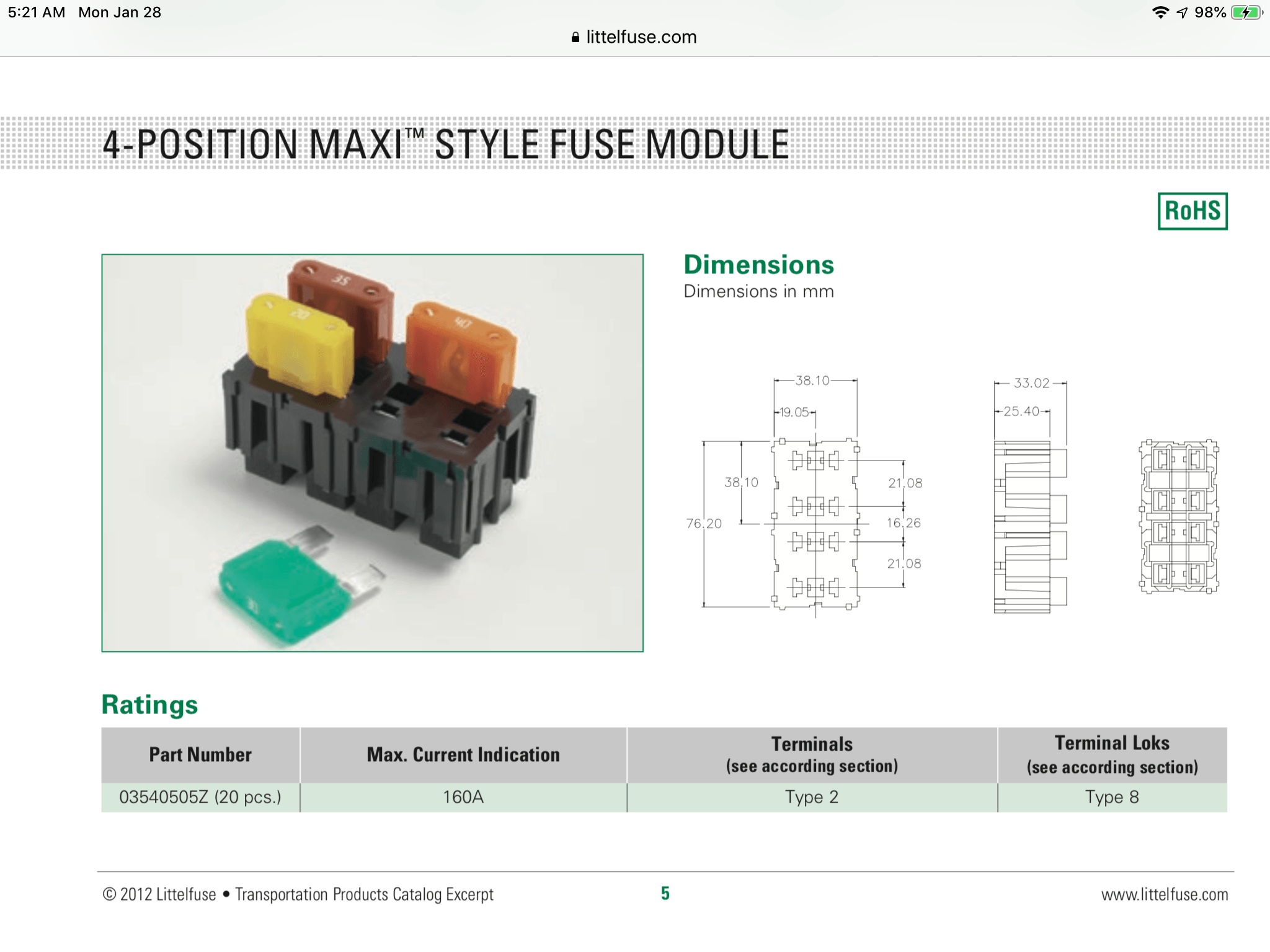
I don’t like your idea for a couple of reasons. The screw down wire connections are just not very good. They damage the wire strands and loosen over time. Plus getting the glass fuse out of that holder would still be difficult, and you run the risk of breaking it. I personally hate glass fuses. They don’t belong in the 21st Century IMHO. My suggestion is to replace the MDL fuses with modern Slo Blo Maxi blade fuses. https://www.amazon.com/Littelfuse-MAX30BP-Slo-Blo-Automotive-Blade/dp/B07DMR4F33?th=1 https://www.amazon.com/Kingopt-Opt-43/dp/B00030CPOQ/ref=pd_rhf_dp_s_all_spx_wp_0_2?_encoding=UTF8&pd_rd_i=B00030CPOQ&pd_rd_r=bef2f751-e11b-49a7-b10b-8b16273098ee&pd_rd_w=HIwes&pd_rd_wg=IJWq3&pf_rd_p=be1fc0a3-5323-42ce-8eda-5c75d301717d&pf_rd_r=S6M9062KWZD7EPFKP4SJ&psc=1&refRID=S6M9062KWZD7EPFKP4SJ You could instead go with a big automotive style fuse block, but that would be a much more involved project I think. But it would look very slick! Here is a tech page for the fuses. https://m.littelfuse.com/~/media/automotive/datasheets/fuses/passenger-car-and-commercial-vehicle/blade-fuses/littelfuse_maxi_32v_datasheet.pdf They are more expensive than MDLs but normally they will never ever blow unless there is a problem with the jack. You can’t find slo blo MDLs stocked on any auto parts display, so you might as well go with these, which ARE commonly found at any NAPA, since they are a normal auto fuse for modern cars. You can safely pull these Maxi fuses from the holder using a small pair of flat nose pliers, but without disconnecting the batteries it is a little risky if you drop them onto an exposed terminal or bus bar! A plastic Maxi fuse puller is a better choice. I don’t know if Amazon carries these..... but your local NAPA could get one for you easily. https://www.delcity.net/store/Maxi-&-Mini-Fuse-Pullers/p_795485.h_795490 If you want to cut the dust covers off that would be fine. If you decide to also change the fourth fuse at the tongue jack (did you know about that one?), keep the cover and also use some silicone electrical grease on the terminals to prevent corrosion. I hope that helped. John Davies Spokane WA
-
What if you want to disable the jacks for when you are gone but don’t want to kill all the appliances and lights? A master switch is fine if you want the entire trailer completely dead. I think CedarForks was looking for a way to quickly kill just the jacks.... John Davies Spokane WA
-
Interesting side note.... my Land Cruiser 200 has a rating of 8500/ 850 lbs, but the manual makes no mention whatsoever about a WD hitch. Which is most definitely needed with 600 to 700 lbs on the hitch..... The truck is way shorter than a Tundra and more softly sprung, but the frame is 20% stronger. Strange indeed.... But hardly any 200 owner ever tows even a dinky trailer. Mine is unusual in that I work it hard. John Davies Spokane WA
-
There are three fat fused yellow wires coming off the DC bus under the street side bed, one runs to each jack motor. Install a 12 volt 30 amp relay in EACH circuit between fuse holder and the bus strip. https://www.amazon.com/ONLINE-LED-STORE-Waterproof-Harness/dp/B01N66W2XF Run the three relay ground wires to a nearby ground. Run the three power (control) wires for the relays to one of the single SPST switch terminals. Run a fused (5 amp would be good) 12V power wire to the other terminal of the switch. When you flip the switch on, power flows to the relay coils, energizes them "Kachunk!" and allows all three jacks to work. Switch it off, and all jacks are stone dead. Do not try to do this with one switch but no relays, the current flow is way too high. But DC breakers as suggested above would also work. The downside of adding relays is that there could be a failure that prevented one jack from working. If that happened you would have to bypass the failed relay and put that jack circuit back the way it was. Or mount a spare relay right next to the other three and swap it out, which would be a two minute job. OR just remove all three fuses from the inline holders when the jacks are not needed. Adding relays sounds like a lot of work but it would be a simple and reliable mod. No worries if done correctly. This would be a great $100 Hidden Security option for the factory to offer. John Davies Spokane WA
-
Welcome, I know nothing at all of Bigfeet.... OTH are you aware that there are a number of used Ollies for sale here in the Classifieds? You could have one in a matter of days or weeks, not many months. http://olivertraveltrailers.com/forums/oliver-campfire/classifieds/ John Davies Spokane WA
-
Wish I were there....it is miserably cold and wet here. If you use the GAIA nav app, they just added the National Geographic Trails maps for BB. It is available for Premium members. These maps are most excellent, I use them whenever they are available for my location. The app is stellar also, the best out there for back country where there is no cellular. As an aside they also added an excellent USFS Roads and Trails overlay, which shows all the large and small tracks in the National Forests. Click the trail and a popup tells you its status, conditions, material (gravel or “natural”) and width. Very cool, much better than the USFS MVUMs, and updated every three months. This summer they are also going to release an update that will allow you to overlay wierd user downloaded pdf maps, which is the only drawback to the current program. Have fun down there, carry a satellite communicator, carry a gun (snakes and two legged varmints), and watch yer back, https://www.latimes.com/nation/la-na-border-patrol-big-bend-2017-story.html John Davies Spokane Wa
-
I don’t know anything at all about the Base Camp but 200 lbs of dogs will also be a problem in an Ollie. We have two 40 lb labradoodles and it gets troublesome. Did you ever investigate converting your Sprinter to 4wd? With a 4.5” lift, transfer case, AT tires, armor and optionally regearing the axles it ought to get you around pretty well. Cost for the basics starts at $23k and goes (way) up.... it seems a shame to have a custom RV that you can’t use; a 4wd converted truck like that would have a much high resale value than a 2wd model, especially out West. You could always add a single axle cargo trailer for extra stuff, but that won’t do anything about floor space unless you are already carrying bikes inside the Roadtrek... https://whitefeather4x4conversions.com/f-a-q/ John Davies Spokane WA
-
Cptdondo, do you regularly boondock? If not a medium sized pusher diesel motorhome with a good offroad toad like a Wrangler Unlimited with roof rack checks most of your buttons. Being able to drive to trailheads really complicates your decision, since even a shortbed HD truck with no camper is a real PITA on those vertical ledgey secondary forest roads and high passes.... every reply you make adds more info that makes things harder. Can you post pics or a link to your custom Roadtrek? I’m assuming you already have the lifted 4wd chassis, is the rig just too low and vulnerable for uneven roads? Do you already have bigger tires and skidplates? Have you considered posting your questons over at Expedition Portal? That sounds like an appropriate forum for your lifestyle. You could go bigger than a dinky 1 ton pickup..... Thanks. John Davies Spokane WA