
Water tank capacity is one of the first things worth checking when you are shopping for a travel trailer, and it matters most if you plan on boondocking and camping without full hookups. How long you can stay in one spot usually comes down to your tanks rather than anything else on the spec sheet.
There are three of them, and each one ends a trip in its own way. Fresh water is what you have to use. Grey water is what drains from the sink and shower. Black water is what leaves the toilet. Whichever fills or empties first is the one that decides when you move.
Why water tank capacity matters
On full hookups none of this comes up. You are connected to city water and a sewer line, so the tanks barely enter your day. Off hookups they set the schedule for the whole trip.
A smaller fresh tank means shorter showers and more thought about dishes. A larger one means you carry on more or less as normal. The same logic runs in reverse on the waste side, because a grey tank that fills in two days sends you to a dump station on day three whether you are ready or not.
This is why the fresh number on its own tells you very little. A trailer with a big fresh tank and small waste tanks will still stop you early. What you want to know is the balance across all three, because your stay is limited by whichever one runs out first.
What to ask about any trailer
Four questions, and every manufacturer can answer them. Ask them of Oliver too.
- What are all three capacities? Not just fresh. Get grey and black as well, because those are usually what end the trip.
- Is that a design capacity or a measured fill? Published tank figures are usually design capacity, which is the size the tank was drawn at rather than what it holds in use.
- Where are the tanks mounted? Underneath the floor, or inside the structure. That decides whether they are exposed to the weather in cold conditions.
- Do the capacities change by floor plan or build? On a lot of trailers they do, so confirm the figures for the exact configuration you are ordering.
Ask for the current spec sheet rather than working from an article, including this one. Manufacturers revise these figures between model years, and the sheet is the version that is kept current.
How to stretch your tanks while boondocking
Habits move the needle more than capacity does. A careful week on modest tanks beats a careless weekend on large ones.
- Take navy showers. Water on, water off while you soap, water on to rinse. This is the single biggest saving available to you.
- Catch the warm-up water. Put a jug under the tap while the water heater comes up to temperature and use it for washing up.
- Wipe plates before washing. Food scraped into the bin instead of the sink keeps the grey tank cleaner and slows how fast it fills.
- Wash up in a basin. One basin of water for several items, tipped out at the end, uses a fraction of what a running tap does.
- Use the campground facilities when they exist. Showering in the bathhouse on a partial-hookup site leaves your fresh and grey tanks almost untouched.
- Carry a few gallons in reserve. A couple of jugs in the truck turns a trip-ending problem into an inconvenience.
Keep an eye on the tank monitors from the first day rather than the last. Knowing you are half way through your fresh water on day three tells you whether to adjust, and by then adjusting still works.
How Oliver handles water
Specs for every Legacy Elite II and Apex X23 build are on the full build sheet comparison, which is the version kept current with the factory. For tank capacities, request the build sheet for the model you are considering. Like most published figures, those are design capacities.
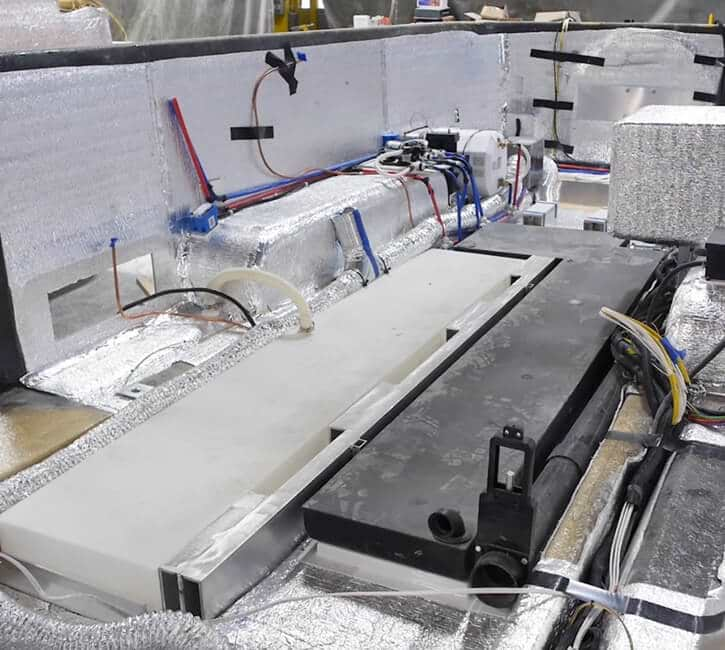
The part that is specific to how an Oliver is built is where the tanks sit. The shell is formed in four molded fiberglass pieces, two inner and two outer, bonded into one structure with insulation and an air gap in the cavity between them. The tanks and plumbing run inside that space rather than hanging below the floor.
That is worth asking about on any trailer you look at, because it is the difference between tanks that sit in conditioned space and tanks that sit outside in the weather. There is more on how the system is set up for cold conditions in our piece on keeping water tanks working through the seasons.
Working out what you actually need
Start from how you camp rather than from a number. Two people on hookups most weekends need very little. Two people parked on a forest service road for a week need a great deal more, and a family of four changes the arithmetic again.
A useful exercise before you order anything: track your water use at home for a couple of days, then halve it for the habits above. That gives you a real daily figure to check any trailer’s capacity against, and it is a far better guide than comparing spec sheets to each other.
Once you have that number, ask us how it maps to the build you are considering. Every Oliver is built to order in Hohenwald, Tennessee, so the people who answer are the ones whose colleagues do the work. Contact us and ask, or request the current spec sheet and check the figures yourself.