John Dorrer
Member+-
Posts
931 -
Joined
-
Last visited
-
Days Won
9
John Dorrer last won the day on March 9
John Dorrer had the most liked content!
My Info
-
Gender or Couple
Couple
My RV or Travel Trailer
-
Do you own an Oliver Travel Trailer, other travel trailer or none?
I own an Oliver Travel Trailer
-
Hull #
1045
-
Year
2022
-
Make
Oliver
-
Model
Legacy Elite II
-
Floor Plan
Twin Bed Floor Plan
Recent Profile Visitors
3,486 profile views
John Dorrer's Achievements

-
Mike Sokol will do his own test and that should be a good comparison with Will Prowse. We shall see.
-
Made in USA leaf springs
John Dorrer replied to Mountainman198's topic in Mechanical & Technical Tips
Thank You. I have time to decide. Our 2022 LE2 has the 5,200 lb. axle. I can do 4-leaf and add the 5th leaf later, or have the 4-5 leafs in the basement when we decide to sell. -
The later Will Prowse videos were done with battery intact
-
Here is the Mike Sokol Battleborn interview with Battleborn. I can't figure out how to make this viewable to everyone. For Facebook members, you can open the post before this one. Mike Sokol interviews Denis Phares from Battle Born Batteries on lithium battery terminal overheating! “I reached out to Dragonfly Energy (Maker of Battle Born Batteries) a few months ago after a number of my readers at RVelectricity.SubStack.com asked me to investigate if there was a design flaw with Battle Born Batteries that could cause them to overheat in their RVs. After a few in-depth conversations with Dragonfly Energy’s Founder and CEO, Dr. Denis Phares, I asked for a written interview. Following are my unedited questions and Battle Born’s answers.” - Mike Sokol Mike Sokol: Exactly who is Dragonfly Energy and when did they start building Battle Born batteries? Denis Phares: Dragonfly Energy is a U.S.-based energy storage technology company headquartered in Reno, Nevada. We design and manufacture lithium iron phosphate battery systems for applications including RV, marine, off-grid, and commercial use. Battle Born Batteries is our flagship brand, focused on deep-cycle lithium batteries and complete power systems for real-world applications. We brought our first deep-cycle LiFePO4 battery products to market in 2014. Mike: How long has this core battery architecture been in use, and what does its track record look like across real-world deployments? Denis: The core battery architecture for the 100Ah models was developed and validated between 2014 and 2017, with the product first reaching market in 2016. Since then, it’s been deployed at large scale across RV, marine, off-grid systems and in commercial applications. That long-term field use, combined with consistently low warranty rates, gives us a clear, data- backed understanding of how the design performs across a wide range of real-world conditions, environments, and installation types. At this point, the performance isn’t theoretical, it’s based on years of observed behavior in the field. The design has also been repeatedly validated through third-party certification testing. This includes achieving the ETL mark by Intertek, where the batteries were tested to UL 2054 standards, among others. The most stringent electrical test requires the battery to survive a short circuit where the primary protection mechanism is faulted. In our case, this amounted to completely bypassing the Battery Management System (BMS). Our 12V 100Ah (BB10012) model in particular is among the most extensively tested and certified deep-cycle LiFePO4 batteries in its class. Taken together, that combination of certification testing and long-term field data provides a consistent and well- understood picture of how the products perform. They perform safely and as designed. Mike: How many Battle Born batteries with this design architecture are currently in the field? Denis: Based on our sales information, there are over 400,000 Battle Born Batteries in the field today across a wide range of models and applications. A significant portion of that installed base is our 12V 100Ah batteries, which are the most widely deployed configuration. That scale spans everything from RV and marine systems to full-time off-grid and commercial use. Mike: Since there’s approximately 400,000 Battle Born batteries in use, have there been any large design changes based on user feedback or returns? Denis: There have been no fundamental changes to the core battery architecture. That consistency is intentional. The design was validated through extensive internal testing and third-party certification, and the long-term field data has remained consistent with those results. Maintaining these certifications requires that any component changes be relisted and revalidated through third-party testing, ensuring continued compliance with the same safety standards. Mike: At a high level, what layers of protection are built into Battle Born lithium batteries, and how do they work together to assure maximum safety? Denis: Battle Born Batteries are designed with multiple layers of protection that work together as a system. At the chemistry level, we use lithium iron phosphate (LiFePO4), which is inherently more stable and resistant to thermal runaway than other lithium chemistries. At the electrical level, the battery management system actively protects against overcharge, over-discharge, overcurrent, short circuit, and temperature extremes. At the mechanical level, the batteries use a flame-retardant enclosure and cylindrical cells, a format known for mechanical durability, efficient heat dissipation, and integrated pressure relief features, along with physical spacing that enables passive thermal management. Each of these layers is independently effective, and together they provide a system designed to prevent conditions from escalating. Mike: Why does that internal fail-safe system exist in your batteries in the first place? Denis: The internal fail-safe exists because of how these batteries are evaluated and used in real-world RV OEM applications. To be used in RV OEM installations, batteries must meet safety expectations aligned with RVIA standards, which rely on certifications like UL 2054. That standard includes the single-fault short-circuit test, where the battery is subjected to a direct short with no electronic protection active and must not produce fire. This testing is repeated across multiple units to ensure consistent results. The battery architecture was designed with that requirement in mind. In addition to the battery management system, the design includes a passive, built-in fail-safe within the positive terminal inside the battery pack. Under normal operation, it conducts power with very low resistance. Under sustained fault conditions, it transitions to a high-resistance state and stops current flow. In practical terms, this creates a defined point where current can be interrupted if conditions become unsafe. That behavior has been validated through both certification testing and long-term field data, where the outcome is consistent: the battery stops delivering power rather than allowing the condition to escalate. Mike: When people notice heat at or near the battery terminals, what’s usually going on electrically—and how is that different from an internal failure in a battery causing the problem itself? Denis: In high-current DC systems like RV and off-grid applications, heat at or near battery terminals is almost always related to resistance in the external electrical system, not an internal battery issue. Common causes include loose connections, improper torque, undersized wiring, or resistance elsewhere in the system such as bus bars, disconnects, or inverter connections. When current flows through a high-resistance point, it generates heat. Heat can also travel along conductors, so it may appear to originate at the battery even when the source is elsewhere in the system. The battery is designed to operate normally under proper installation conditions. If a sustained fault develops, such as prolonged heat at a connection point, the internal fail-safe at the positive terminal responds by increasing resistance and interrupting current. So, in most cases, what people are seeing is not originating within the battery itself, but the battery responding to conditions elsewhere in the system in a controlled way, as designed. Mike: There’s been a number of YouTube videos showing overheating of Battle Born batteries. Is that a normal occurrence with an intact battery, or has disassembling the battery for demonstration videos actually created the overheating condition? Denis: The videos questioning the positive terminal design in our 100Ah battery are technically invalid, and here's exactly why. The positive terminal in a Battle Born 100Ah battery is a sealed, structurally constrained assembly. The brass terminal is epoxy-bonded to the lid, which holds the internal components under fixed compression. That's not incidental to the design, it's central to it. Under a sustained thermal fault condition, the polymer layer softens, reducing contact pressure at the metal interfaces. As that pressure collapses, current concentrates at microscopic contact points, causing rapid localized heating. This accelerates the formation of an insulating aluminum oxide layer, which quickly drives the terminal into a high-resistance state and stops current flow. The battery shuts down. No fire, no escalation. When you remove the lid to film what's happening, you've eliminated the structural constraint the mechanism depends on. The terminal is now free to move. Cable torque drives continuous motion between the contacts, which keeps exposing fresh metal surface at the contacts, preventing the protective oxide from ever completing. The result is sustained arcing that looks alarming on video, but is entirely a product of the disassembly, not how the intact battery behaves. In other words, opening the battery to observe the safety mechanism creates a measurement artifact. An intact battery in the same fault condition shuts down effectively. The data, science, and more than a decade of field use consistently support that. Mike: How many battery terminal overheating complaints have you had at your help desk, and what percentage of your help desk calls are from terminal overheating? Denis: Relying on data from 100Ah batteries evaluated through our warranty process since early 2022, approximately 0.2% of units across the installed base have exhibited elevated resistance at the positive terminal. These cases do not appear to be the result of an internal battery failure. Based on our examination of the returned batteries, they are overwhelmingly associated with external factors such as improper installation, poor connections, or system conditions that create resistance and heat at the connection point. Importantly, these events have not resulted in any outcomes that would indicate a battery safety issue and are typically resolved through straightforward troubleshooting or warranty support. We have also closely monitored support activity following the recent videos. While they prompted increased customer inquiries and inspections, we did not observe any increase in or change in type of warranty claims. Terminal-related inquiries represent a small portion of overall support volume. The majority of help desk interactions are related to system setup, charging, or integration, not battery safety concerns. Mike: Have you separated out any battery terminal overheating failures into DIY and Dealer installations? If so, what are the numbers and percentages? Denis: We do not categorize every case with a formal DIY versus dealer label, but we do analyze warranty data across OEM and non-OEM installations, and the pattern is consistent. In OEM installations, where torque specifications and conductor sizing are standardized, cutoff events are extremely rare. The cases we do observe are overwhelmingly concentrated in non-OEM installations, where factors such as connection quality, loose terminations, undersized cables, or improper torque can introduce resistance at the terminal interface. This is not a generalization about DIY installations. Many are done very well. The consistent observation is that installation quality and system conditions are the primary drivers of these events, rather than an issue within the battery itself. Mike: From an installation perspective, how important are best wiring practices, proper torque of terminations, and correct conductor size compared to internal construction the battery itself? Denis: They are critical. In high-current DC systems, connection quality, proper torque, and correct conductor sizing are just as important as the battery itself. Even a small amount of resistance at a connection point can generate significant heat under load. If connections are loose, undersized, or improperly installed, heat will develop regardless of the battery being used. Mike: Do you train your dealers on best practices for Battle Born battery installations? Denis: Yes. Education has been a core part of our approach from early on, and we provide ongoing training and support to dealers and installers on best practices for system design and battery installation, including wiring, connection methods, and overall system integration. This includes technical documentation, direct support from our U.S.-based team, and formal training programs, including RVTIA Level certification courses. The goal is to provide the support to help ensure installations are done correctly and consistently. Mike: How does Battle Born’s Nevada-based technical support team handle questions about battery design and safety, especially when the issue may involve the broader electrical system? Denis: Our Nevada-based technical support team takes a system-level approach. When customers reach out with questions, we don’t just look at the battery in isolation. We work through the full electrical system, including wiring, connections, charging sources, and loads, to identify where issues may be coming from. That often means helping customers troubleshoot installation-related factors such as connection quality, conductor sizing, or integration with other components in the system. The goal is to provide clear, practical guidance to help ensure the entire system is operating safely and as intended. Mike: How does Battle Born’s technical support team adapt as new questions or concerns trend within the RV and off-grid community over time? Denis: Our technical support team has been doing this for a long time, and they’re not just repeating information. They’re actively problem-solving. We’ve been supporting lithium battery systems in these applications for over a decade, so the team has extensive experience working through a wide range of system behaviors, including more complex or less common configurations. As new questions or trends emerge, the team works directly with customers to identify root causes and practical solutions. Mike: For customers worried about internal battery issues, what can they realistically observe, and what should prompt them to reach out for Battle Born support instead of guessing or watching a YouTube video? Denis: In most cases, customers are not going to observe an internal battery issue directly. What they’re seeing are system-level symptoms. Things like heat at a connection point, intermittent performance, or unexpected behavior are typically related to the broader electrical system, not the battery itself, and are not unique to any one brand but common considerations in any battery-based system. If anything seems abnormal or persistent, such as excessive heat or loss of performance, the best next step is to reach out to our technical support team rather than trying to diagnose it based on assumptions or online videos. Mike: If a customer notices overheating at battery terminals or wiring, intermittent performance such as loss of capacity, or anything that doesn’t seem right in their electrical system, what’s the safest next step and who should they contact?” Denis: If something doesn’t seem right, the safest first step is to stop using the system and disconnect power if it can be done safely. From there, they should contact our technical support team so we can help diagnose the issue and guide next steps. END Mike Sokol from RVelectricity.com and the NoShockZone is an independent electrical safety instructor and consultant working out of his FunkWorks Lab in Funkstown, Maryland where he tests a variety of electrical products and systems for the RV industry. As many of you know, Mike’s been producing electrical safety and use articles for RV consumers and technicians over the last 16 years. Sokol_Bb_Interview_Substack.pdf
-
https://www.facebook.com/share/p/1ABG97SjiK/https://www.facebook.com/share/p/1ABG97SjiK/
-
Made in USA leaf springs
John Dorrer replied to Mountainman198's topic in Mechanical & Technical Tips
I have ordered Alcan Springs and will need to decide whether to install as 5-leaf or 4-leaf. I have a truck service place that will do the work. Their recommendation is to install 4-leaf based on trailer weight. Without going through the entire thread, are there any owners that went Alcan 4-leaf? We don't plan on driving rough gravel roads. That got done pre-Oliver. Our 2022 LE2 has the 5,200 axle. -
Water pump runs continuously after tank sanitization
John Dorrer replied to Sandman's topic in Welcome to the Oliver Forums
Steve Landrum shared his sanitizing several years ago. Instead of changing the valves, add a 1/4 cup of bleach into the hose, connect your quick connect to the hose end and to the fresh water intake. Fill your fresh tank. Run all of the faucets to bring water/bleach through the lines. Empty the fresh tank. Refill and you are ready to go. -
-
Welcome from Hull #1045, Jolli Olli
-
Lithionics large phantom draw
John Dorrer replied to DaveAndBecky_NorthernMI's topic in Mechanical & Technical Tips
Great News -
Lithionics large phantom draw
John Dorrer replied to DaveAndBecky_NorthernMI's topic in Mechanical & Technical Tips
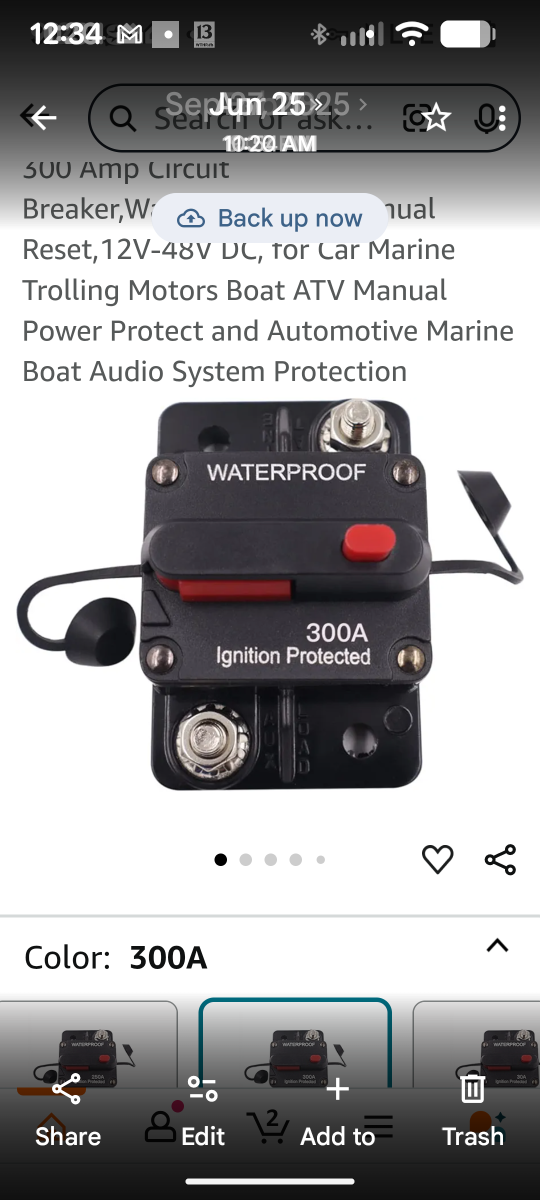
We have a 2022 and when I see something like your situation, my brain goes to "Inverter Breaker". We have the 3 Lithonics batteries and 3000 Xantrex Inverter. We spent the night at Oliver after pick-up and plugged in. The next afternoon we packed up and moved to David Crockett State Park and plugged in. That evening I opened the Lithonics app only to find my batteries down to 73%. Shore power wasn't charging the batteries. I reached out to Oliver and Mike sent me a picture of the breaker. He stayed on the phone and walked me through checking the breaker, which was tripped and resetting the breaker. All was good for 2 months and it happened twice more. Oliver sent me a new breaker. In October 2024 we were boondocking, turned on the inverter to cook oatmeal, and 30 seconds in the microwave shut off. Jason was at the Texas Rally and ran tests. In February 2025, during service, it was determined that the issue was the breaker. Since they were no longer using the breaker and didn't have any, we lived with things until we got home. We were plugged in for the trip, so really was not inconvenienced. I order two new ones. I followed the shut down procedures, solar off, inverter breaker off, then each battery. Start up is reversed. I discovered to my horror that problem was very loose connects, resulting in pitting of the cable ends. Arching was obviously occuring. I replaced the breaker and now will check the connections each fall after our last trip. While your breaker might not be the issue, I would really check it over. Just make sure you completely power down per the sequence mentioned in this post. Good Luck. Please provide an update. During this period we experience a few weird things, which we attributed to the loose connectors. I suggest you send a service ticket request to Oliver so they can provide input. support@olivertraveltrailers.com -
Did you by chance have debris as acorns, broken branches that may have kicked the awning back out. Girard and Oliver say if you run it out and in you need to let it rest so you don't burn up the motor. You far exceeded that warning. There is something hear that just doesn't make sense. I maybe totally wrong, but I think the motor wasn't allowed to cool down and this was self-inflicted. This is solely my opinion.🙃
-
I run our 2022 LE2, between 50 and 55 lbs. on our Cooper Discover HT3, 16" tires. The higher you go the more jaring the ride for the trailer. Prior to 2022, Oliver was sending trailers out the door at 80 lbs. That shook a lot of electrical connections. We run with a full water tank.
-