All Activity
- Today
-
John, Yes, I had already purchased the 50-amp Orion and have it mounted, although I haven't run any of the wiring yet. I also purchased the Mobile Solar fan because my installation requires the charger to be mounted horizontally. Had the 70-amp Orion been available before I made those purchases, I likely would have gone that route. At this point, however, I'm committed to the 50-amp setup. If the Orion 50 ever fails, I would probably replace it with the 70-amp version. I am curious how many changes Victron actually made between the 50-amp and 70-amp models. From the outside, it appears that much of the increase may come from the addition of active cooling and perhaps some upgraded output-stage components.
-
Yes, I agree. These wire reducers, shown below, may be a little too large to fit, but I'm going to give them a try. If they work, they should eliminate the additional connections and potential failure points you mentioned, which would make for a simpler and more reliable installation.

-
And I agree with everything you wrote in these posts. ”The tables” re voltage drop and real world measurements are showing the tables are (engineered on purpose) to be conservative. Maybe you already purchased the Orion 50 and if so perhaps it could be returned. I believe with 1/0 wire installed you can exceed 50A. I’m in the 40s in the Orion 50A with only 4 AWG and the Orion 70A could be getting over 60A. At the same time, I truly understand if you’re about done with sourcing parts, the hardest, longest part of any DIY effort!😎
-
Oh, my mistake, I thought I had read that and trying to confirm and found I not to be true. Sorry for that misinformation. The Anderson SB175 can be used with 1/0, 1, 2, 4, or 6 gauge wire. It does fit the hand better and I added the handle kit.
-
I appreciate the explanation of the potential issues that can arise when using the 7-pin tow harness to trigger the Orion. Those are important considerations and something I have spent a fair amount of time thinking about. My plan is to use the 7-pin connection as a redundant method to ensure the Orion is powered down when the vehicle is not running. At the same time, I intend to configure the Orion's voltage-sensing parameters as if no external ON/OFF control were present. That way, the charger should still operate properly based on voltage conditions, while the 7-pin trigger provides an additional layer of assurance that it remains off when the tow vehicle is shut down.
-

Curosity concerning Truma water heater straps
Ollie-Haus replied to FloraFauna's topic in Mechanical & Technical Tips
I’ll send a pm regarding my fix. -
Wow, I did not know about the Door Closed condition! I like it. Also good to know when you are sitting there in the front seat looking at the numbers and not seeing any current and wondering WHY??????? The lugs inside the housing of the SB175 can also support smaller cables.... such as our #4 AWG wires. The contact point of all the various lug sizes listed is the same. I like having oversize contact points so went with the larger SB175's contacts with the smaller #4 lugs. Besides the SB175 fits my hands better! GJ
-

Curosity concerning Truma water heater straps
Geronimo John replied to FloraFauna's topic in Mechanical & Technical Tips
The further back something is from the tongue, the rougher the ride is back there. An unknowing driver's rear utilities on a washboard road can easily see 2 to 5 G's of verticle acceleration back there. Which makes JD's statement that the wrong material used is on point. I add to that that it was not properly engineered. Hence care is needed in engineering a solution. Hence the need for OTT's involvement. The trailer axles and springs can help or hurt this issue. Stiffer suspensions genarally makes payload shocks worse. The exception is when the frame and axle slam together from having too soft a suspension. Compliant suspensons help things a bit. Having a heater hard mounted generally hurts. Allowing it the ability to float a litte ... is good.... so long as all the attachments (such as controls, water and gas lines) are engineered to accomodate such movement as well. Think about a wash board with bumps every 6" and 5 miles long. That's generation over 10,000 fatique cycles every time you pass on it. This is why so many people have trailer issues going to Alaska.... Bottom line is that the way your Truma's were secured was not up to the job. And that's a real problem. How big a one is TBD. How many trailers have this very same issue and don't have a clue about? I for one have never checked my Suburban hot water heater's attachment. Dittofor the 3,000 watt Renogy, the furnace, and everything else hidden below decks. Can I move the vertically? If so, how much? What's attached to that item and does it have the ability to flex enough not to become damaged. When doing so, I will pay a LOT of attention to anything with a gas connection first. Hence my "Safety John" approach to this topic. GJ -

Curosity concerning Truma water heater straps
jd1923 replied to FloraFauna's topic in Mechanical & Technical Tips
Depends on what you have to work with, how far you can reach under and around it. I’d like it bolted down sitting on rubber bushings vs floating with only a pipe strap keeping it from bouncing down the highway! What a LAZY installation! An on-demand heater doesn’t have the 6 gallons/50 LBS additional weight so they figured, “let’s just hang it.” And “Figured” is a polite word for lack of installation procedure. Shows the state of “professional installations” in the trades today! 🤣 I'm pretty sure our water heater is sitting on the floor. It’s wrapped in a foam casing, so it’s hard to tell. i understand what GJ is stating, but I’ve never received a company email re a safety warning in 3 years except the one time when they mounted a Bulldog receiver not 7K rated on one hull (was Bulldog’s fault for mis labeling their product). They’re not going to give you repair advice. You got this! 😎 -
John, I completely agree with what you're saying, and I've given this a great deal of thought. The one area where I might differ is on the voltage drop. The tables I'm using show a voltage drop closer to 1.23 volts on an 80-foot round-trip run of 4 gauge wire. That said, the Victron manual specifies an input voltage range of 9-17 volts, meaning the charger can still produce a charging voltage for the trailer batteries even with an input as low as 9 volts. The manual also lists a maximum cable cross-section of 4 AWG, which I assume is more of a terminal-size limitation than a recommendation for optimal system efficiency. I also place value on real-world experience. The eXplorist.life videos, which I find very informative, indicate that 4 AWG works well in about 95% of their installations (I believe they do a lot of camper vans etc). Your setup is another good example of 4 AWG performing successfully, even at or near the charger's maximum output rating. You're also absolutely right about cable cost. Good grief, I paid nearly $5 per foot for 4/0 cable the other day. So why am I using 1/0 cable? Partly because I grew up on a farm where the philosophy was, "If four nails will hold it, use five screws." More seriously, it's about efficiency. Output wattage cannot exceed input wattage minus conversion losses, and those losses include the voltage drop across the cables and connectors. Larger conductors reduce voltage drop, reduce losses, and allow the charger to operate more efficiently. That said, if I already had 4 AWG cable installed with a 30-amp charger and wanted to upgrade to the 50-amp version, I probably wouldn't replace the cable. The performance gain wouldn't justify the additional cost and effort in most cases.
-
Great, that has to be a good feeling. Glad the problem is solved. John, My perspective is still shaped by the 18 years I owned a Bigfoot RB21. Even with a solid solar setup and a healthy battery bank, I never had enough capacity to completely ignore phantom loads and stop keeping an eye on power consumption. With the new system, that should no longer be a concern. That said, I decided to control it using pin 4 of the 7-pin connector. Based on what I've read in the owner's manual for my 2019 Ford F-150, that approach should work well. It will also power the unit down automatically when appropriate, and startup should be automatic once the tow vehicle detects a trailer and the required conditions are met, such as the driver's door being closed. I'll share more details once I've completed the installation and had a chance to test everything in real-world use. I appreciate your report on temperature. I will mount mine on the fan produced by Mobil Solar consulting because I need to mount it horizontal. I also plan on putting all of my isolation breakers, cutoff switches and misc. switches under the dinette. The Anderson SB175 supports cable contacts up to 1/0 AWG, while the SB120 is limited to contacts for up to 2 AWG cable, according to the Powerwerx specifications. Since I am running 1/0 cable, I ordered the SB175 along with the matching 1/0 cable contacts. I completely agree with this sound advice. Thank you for taking the time to outline the pros and cons of the different approaches. Those considerations are important and will help others determine which option best fits their particular setup and needs. Each tow vehicle will be different. I will soon test my F-150 to determine if what I read is correct and post the results.
-

GM trailering package - integrated rear camera
Snackchaser replied to BackofBeyond's topic in Towing an Oliver
I have the RAM version, it turns on when hooked up for towing. It's like the trailer isn't there. Resolution is fantastic and it was well worth the upgrade. I ran the camera cable along the outside trailer frame with ti-wraps, and mounted the camera on top of the spare tire cowling. It's the perfect hight. I actually like running wires inside the trailer, but I think cutting penetrations in and out of the trailer is completely unnecessary for the camera. Mines been there about 4 years and it'd never faltered. I like it so much, if I ever got a different truck i'd be looking at the Wolfbox mirrors. -

Curosity concerning Truma water heater straps
FloraFauna replied to FloraFauna's topic in Mechanical & Technical Tips
Were you able to do this without removing or loosening the furnace (in the bottom of my photo and allowing very little clearance around the one side of the strap)?? -
Curosity concerning Truma water heater straps
FloraFauna replied to FloraFauna's topic in Mechanical & Technical Tips
Yeah I think so too which is why I posted. I am debating in my head whether locking it down to the bottom with angles in the corners as you suggest OR would it be better to have a slight flexibility? I am concerned the strapping was stressed to the extent of two symmetrical fractures - that's kind of weird. I have to look closer but yes perhaps it is only being held by the face plate now and the plumbing (not good). I am going to wait to talk to OTT service before pursuing a fix. -
Curosity concerning Truma water heater straps
FloraFauna replied to FloraFauna's topic in Mechanical & Technical Tips
Will do so on Sunday. I assume over the weekend no one will see it. Your worst case fear is not unreasonable. But I have concerns now about how much movement was happening even when the banding intact. Obviously one doesnt want the unit bouncing around relative to the plumbing both gas and water but some of that is probably happening anyway. So how best to dampen out and restrict movement. I think the strap fatigued from repeated vibration suggesting things are bouncing around there. Just fyi, i am a pretty slow driver with no recollection of single severe jolts. - Yesterday
-
Sometimes "air sucks"....... GJ
-
Curosity concerning Truma water heater straps
Geronimo John replied to FloraFauna's topic in Mechanical & Technical Tips
FloraFauna, Ollie-Haus, and Steve: PLEASE today take the time to send OTT a safety ticket on this topic. I have alerted Jason E off line. But the system should be documented with your inputs and how you chose to fix your discovery. My second worst fear is that other owners who do not read this forum will not know about this hazard. To them, the only way they may become aware is if an OTT Tiger Safety Team gets the word out. Your personal input is needed for that. My WORST case fear is that a Truma trailer with this banding gets a cracked gas line and over time leaks enough gas for the interior to reach into the explosive range of concentration. There are several possible ignition sources (I.E. some switches, Dometic three-way, or the gas heater) that could start a rapid disassembly event... with them inside. Please share your experience with OTT via a ticket. Thanks GJ -
Third-Party Maintenance Facilities
Geronimo John replied to MDuncan's topic in Mechanical & Technical Tips
Totally agree. By the good will of OTT we have this forum. And with the goodness of heart of so many OTT Owners willing to take the time to share their expertise and to guide and help others we are blessed. We all at some point were newer and less savey about the technical side of trailers. If you are stumped, just "Roger Up" and reach out to this forum. Just beware of the rabbit holes! 🙂 LOL GJ -

GM trailering package - integrated rear camera
tallmandan replied to BackofBeyond's topic in Towing an Oliver
Here is a link to my post on the GM trailer camera install when I had a 2021 Silverado. The GM wired camera is excellent and once set-up, the active guidelines are very helpful in backing the trailer. I replaced my Silverado with a 2026 Tundra Hybrid that had the factory installed option of wireless trailer camera. It’s nowhere near as good as the GM camera system. -
For sure. But then if we had not disconnect that direct link between our Litho's (when we installed them) at best we would have blown its fuse in the TV. Or worse. But a good reminder to disconnect that wire as GalwayGal (I think) mentioned this long ago. Always good to keep Top of Mind the requirement to disconnect the TV charge wire (Usually AWG 12 or smaller) from the TV OEM line. Originally, the OEM "Charging Wire" to the 7-Pin Connector was to keep the trailer emergency brake battery "somewhat" charged. Back then they were TV LA to Trailer LA batteries. The two batteries would equalize while driving. With a brakeaway, a ten year totally neglected near dead trailer battery likely would have had enough charge in it to sent 6 or 12 amps (Single axle/Double axle) for the ten seconds or so to lock up the trailer wheels and get the trailer stopped or at least slowed down. For most modern RV's, the onboard batteries provide the power for a breakaway event. And for those trailer with LA, the wire still is a good feature. Hence it is still provided by the TV OEM's. But as soon as Litho's in the trailer are involved that line needs to be disabled from the Litho's. For reuse in this creative approach, your cautions are very much on target!
-
I went with 4 AWG for cost reasons and the fact the Orion 50 terminals take 4 AWG max. I spent $95 for 65 ft. Today this costs $145. Also today 85 ft of 1/0 costs $354! https://www.amazon.com/TEMCo-WC0180-50-Welding-Battery-Copper/dp/B00LIB4JP2/?th=1 These prices are generally even higher from other suppliers. I understand the EE calculations for a 50A load and wire gauge and length considerations. And I truly understand how important this can be in residential, commercial and industrial installations. Voltage drop can be an issue with electronics and some discerning appliances but honestly isn't it a lesser consideration for a battery charger? These DC-DC chargers can accept input voltage from 9V to 17V. Does it truly matter that an alternator producing 13.8V at the low end (13.8-14.2V is our range) with a 0.5V voltage drop, still delivering 42A at 13.3V? You lose potential but your not hurting anything given the drop is not causing excessive heat in the charger and wiring. If you're going to spend $200 more in wire gauge, I strongly suggest you spend ONLY another $67 to upgrade to the Orion XS 70A. With 1/0 wire, after you leave the EE calculations and worries to the side, you'll find in application you'll likely get 60A from the Orion XS 70A. You can always limit the Input Current to any value on any Orion charger model. https://invertersrus.com/product/ori121221040/ It also has built-in cooling fans for the little extra money, but our 50A barely gets warm at all running on under-sized wire, go figure! 😎 Geoff mentioned this first re the Orion terminals and here re the Andersens. Yes, both are 4 AWG. In the Andersen SB175 lug designed for 4 AWG, the opening is actually a little larger, but the Orion has a tight fit with 4 AWG. Instead of adding pigtail cables, wouldn't it be a simpler the strip the 1/0 wire and then trim the copper strands down in size to fit the terminals? The pigtails adds more cost, more resistance in connections and additional points of failure. I imagine trimming the wire size would not be "to code" but it's the way I would do it for simplicity. Heat shrink the Andersen poles as I showed above and certainly buy the "environmental boots" (also pictured above). You need two parts, both Source and Load side boots https://powerwerx.com/anderson-36036p1-sb175-environmental-boot-source https://powerwerx.com/anderson-36037p1-sb175-environmental-boot-load
-

GM trailering package - integrated rear camera
Randy R replied to BackofBeyond's topic in Towing an Oliver
We had started using it 3 weeks ago . We ran it under the trailer to the back to the spare tire attached it to a piece of rubber we had .bolted it to the spare for now until we can get with the service dept and see if they could run the wiring on the inside . We have an Apex x23 so the tire is exposed. HULL 1742 -
Curosity concerning Truma water heater straps
jd1923 replied to FloraFauna's topic in Mechanical & Technical Tips
OTT certainly used the wrong material. Is the Truma heater currently hanging by the faceplate only? Better materials must be used for this application. This strapping material is for hanging pipe without a strength rating at only 28-gauge. Don't buy this stuff: https://www.homedepot.com/p/Oatey-3-4-in-x-25-ft-28-Gauge-Galvanized-Pipe-Hanger-Strap-33530/301505501 Go with Simpson Strong-Ties made in the USA. You could mount two hard corners with straights or use their Coiled Strap. This item is 16ga and should be extremely strong. I have a coil of their lighter 22ga. I doubled the ends at mount points and used it to strap our inverter against the basement wall. The 22ga might be strong enough for this case but I promise the 16ga will be harder to bend but would never fail. They have an array of thicknesses, chose from 12, 14, 16, 18, 20, 22 gauges. The lightest 22ga is thicker, wider and stronger than what OTT installed. Buy this instead: https://www.homedepot.com/p/Simpson-Strong-Tie-CS-25-ft-16-Gauge-Galvanized-Coiled-Strap-CS16-R/100375320 -
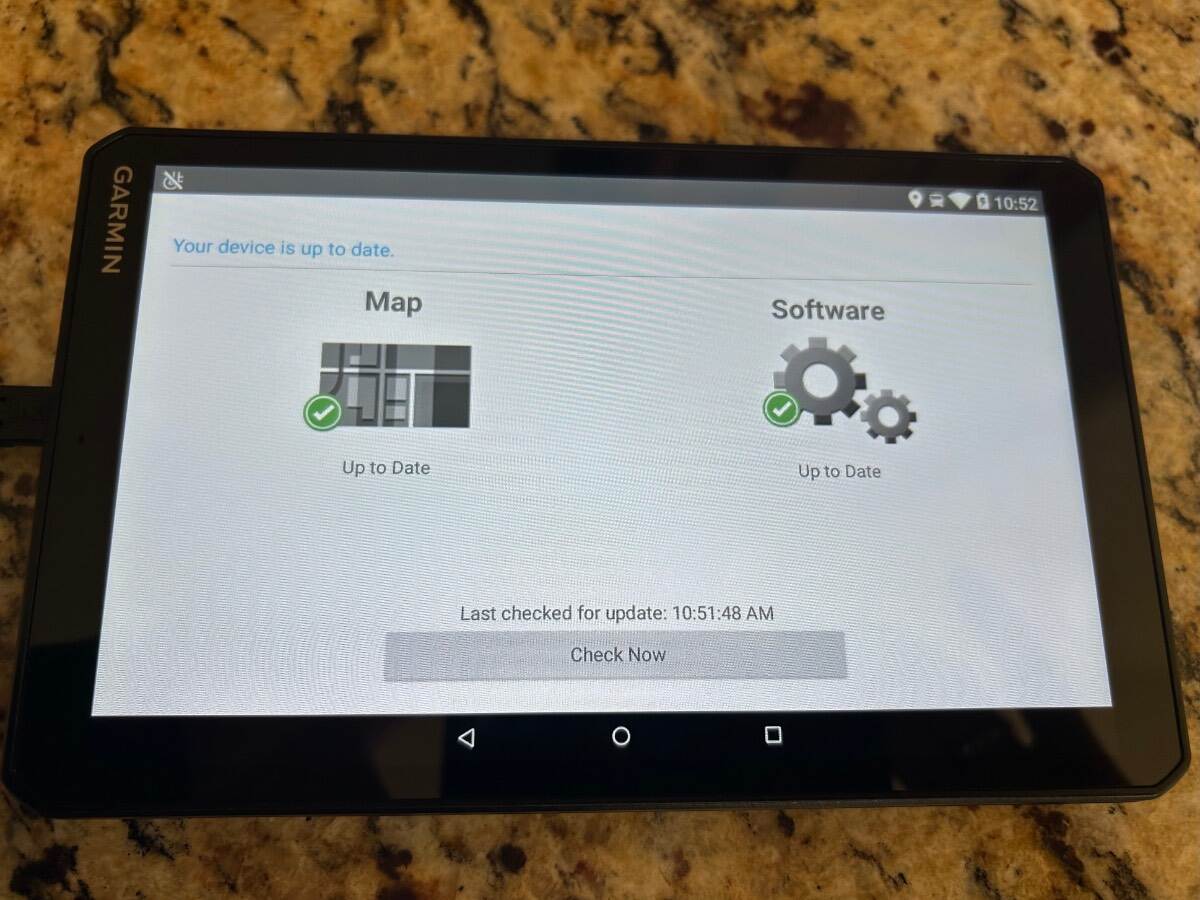
Just updated our Garmin 890 RV…and we are good to go! Thanks for the reminder @topgun2 and @rideandfly.
-
My suggestion of using the 12 V wire from the 7-pin tow harness to trigger the Orion through its L input is gaining traction. But it was only meant as a last resort if changes to the Orion’s settings didn’t correct the problem. The preferred method is still automatic detection, and it will work best for most installations. However, if you choose to go down that road, I’ll re-caution that the wire needs careful testing first. The tow harness 7-pin 12 V wire must be disconnected from the trailer battery, or the battery will back-feed it and hold the Orion on. The wire must be hot only with the engine running, not with the key off, and not with the key on and the engine off, or it can quickly drain the tow vehicle’s battery. Also be aware that some vehicles reportedly only energize it when they detect a trailer or a load, and the Orion would be invisible because the input draws almost nothing. Just be aware that the 12 V tow wire can behave differently across truck brands, models, and years. If you still want to go that route, then a cleaner option is a separate connector fed from a true engine-running source, such as an oil-pressure switch, an up-fitter engine-on output, or a CAN interface module programmed on engine RPM. Consider using Anderson’s SBSX-75A sealed connectors. They connect the power cables and up to 6 additional wires. They have a waterproof rating, handle up to 140 amps, and they are designed for 5,000 mating cycles. The new SBSX Pro model was robustly designed for electric riding mowers with battery monitoring. It has a clean looking panel mounting and 8 aux contacts. In my case, the 12 V wire is already in use for automatic rear camera switching, and I’ve been noodling a project to use the SBSX PRO to wire a BMS display head in the truck using the Anderson contacts for an RJ12 connection. That still leaves extra contacts for creative ideas such as a in truck - trailer air conditioning control. Let's see how fast this idea catches on! Oh, the Anderson connectors only accept up to #4 wire, so a short pigtail might be needed to connect heavier cable. This only adds negligible voltage drop. Either way, it’s worth careful thought before going down the road of tow-wire signaling over the preferred automatic engine on detection. Hope this helps for better informed decision making. Cheers! Geoff