
jd1923
-
Posts
3,898 -
Joined
-
Last visited
-
Days Won
316
12 Followers









Recent Profile Visitors
4,291 profile views




jd1923's Achievements


-
Mike, I'm guessing you mean no power to the CO monitor only and other things like the cabin lighting works. You likely blew the fuse when cutting the wires. I've done that too often where I should just locate and remove the fuse first! So, our hulls 5 years apart are going to be different. Look at the wiring below the CO monitor inside the front of the rear dinette seat and there should be an inline fuse there. If not, follow the wiring if you can and an inline fuse may be at the other end of the wire at a positive bus. Yeah, it will be a thin inline fuse holder for the light 1A fuse. Look at the +bus where you'll see 3 big yellow inline fuses for the jacks. See if there may be 1-2 other fuses attached there, but my first look would be below the CO monitor.
-
Yes, DC-DC charging is the best electrical upgrade we have made, period! We use it, connect the cables every time we tow. For those of us who travel in a series of short stays (average 1-3 overnights) you'll never need to plug-in again (given 600+ Ah lithium). We spent about the same money on our DC-DC charging system that we spent in adding a 400W suitcase solar system. We've used extra solar rarely, on the rare occasions when we stay in one place longer than 3 days. The DC-DC charger is a better investment than additional solar. BTW, my issue here was in my failure to configure the engine shutdown detection voltage parameters. Geoff pointed me to the issue. The YouTube video I posted above got me to fully understand the settings. I reconfigured voltage settings in a minute and we're back to getting 40+A. That's +40 Ah added to battery SOC for every hour on the road.
-
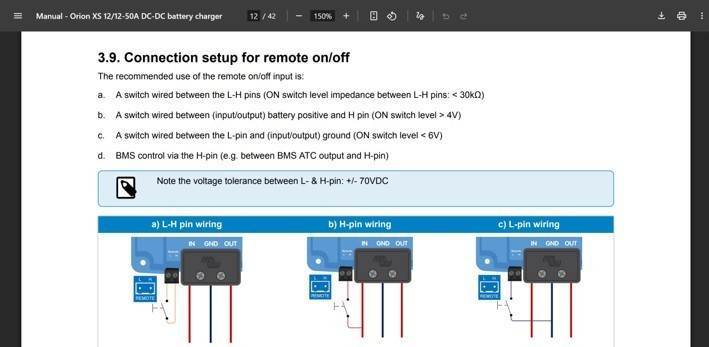
Go to the source. Screenprint from the Orion 50A manual (check your 30A manual). Most of us use engine shutdown detection feature vs. this hardwire switch.

-
 It would only be worth it for those who pay for Roam Unlimited 12 months a year (then monthly plans are likely the same as the original Mini). This service bundle could be of interest to new full-timers who travel regularly where cell service is limited. We pay the $10/mo Standby Plan 6 months a year and then only what we need when we travel. When you have a viable cell router and antenna you need Starlink much less often. The 5G cell SIM card adds $30/mo to our cell plan which is much less per Gb than Starlink. Regardless, we would not travel without Starlink for when we need it. For those still holding out, now's the time to get the original Mini before this becomes the only available option! The Mini keeps getting cheaper too, now only $149 ($12.41/mo for 12 months). Are they advertising any better performance in their new product? It boots faster and has a built-in quick swap battery (after you buy an extra), and having an extra is truly a must unless you want to be offline every time it needs charging. We have 2 external batteries and plug-in options and when you swap a battery, of course the Mini reboots. If the Mini 2 has hot-swappable batteries, that would be cool!
-
Yes, but we have both. Our 2016 hull has Scandvik in the wet bath. I started the thread below asking about replacement parts last year. Our outdoor shower is an ITC part. I purchased the entire assembly recently since the plastic housing was cracked and for the price buying individual parts made less sense to me. This part is identical to the shower assembly I removed: https://itcshopnow.com/products/exterior-shower ITC also sells the Oliver Porch Lights. I purchased one to install a new rear light and a couple extras. When one light fails, I'll install the two new ones on the curbside. https://itcshopnow.com/products/assurance-exterior-flood-light?variant=50392962007319
-
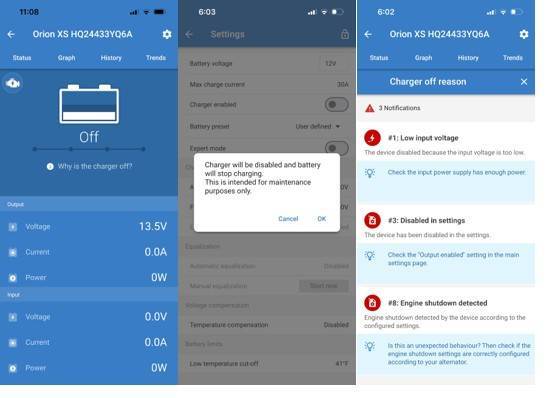
The screen below shows the Orion DC-DC charger is OFF (left frame). When you click on the message, "Why is the charger off?" you get 3 reasons. In the setup, I clicked the app toggle Charger enabled to OFF, the option Geoff had mentioned which is given in see reason #3. Notice the warning message when using the app switch to disable charging (middle frame). As soon as the TV ignition key is turned OFF reason #8 will appear since the engine detection will immediately show <12.9V (configurable). A sitting lead acid starter battery in good condition should read about 12.6V. Reason #1 is Low Input Voltage which occurs as soon as you physically disconnect the DC-DC cables at the Andersen terminal at the bumper. You can see that looking at the first screen where it shows 13.5V on house batteries and 0.0V on the starter battery since it is disconnected. A 4th method to turn off the Orion, e.g. for servicing the system is the 60A breaker connecting the charger output to the +bus. 😎
-
Two things... Be certain as to where it is leaking. Is the water coming out from the threads to the hose? If so, what @Ollie-Haus wrote is likely the simple reason. And given the threads are crossed could be a reason why it's on so tight. Many of us have had a similar leak but not from the hose threads. Instead it leaked in the plastic molding to which the hose connects. Run more water while looking to be sure of the specific location of the leak. If it is cracked above the hose connection you will need a new assembly: https://itcshopnow.com/products/exterior-shower Either way you can pull the shower assembly out from the hull. When standing outside disconnecting these hose(s) a simple task vs. hunched over the basement with one hand in there. This link should take you to where I installed a new shower assembly. Notice there is ample slack to work these connections from the outside. Remove the 4 screws and some caulk.
-
Yeah, I believe you chose the right place that a custom mattress is a Mod!. I've read several positive comments on our Forum re this brand mattress. They came with when we purchased our Oliver used 3 years ago. Therefore, I do not know the full history, how old they were at the time. Whether there were choices for firmness. If new when the hull was born would make them 7 years old at the time. They were WAY too soft for me. My wife was OK with them. At my 6'2" height with 220+ LBS, I felt like I would sink into the foam, it would limit my movement and it got hot. We replaced ours after only a few nights use. We went with Brooklyn Beddings at RVmattress.com and purchased a 30x75" Dearfoam Essential which I believe is comparable to the CopperFlex Essential today. This product became a little too firm even though we went with the 12" height advertised as medium firmness (but too tall if you like to sit on them). It's impossible know firmness when you are ordering online. We opened a corner on each, measured and trimmed a radius using an insulation knife. Tacked the corners back together and the mattress cover holds it all nicely together. I'm happier with a mattress a little firm which let's me sit up to watch TV. Too soft made me struggle with the bedding and was difficult getting in and out of those little 30" mattresses. Just my take, some feedback for your decision.
-
After some on-the-road use, you'll find that all that matters in a DC-DC charger is that it turns on to BULK charge and gives you 40 to 50Ah for every hour towing. Absorption and float are final charging modes used to bring SOC up to 100%. BTW, this was a lot more important for LA batteries vs. LiFePO4. Our solar charger will bring SOC up to 100% when parked at home. When traveling we are most often between 50% to 80% SOC, so the Orion is almost always in bulk charging mode when towing. My goal is tow a half day and add 200 Ah to battery SOC for when we get to our next campsite! 😎
-
Has anybody gotten a reply from OTT @Aaron Wolters after emailing a picture?
-
Curosity concerning Truma water heater straps
jd1923 replied to FloraFauna's topic in Mechanical & Technical Tips
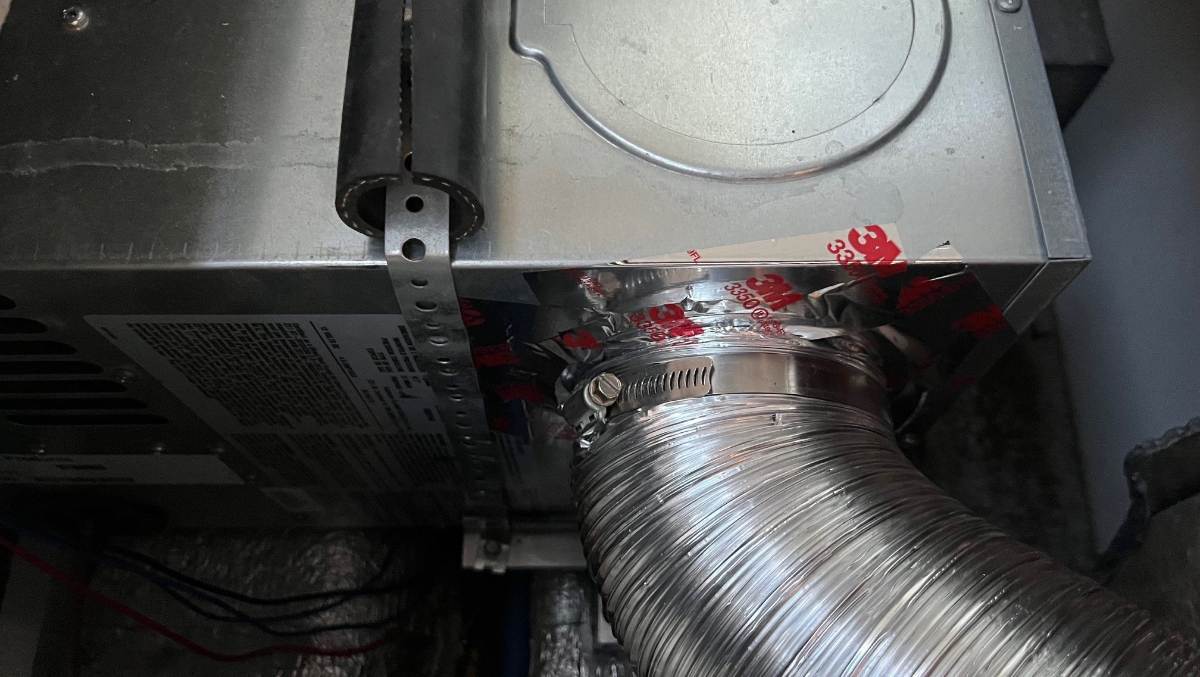
Our Suburban 6-gal HWH has a foam insulated casing and does not have hold-down straps. I'm uncertain in how it is secured besides the many screws holding the exterior plate, and the water and LP lines and electric. Our Suburban furnace was replaced by OTT in 2020 with an Atwood model. First owner brought it in during 2018 complaining about excessive noise. When they didn't fix the noise, he brought it back in 2020, the service ticket ordered the replacement furnace. I remembered this picture I had. It shows the furnace with the same kind of strapping holding it down to the platform below. The strapping was always a little loose and I put the section of heater hose on it years ago to add some cushion.
-
And I agree with everything you wrote in these posts. ”The tables” re voltage drop and real world measurements are showing the tables are (engineered on purpose) to be conservative. Maybe you already purchased the Orion 50 and if so perhaps it could be returned. I believe with 1/0 wire installed you can exceed 50A. I’m in the 40s in the Orion 50A with only 4 AWG and the Orion 70A could be getting over 60A. At the same time, I truly understand if you’re about done with sourcing parts, the hardest, longest part of any DIY effort!😎
-
Curosity concerning Truma water heater straps
jd1923 replied to FloraFauna's topic in Mechanical & Technical Tips
Depends on what you have to work with, how far you can reach under and around it. I’d like it bolted down sitting on rubber bushings vs floating with only a pipe strap keeping it from bouncing down the highway! What a LAZY installation! An on-demand heater doesn’t have the 6 gallons/50 LBS additional weight so they figured, “let’s just hang it.” And “Figured” is a polite word for lack of installation procedure. Shows the state of “professional installations” in the trades today! 🤣 I'm pretty sure our water heater is sitting on the floor. It’s wrapped in a foam casing, so it’s hard to tell. i understand what GJ is stating, but I’ve never received a company email re a safety warning in 3 years except the one time when they mounted a Bulldog receiver not 7K rated on one hull (was Bulldog’s fault for mis labeling their product). They’re not going to give you repair advice. You got this! 😎 -
I went with 4 AWG for cost reasons and the fact the Orion 50 terminals take 4 AWG max. I spent $95 for 65 ft. Today this costs $145. Also today 85 ft of 1/0 costs $354! https://www.amazon.com/TEMCo-WC0180-50-Welding-Battery-Copper/dp/B00LIB4JP2/?th=1 These prices are generally even higher from other suppliers. I understand the EE calculations for a 50A load and wire gauge and length considerations. And I truly understand how important this can be in residential, commercial and industrial installations. Voltage drop can be an issue with electronics and some discerning appliances but honestly isn't it a lesser consideration for a battery charger? These DC-DC chargers can accept input voltage from 9V to 17V. Does it truly matter that an alternator producing 13.8V at the low end (13.8-14.2V is our range) with a 0.5V voltage drop, still delivering 42A at 13.3V? You lose potential but your not hurting anything given the drop is not causing excessive heat in the charger and wiring. If you're going to spend $200 more in wire gauge, I strongly suggest you spend ONLY another $67 to upgrade to the Orion XS 70A. With 1/0 wire, after you leave the EE calculations and worries to the side, you'll find in application you'll likely get 60A from the Orion XS 70A. You can always limit the Input Current to any value on any Orion charger model. https://invertersrus.com/product/ori121221040/ It also has built-in cooling fans for the little extra money, but our 50A barely gets warm at all running on under-sized wire, go figure! 😎 Geoff mentioned this first re the Orion terminals and here re the Andersens. Yes, both are 4 AWG. In the Andersen SB175 lug designed for 4 AWG, the opening is actually a little larger, but the Orion has a tight fit with 4 AWG. Instead of adding pigtail cables, wouldn't it be a simpler the strip the 1/0 wire and then trim the copper strands down in size to fit the terminals? The pigtails adds more cost, more resistance in connections and additional points of failure. I imagine trimming the wire size would not be "to code" but it's the way I would do it for simplicity. Heat shrink the Andersen poles as I showed above and certainly buy the "environmental boots" (also pictured above). You need two parts, both Source and Load side boots https://powerwerx.com/anderson-36036p1-sb175-environmental-boot-source https://powerwerx.com/anderson-36037p1-sb175-environmental-boot-load
-
Curosity concerning Truma water heater straps
jd1923 replied to FloraFauna's topic in Mechanical & Technical Tips
OTT certainly used the wrong material. Is the Truma heater currently hanging by the faceplate only? Better materials must be used for this application. This strapping material is for hanging pipe without a strength rating at only 28-gauge. Don't buy this stuff: https://www.homedepot.com/p/Oatey-3-4-in-x-25-ft-28-Gauge-Galvanized-Pipe-Hanger-Strap-33530/301505501 Go with Simpson Strong-Ties made in the USA. You could mount two hard corners with straights or use their Coiled Strap. This item is 16ga and should be extremely strong. I have a coil of their lighter 22ga. I doubled the ends at mount points and used it to strap our inverter against the basement wall. The 22ga might be strong enough for this case but I promise the 16ga will be harder to bend but would never fail. They have an array of thicknesses, chose from 12, 14, 16, 18, 20, 22 gauges. The lightest 22ga is thicker, wider and stronger than what OTT installed. Buy this instead: https://www.homedepot.com/p/Simpson-Strong-Tie-CS-25-ft-16-Gauge-Galvanized-Coiled-Strap-CS16-R/100375320