All Activity
- Today
-
That's the one you want. Lay it out in the sun on a summer day and it will uncoil just fine. Clean the area just above the window with iso alcohol and let it dry before install. When you put it on be precise because that's where it will stay. When I installed I found that there was a window that I had to use two pieces on because of the length of the roll. (25' I think) You might want to measure and buy more to avoid that. Cannot recommend thus enough. Good Luck.
-
There are two types of generator transfer switches, ones that break the hot wire only, and ones that break both hot and neutral. If a hot wire only switch is used, then the generator must have a floating neutral or there will be dual bond condition as @CRM mentioned. Conversely, a double pole switch needs a bonded generator or the bond is lost. This is why some generators come with a bonded or not option. It’s difficult to explain why neutral-to-ground bonding works, but I try in the simplest terms with plausible scenarios. If a hot or neutral wire becomes shorted to a conducting element of the trailer, such as the skin or frame, then a person touching the frame could create a current path to earth and get shocked. However, the ground wire is bonded to the trailer frame — so with a normal properly bonded power supply, a fault to the frame would result in a direct short that would trip the breaker. If using a power pack such as the Bluetti, then there is no path to earth and such a fault would energize the frame. There is no current path to trip the breaker. You could touch the frame and create a shocking path to earth. This is where a bonding plug comes into play. With it installed, a hot-to-frame fault becomes a direct short back to the source's neutral — this collapses the frame's voltage to near zero and may trip the breaker outright. Either way, the frame is no longer dangerous to touch. I hope this helps explain a very complex, but interesting, subject! Cheers! Geoff
-
Thanks Scotty! I found their website and I ordered a FREE Sample Kit. Then found it on Amazon (links below). I'm wonder, what products have others used? I remember our friend @rich.dev ordered one product that would not straighten from a circular role, so wavy it was unusable. Prior owner of our hull installed a drip rail on the entire curbside up near the awning. We get no streaks on this side but a lot of streaks from frost melting or morning dew, condensate dripping on the other side. Request a Sample Kit | Trim-Lok Amazon.com: Trim-Lok Drip Rail, White – 1/2” Height, 25’ Length – PVC Plastic Rain Gutter for Cars, Vans, and RVs, Easy to Install Flexible Drip Rail Molding to Control Water Runoff, Durable 3M Tape Included : Automotive
-
To make sure that if the generator is connected to a residential service that will always be code complainant. You can't have more than one neutral/ground bond in a system, and since a residential main panel is already bonded you would be violating code and creating a possible hazardous condition. Edit- I shouldn't have said "always be code compliant" since there are ways to connect a generator to a residential system that will violate code even if you use a floating neutral generator.
-
Ok, I think I got that, thanks. So why are so many generators built with floating grounds?
-
Yes, using a bonding plug makes it safer by providing a low resistance path back to the generator to trip the breaker in the generator if a short to the metal case of an appliance inside the RV or the generator itself occurs. When it comes to the ground rod system in a residential system, it is there for voltage stabilization and surge dissipation, not to trip breakers. In fact, if the neutral and grounding electrode system are not bonded in the service panel you could connect a hot conductor straight to the ground rod and it will not trip the breaker. You need the bonding in the panel to provide a path back to the transformer for that to happen. You get that path when the ground and neutral are bonded in the service panel, completing the circuit back to the utility transformer's neutral point.
-
For the electrical engineers out there: does using a bonding plug on a generator with a floating ground actually do anything to improve safety? There's still no actual connection to earth ground. I always thought of a household ground as a way for stray current to be shunted safely to earth ground rather than finding a path through a person. Why are earth ground and neutral tied together at a household panel? What good is bonding them together without an earth ground?
- Yesterday
-
I got a little zap off our aluminum skinned trailer when it had an open ground once. Didn't hurt me, but definitely got my attention.
-
One of the first "mods" I did to hull #145 was to install 3M trim lock drip rails. We've owned the trailer for 10 years now and although we have been fortunate to be able to store inside for the last 8 years, I have never had a window leak problem. Once a few years ago I decided to remove the rubber and clean the weep holes and window channels. I only found dust. I credit this to the drip rails. They just channel all that rain run off around the window and keep the channels clean. Just my $0.02. It's an easy install and I believe prevents a LOT of problems. I even put it above the Oliver sign at the back. Happy Camping, Scotty
-
Could get a little exciting with an Airstream! On the plus side an Airstream probably would make a pretty good Faraday cage!
-
That’s a great comment. In reality, the manufactures are producing these things faster than the regulatory bodies can keep up. Merely disclosing a floating neutral is enough to keep them off the hook for now at least. This was first mandated for the generator industry, and It’s ultimately the installers responsibility for how they are connected and used. These power packs have a least off-set the risks with built-in GFCI’s for personal shock protection, but that does not satisfy the long standing rules for bonding that the trailer industry must follow. This is directly related to the trailer “hot-skin” issue that was bandied around for years. They recently codified long overdue requirements for trailer Ground Monitor Interrupters (GMI) that will be phased in over the next few years. Similar to the EMS (except it can’t be by-passed), the GMI’s will prevent the use of non-bonded power supplies, and it will be non-optional for new trailers. We watch with interest how this story fully evolves! Cheers! Geoff
-

-
Interestingly, Bluetti makes units with 30, and even 50A, RV receptacles specifically for plugging in an entire RV. Not sure if that's what the OP has, or how they handle the ground circuit.
-

12Volt issue inside trailer
Buddhabelly replied to Buddhabelly's topic in Mechanical & Technical Tips
Thanks for trying to help everyone. I wish Oliver would let us owners have and electrical diagram so we can tell where all the relays and circut breakers are hidden. After countless hours of testing and looking around I finally found a breaker hidden at the bottom of the trailer below the negitive ground terminal on the outside of the battery box. There are two switches on the breaker. One is on the front side and easy to see but, the other is underneath the breaker and is a swing arm thats hard to see. That was the one that popped. Everythings is honky dory now. Thanks again for trying to help....I really appreciated it. -
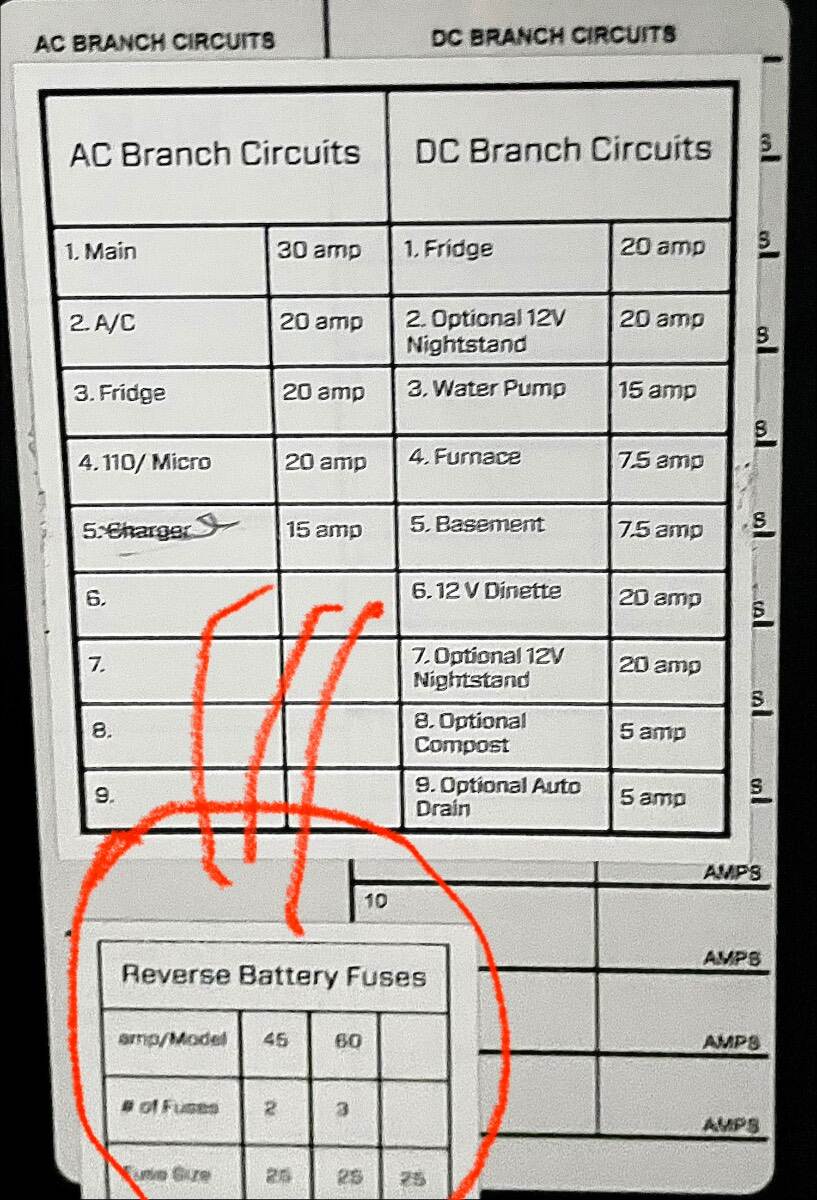
Thanks Craig. I just checked my panel label picture, and we have similar labeling. I guess these only protect the circuits connected to the various fused circuits in the 12VDC panel. For a reverse polarity condition to occur, you'd have to connect your battery cables in reverse or rewire AND reverse the internal OEM 12VDC wiring to the panel. This could be cause here if the batteries were removed for charging and then connected backwards! 🤣 The 4/0 cables from the battery connect to the inverter first (when present), these reverse polarity fuses would not protect the inverter from reversed wiring. Inverters must have their own internal reverse polarity protection. More guessing until questions are answered...
-

12Volt issue inside trailer
Tom and Doreen replied to Buddhabelly's topic in Mechanical & Technical Tips
On the 2023 Elite there's also a breaker (60A) for the +12V systems, it's probably a Optifuse like in the Elite 2s. I don't know where it would be located on an Elite but probably under a seat or bunk. The load side of this breaker connects to the fuse panel. The input side is connected to the +12V bus bar. -

12Volt issue inside trailer
Galway Girl replied to Buddhabelly's topic in Mechanical & Technical Tips
In our 2019 E2 we have reverse polarity fuses.
-
Reset the GFCI outlet under the dinette when the other 120VAC outlets are not working. They are wired in series so the GFCI (Ground-Fault Circuit Interrupter) in the first position protects the entire circuit. @Buddhabelly has the opposite issue, "no power for 12 volts items." Do we actually have said fuse in the Oliver? Maybe on the charger circuit board? (I'm not generally AI trusting.) I guess he could have disconnected the batteries to charge them and then wired them in reverse polarity? (The only way this fuse would blow.) Because you're on shore power, or because your inverter is working? It always gets me when a request seems really important, "WE HAVE NO POWER!" Then the person asking for help doesn't login for the next 17 hours... We can only help those who help themselves! So much we do not know without follow-up questions answered! @Buddhabelly, your answer to @Steph and Dud B's question? And is your inverter working? (if you have one) And re another 12VDC item, are your stabilizer jacks working?
-
The bonding plug needs to be at the source -- the Bluetti or generator outlets. Not an outlet in the trailer. Because the Bluetti outlet has nothing connected to the ground, the bonding plug cannot join the ground and neutral. Therefor a one-to-three outlet adapter can be plugged into the Bluetti, one of the three adapter outlets gets the bonding plug, another gets the trailer feed cord, and the third is a spare. That effectively bonds the ground and neutral. Bonding at the power source has always been required by code, these power packs just add a new dynamic. Someone had an idea to use the EMS bypass "in a pinch." This isn't risk free, but it would be fine for getting the lights on while finding the bonding plug. The EMS is actually protecting the trailer from an un-bonded neutral that the bonding plug fixes. Keep in mind that these power supplies are perfectly fine for single power cord loads as designed. They are not designed to be connected to a trailer where the wiring system assumes a bonded supply. Cheers! Geoff
-
Also across northern Texas, Oklahoma and environs this morning. I'm hitched, but stalling my departure until it passes. On my first night in my Oliver, I was planning to camp in a very nice park in Tennessee -- but on advice of Rodney Lomax, I stayed the night at the Oliver factory campground where there were a lot fewer trees to come down, and hitched the Oliver to my truck to help stabilize it. It was a real blow and a good lesson.
-

12Volt issue inside trailer
Boudicca908 replied to Buddhabelly's topic in Mechanical & Technical Tips
I have very sketchy memory of a time when I couldn't figure out a similar issue (but I had not drained my batteries)... the solution in my case was to reset the GFI protected outlet that (on my Elite2) is located on the face of the forward dinette bench seat. -
Never at an outlet. This is known as a "bootleg ground" and can cause dangerous situations.
-
Into the outlet on the generator. I believe this is an artifact of the lack of a grounding rod and grounded electrical system on the trailer (which would be totally impractical).
-
Not really. Lots of people have RVs with no EMS system at all. The EMS cuts off power to your rig if the voltage is too high/low, the wires are not connected properly, or the source has the wrong Hertz (cycles per second). Cheap generators can have all of those problems. Shore power can be wired incorrectly or have voltage issues. Check your specs, but most new Bluetti power stations use a pure sine-wave inverter. That means the power should be "clean" enough for sensitive electronics. Almost certainly safer than plugging into shore power at a campground. I got this from an AI search: "Bluetti power stations are very safe for sensitive electronics. All Bluetti units use pure sine wave inverters. This mimics the clean, stable power of a standard wall outlet, preventing screen flickering, overheating, and data loss for devices like laptops, TVs, and CPAP machines... Avoid ECO Mode: If using a Bluetti solar generator, users on PowerEquipmentForum suggest turning off the "ECO mode" for the most stable and reliable power delivery to sensitive electronics."
-
That sounds dangerous and I could fry something; yes?



.thumb.jpg.e34bf01ef7f7d5e99ad31856d45afbeb.jpg)