
Geronimo John
-
Posts
2,404 -
Joined
-
Last visited
-
Days Won
68
Everything posted by Geronimo John
-
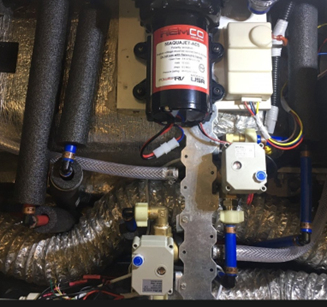
Another quality JD install for sure. I have attached the spec's (in my usual format) as a reminder for my DIY pump replacement down the road. It compares the specs and cost of your superior pump to the OEM OTT pump. Both have US distribution and service. Your version is a 6.5 amp vs OTT's 7.5 amp. It also puts out .4 gallons per minute more. My anticipation is that it would last a lot longer than the Sureflow. If I were a young owner with a failing pump I would upgrade as you did. Buy high quality, mess with it once, and expect it to last. But since many of us are still young in heart, but not so much in other ways, and unless frozen solid, these pumps tend to last far longer than us RoF's will be around, the one-for-one replacement path would get a few votes as well. JD: You have several high quality, well thought out upgrades that I look forward to seeing in person down the road. DIY - Fresh Water Pump Replacement Options.docx GJ

-

Andersen WD Hitch Periodic Maintenance?
Geronimo John replied to Galileo's topic in Mechanical & Technical Tips
I would wager it is well over $20K with materials, labor and at least $1 per hour for the PITA factor that we have endured. But that said, the learning curve was so satisfying ... when the job is done of course. -
You guys may find this unusual, but our Hull 342 (2018 Model Year) has had zero plumbing problems. Now heading to our 8th season I think it best that I get some interest in understanding and having some organic repair capability. Especially when off the grid. The two systems (SB Fittings) and Clamping Rings appear to be different approaches for repair of PEX. Which years use which system in our Oliver's? Pro/Cons of each? Going lightly and conservatively on spare parts is my approach. Which would suit us the best? Thanks GJ PS: Can assume all our Ollie plumbing is 1/2" pex?
-
That's a good idea. Can you share what you have in the kit so we can replicate it? Thanks GJ
-
LoL. The world is your Oyster on that one. Hope you find it and its an easy fix. GJ
-
Andersen WD Hitch Periodic Maintenance?
Geronimo John replied to Galileo's topic in Mechanical & Technical Tips
I've lived, worked or played in 51 countries. Wish I could do it all over again! GJ -
Andersen WD Hitch Periodic Maintenance?
Geronimo John replied to Galileo's topic in Mechanical & Technical Tips
We are in total agreement on all 5 points. Except I have just a tad more years. GJ -
Andersen WD Hitch Periodic Maintenance?
Geronimo John replied to Galileo's topic in Mechanical & Technical Tips
AI says it better. I have to admit that AI is smarter than I am.... by a very wide margin! AI focuses on a more general aspect (Ride and miles) whereas my experience was from a performance (braking and miles) perspective. Either way, message is the same. My Michelin Defenders, Cooper and BFG's on new vehicles all wore out faster then their replacements for the same replacement tire. GJ
-
Andersen WD Hitch Periodic Maintenance?
Geronimo John replied to Galileo's topic in Mechanical & Technical Tips
Generally speaking as stated, yes. I can not comment on what your dealership sells. Because I never buy tires from a "stealership". As stated above in my post: "They have a more durable and longer lasting tread compound." The logic behind has to do with braking distances for sale of a new vehicle. Congrats on being a unicorn for getting "considerably more miles out of my tires than they’re typically rated to deliver". The vast majority of owners towing an OE2 would not be getting considerably more miles out of their tires than they are rated for. But then that's just basic physics of towing a 6,000 pound trailer with non-paved roads used for boondocking, and for many of us mountains in the mix. If you don't venture off road ever, then your highway tires likely are your best choice. If that does not describe your operations, and mountain gravel roads are in the mix, some owners would say get a good AT tire that is E-rated would be wise. Personally I use and like the E-rated Nitto Recon's. But there are many other great tires out there. Just check the forum and you will be impressed by our owner's experiences. GJ PS: It would be helpful if you would kindly add to your signature line and profile your TV info. Thanks! -
Andersen WD Hitch Periodic Maintenance?
Geronimo John replied to Galileo's topic in Mechanical & Technical Tips
Ditto from my side. I always go for premium tires when they are due, or before. Yes it costs more. But it is worth every penny from my perspective. Galileo: I have found that the OEM tires tend to be good in stopping distances because that is what many owners want to see in the specifications. Problem to get those ultra low distances they use tires that are specially made with a softer compound. That's why they stop shorter. But it leaves the vast majority of new car buyers wondering why their OEM tires don't last anywhere near as long as their premium replacements. So, Galileo your replacement tires that you thought were exact replacements generally are not. They have a more durable and longer lasting tread compound. And the MFG knows this. So using the same exact tire likely will work fine if it meets your needs. Here is where the logic line gets a bit soft. The MFG of your TV had no idea what or if you are towing. Or what kinds of roads you are traveling with your Oliver. Where you will be going...... etc..... As such, the off the shelf OEM factory tires tend to be a general duty tire. Hence the need to at least relook at your towing needs as it relates to your TV and where your needs to safely do so. There are more than a few reams of paper worth of discussions on tire selections posted on this forum. Maybe worth a look at the posts. Or just post what your TV is at the bottom of your signature line, and how you intend to use your Ollie. I feel certain you will get plenty of good info as a result. -
Andersen WD Hitch Periodic Maintenance?
Geronimo John replied to Galileo's topic in Mechanical & Technical Tips
Galileo: To lube your ball, or not lube your ball..... A philosophical question of the forum. Some of us believe that having a bigger ball is better than smaller ball. Some of of us like bigger and lubed. Some don't. Totally depends on your perspective. I can't speak for anybody but myself and Crazy Horse. We believe that for our OE2 and F-150 SuperCrew the sway control of our Hull is not need. I am convinced that Scott Oliver's long nose design tandem axle, shocks and EZ-flex, and light rear end all together make that possible. That may or may not apply to your trailer loading. Personally I have about 540 pounds of tongue weight as measured at Art's, and no stuff over the rear bumper, stiff Bilstein 5100's on my TV rear end, and Firestone Airbags as well. We cover huge miles each summer from TX to Idaho/Oregon and the back with lots of detours such as Alaska too. Never once a sway. Hence we go with a lubed ball. Friction cone wear likely will not be a problem for quite a while. When I was lurking this web before our 2018 purchase, I was schooled well by John Davies post and pictures about the cone and ball wear issue. My thoughts were that the contact patch wear for the heavily loaded Anderson dry was simply normal wear. Solution: A bigger ball and lube it. Took a whole two seconds to figure that one out. So we purchased ours with the larger 2 5/16" Anderson system. After seven years, my conclusion still that we like having the Weight Distribution of the Anderson, but do not need the sway control..... for our rig. BUT: if your rig is loaded tail heavy, or your TV is a shorter wheel base or lighter, or a bunch of other what if's.... You may want to keep the sway control. If you do, USE IT. The safety of your family is riding in your hands. So travel safely and travel far. And everybody on this forum will support your decision. If not, let me know and I launch Crazy Horse that way! LoL Geronimo John -
Alternative Front Storage Basket
Geronimo John replied to William James's topic in Ollie Modifications
JD: Good news is that I use my 2 gallons of generator either in the Honda or in the F-150 so no worries there BUT, I store my truck for eight months and use Stabil. Please elaborate on your post. I'm all ears. GJ -
JD: Thanks for the comments. Both Art and I (And a bunch of others who went lithium earlier) have 3 ea 100 AH Battleborns, Orion 12/12-30 truck chargers, and various solar panels. Would your approach apply as well? GJ
-
Remove the rain seal on the awning?
Geronimo John replied to John E Davies's topic in Ollie Modifications
Actually that's great as you can do your windows, door, and still have enough for over the windows adjacent to the awning and still have a few feet left over. GJ -
OOPS: When I reread Art's post, I realized i was climbing the wrong tree. Massive delete of what was below needed as a result. My bad..... Art was focusing on the bathroom RETURN AIR to the furnace when it is running. I was addressing the natural convection concept for the wardrobe closet and forced cabin air movement into and out of the bathroom to the below decks area. My bad. GJ One thought for the extreme cold weather campers: If I were one, I would install the vents as suggested above plus a 4" fan to move air from the bathroom into the inter-hull area. This would ensure continuous air flow from the cabin via three or more vents and would ameliorate the bathroom temperatures swing between furnace cycles. I would likely power the fan through a thermostat to auto on the fan at a desired temperature, and with a manual on/off switch and fuse of course. This and the suggested vents would be a good "Cold Weather Option" for OTT to consider. GJ
-
Nicely done! I think the meat locket cold box issue will be greatly improved. By adding another vent above the closet door (as has been done by others), the vents would also greatly help reduce the hot box we get in the closet during the summer! And take a look at those two great shelves we installed in our trailers last summer. I will admit that getting the curved and tapered front edge template correct was a real PITA. But in the end they turned out GREAT. Sure would save a lot of effort for other owners to have a cardboard template before starting such a project! I bet we could be enticed to remove them if an owner wanted to replicate the template out of cardboard, and then share it with others at the rally. For a couple of cold dark beers we could unload mine pretty easily to greatly simplify template making. Owners interested: you would need a cardboard box. Great use of the unusable space in the closet! Awesome! 🙂 GJ
-
LE1 Generator Selection
Geronimo John replied to My Imagination's topic in Mechanical & Technical Tips
I use your method as a back-up plan for my Honda Generator. Reason is running a 400 horsepower engine, even at idle, to create what a small generator can do just as well..... causes me to pause. But if my solar panels and Honda fail to get the job done, then I will for sure be singing praises for your suggestion! -
Truma Pressure Relief Valve Leaking
Geronimo John replied to Rich and Jane Walker's topic in Mechanical & Technical Tips
Oh boy, this response is going to be a lot of fun. Pressurization of our fresh water tank (FWT) can be realized with well or city water lines. The above post and response is one way. However, the Poly water tanks I am aware of are not rated pressure tanks. It is for this reason that 99% of them do not post a working pressure rating. But that does not prevent some people thinking otherwise. Ok, so lets assume you are filling your FWT with a non-functioning vent. And you "increase the pressure and blow those LBs out!" What would happen if you did? Actually this has been done, tested, and documented. The results are always the same. One such test report can be found at: https://blog.polyprocessing.com/blog/tank-pressurization-and-your-chemical-storage-tanks-service-life Here is a short version: "Poly Processing performed a test to failure with XLPE vs HDPE. We pressurized both tanks with water to the point of failure. The linear polyethylene tank catastrophically failed at 9 psi of water pressure. The cross-linked tank failed at 10 psi. So this is likely why OTT has very large FWT vent hose and separate ports for boon docking and FWT Fill. The Boondock line is not designed to be hooked up to a pressure system (ever). The Fresh Water Fill is a direct path to the FWT and it has an oversized vent. Just be careful to slow down the fill rate as you approach a full tank. Oh, and I recommend to not never use a "Bigger Hammer" just cause you can. It generally gets the job done, but with unintended results..... Ouch! Gotcha! LOL GJ -
Factory installed DC to DC charger
Geronimo John replied to Snackchaser's topic in General Discussion
Your logic line is the same I used. I also figured that there was no way that the ground would ever get in the way of my Anderson that I had mounted below and in front of the rear bumper on our F-150. But alas a young driver on a very tight mountain switchback trail road proved me wrong. He unknowingly backed my TV into the sloped side of the mountain and crushed my TV Anderson plug. No electrical problems as I always turn off power at the battery circuit breaker when not towing. Experienced as your are, I know that you'll be wise when backing back up to bumper blocks and curbs. GJ -
Truma Pressure Relief Valve Leaking
Geronimo John replied to Rich and Jane Walker's topic in Mechanical & Technical Tips
Yes, at least 99.85% of the time. And you are correct in that the OE2 fresh water fill, lines and tank is an open system. But the open part is only the fresh water fill tank overflow tube located in the area under the microwave space. This line vents out of the trailer just aft of our steps. Should mud daubers or other critters build their nest in that line, that open tank system no longer is. Problem with this line of logic is that many owners set their pressure at 40+ PSI. I am not at all sure what the OTT poly FWT is pressure rated for. And being that water is a non-compressible fluid, an over pressured tank would only fail with just a big puddle. Not like how pressurized compressible gasses act during failures. But could easily test to failure the FWT system to find out.... on your trailer! Actually funning aside, I wonder if OTT ever tried to blow up a FWT by overpressure? I suspect yes, hence the oversize vent tube..... But I'm just guessing. 🙂
-
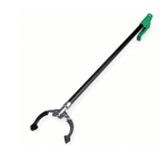
One of our original purchases was a trash grabber: It works GREAT for pushing our milk crates back into the basement. But when removing the milk crates the vinyl flooring hooks the edge of the milk crate. So I tied a paracord "Yoke" to the base of the crate one one end, and to the door hinge on the other. By pulling the paracord "high", it lifts the milk crate just enough to pass that edge. Also a lot faster. GJ
-
Charging my batteries from generator
Geronimo John replied to a topic in Mechanical & Technical Tips
I like keeping things Simple! Especially as I get older. John D turned me on to Sharpie Paint Markers for marking which way to hand crank down the jacks when you gotta. So, welcome to the "Simple is Smart" team. -
Charging my batteries from generator
Geronimo John replied to a topic in Mechanical & Technical Tips
Great idea! -
New axles may not fit all older sub-frames
Geronimo John replied to Wayfinder's topic in Mechanical & Technical Tips
I wish I needed new axles. So I could dream about getting 5200 axles with disk brakes and springs of my choice (written so as not to kick the sleeping Spring Bear topic). Bullet Proof! But then I would need to ask Crazy Horse to rob a bank to pay for it.......... GJ -
New axles may not fit all older sub-frames
Geronimo John replied to Wayfinder's topic in Mechanical & Technical Tips
Would love to have been one of the luck owners to benefit from the 3500 pound axle shortage and got the super duty 5200 pounders. I believe I remember that they can be upgraded to disk brakes which is an option that OTT really should consider for new trailers. Thanks for the low down Bill! GJ