
Fritz
-
Posts
224 -
Joined
-
Last visited
-
Days Won
2
Everything posted by Fritz
-
The Zamp connectors are proprietary, but apparently do not have reversed polarity. From the Zamp website (https://www.zampsolar.com/pages/faq): "Is the Zamp Solar port reverse polarity? No, but they are different from other brands of solar ports because all of our SAE plugs are polarity-protected for safety reasons. That means the positive pin on all of our SAE plugs is set back and covered to prevent accidental contact that could damage your panel, short your battery, or give you a pretty nasty shock. So, because of the polarity protection on our plugs, Zamp Solar ports are only compatible with Zamp Solar SAE plugs."
-
Lithium Pro Package vs Solar Pro Package
Fritz replied to John Dorrer's topic in Welcome To The Oliver Travel Trailer Forums
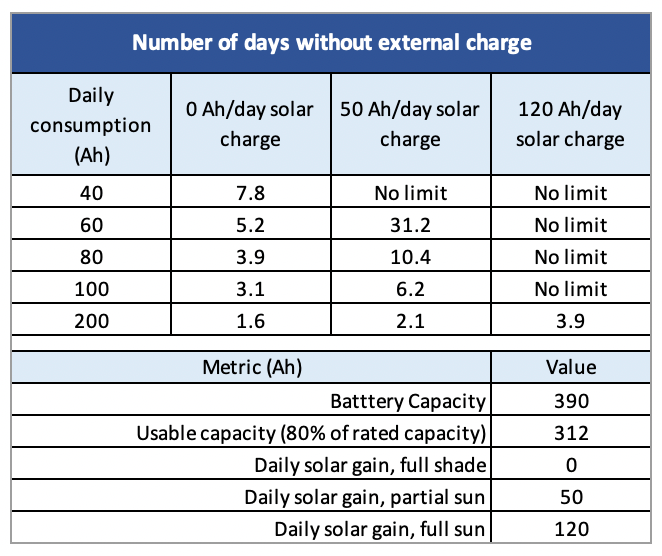
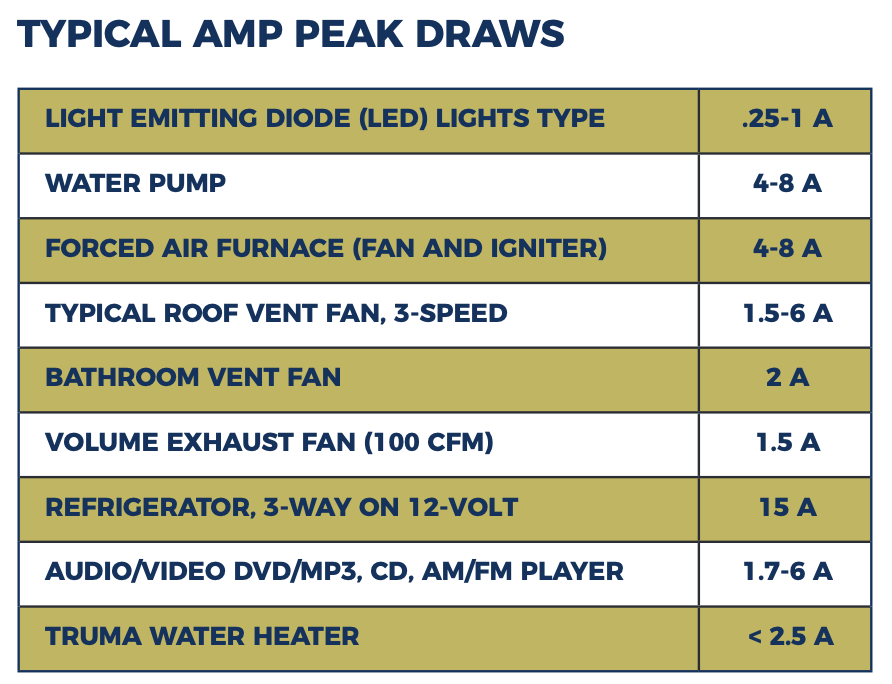
I think it depends on how you like to camp. Our solar package (with 340 watts of solar and 390-Ah batteries) typically produces between 100 and 120 amp-hours per day (Ah/day) in the summer, depending on exposure, shade, etc. Late fall and early winter (with sun at a low angle) we were gaining about 20-30 amp-hours. Maximum summer charge rate is about 15 amps. Of course, hourly and daily charge rates are less if there is shade. In the summer when boondocking we use about 40-50 amp hours for lights, water pump, CPAP, jacks, awning, etc., and more with abundant furnace use. A microwave (which we don't have) uses a lot of electricity; the amount of electricity it consumes depends on how long you use it and the power setting. The A/C uses about 100 amps per hour, so it works fine for rest stops but it can't be run very long with the expectation that it will charge quickly with solar. Here are typical draws (per Oliver User's Manual): When traveling, the refrigerator uses about 15 amps when switched to 12 volts (and it generally runs continuously when it is switched to 12V). Thus, even in full sun with the panels producing 15 amps, the batteries are not charging when the refrigerator is on 12V. This is why some have installed DC to DC chargers for the lithium batteries: it lets you drive down the road with the refrigerator on 12V and provide additional charging capacity for the batteries. Here are some simple scenarios to illustrate the number of days before an external charge from shore power or generator is needed. I calculated the number of days before a charge is needed based on an assumed useful capacity of 312 Ah (80% of 390 Ah, the rated non-platinum lithium battery capacity). Clearly, a 600-Ah battery set will let you boondock longer in the shoulder seasons, under shade, or with greater power demand, but perhaps the 390-Ah battery set is sufficient for your intended use. So, whether you need 390-Ah or 600-Ah batteries depends on how and where you intend to use your trailer. Good luck!
-
HOW TO: Lithium Battery Powered Vent System
Fritz replied to John E Davies's topic in Ollie Modifications
I might add that if the heating pad is turned on when there is no other source of power (or no incoming charge from solar in excess of what the heating pad draws), the heating pad may draw down the batteries unnecessarily. -
HOW TO: Lithium Battery Powered Vent System
Fritz replied to John E Davies's topic in Ollie Modifications
Another reason for installing a fan would be for summertime heat reduction. I have found that static temperatures in the batteries to reach 95°F when the outdoor ambient temperatures are slightly over 100°F. A fast charge to the batteries (100 -150 amps), which I have only done a cooler temperatures, can add 25°. Although the Lithionics batteries can handle up to about 130°F, I would be cautious about a fast charge during the summer (such as after using the air conditioner on battery) without being able to cool the batteries. For that matter, just using the air conditioner with battery power heats up the batteries -- another reason to install a cooling fan. Some have insulated the battery box door to keep the batteries from getting too cold. This helps, but absent internal conditioning, the vents should remain open (IMHO) during the summer for cooling. -
HOW TO: Lithium Battery Powered Vent System
Fritz replied to John E Davies's topic in Ollie Modifications
The Lithionics batteries come with a heating pad underneath the batteries. There is a switch in the battery compartment that turns the heating pad on or off. When turned on, the heating pad comes on when the temperature falls to 35°F. It goes off when the ambient temperature reaches 45°F. This is only necessary to charge the battery, and if there is a charging source available (i.e., shore power, solar, or generator). The batteries do not need a heating pad to discharge (e.g., turn on lights, etc.), even when the temperature is below 35°F. -
HOW TO: Lithium Battery Powered Vent System
Fritz replied to John E Davies's topic in Ollie Modifications
It appears that the programmable thermostat speed controller that you used (this one, perhaps: https://www.amazon.com/TerraBloom-Programmable-Thermostat-Controller-Temperature/dp/B083W2MRK6/ref=pd_day0fbt_img_2/146-3356731-9507947?pd_rd_w=Q7AR3&pf_rd_p=bcb8482a-3db5-4b0b-9f15-b86e24acdb00&pf_rd_r=XVV5SHAE2FP5518SGFZW&pd_rd_r=e2e72b65-4f68-4988-9560-bae75e92c00e&pd_rd_wg=FyVXm&pd_rd_i=B083W2MRK6&psc=1) will handle up to 4 fans. I'm curious if there is a reason that you used two controllers for your installation (one for the basement and one for the battery compartment)? -
HOW TO: Lithium Battery Powered Vent System
Fritz replied to John E Davies's topic in Ollie Modifications
I just noticed the mouse-in-the-pantry decal in one of the photos in John Davies' original post for this thread (I was looking for the type of hole saw you guys were using). Nice touch for the Mouse Haus! -
Good summary, Overland. One question, though: my impression is that the 7-pin charge wire on recent trailers with a lithium package is not even connected to the battery. Is this correct?
-
HOW TO: Lithium Battery Powered Vent System
Fritz replied to John E Davies's topic in Ollie Modifications
Nice work! Just to be clear: I assume that the basement fan is different from this installation, i.e., the battery fan conditions the battery box and the basement fan conditions the basement space? -
We opted for a high topped (but not the highest topped) A.R.E. shell. I like the extra height; it's easy to crawl into the back; taller items (e.g., bicycle, chairs, patio rug) can be transported vertically. Eventually I'll build slide out drawers that can double as a bed platform. I agree with Jim and Francis: build quality is good but not great. I really like the flip out side windows for side access.
-
You might also want to confirm that the cabinet-instead-of-microwave option is still available; I was under the impression that 2021 was the last year for this. Also, temporarily sliding an oven away from the back wall while in use may not be an option in that the bottom the cabinet door when open is about 1/2 in above the cabinet floor, and the top of the door when open extends about 4.5" beyond the counter into the isle.
-
The storage cabinet in a 2021 LE2 is 19.25" W, 13.0" H, and 13.5" D. You can request a hole in the roof of the cabinet that goes to a 120V outlet in the cabinet above. I agree with the other responses: you'd want to be careful with oven temperatures. We keep an instant pot in the storage compartment. On slow cook, no problem. We put the instant pot elsewhere (e.g., outside, or on the table) for pressure cook.
-
Xantrex: inability to update firmware [updated]
Fritz replied to Jim_Oker's topic in Mechanical & Technical Tips
After spending hours and hours dealing with communication errors and unsuccessfully uploading new firmware Xantrex has sent me a replacement Freedom XC Pro inverter. It looks like at least two of you have replaced the inverter. Might you have any guidance that would help in replacing this unit (and to help keep me from electrocuting myself)? Thanks! -
Living with Lithionics—Some Tips, Tricks, and Observations
Fritz replied to Fritz's topic in Mechanical & Technical Tips
My comment about the Zamp controller in the original post in this thread is incorrect. The Zamp controller does charge the batteries up 14.4 volts. Moderators: I tried to modify the original November 4 post, but could not find the "edit" option. Could one of you please show me how to correct the error in the original post? -
I recently purchased the 780. As far as I can tell, it is mostly the same as the 890 except for a smaller screen. The old TomTom failed a couple years ago. This last year we used Google maps and Carplay exclusively, but were of course limited in areas of no reception. Of which there are still quite a few, especially out west. (In our experience, cell phones will work on GPS in an area without coverage if already programmed for a route; they’ll lose the map if you turn the phone off in an area of no coverage). I suspect the RV functions on the 780 will turn out to be mostly gimmicks, but I liked the higher screen resolution compared to less expensive GPSs. There’s also something to be said for comparing google and Garmin routes, especially in urban areas. I would not want a bigger unit than the 780 on our pickup’s dash. The 780 is almost too large as it is.
-
Living with Lithionics—Some Tips, Tricks, and Observations
Fritz replied to Fritz's topic in Mechanical & Technical Tips
I received the following private message, and am posting it here in case anyone else has the same question (or to give others a chance to correct my response): "Are there switches/breakers inside the trailer that I need to switch off before I remove my batteries? I would assume so - like a "main" switch similar to on a house panel that would just power everything off." I have not yet removed the batteries for the season (I'm still trying to get an inverter issue resolved). That said, I think the only thing that is necessary is to stop all major loads (e.g., unplug from shore power, turn off major uses (e.g., microwave), and perhaps turn off the solar controller (the red dial-switch located in the upper cabinet above the streetside bed). Record the SOC and voltage for warranty purposes (I take screenshots of these readings for each battery). Take a photo of the wiring array before you begin disconnecting terminals to help with reconnection in the spring. Then turn off each of the Lithionics batteries (the light-blue lit button in the far right corner of each battery). Disconnect the batteries beginning with the primary negative terminal (this is the right-front terminal with multiple, heavy-gauge wires), then disconnect all of the other wires being careful not to accidentally bridge terminals with a wrench. As a heads-up for reconnecting in the spring, I think I recall seeing a torque specification in the manual for tightening nuts on the terminals (to avoid damaging the batteries by over tightening terminal nuts). -
Relocate the furnace inlet grill and block off that opening?
Fritz replied to John E Davies's topic in Ollie Modifications
The question that I have -- and I like your idea -- is whether this configuration of return air vent (with associated length, twists, and turns) would have too great of a friction loss given the size of hose that would fit, thereby making the heater work inefficiently (or perhaps shorter life because of getting too hot). You might want to look up specs on the furnace to see what the friction-loss constraints would be for this return-air venting location and configuration. Please let us know if you do this -- I think several of us would be interested. -
Lithium Battery Storage For Colder Climates
Fritz replied to connor77's topic in Mechanical & Technical Tips
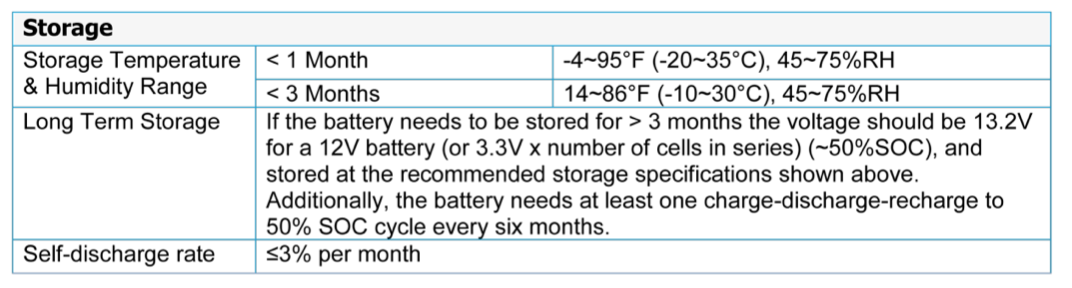
To me, the Lithionics storage requirements are a bit ambiguous, in that the duration of extreme temperatures isn't addressed. For example, the batteries have a 130°F maximum operating range; does this mean that temperatures during storage cannot exceed ~95°F at all, or for most of the time, or? Similarly, short-term low temperature limit is -4°F, but longer term short-term limit is 14°F. So for how long can short-term storage can batteries be less than, say, 14°F -- a month, or? Here in southern Idaho temperatures can be lower than 0°F for a few days (or nights), but not generally very long. But nighttime temperatures can be less than 14°F for several weeks at a time, with daytime temps above 14°F. To be safe, I'll be removing the batteries for the winter, storing them at about 50% SOC. I haven't done so yet, because daytime temperatures here are still in the mid 50s -- and it's December! There are also relative humidity (RH) criteria for storage. I have no idea how to address these here in a relatively dry climate, especially indoors in the winter (the batteries will be stored in a heated shop/garage). Recognize that the SOC values under load (or while charging) can be substantially different than those when the batteries are at rest, at least in my experience. So, I plan on discharging for a while, stop the load, look at the resting SOC, repeat as necessary. Next, for those that haven't seen earlier Lithionics-related posts, the SOC is unreliable if the battery firmware has not been upgraded to the current version. See: Finally, note that the manual suggests that you record SOCs and voltages when storing the batteries for warranty purposes. See https://lithionicsbattery.com/wp-content/uploads/2018/12/12V130-G31LRBM8-Battery-User-Guide-R1.pdf.
-
We use a foldable shower stool. Toilet does not get wet. I wipe down the shower door before getting out, and then squeegee the shower pan. Works well, at least for us. I think I prefer this approach to having a shower curtain bulked up in storage next to the toilet and towel rack, although I haven't really tried the latter.
-
Did you by any chance look at Park-it 360 (e.g., 10,000 lb version)? I have no experience with either, but am looking at both....
-
Lithium Pro Package vs Solar Pro Package
Fritz replied to John Dorrer's topic in Welcome To The Oliver Travel Trailer Forums
Something isn’t right. Your batteries should be able to put out full power up until they’re almost dead. My guess is that the low voltage cutoff on your inverter is set too high. Larry and Linda, if you picked up your trailer in May, and if you have not updated firmware for the Lithionics batteries, I'm willing to bet that your State-of-Charge values are incorrect. Here is a thread that might help... -
Compost Toilet V Traditional RV Toilet
Fritz replied to Chris and Lisa's topic in General Discussion
I agree -- we've been very pleased with the composting toilet. No second thoughts on that choice. Urine in the primary compartment has simply not been a problem. It did take several cycles to properly prepare the coconut coir (i.e., to get the right amount of starting moisture, which varies depending on whether we are in a dry or humid climate). And we don't seem to get the 3-4 weeks of use that some might; 7-10 days has been quite manageable (the crank gets too hard to turn for arthritic hands). But even with that, I empty on my terms (not when the blank tank is suddenly full and won't take the last flush, like in our previous camper). We don't wait in line for the campground dump station, and we don't have to drive around looking for one when boondocking. -
Relocate the furnace inlet grill and block off that opening?
Fritz replied to John E Davies's topic in Ollie Modifications
I spoke with Jason Essary about this when we picked up the trailer. He expressed concern that reducing the warm-air vent closest to the cold-air return would force more air into the second duct (the one that sends warm air to the vent under the drawers and the one in the bathroom, but that this line wouldn't carry enough air for the the furnace to operate correctly if the closest air vent were closed too much. So I suppose it would depend on just how much you close off the closest air vent. I agree that the system short-cycles. However, the interior space is sufficiently small that the air mixes well enough. It gets warm throughout the cabin, in our experience. Leaving the bathroom door slightly open (or installing a vent) helps. -
Heat Management of Lithium/Solar/Charging Upgrades
Fritz replied to Geronimo John's topic in Ollie Modifications
Thank you very much for correcting this. I agree with after looking at the manual, and just to be sure, I verified with Zamp that the ZS30A PWM controller goes to 14.4V in absorption mode before returning to 13.6V in float. It does. So a full solar charge should serve to calibrate the batteries' BMS, resulting in a more reliable SOC. So then, if I understand correctly (which clearly is not always the case), the reason to install a PMMT controller is for a bit greater efficiency, which becomes more important for larger solar arrays. I also asked whether Zamp would be building one, and the rep said there had been discussion about this some time ago but he hadn't heard anything recently. -
Heat Management of Lithium/Solar/Charging Upgrades
Fritz replied to Geronimo John's topic in Ollie Modifications
Not at all, IMO. The only benefit of the DC to DC charger is if you want to charge your lithium batteries using your TV while driving. Without DC to DC charging, the batteries will charge with solar (if you have that option) while you are driving or parked (as long as there is sun), or with shore power at night. Not sure about other lithium batteries, but the Lithionics batteries want to be fully charged (to 14.4 V) at least once every two weeks. There are at least 3 ways of doing this: (1) plug into shore power (or perhaps a generator), (2) use DC to DC charger while driving, or (3) have an MPPT solar controller that allows the batteries to reach 14.4 volts from solar (Oliver currently installs a PWM controller, which charges the batteries, but not to 14.4 volts). So whether or not to use a DC to DC charger might depend your battery requirements and on the way you intend to use your system. With batteries like the Lithionics, extensive boondocking (i.e., no shore power) and avoiding a generator steers you to either option 2 or 3.


.jpg.4e3cf0ec4b7acb4013e76adbf7a2e36c.jpg)