Leaderboard




Popular Content
Showing content with the highest reputation on 12/31/2016 in Posts
-
Wishing Everyone a Safe and Happy New Year!!!!!! Blasting off to 2017!!!!!
 3 points
 -
OH MAN! When did Oliver add the Saturn V option???? And can they retro fit one for me? :-) Happy New Year everyone! Scotty... and Donna.. and the Flying Sea Turtle... and now... Piper! Newest family member. Picture of Donna and Piper attached.
3 points
-
Can someone post pics of the optional $250 wall/ barrier/ separator/ splash guard .... whatever you call it. It goes to the rear of the cooktop, correct? What is it made of, and are there color choices? It sounds like a good idea, to stop a nasty spill if a pot boils over, or to reduce grease splatter onto the bedding... can we hear from owners who have it? Good or bad? Ta. John Davies Spokane WA1 point
-
Sure is going to be one hell of a meltdown when that puppy lifts off! Bill1 point
-
As I have been asked about my plumbing setup and how I choose to rectify the hot water lapse in the shower I will post it on here so that whomever might benefit from the info can. The problem being that when taking a shower "Navy Shower" and using the trickle switch on the shower head, this is supposed to allow the water to dribble so that the hot and cold water stay present at the head, however in an unbalanced system one will over power the other and when the valve is re-opened you will get too much hot or cold until the balance is restored. In our systems, keeping in mind that my trailer is #69 produced in early 2015, the configuration is such that the cold water has a more direct line to the shower head than the hot and with the 6 gallon tank the hot water would lose some of its pressure there too. So basically the system allows the cold to build more pressure at the shower head and over power the hot line (My system is dry right now or I would throw a pressure gauge on it to see the difference to be accurate). The easy fix for the problem is to insert a check valve into the hot water line between the hot water heater and shower head. This will not allow the cold water to over power the hot and push it back up its own line, placement isn't critical as the return flow is stopped the entire length in front of it. One thing to note is that the kitchen faucet tees off the hot water line under the front set of kitchen drawers, so behind that would allow reverse flow if the kitchen faucet is not closed completely. One big thing to note is that this will effectively stop a gravity drain of the hot water line from the shower, however blowing out the line and filling with pink stuff would be unaffected. I also did some checking on the initial flow of hot water with the Truma system as has been discussed recently. For those of you who are meticulous about your boondocking and water conservation, the initial flow of hot water to clear the cold out of the line results in a waste of .22 gallons, if not recaptured. For those with the suburban heater, creating a recirculation system is easily possible, however you would need to be comfortable removing the shelf unit in the bathroom to access the PEX as close to the faucet as possible to install a tee and return line, then determine where you would like an open/close valve and reconnect to the system in front of the pump. This way when you turn on the pump, it pressurizes the system and if you open THAT valve, only the hot water flows in a circle to clear the line of cold before the initial turn on. I would imagine that Oliver would be able to add this configuration easily enough for a couple hundred dollars on any new trailer with a suburban to get the same effect. The check valve that I used is the Shark Bite, I prefer these as they do not require any crimping and can be removed if draining the line is necessary. Here is the link to the Check Valve https://www.amazon.com/SharkBite-U2008-0000LFA-Check-Valves-2-Inch/dp/B00506ET101 point
-
Randy, It's not enough to say different pressures exist on the hot and cold lines. Not exactly. Static pressure with all faucets off will be identical on both hot and cold. When showering, you are looking for a ratio of hot and cold that suits your temperature needs. This might be 70% hot and 30% cold, for instance. So you balance the restrictions at the shower faucet to achieve this ratio. You are measuring restrictions with a temperature gauge. You are the temperature gauge. At that moment, all restrictions in both hot and cold lines are factored in. It's true that the hot may have more length and more fittings to get through on the way to the shower, but it doesn't matter. It's a dynamic system and it is in balance at the flow rate you want at that moment. For instance, it might be supplying 3 gallons per minute total at the shower head, with a ratio of 70% hot and 30% cold. Now you slow the flow with your trickle valve and the restrictions all change. At 1/8 GPM, for instance, the flow restriction through the entire plumbing system changes and becomes more equal between hot and cold. The hot and cold line restrictions change unequally. The flow restrictions through the hot and cold valves changes significantly and the shower head restriction changes. So your ratio changes, due to several factors, causing your temperature to change. When you open the trickle valve to full flow again, the original restrictions return and the original temp returns, once the flex line is flushed out. A small difference will still be present from the heat loss through the uninsulated hot line that was flowing slower and losing more heat during trickle. You would probably have better results by turning the flow off completely at the shower head, than reducing it to a trickle. That way all flow will be either at full volume or off. The valve restrictions and the entire hot and cold net restrictions will remain in balance to deliver the temp you want. A check valve in the system, as you suggested, will do no good and reading the pressures on a gauge will be meaningless. Static pressure will always be equal with no flow. Gauge pressures near the shower faucet are meaningless because it's a flow ratio you are interested in and that flow is measured in temperature, not pressure. I suppose you could try some kind of temperature controlled shower valve, but it won't be satisfactory. Just try a total shutoff at the shower head and put up with a small temperature fluctuation.1 point
-
Thank you for taking the time to explain it. I really do appreciate when people who have the knowledge are willing to take the time to impart it rather than just state "because that's how it works" So basically, I got lucky, the system is small enough and the durations are short enough that in this situation the check valve works but in a larger scenario it wouldn't be as effective. As you explain it, the closer the check valve is to the faucet the greater the affect it will have then. Thanks for that clarification. One of the nice things about the way Oliver laid out the system, at least around my hull number is that the water lines lay in the channel directly underneath the bathroom heat duct, so when the furnace runs it warms the water lines that run to the shower. We have two showers at home, my wife prefers the aesthetics of the single mixer valve, so insisted on it for her remodel. For the other, I put in the single controls with a shut off, she now understands the benefits of the single system and prefers it too.1 point
-
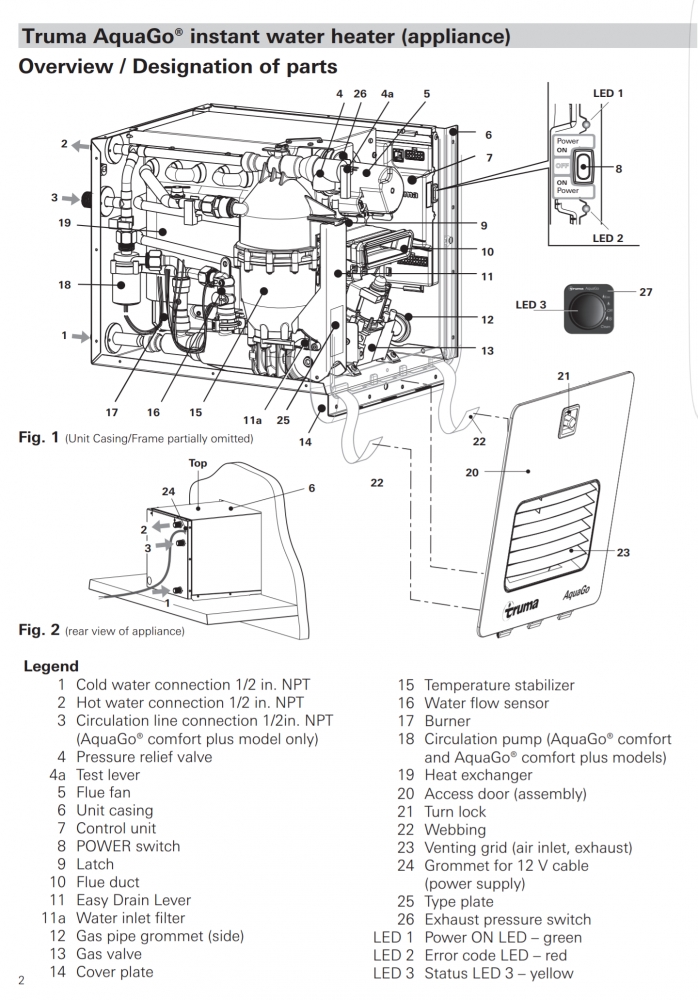
Sorry, I am almost always on my phone when on here and cheated the easy way for the screen capture. Here is the link for the Truma PDF it says it's all three systems and just lists that connector 3 is for the plus. So basically the guts are the same just that tee is added, makes me think they are probably all able to have it internally, just whether it's hooked up and configured. https://www.google.com/url?sa=t&source=web&rct=j&url=https://www.truma.com/downloadcenter/aquago_operating_installation_us.pdf&ved=0ahUKEwitmNyStZ3RAhVj4YMKHfWuCCMQFgglMAE&usg=AFQjCNH7EM6tnsTwkZ0wkEW9ru01ujM0CA1 point
-
I will work from two trains of thought, but first let me state that I have no working or education background on this subject, I believe I read in one of your other posts you have a background in boilers, so mine is from what I see figuring out my problem and what I then find researching it out on the web to explain why. 1. If one pump feeds the system and one path is 1 foot and the other path is 10 feet where they rejoin, the "by whatever margin" the longer path would have lost more of its pressure just by the friction of passing through more pipe. The single pump trying to reach balance would therefore find it, in my mind anyways, at the 4.5 foot mark past the join point, which would then be center of the path. 2. Cold water has a higher density than hot water, thus if the pressure IS the same at that point would the higher density liquid be able to move the lower density liquid or if not move it then overwhelm it? Now, in a closed system I would agree that when the two ends were joined that both sides would hold their own equally, but with the dribble valve engaged, this bleeds off pressure and is what allows the denser higher pressure fluid to attempt to equalize. Otherwise, I do not have the education to understand the why, but stopping the reverse flow as described, corrected the problem for me and I'm just a get-r-done kind of guy, without a lot of education to get in my way.1 point
-
And as I have done at my house, with a Takagi unit back before you could by the on demand system in the big box stores. This was what I checked for and ultimately why I decided the Truma system wasn't worth it to me. While the second attachment you have is somewhat of a parts list, this one is more of an image, of the left side actually, maybe it will help your search. 18 is the circulation pump
1 point
-
Just saw this stream. I run a F250 4x4 crew cab, short bed with a 7.3L Diesel with about 195,000 miles on it. My mileage with the trailer is about the same as without, ranges from 12-16 and I watch it very closely. I used to pay attention to my mpg meter in the truck which predictably displayed 20-25 MPG and for many years I accepted this number and blissfully believed that the mpg displayed was accurate, enjoying the "amazing" mileage I was getting on my truck and finding all opportunities to show others just how efficient my truck was, even when compared to other much smaller "economy" cars. However, I began reading a lot of blogs over the last year to see what I might be able to do to make it even better. I was confronted by a lot of disbelievers in my current MPG results. They asked over and over whether I'd actually put pencil to paper and calculated my mpg. Well, why would I, I thought, it's so awesome, what do I care if it's off by a percent or two. To prove them wrong, I ran 5 fill ups and monitored mileage and fuel usage very closely. To my surprise and disappointment, it turns out "they" were right, when calculated, the mpg worked out to around 14 on average, SUCH A DISAPPOINTMENT!! Now, that I'm informed on what my actual fuel consumption is, I don't live in blissful ignorance and am daily disappointed in my trucks mileage, EXCEPT that I still love my truck and will likely never get rid of it. The moral of this story is, don't put a pencil to any mpg as I'm CERTAIN everyone else's mpg indicator are accurate and am quite confident that mine was the only one that was off.1 point





-
Recent Achievements
-