
Fritz
-
Posts
224 -
Joined
-
Last visited
-
Days Won
2
Everything posted by Fritz
-
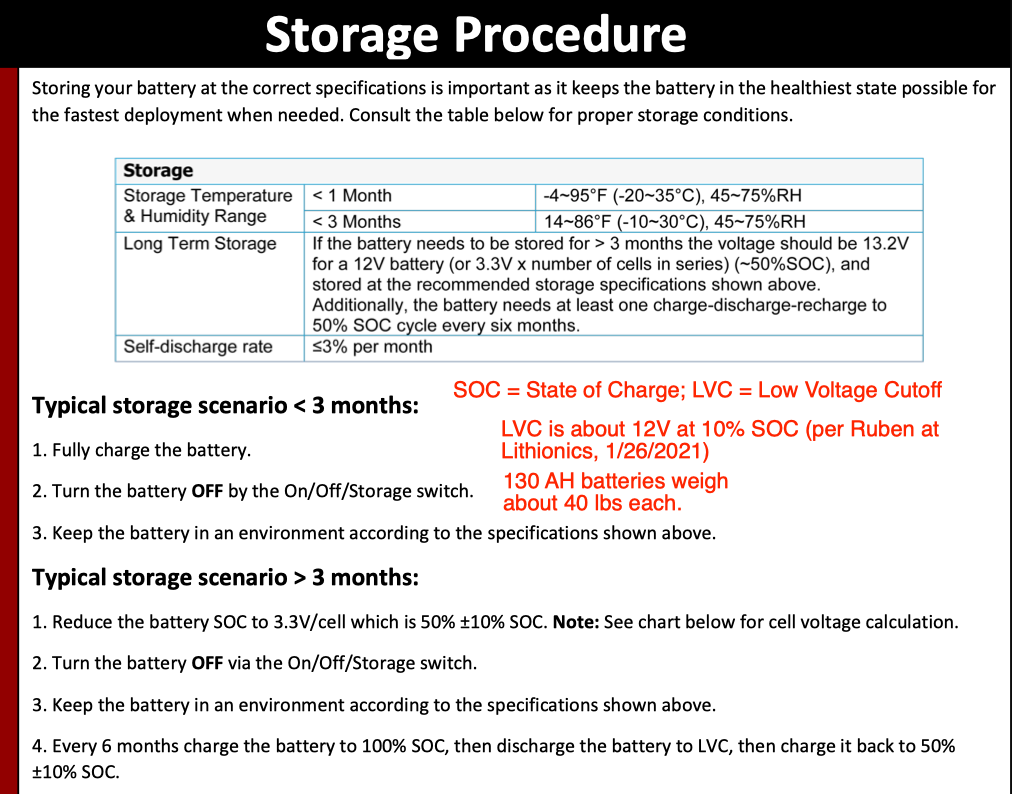
Oliver is now beginning to use three 130 AH batteries (390 AH total) as part of the lithium package. Listed below are the storage requirements from the Lithionics website (https://lithionicsbattery.com/wp-content/uploads/2019/02/Lithionics-Battery-Storage-Procedure.pdf -- my additions are in red text). LifeBlue batteries likely have similar storage requirements. These are storage requirements; the lithionics batteries have a charging range of 32°F to 113°F, and a discharge temperature range of -4°F to 113°F. In other words, when the batteries are in use (e.g., when traveling) they can handle a broader temperature range than when in storage. After much back and forth, I have decided to order the lithium package. Here's why: (1) there is ample charge for several cloudy days at our anticipated daily use (probably between 75 and 100 AH per day) to last for several cloudy days; (2) there is ample battery capacity for occasional, short duration A/C use (perhaps for an hour at 100 AH per hour), although this will likely require supplemental charging from non-solar sources); (3) the lithium package comes with the 3000 W inverter, which allows A/C use at rest stops; (4) I've satisfied myself that I will generally be within the operating and storage temperature ranges; (5) lithium batteries charge more quickly than other battery types from generator or shore power; (6) lithium batteries reduce trailer weight; (7) at least in theory, lithium batteries will last longer; and finally (8) it is done, the system is built, I won't (hopefully) need to upgrade soon, and I can simply use the system. Yes, the lithium batteries do require some attention, especially in exceptionally hot or cold climates (e.g., during extended visits with BackofBeyond's sons). However, here in the arid west where temperatures are typically less than 105°F, and generally greater than 0°F, it should be OK. If it looks like the temperatures will be excessively high or low during times of storage, I can remove the batteries from the trailer and keep them in a conditioned environment: each individual battery weighs about 40 pounds. Another alternative would be to purchase the solar/AGM package and wait for lithium battery prices to fall. However, the solar/AGM packages only comes with the 2000 W inverter. Future upgrades to lithium with the intention of occasional A/C use would require a new, larger inverter. Another reason to perhaps delay going with lithium now is that future lithium battery packages may have greater capacity (e.g., 500 or 600+ AH). However, charging this size of battery (the initial cost of which will likely be expensive) would probably require the use of shore or generator power; there is insufficient charge current available from the existing (340W) rooftop solar system to charge a mostly discharged 600 AH battery pack in a reasonable amount of time. A general rule of thumb might be to have ~1.5 watts of solar panel for every AH of battery capacity (thanks for this, Overland). Thus, 390 AH battery (as is offered in Oliver's current lithium package) is perhaps sufficiently right-sized for the current 340W rooftop solar array (especially if using a 100W or 200W portable panel in conjunction with the 340W rooftop solar). Lacking additional solar, additional charging capacity has to come from the TV, generator, or shore power. If the goal is to reduce or minimize generator use (or shore-power reliance), there's an argument to be made for not oversizing the battery. (Actually, thanks to Overland for helping frame this entire bigger-battery-is-perhaps-not-better perspective.) In summary, I am not in the more tech-savvy group among you (although I feel like I'm confused now at a higher level than when I was before -- that's progress). Nonetheless, I am grateful that Oliver is offering a lithium package, even if the implementation is still evolving. I'm looking forward to giving it a try. quirements

-
CELL BOOSTER As Andrew notes, Oliver is no longer using the WeBoost unit; they've gone to the SureCall Fusion2Go 3.0 (https://www.amazon.com/SureCall-Fusion2Go-Vehicle-Booster-Carriers/dp/B079TKG6Q5/ref=sr_1_3?dchild=1&keywords=Fusion2Go+3.0&qid=1611515323&sr=8-3). A 5-G knock-off, perhaps, although it seems like SureCall is one of the larger suppliers for this sort of device. Here are product specs: Uplink Frequency Range (MHz): 698-716 / 776-787 / 824-849 / 1850-1915 / 1710-1755 (G Block Included) Downlink Frequency Range (MHz): 728-746 / 746-757 / 869-894 / 1930-1995 / 2110-2155 (G Block Included) Supported Standards: CDMA, WCDMA, GSM, EDGE, HSPA+, EVDO, LTE and all cellular standards Input/Output Impedance: 50 Ohm Maximum Gain: 50 dB Noise Figure: ≤5 dB VSWR: ≤2.0 Gain Adjustment: 20 dB (Automatic) DC Car Charger: 6-15V Maximum Output Power: 1 Watt EIRP Cable: SC-240 Exterior Antenna Cable Length: 40 ft RF Connectors: FME Male (both ends) Power Consumption: <10W Dimensions: 5.625" x 4" x 1.125" Weight: 1.43 lbs This unit supports multiple frequencies: LTE bands 12, 17, 13, 5, 2, 25, 4 (i.e., more than bands 4 and 13 on older models, which is good). The Internet Resource Center folks (MIMO vs Boosters: Do Cellular Boosters Provide the Best Signal & Data Performance? - YouTube-- thank you, Andrew, for the initial link) seem to have a decent opinion of the SureCall cell booster. However, I'm beginning to think that the hotspot approach (such as the Jetpack sold by Verizon) may offer a better antenna, wifi access to internet for other devices (e.g., laptop and tablet), and a port to plug a MIMO antenna or an even better antenna (such as John Davies is doing). Furthermore, StarLink (https://www.starlink.com) may soon provide an internet alternative where one system serves both home and trailer (100 Mbps download, ~$100/mo), with access in and out of cell areas, negating the need for pulling in weak cell signals. Expensive, yes, but if it replaces DSL or cable at home a well as provide mobility, then it's an intriguing solution. WiFi BOOSTER According to the Internet Resource Center (IRC), the WiFi booster used by Oliver (WiFi Ranger Sky Pro, based on photo in Upgrades -- please correct me if this is not true) is decent, but not very future proofed. My understanding is that the model is being discontinued. There are many alternatives out there at various price points that do different things. Head-spinning, really. The IRC folks are making a full-time occupation out of reviewing the plethora of devices for mobile cell, internet, and wifi uses. Thus, unless some of you make a compelling argument to the contrary, I think I will try the trailer without the factory-installed devices initially, and perhaps look more closely at a Jetpack or similar device in the future.
-
Thank you, Bill, for your detailed descriptions and comments. Do you think that the combination 890 and BC35 camera would be a solid alternative to the backup camera system that Oliver installs on new trailers ("Furrion Vision S" with a 4.3-inch screen)? Or, do you find that the 890 provides substantial benefit as an additional backup camera system so that both are warranted? From your description, the Garmin combination would offer a much bigger back up screen (perhaps making it easier to see obstacles when backing up), plus give all of the benefits of navigation, especially if you can easily toggle between rear-view and navigation when driving. Does the BC35 camera have a motion-detect function (I don't see anything mentioned in the Amazon descriptions...).
-
2,000 watt inverter vs 3,000 watt inverter
Fritz replied to Fritz's topic in Mechanical & Technical Tips
Thank you — I’ll check with Oliver. -
Thank you for finding and posting this. Do you know the purpose of the small rail above the exterior light? Perhaps shield the window from some of the rainwater coming off of the roof?
-
2,000 watt inverter vs 3,000 watt inverter
Fritz replied to Fritz's topic in Mechanical & Technical Tips
Thank you for all of your comments. I agree that "less might be better" -- we have not yet decided on the microwave (that cabinet could be a good spot for storing the instant pot instead). But how many of you have (or perhaps would have if you had the larger inverter and sufficient battery power) run the A/C for short periods of time, taking a short respite from the heat on a hot summer day? -
I agree - partial deployment, and maybe a solid fabric to help shield rain, would be good. If they are light, perhaps they could be held on with suction cups (and removed for travel)...
-
Thanks -- your first photo came through, but not the second one...
-
Is there any advantage to a 3,000 Xantrex watt inverter over the 2,000 watt model other than perhaps occasional, short-duration use of the A/C using lithium battery power?
-
I've lurked now for several years on this forum, and over the last year have even begun sneaking in some questions. I've been highly impressed with the knowledge, advice, suggestions, and ideas; the constructive forum community has contributed to our selecting an LE2. And now that we are getting closer to finalizing our order, I thought I'd send in a more formal introduction. My first RV in the late 1970s was a Job Corps bus (a shorty school bus); since then my wife Susan and I have backpacked, tent- and car-camped, owned 2 Airstreams (1965 Globetrotter and a 1966 Caravele), and over the last 13 years have averaged 2-3 months per year in a Sprinter conversion attending old-time music festivals, exploring the west, and visiting friends and family throughout the country. Our vacations over the years have also included numerous self-supported whitewater raft and kayak trips. We hope to continue doing all of these things, and perhaps, in our travels we'll have an opportunity to meet some of you in person. In the meantime, I look forward to learning from you.
-
Has anyone perhaps used suction cups and tarps (e.g., lightweight nylon) to create occasional streeetside shade in lieu of an awning? If so, how has it worked? Similarly, has anyone tried smaller, window-size awnings for shade or as a rain shield? In advance, thanks for your insights.
-
Back to solar/battery (and inverter) options ... Our ordering deadline is approaching quickly, and I'm still wrestling with the Solar Pro vs Lithium Pro option. The lithium package appeals to be, but it seems that the implementation in Oliver trailers is still being refined. Several have suggested going with Solar Pro (340W solar, 2000W inverter, AGMs) now, and perhaps replacing the AGMs (or less expensive flooded-cell batteries) with lithium when the AGMs wear out. However, the Lithium Pro (340W solar, 3000W inverter, lithiums allows use of the AC for short periods of time (e.g., highway rest stop for lunch on a hot summer day). The 2000W inverter in the Solar Pro setup, even with lithiums added later, may be insufficient for the the AC (as I understand it). So selecting the solar/battery package based on batteries may preclude future use of the AC. So, my questions are these: 1. How hot does it really get in the trailer on very hot days (e.g., over 100°F)? Does the white outside color reflect enough light so that the interior temperature is OK with fan, open window, etc.? Is the AC a needed for this situation, or am I overthinking it? 2. Are there other reasons for having the 3000W inverter other than AC? (We can easily do without microwave or other high-use items when the AC is on.) 3. Can the 2000W inverter somehow be used to run the AC (with easy start) from battery power for relatively short periods of time (thinking ahead, when the AGMs have been replaced with lithiums) as long as there are no other major, simultaneous electrical draws? 4. Is it better to stick with the 2000 W inverter, carry a generator in the optional utility box in front of the propane doghouse, and rely on the generator for AC during rest stops? Theoretically, on option would be to order solar, less expensive batteries, and the 3000W inverter now, but that's not how the packages are arranged and it seems highly unlikely that Oliver would deviate from the pre-packaged options. In advance, thank you for your thoughts! p.s., Based on current patterns, I anticipate that 60% of our use will be boondocking (in the open or in SP or FS "primitive" sites), 20% with hookups, and 20% in friends or family driveways (most often with 15A 120V electric).
-
From previous posts I understand that the awning is a 16-foot version of the Girard model GG750. FYI, I called Girard about the two fabric options (standard is a vinyl material; "pro" is a canvassy sunbrella material called "Bravia") -- I was interested in longevity. Longevity, of course, depends on many factors, including sun exposure, humidity, conditions during storage, etc. I was told that the vinyl might last at least 3-6 years with "typical" usage (whatever that means, although the company is in Southern California); Bravia 5-8 or perhaps 10 years. Bravia is breathable; vinyl is less so, and can mildew if stored wet. The vinyl costs $270 + shipping and labor to replace (he said replacement is not all that difficult, and there is a video to help guide the process). The corresponding replacement Bravia material costs $560 + shipping. Thus, a person could go through 2 vinyl replacements and still be ahead over the cost of the Pro model (assuming labor is DIY and free), although the Pro model represents less throw-away material (the Pro model would also include the sensor and light, I suppose). Finally, FWIW, the entire unit (didn't specify standard or Pro) weighs about 80 lbs.
-
Kudos on collecting, compiling, and presenting these data. It appears that the space heater resulted in a 10°F temperature differential between outside ambient and basement temperatures, and the furnace (with the ducting mods you've made) made an approximate 20°F difference. Thank you also for recording propane use. Your nightly use of 7.2 lbs of propane, or about 1.7 gallons (at 4.24 lbs per gallon), would cost about $7 (at $4.00/gallon). Substantially less than the tax on a ski-area hotel room.
-
Ram 2500: Air suspension? 2nd Alternator?
Fritz replied to Fritz's topic in Mechanical & Technical Tips
Thank you all for the responses. I think I'll pass on the air suspension (based largely on Mike's comments) and second alternator. I spoke with a local auto electrician -- he confirmed that the single alternator would produce plenty for whatever sized wire that can be reasonably extended to the hitch area and on to the trailer battery. I'll be curious what mileage you experience, Mike, when you head for Arizona...🙂 -
Ram 2500: Air suspension? 2nd Alternator?
Fritz replied to Fritz's topic in Mechanical & Technical Tips
Thank you! That's encouraging about the suspension -- I would prefer to pass on it. Is your truck version slightly higher than the standard Laramie? In the 3 weeks have you towed enough to get a sense of towing fuel mileage? -
I'm getting close to ordering the Ram 2500 (w Cummins) to tow an LE2. With the trailer tongue weight (~600 lbs), topper (200 lbs), and perhaps 400 lbs in the bed, is the air suspension really needed or is the squat tolerable without? Similarly, even with a heavier gauge charging system to the trailer (heavier gauge wire, with or without a DC to DC converter), is there any benefit to ordering a second 220-amp alternator. It seems that the single, standard 200-amp alternator should suffice (given the wire-gauge limitations of anything that can be run and connected to the trailer batteries), but I'm interested in your opinions. Thanks!
-
There is still much to be said for the Lithium Pro Package, largely because of the lithium batteries themselves. But with recent threads about solar controllers, solar charging levels, DC to DC converters, and options for increasing current flow from tow vehicles, I'm inclined to think there are at least 2 relatively low-cost improvements that would make the Lithium package more much useful, efficient, and appealing. The first is to use a MPPT charge controller instead of a PWM controller. There doesn't seem to be a substantial cost difference, and the MPPT will allow batteries to reach 100% charge from solar. The second is to install a heavier gauge wire during initial construction from the hitch area to the batteries (with dedicated fuse) that can be used by a later, owner-installed charging system from the tow vehicle. Such a system would allow greater charge rates from the tow vehicle than is possible through the 7-pin connector. If the AC is to be run for short periods of time from batteries (e.g., for 15 minutes at a rest stop), it would be very nice to return portion of the battery charge during 2-3 hours subsequent driving (at least more than is possible through the 7-pin connector). A dedicated owner-installed heavy-gauge wire from TV battery (as LifeBlue has suggested) to the TV hitch is part of the solution; a matching cable from the hitch area to the trailer-battery area is another part (a DC to DC converter could also be installed later by an owner, if desired, but the harder part seems to be installing a heavier-gauge charge wire from the trailer hitch to the battery area). In fact, for those opting for the Pro package, a 12V charging port for connection to the tow vehicle may be more useful than the optional 30-amp connection near the propane tanks. Such a 12V connection could also be used for additional TV-mounted solar panels (with separate controller). I can only imagine that such vehicle-based charging will become more popular with hybrid and electric pickups. It seems both of these relatively low-cost improvements would make the Pro Package much more useful, allowing short-term use of the AC without needing to hook up a generator or plug into shore power to charge batteries afterwards (which kind of defeats the purpose of the beefier batteries, inverter, etc. Perhaps Oliver would be willing to weigh in on the feasibility of these changes for those of us in line for a 2021 trailer. And one other non-solar (but wiring-related) suggestion: might it be possible to wire one exterior light (e.g., the one by the door) separate from the others? This would provide lighting to enter or exit the trailer at night without needing to light up the entire campsite. Several others have commented on this; I think it would be a popular improvement. To Oliver: thank you for your dedication to thoughtful engineering and quality builds, and for the opportunity to have these community-wide discussions. My hope is that these suggestions could make an already stellar product even more so.
-
I've been learning lots from these solar/battery/charging threads, but still feel confused, although perhaps confused at a slightly higher level than before 🤔. So, I wrote to LifeBlue about charging using a DC to DC charger: "I was shown the LifeBlue electrical diagram for increasing charge current to LifeBlue batteries in an Oliver trailer. How does this compare to using a Redarc DC to DC charge controller (e.g., https://www.etrailer.com/Battery-Charger/Redarc/RED96FR.html)? Here is his response: "We don’t recommend any external DC converters. If you use the right size wire for the circuit, the battery will charge." So my question is this: Is charging the LifeBlue batteries from the TV "simply" a matter of having a large-enough wire to carry adequate current to the trailer (and from the front of the trailer to the batteries), or is there a benefit from an external DC converter (which is what I understand the Redarc charge controller does) to fully top off the batteries. Larry, if you see this, perhaps you could weigh in on why you don't recommend an external DC converter.
-
Has anyone tried to modify the wiring so that there is a dedicated switch for just the light by the door? Or perhaps a dedicated switch for just the lower light near the steps. With such a switch one could see enough to exit for enter the trailer without lighting up the entire campsite...
-
My understanding is that you can choose any awning color as long as it is black.
-
I've been contemplating a tow vehicle now for several months (a long waiting time for the LE2 allows this). Preferred TV: 1/2 ton diesel, but the payload isn't there. John Davies said "You owe it to yourself to go try the Ram 2500." I did, and tried the GMC HD also. Big vehicles, but solid. It appears that either of these trucks would get better towing mileage than any of the 1/2 ton, non-diesel pickups (search for "LE2 Towing Mileage"). But in the back of my mind, I saw folks like Mike and Carol trading a 1500 for another 1500, and concluded they must have been plenty happy with the 1/2 ton truck. But now they trade to a 2500 -- more payload and capability mountain passes. Well, I guess that points us even more toward the 2500. BoB, from your picture above it looks like you're using the Anderson WDH with your GMC 2500... am I seeing this correctly? If so, do you do this for the weight distribution, or ride quality, or...?
-
Factory lithium batteries - do they have a heating system?
Fritz replied to John E Davies's topic in General Discussion
NCeagle, what brand temperature monitor have you installed? Does it also have sensors for outside and inside temperatures? Thanks! -
There are multiple references to replacing the 2" hitch ball with a larger 2 5/16" ball and coupling. Oliver will do this on new trailers for $230, which includes some credit for the 2" coupler. Seems like the primary purpose for going to the larger diameter hitch ball has been to reduce wear associated with use of the Anderson weight distribution hitch. But what about trailers without the Anderson WDH? Is there still a wear or strength advantage? Seems like most 2" and 2 5/16" hitch balls have the same 1 1/4" shaft (and therefore the same shear strength), or perhaps that's not the case. Would hitch-ball material make a bigger difference than diameter? Thoughts?
-
I agree with this, but am leaning toward ordering the Truma unit anyway. It's not that we're interested in long, uninterrupted showers. On the contrary, in our current camper we have a diesel-powered Espar hot water heater, and we generally use it to simply fill a solar-shower bag at the closest faucet to the heater, and then move the bag to the shower. This approach uses *much* less water than that which is needed to get the shower-water temperature set at the shower itself. Less water from the freshwater tank, and less water in the gray tank. My current (but not firm) logic behind the Truma is that the Truma should heat water more quickly than the standard heater (thus using less LP), heat just the amount of water needed (which is typicallynot much), and be substantially lighter than the standard option (6 gallons that doesn't effectively add to the freshwater supply weighs about 50 lbs). 50 lbs here, 50 lbs there -- it adds up. It's appealing to use 120V power to heat water, but we are often not plugged in to shore power. I'm also hoping that while perhaps somewhat delicate, and Overland's experience notwithstanding, that the Truma will, in fact, be relatively reliable. How many of you have had ongoing, unresolvable trouble with the Truma?