Leaderboard




Popular Content
Showing content with the highest reputation on 03/21/2020 in all areas
-
One oil change every four years is risking internal corrosion. If the machine is parked in a dry environment that may be OK but if you run it even one short time, you should consider changing it more often. A full synthetic is better. An inductive hour meter/ tachometer is a super easy mod to monitor use and engine performance. I change the oil in my Yamaha every 50 hrs or at the end of every camping season. When parking your machine every time, pull the cord slowly until you feel resistance (compression) and then stop. This places both valves fully closed so moist ambient air cannot get into the cylinder and possibly cause rust. John Davies Spokane WA1 point
-
I finished my 3589 mile trip on March 9, 2020. The highest price I paid for diesel was $2.31 and the cheapest was $1.71. In the majority of the cases, I was paying considerably less for diesel then the gasoline listed price. Loves by far is my number one choice. The typical price paid was usually between .60 to .75 cents below listed price. For example, today the Loves near my house where I fueled listed diesel at $2.48 and I paid $1.65 for diesel. Gas is listed for $1.78. This was a discount of .83 cents from the marquee price for diesel. I love this fuel card!1 point
-
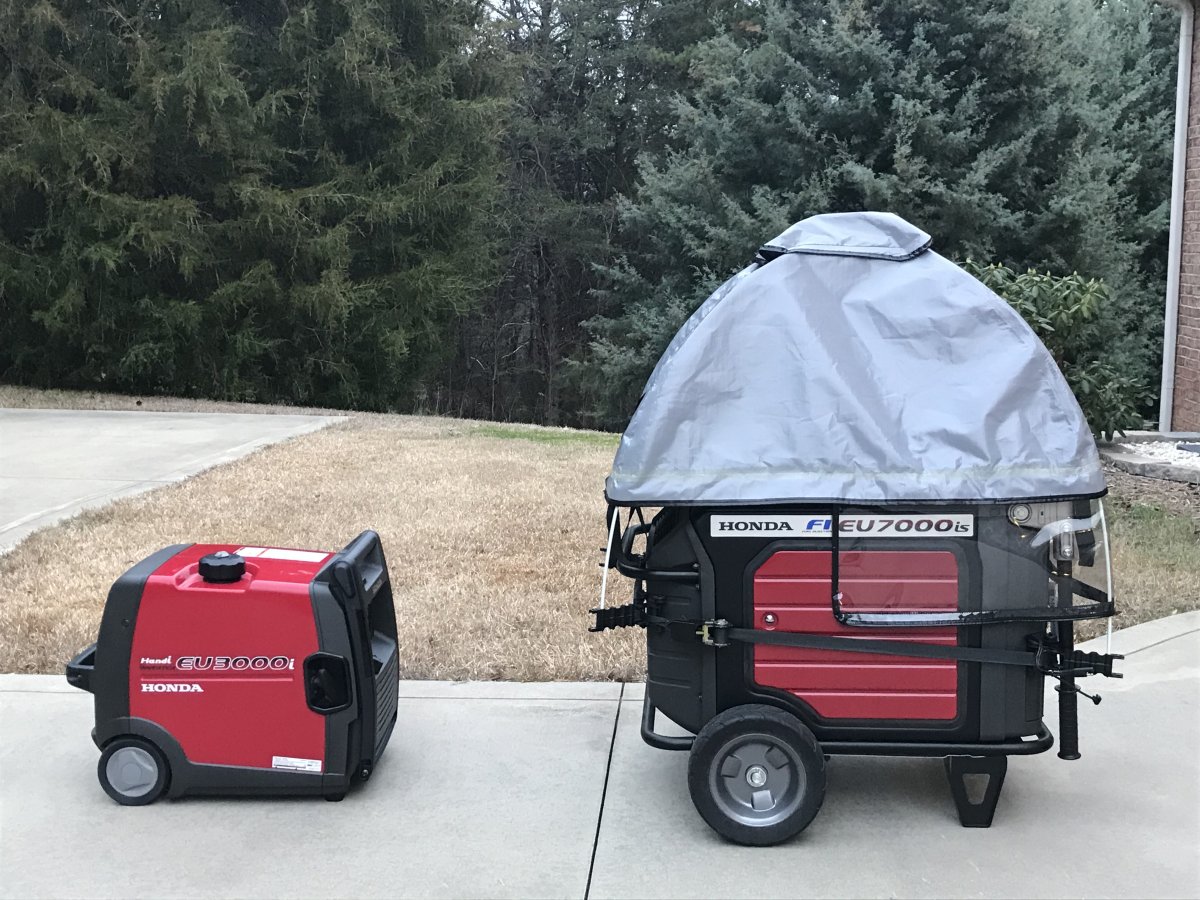
Here- We still like the whisper quietness and years of reliability of our two Honda’s. I can’t speak for other brands. The larger EU7000is is a backup for our home. It runs everything we need during a power outage except our 4 ton Trane AC. Ceiling fans are in play during a power outage to keep fresh air circulating.
 1 point
 -
Ah, I didn't catch that in your earlier post. If Oliver has moved to an integrated inverter/charger then that's a big upgrade. edit - well I thought it was a big upgrade. It doesn't look like that Xantrex unit has power assist, nor the networking of a Victron system. It looks like it has slightly faster charging @80 amps, but unless I'm missing something, the only advantage I see for the buyer is the switchable lithium profile. It'll be easier for Oliver to install, of course - at least from scratch. It'll be a bit of a pain as an upgrade. Come on, Oliver - you're just one step away from a modern electrical system. You can do it!1 point
-
Like a lot of people a year or so into ownership, I've been working lately on reducing the amount of stuff I carry - getting rid of things we never use and also finding strategies of making what we do carry lighter and more compact. I've also been working on a dedicated toolkit that would just stay in the truck permanently, so I don't have to worry about packing tools up and inevitably forgetting the one tool I need that trip. So what I've been after is, 1) a complete toolkit that has everything I might reasonably need for roadside or campsite repairs; 2) compact enough that it can be stored in the cab of the truck permanently, without being in the way; 3) can be stored in a way that still gives easy access when traveling; i.e., I don't have to completely unpack the truck to get to them; and 4) contains quality tools that can be relied upon. Certainly the easier solution is to ignore requirement #2 and just put a toolbox of some sort in the bed of the truck. I think that's perfectly fine; but personally, I'd rather keep them in the cab to protect them from moisture, trail dust, theft, and getting all scuffed up from being jostled around. Plus by keeping everything compact, I'm also forcing myself to keep the weight down. So in the following posts, I'm going to try to list all the tools I've placed in my kit, the reasons for choosing what I did, and then some ideas on how to best store them in your vehicle. The tools I've included are, as I said, what I think constitute a "reasonable" tool kit for repairs while traveling. "Reasonable", of course, is subjective. If you're the type who is likely to call Good Sam to change a flat tire (nothing wrong with that), then your "reasonable" might be limited to a few screwdrivers and a pair of pliers. On the other end of the spectrum, there are guys over on Expedition Portal who wouldn't go to the grocery store without a welder in their Jeep. And nothing wrong with that, either - to each his own. With that in mind, I'd like to think that my following posts are just a starting point for conversation. I'd love to know what others think about these choices - surely I've forgotten something, or one of you knows some better options or alternatives. With some additional voices, hopefully this thread can provide some guidance for new owners or others like me who are looking to pare down what they've been carrying. Fair warning, I do like nice tools, and have a thing for German tools in particular, so some of the stuff listed below is pricey. But I don't think that there's anything here for which you couldn't find a decently priced alternative, and arguably a better value. Or, you might be the guy who doesn't accept anything shy of Snap-On. Either way, buying all of these at once will put a good dent in your checkbook, even if you're shopping at Harbor Freight. So keep in mind that this isn't intended to be a "must have" list. Like I said, you probably don't "need" any of this. All you really need, in most situations, is a cell phone. But if you do decide to put together a toolkit of any size from scratch, I suggest you make an Amazon list and then set price alerts for each tool using 3 Camels (www.camelcamelcamel.com). That way you can buy at the lowest price and spread your purchases out over several months to make the cost seem more palatable. (I've also found after explaining that strategy to my wife, that when the packages arrive, she asks how much we saved vs complaining that I've bought yet another tool.). Actually, she does both, but I think there's less complaining than before.1 point
-
If you google search for WiFi Ranger, the first hit will be the website (https://wifiranger.com) for the company that makes them. A lot of info there. The google search page also lists reviews about the product. This is copied from my earlier post on Tethering a Hotspot to WiFi Ranger : "The WiFi Ranger has two inter-connected routers, the Sky router on the roof and the Go2 in the cabinet above the dinette, and it provides a number of useful features. First, it creates your own local network, which is especially useful if you have multiple devices. Logging in to your network is easy, as your devices can remember the password to your local network. Second, the rooftop antenna can boost the WiFi signal from a campground, a Starbucks, or a truck stop, from as much as a mile away (see post by RVGeeks). If your device (phone, tablet or laptop) is connected to the WiFi Ranger, you would have a much stronger signal and faster speeds than if you connected your device directly to the WiFi source. Third, the Sky router on the roof allows you to access your WiFi signal outside the trailer, as much as 1000 feet away. This allows you to surf the web at the picnic table or by the river. When inside the trailer you should connect to the interior Go2 router."1 point
-
Answers to your questions depend on you use case for mobile data: Some considerations and a quick table I made to show the differences... A key resource for all of us who are going to be mobile, and want to use internet on the road. This site was started by some previous Oliver owners...who were living the life of mobile technical writers. Since then, they've grown their YouTube and Blog on Mobile Internet into their main line of business. They do reviews of various types of BOOSTERS for CELL and WIFI and discuss the differences and why each is needed. They also describe many different use cases for RV's. From full time to part time, mobile workers to occasional travelers. They review and track the various data plans by Carrier, AT&T, Verizon etc...and tell which is the best value, has best coverage. Link below: https://www.rvmobileinternet.com/ C Short Hull 505 -Galway Girl
1 point




-
Recent Achievements
-