
John E Davies
-
Posts
5,759 -
Joined
-
Last visited
-
Days Won
243
Everything posted by John E Davies
-
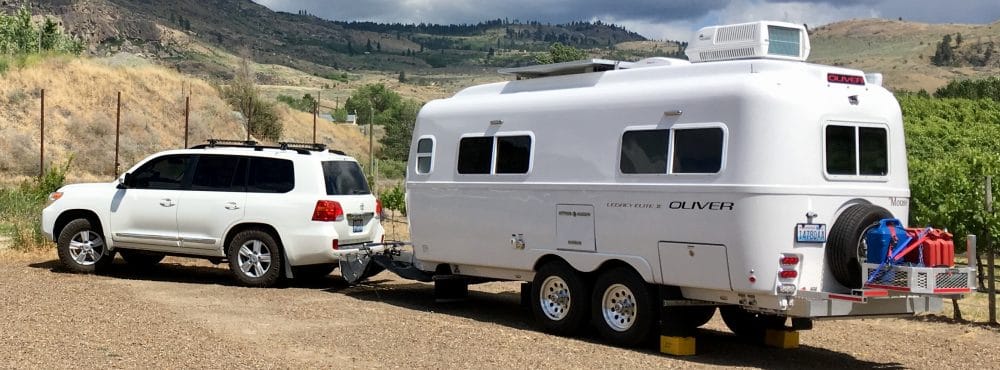
I forgot to ask, what options have you ordered? To minimize towing weight I suggest AGM batteries, standard solar, and the composting toilet only. No inverter and no microwave, it is a huge energy user when off-grid, no satellite dome, it increases drag! Those choices and traveling with an empty fresh tank will improve your range measurably. Add a bunch of heavy options and your trailer weight will go way up. The Elite is a little tank, small and quite dense, it is no 2200 pound Casita. John Davies Spokane WA
-
It is always interesting to hear from folks trying to push the towing boundaries. Where do you live - you mentioned camping in Nevada and Utah in an earlier post. Obviously the number and location of chargers is paramount. You need to fully understand that there are lots of places in the West where you will not be able to go, period, because even gas stations are in short supply. A (hoped for) 150 mile range is simply not enough. What about severe mountain grades? Have you considered the hassles of running empty and having to get towed from a remote location that any old gas or diesel truck would get to with “no worries”? Assuming you can even call out when there is zero cell service? Finding available charger stations where you can take an attached trailer is a whole lot of non-stop mental stress that will ruin the pleasure of being out camping. Getting rid of your stresses is important, that is why we advise roadside assistance coverage, a satellite communicator (out West), a more than “adequate” TV, and TPMS on the trailer. Lots less worries, more enjoyment. One thing you may not have completely thought through, how do you plan recharge your depleted trailer batteries? Surely you can’t tap current off the X without further reducing your range. Or do you plan to stay only at full hookup campgrounds, which is in itself problematic. Many National Parks and Monuments don’t have any at all. Your solar will help, but it cannot be relied on for a complete daily recharge. Are you going to bring a generator and extra gas? If one large enough to run your AC is mounted on the tongue cargo tray it will max out your tongue weight. A Honda EU1000i is light and would be enough for a couple of trailer batteries. Good luck on your X adventure, I hope you will post threads and pictures, I am sure there are a few people interested here. John Davies Spokane WA
-
Bill, that is very cool, and I am a huge fan of RAM mounts, but my concern would be unwanted reflections in the windshield. Those bug the heck out of me, I much prefer stuff to be down, below the lip of the dash cover. It does look like a solid and versatile piece of kit. Can something similar be mounted lower down? Or you could install a flat black Dashmat carpet cover over the whole area, and make a small “hat” out of black felt to cover the mount parts. That would look a little odd but would completely kill all reflections. Every car I ever owned has had a black dash cover, they work really really well. The light colors, not at all, they reflect into the glass. https://www.covercraft.com/us/en/dash-covers John Davies Spokane WA

-

Dexter Leaf Spring Axle Zerks - Elite I
John E Davies replied to WNCpete's topic in Mechanical & Technical Tips
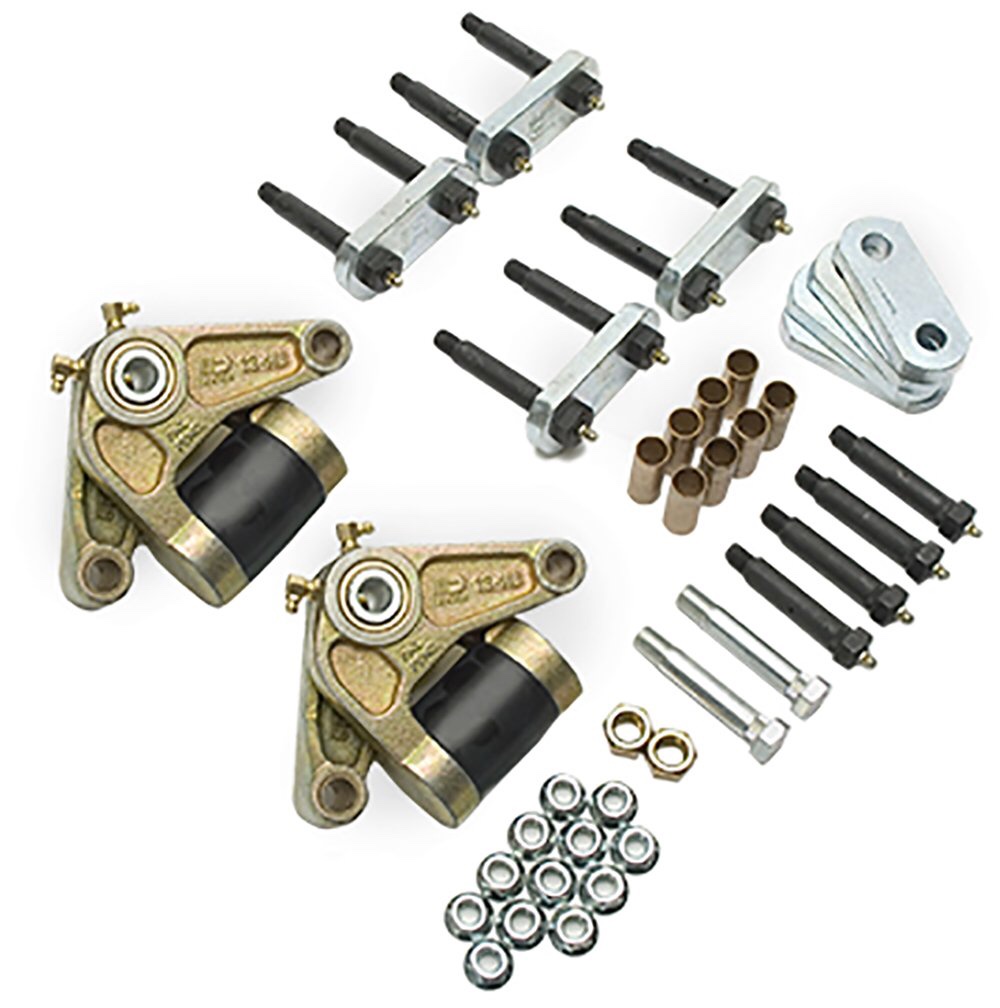
Whenever a GREASEABLE suspension part is bolted between two tabs or “ears” (the fixed mount on the frame or a moving shackle) it MUST have a bushing between the two ears. The bushing is slightly longer than the part it goes through, the spring eye for example. When you tighten the nut it draws all the parts together until the ears contact the bushing. At that point, further tightening applies the correct torque to the nut and the parts don’t move inwards any more. With no bushing to stop the movement, the ears bottom out hard against the part, like your sides of your spring eye. It also causes the nut to go further onto the bolt than it should and “may” cause damage to the nut or bolt if it runs out of threads. So not only can you not apply grease, it is binding up that location. So you get noise and lack of motion. One way to “fix” the noise is to loosen the nut half a turn. Now the spring isn’t getting pinched, but you will have no way to lubricate the parts, and it will be noisy eventually, and wear out very fast. This is basic Auto Mechanics 101. If you are not comfortable taking your suspension apart, then start a service ticket so a RV tech or trailer tech can do it. Do not leave it as is. You need all the parts looked at and corrected to the proper setup. Oliver will pay for it, no worries. John Davies Spokane WA -
Thanks for the link, I added it to my RV Wish List. It uses 4.8 amps at 12 volts, a little high IMHO but since it cycles on and off that isn't a worry. HOWEVER, the manufacturer doesn't say anything about batteries, it is for gluing to the bottom of a holding tank. I would be very concerned about placing a bunch of heavy batteries on top of it. OTH you could glue it to the bottom of the sliding tray, that would still work and would not smash any internal wires. John Davies' Spokane WA
-
I am firmly in BoB’s camp. The new tech is jaw dropping but I always have to think, what about an out of warranty failure? What cost, and how long to get parts? Is the inverter repairable or do you toss it? And I still have a hard time accepting the concept of idling your truck for hours in a campground, but I can certainly see how tempting that would be for running the AC. It will be interesting to see how this develops. John Davies Spokane WA
-
That is a great article, I did not see anything wrong with what they did, it is just a really souped up version of the small Redarc unit I started this thread about. They just multiplied all the parts by about four times 😳. I don’t think I would do anything different, except I would run a dedicated ground wire all the way to the battery area, not just hook it to the frame in back to a bolt ... that can make problems years later from corrosion caused by stray currents moving where they are not supposed to be. I saw this and was impressed, I have never seen one of those hinged covers in the forty years I have been using Anderson connectors. I need to find a source. Thanks very much for posting, I enjoyed the read.... EDIT: I found that cover and mount, it has to come from Oz, it isn’t sold here. “ the original version, not the rubbish from Asia.”😀 .... https://andersonconnect.com.au/store/index.php?main_page=product_info&products_id=58 John Davies Spokane WA
-
That is a very good question, why don’t you ask the Mother Ship about it? I think it deserves its own thread. Their lithium packages seems to be a work in progress at this time. Way WAY big battery capacity, but the other side of the equation- how to recharge all those amp hours once it gets depleted - has not been figured out yet. I see no point in a huge battery bank if you can’t get it recharged without plugging into shore power or running the generator every other day. I do think that something like this Redarc charger, an onboard unit that has the ability to take the batteries to 100%, not 70%,, should be a fundamental part of the lithium package. As should be a more efficient solar charge controller. Every little improvement helps the overall package.. John Davies Spokane WA
-
First few months of ownership (Legacy Elite I) -
John E Davies replied to QuestionMark's topic in Mechanical & Technical Tips
You need to have your shackle bolts fixed, what you have described is not right or normal. All my wet bolts accept grease properly and all have bright cad plated bushings, so the grease squirts out to where it needs to go, between the moving springs and the shackles. Without a bushing the hole is open to the sky, as you discovered. Plus you cannot achieve correct bolt torque with no bushings, the nut threads will bottom out (damaging the nuts and the bolts) and the shackles can pinch the springs. As shown here, the bushings for the equalizers are pressed into those parts. You need to open a service ticket and have all your hardware inspected and replaced if necessary. At the very least all the nuts have to be replaced. If the shackles or springs are worn from contact, they also should be replaced. Oliver should pay for it. You can get a mobile RV tech to do it if possible, rather than leaving it at some idiot dealer. This is not something you should let slide at all, it needs to be correct. Ollies do NOT squeak and groan, it is a warning sign, a cry for help. The axle ubolts can and will bang hard against the frame, but the other parts, if greased properly, should be dead silent. OTH old style Andersen hitches can sound like the Spawn of Satan if the friction cone gets wet/ contaminated. Please keep us posted. John Davies Spokane WA
-
OTH, there was a thread here about how to add extra security to your Ollie when boondocking. I think this would qualify, as long as the owners remembered to wear non conducting gloves and shoes. Keeping the frame and steps juiced up with 120 volts AC might deter a bad guy or even a bear.... 😜 John Davies Spokane WA
-
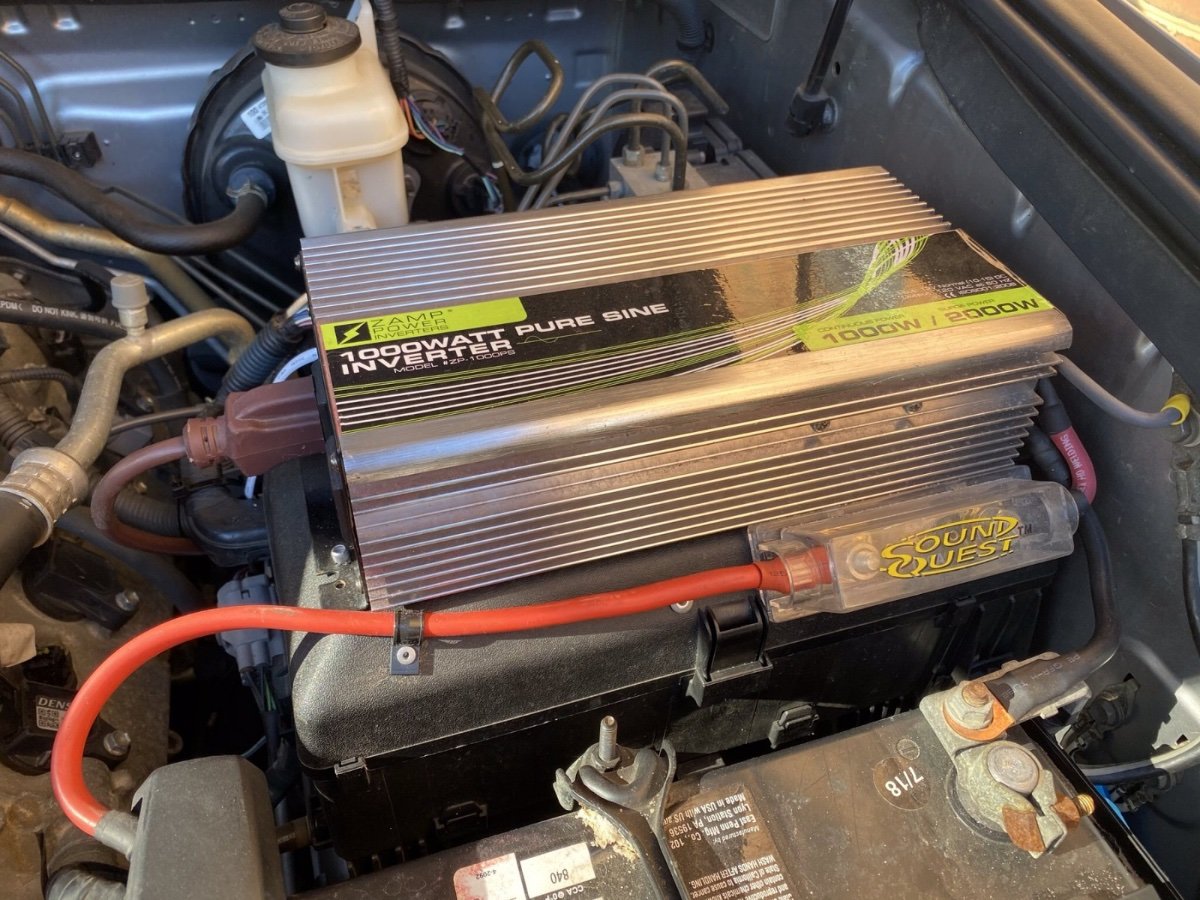
Edit 10/16/22, in case that link disappears. Yikes! He mounted a 2000 watt (surge) inverter in the engine compartment; these units will shut down at temps above around 150 degrees F. The heat is really bad for them. And no way is that unit OK for a wet environment like that. Zap! He ran a 120 VAC 16 AWG live household extension cord past the engine, exhaust and under the truck chassis! The first is just poor planning, the second is super dangerous and against all kinds of codes and logic. I did not read any further, this is criminal. Please do not do this. John Davies Spokane WA
-
My onboard Progressive Dynamics charge converter itself draws 725 watts, around 6 amps AC. If you flipped off all the other circuit breakers you might be able to get by with a 1000 watt inverter. But if any other circuit was live and drawing power, like the microwave, then it would not carry the load. Regardless, going from DC to AC and back to DC to charge batteries is really inefficient. And that 1000 watt inverter would need a 6 AWG supply cable. John Davies Spokane WA
-
I agree that is "best" in terms of being able to handle 30 or 40 amps DC continuously, but not at all best in that you have to modify your existing tow vehicle, run huge wires with huge fuses and connections, which is always a major hassle, and then do the same for the Ollie. You could punch a hole in the hull below the propane bottles next to the factory wires and then run the new cables under the vanity and along the waste system to the battery area. Doable, but hardly an easy solution. Big cables, big connectors and big fuses are expensive and require special tools to fabricate. Then you trade in the truck and you have to do it all over again for the new one. And when you sell the Ollie the new buyer looks at that extra cable on the tongue and says "What the heck?". You either take a loss on the cost of all the installed equipment, or you yank out the electronics, leaving all the cables in place, to reuse on the new truck installation. You will always have the extra hassle of a large cable pair carrying a high current on the trailer tongue, and you need some safe location to plug it into near your back bumper. If you can provide your own tools and skilled labor, it may be a good approach, but if you have to pay for 5 or 10 hours of shop labor, probably not. They won’t quote you a price, it will be “time and materials”, and you just have to hope they don’t work slow or run into bottlenecks. OTH it should charge the factory Ollie lithium package very well. So, I guess “best” is determined by your purse size, battery bank size, solar conditions, and your priorities. I think the really big advantage of this Redarc unit, other than ease of installation, is that you can say to a buyer, “Sure, it only gives you 11 amps, but it is a high quality charger, it protects your truck’s electrical systems, and you probably won’t even need to a small sense wire to the engine bay. If you do, it might cost $100 including labor.” It is better than telling them, “To get this to work you need to install a whole bunch of expensive specialty equipment on your TV.” John Davies Spokane WA
-
Keep in mind that a simple converter is not a “smart” charger, it relies on a battery’s built in BMS to prevent cell damage. I would be happier with the more precise control of a real charger. I peeled off the Redarc charger info onto a brand new thread since it addresses more than just isolation. Let’s add comments specific to that particular unit here: https://olivertraveltrailers.com/forums/topic/4759-redarc-trailer-charger-mounted-inside-the-ollie-for-100-lithium-charge/ Thanks. John Davies Spokane WA
-
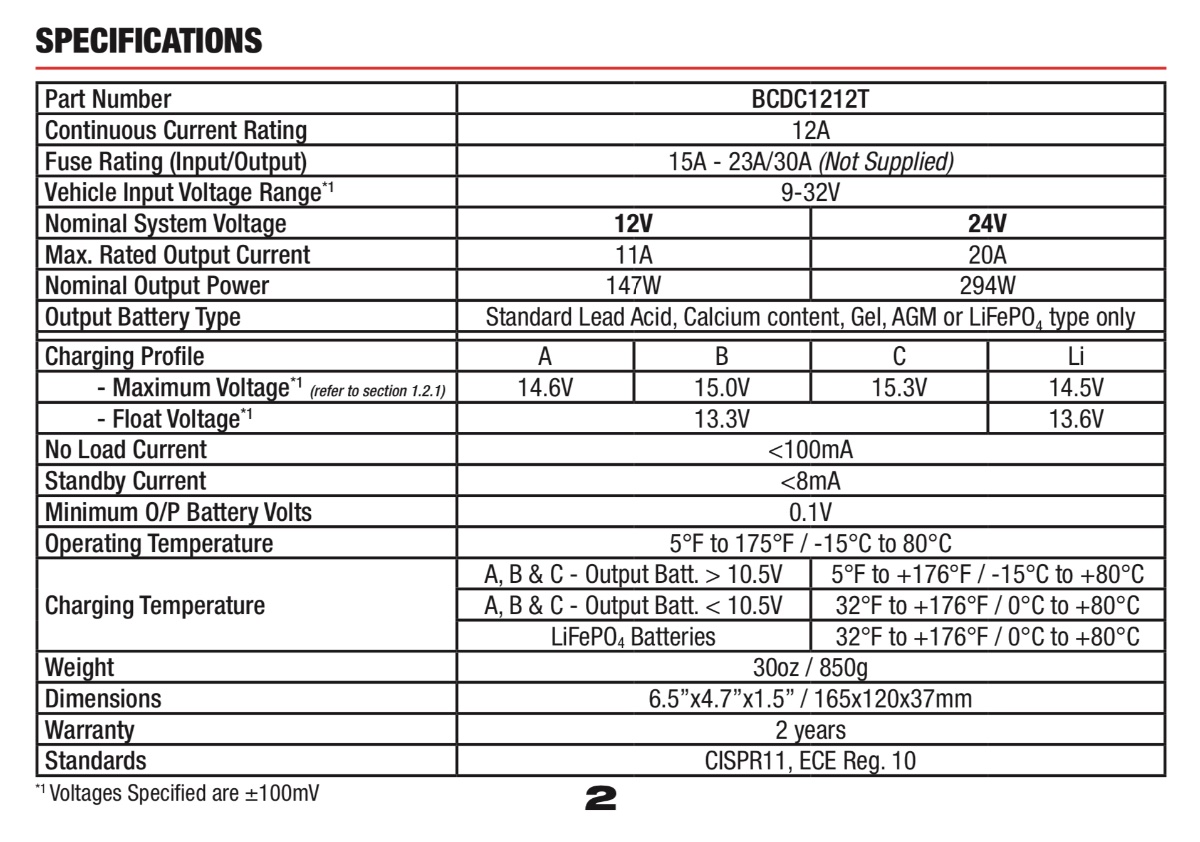
I peeled this off another thread about the need to isolate the higher voltage of the lithium batteries from the truck to prevent “back feeding”, one owner noted a continuous 5 amps😳. I am pretty sure it would work fine with the 20 amp fused charge wire already installed in the trailer harness but I would appreciate confirmation of the Ollie fuse and wire size. This device requires a 15 amp fuse on that input, and the max draw is only 11 amps (for a 12 volt system). This won’t flow a huge amount of amps to the batteries like other alternatives, but it should be plug and play for most tow vehicles; only a smart “variable voltage” alternator would require you to run a small sense wire up to the engine bay. All regular TVs don’t need that, it simply senses the rise in voltage when you start the engine and ten seconds later it switches itself on. Very cool, I think! It will charge lithium’s to 100% which is what I am after. Otherwise my Land Cruiser system probably won’t be able to get it over 70%. During sunny weather the rooftop solar should be enough, but I don’t want to completely rely on that in night time or gloomy weather. “The BCDC1212T is specifically designed for, but not limited to, applications where the input current required to charge a trailer mounted auxiliary battery is drawn through the vehicle’s towing harnesses and connectors. It limits the input current drawn to 12A which provides for safe and reliable operation when using towing harnesses, fuses and connectors that are suitably rated without the need to install additional cables and connectors between the start battery/alternator and the BCDC1212T/auxiliary battery. The BCDC1212T is a three-stage, 12V DC-DC battery charger that operates from an alternator input of 12V or 24V. The input voltage to the BCDC1212T can be above, below or equal to the output voltage making it ideal for charging an auxiliary 12V battery where the distance from the start battery or alternator may cause a significant voltage drop. When connected to a 12V alternator the BCDC1212T will typically provide peak boost currents of 11A. The BCDC1212T isolates the start battery from the auxiliary battery, to avoid over-discharging the start battery.“ https://redarcelectronics.com/products/trailer-battery-charger Instruction Manual pdf Excellent install video here at eTrailer.com: https://www.etrailer.com/Battery-Charger/Redarc/RED96FR.html They do caution that the lithium batteries must have a built in battery management system, which most RV batteries do (home brewed battery banks may not). I emailed the dealer I ordered my new Victron batteries from to confirm it would be OK to use this. So, are there any reasons this would not be a good choice? The fact that it is mounted on the trailer is really good in case you change TVs, or if you sell the trailer it will be useable by the next guy with little or no fuss. I think the 11 amp charging limit is acceptable for most people if it allows them to get close to a full charge during a typical drive. If you have 400 amp hours of batteries (the factory setup) that are severely depleted, there is no way it will bring them up to 100% on a single days drive; that is why you carry a generator so you can use the high charge rate of your standard converter. I plan for just two 100 amp hour batteries, using 80%, so I think this would be quite helpful. At the very least, it provides an easy fix for the isolation problem some owners have. Comments please. John Davies Spokane WA
-
You need to consider more than the continuous amp rating, the 18 amp one puts out 25 amps for ten seconds, it would pop that 20 amp fuse immediately. How about this Redarc Trailer Charger, it could mount inside the Ollie near the batteries and connect to the 12 AWG factory charge wire, no worries. Plus it isolates, so no back feed of current. “The BCDC1212T is specifically designed for, but not limited to, applications where the input current required to charge a trailer mounted auxiliary battery is drawn through the vehicle’s towing harnesses and connectors. It limits the input current drawn to 12A which provides for safe and reliable operation when using towing harnesses, fuses and connectors that are suitably rated without the need to install additional cables and connectors between the start battery/alternator and the BCDC1212T/auxiliary battery. The BCDC1212T is a three-stage, 12V DC-DC battery charger that operates from an alternator input of 12V or 24V. The input voltage to the BCDC1212T can be above, below or equal to the output voltage making it ideal for charging an auxiliary 12V battery where the distance from the start battery or alternator may cause a significant voltage drop. When connected to a 12V alternator the BCDC1212T will typically provide peak boost currents of 11A, and 20A when connected to a 24V alternator (the peak boost current however also depends on alternator voltage and input cable voltage drop). The BCDC1212T isolates the start battery from the auxiliary battery, to avoid over-discharging the start battery.“ https://redarcelectronics.com/products/trailer-battery-charger Instruction Manual pdf John Davies Spokane WA
-
These guys have it for 10% off through 12/06/20. Plus shipping. So it might be a wash compared to Amazon Prime unless you order other stuff. I just ordered $2500 of Victron goodies 😳 Merry Christmas to me. I was planning on waiting but the sale got me. https://www.solar-electric.com/victron-energy-orion-tr-smart-12-12-30a-dc-dc-charger.html I will be interested to learn more about this, though I am hoping my Land Cruiser won’t require it. I’m not sure where I would mount it, it can’t go in the engine compartment and under the chassis might not be so great. Maybe behind one of the interior panels behind the rear wheels. What is your tow vehicle? For a bumper connection I strongly recommend an Anderson 120 amp Power Pole (AKA “winch quick disconnect”) bolted to a bracket in a protected spot. These are super tough and very high quality. They also look super cool with the red pull tee handle (it takes 15 pounds of force to unplug it.) https://powerwerx.com/anderson-sb-connectors-sb120-120amp https://powerwerx.com/anderson-power-sb120-hdl-red-handle Have you thought about how you would get the big cables into the Ollie? Maybe into the space under the bath vanity..... it sounds fun to me. John Davies Spokane WA
-
“Can I recharge my lithium battery from my vehicle alternator? – Yes, but not necessarily to full charge, due to the fact that most Alternators are adjusted for the lower voltage requirements of the vehicle Lead/Acid Battery (approximately 13.9-Volts). Lithium Batteries require 14.4 to 14.6-Volts to fully charge. That being said, you can get up to approximately a 70% charge, depending on the depth of discharge and distance driven while recharging from your vehicle alternator.” https://www.progressivedyn.com/frequently-asked-questions-on-converting-to-lithium-charging/ John Davies Spokane WA
-
I think much of the conflicting info is due to residential vs mobile applications. For your home you have a very fixed set of conditions so you can plan exactly for angle and shadows. Obviously those conclusions do not translate well to an RV rooftop. I ran across an interesting spec: Victron MPPV units are 98% efficient. PWM units are typically 75-80%. I tried in vain to find a number for the Zamp ZS-30A. The fact that they don't mention it says to me that it is low. Has anyone seen an exact figure? If you can gain 20% efficiency by simply changing types, that seems like a very logical first step for those seeking more amps. John Davies Spokane WA
-
The standard Zamp solar controller won’t bring the lithium batteries to 100%. This has been reported by at least one owner who switched from AGM to lithium. It seems as if the factory package should include an upgraded MPPT type unit. It would have to be a brand other than Zamp because they do not make any. Can somebody with the new lithium and solar packages look at your documentation and see what is installed? Please post your info. Thanks, John Davies Spokane WA
-
Interestingly, when they first announced the new and improved version, they kept the older images on their website for quite a while, with no mention of the changes. I hope that it was because their web support team was slow to change them, but the cynical side of me says maybe Andersen wanted to sell off the remaining old stock. I doubt that they recalled all the inventory from their many online resellers. The new one is a much better design than the original , I do recommend removing the collar screws and adding some silver antiseize compound to the threads. John Davies Spokane WA
-
Wow, that is really interesting, it refutes all the many claims I have read that series is better for shade, she shows clearly that parallel in shade is better. Very informative, everybody should watch it! OTH she says that for shady conditions EACH panel should have its OWN controller, to maximize current. I can’t see that happening in most RVs. “So, this kind of shows you, that if you do have some partial shading, and it’s on only one of the panels at a time, so say you’ve got a chimney that you really have no control over, or if it’s on a sailboat, and you’ve got the mast that is kind of important, if you’ve got partial shading that’s going to be changing, it’s better to wire them in parallel to give the parallel path for the non-shaded panel. Ideally, and I know I say this a lot, ideally each panel should have its own charge controller, that way you will get absolute maximum performance, but if it’s not an option, wiring in parallel with partial shading is your better solution.” This video convinced me to keep the roof array “as delivered”. IMHO, folks who want a more reliable supply of amps when camped under trees need to get a portable panel and park it at an angle facing unobstructed direct sunlight (and rotate it and/ or reposition it a few times each day). I have one coming for Christmas. I may mount a more efficient MPPT controller for it inside the trailer, I will see how the suitcase unit does first. I am still going to replace the Zamp controller with a Victron MPPT, locating it under the street side bed, for a variety of reasons. Thanks so much! John Davies Spokane WA
-
Fans for the assurance of domestic tranquility
John E Davies replied to MovingVistas's topic in Ollie Modifications
My single Caframo located in the rear curbside corner works extremely well and it sips power (0.35 amps on High). Normally it is pointed down a few degrees and rotated in a 45 degree angle toward the street bed, where my wife sleeps. We both sleep head to the front, so we get the air on our faces. Even on Low or Medium speed she gets plenty of air, I get enough leakage to stay comfortable. If I am camping alone I point it towards my side. I highly recommend this fan, you could always install two and both have full control, though as noted above they are not remote control. Yes they are pricey, but I look at expensive upgrades as “making it easier to resell the trailer” though you never ever get back your investment in the upgrade part and labor cost. If the labor is your own, it is easier to deal with. https://olivertraveltrailers.com/forums/topic/3305-how-to-caframo-sirocco-ii-12-volt-marine-cabin-fan/ These really are quite nice, and I think Oliver should offer a pair of them as factory options. John Davies Spokane WA -
Thanks for the replies, this is all very complicated, isn’t it? I hate being the pioneer in stuff like this, certainly somebody has already done these rooftop tests.... but I haven’t found one yet. As I mentioned before, the only one was for series vs parallel with a MPPT controller in full 100% sunlight, and there was zero difference in the current output to the batteries. I will hold off on this part of my winter projects until next camping season when I can do some realistic solar gain tests using two of those reverse adapter kits; thanks so much mjrendon for the tip, I had not seen those before. I would need the MC4 connectors and tools anyway, to complete the roof cap change if the series turns out to be better in “challenging” solar conditions like the typical partial shifting shade in a USFS campground. But I really hate those SAE connectors for this type of application. My gut feeling is that with identical panels, series will be better. For those of you who have added extra smaller panels on the roof in parallel, the system will choke on those if changed to series. In that case for series, it would be best to move all small (matching output) ones to their own dedicated MPPT controller, with the main Zamp panels going to the main controller. That will involve more expense and running roof wires, and not worth the effort unless you are truly anal... John Davies Spokane WA
-
Winter Temps and pipe freezing
John E Davies replied to MarkC's topic in Mechanical & Technical Tips
If you know a simple design I would love to hear it. I think it would take two bypass valves with lines going out the bottom of the hull .... or is there another way to purge all the trapped water from the two lines going up to the shower unit? You can’t just bypass the hot into the cold line at the shower or you end up with luke warm (100 degree) hot water. I rarely use that shower and would much prefer it to be ALWAYS bypassed, but not permanently removed. And I would like the valves to be conveniently located with all the others, under the curb side bed on the LE2, that way the lines going across the rear of the trailer would be empty too. 😬 Hmmmm, time to think on this. It seems possible, the bypass valves could tee into the existing fresh tank drain line , but it needs to be completely foolproof when you winterize, with no trapped water. Thanks for any ideas... John Davies Spokane WA