
jd1923
-
Posts
3,883 -
Joined
-
Last visited
-
Days Won
316
Everything posted by jd1923
-
I leave all of our Victron products on all the time. I have breakers for everything under the dinette seat, didn't want extra switches. I'm not saying this is the right way. We also leave our Outside Courtesy Lights on 24x7 (rodent deterrent). Everything on we burn about 1.75A. About 1A for the MP2, 0.25A for the lights and 0.5A for all other electronics ON or on standby. The rooftop solar replenishes this much even on cloudy days. The last thing you want is to be towing down the highway and think, "oops, I forgot to turn on the Orion!" I've read here about some turning off their LevelMate to save batteries. Same thing, you're backing into a campsite and realize the LevelMate is OFF, bummer. We have the PRO model hardwired, always ON. I also have our Victron MPPT SC always ON. It's for the suitcase solar that we rarely use but when I plug in the solar cables it wakes up the SC. Am I hurting the SC leaving it on standby? IDK, but ours has been ON for two years now. Our hull has a power switch for the rear camera. This would be another circuit where just when you need it, it would be OFF! I never used the cameras anyway and have since removed them. Geoff has posts where he added timers to some of his devices, allowing the time-out to switch power off. Lot's of good solutions and things to think through before the installation.
-
DONE - SOLVED - Yay! I hope Bob gets theirs working asap! So glad I took time to add those screenshots. Geoff read them and had the answer. I understand most of it but it's confusing! Turns out I had the Engine Shutdown Detection at the default settings (see pic, left frame). I had adjusted the battery charge settings but nothing else. Not sure why it was running better, then not, since looking back at my pics during installation I'm pretty sure now the Orion was always at these defaults. Taking into consideration what Geoff wrote and the YouTube video, I set mine to Standard Alternator and then when I changed individual voltage settings it's then called User-Defined. The new settings chosen are also pictured (center frame). She's running better than ever! Before I was getting about 42A when towing. Now I'm getting that at idle. I held the pedal to bring the diesel idle up at 1600 RPM and the Orion moved up to a 46A output. For some reason (?) the Input Voltage shown on the app is the same number as the selected Shutdown Voltage. It was 13.1V, now 12.8V and I changed it to 12.7V it did the same thing. Then I set it back to 12.8V. The Klein clamp ammeter showed the same numbers as the app. I measured all three 4 AWG wires at the Orion. I found Input Amps - Output Amps was equal to the approx 4A reading for the Orion Ground Wire. The 4A must be the current the Orion is using in doing the work of the DC-DC charger. The Orion 50A charger during tests today and yesterday got just slightly warm to the touch. I could leave my hand completely over it for as long as I wanted. Yes, @Geronimo John and others might want to upgrade to the 50A given your 30A charger is truly getting hot!

-
Thanks, Geoff. I'll hook up again soon to check settings and tweak the numbers. Installation was March of 2025 and I just checked my write-up where unfortunately I didn't document anything on the Orion XS configuration. To learn more about this I just watched a few YouTubes. This one was the most thorough. @Olive2Roam should check this too as there is a Smart Alternator setting and he discusses how they can run very low voltage. Also discussed in the video is having an ignition wire connection (hot only when key is in ON position) to the switch on the Orion. This might be the perfect fix for a smart alternator so that engine shut-off detection can be turned off. This is hardwire engine ON detection which means running a light gauge ignition wire from TV to TT, having another connection at the rear bumper. Strange how Bob's setup and mine were running just fine for a year or so and then not. Did Victron notify us and we both uploaded a firmware change that reset settings to factory defaults? It shouldn't do that but I'll soon note my current settings.
-
Hooked up the Orion 50A DC-DC charger today at idle on our property. It created a 30A output, most of the time, which is the good number at idle (40A+ when towing). However, it freaked out twice in the first 30 minutes while I was testing/watching the app on-n-off for about 90 minutes. Truck running at idle, voltage at the battery AND at the Andersen DC-DC connection at the bumper (while disconnected from the Oliver) were both exactly 13.56V. I'm thinking you need a load to show voltage drop, but I'm just the installer. 🤠 So, I started the hot water heater, on inverter pulling 120A to bring batteries to some lower SOC to pull amps/needing a charge! The picture below shows the Victron Connect app for the Orion 50, 4 screenshots side-by-side, and note the change in frame #3, all over a 5 minute period of time. I noticed this behavioral pattern twice in just the first 15 minutes. The second time, the Orion went into the OFF (not charging) position, all on its own for just a minute or two. It's difficult to watch the app and take other readings, but later I had the Klein ammeter, clamped around the 4 AWG B+ at the battery. It read 28.9A with very little variation at all for the 10 minutes I was looking. BTW re temperature? It was 60F in the cabin. Hand touch on the Orion 50 was barely warmer, not enough heat to warm my hand. I'm now thinking my connections are fine. I'm going to contact Nations Starters to test the alternator. More likely it's the Victron Orion acting up. I had a Victron 15A MPPT SC fail twice already. More, later...
-
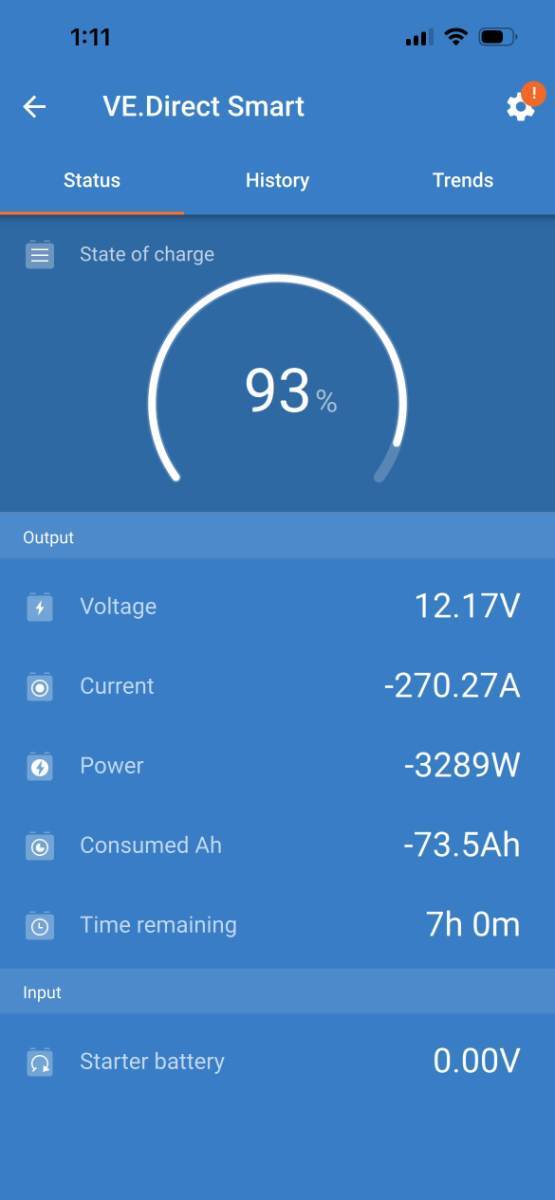
I'd rather an inverter shut down ONLY when there is a problem and have performance in carrying a load when there isn't an issue. Was running our DC-DC charger today, so I turned on the water heater to create a load. Then just to see the inverter at capacity, I set the Emeril Air Fryer at 400F and kicked it ON too! The screen shot shows both running without error messages or shutdown; -270A net for -3290W on the 3KVA (2400W) Victron Multiplus II. Voltage was down to 12.17V where just the minute before the test it was 13.53V. Pretty cool the Victron Multiplus II can produce power without overloading at near 150% of its advertised spec. No worries, go ahead and run two major appliances when needed. 😎
-

Zerk fitting came out of Dexter EZ Flex - Oversized hole?
jd1923 replied to Steve Morris's topic in General Discussion
We're a Dewalt house which made adding the bare tool an easy addition. You will enjoy the ease of use, no more contortions to hand pump both TV and TT. I would try the M7 first. 7mm converts to .276" which is 10% over 1/4" easy tap without drilling. The 8mm (.315") is a big step up requiring the correct drill size and tap. (I'm starting to love the convert function on the iPhone calculator!) -
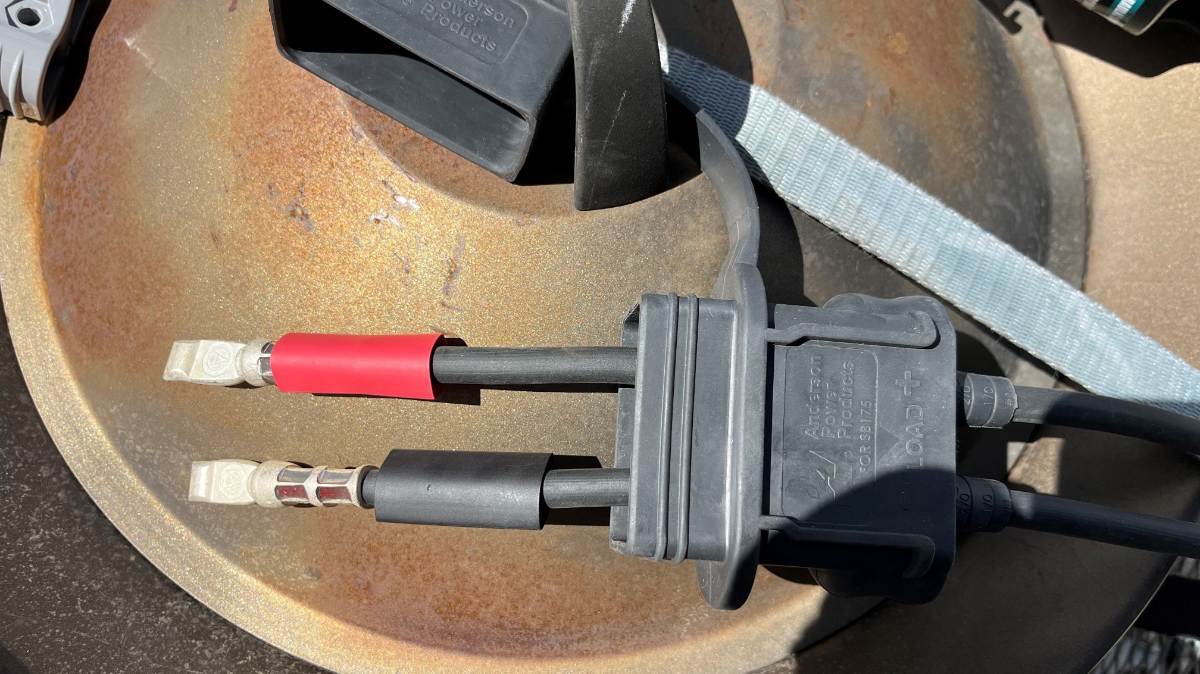
Exactly, thanks Dean. I just checked my Oliver travel and maintenance spreadsheets to see if there was something I did/worked on or changed recently. All I did mod-wise was add courtesy lights front and rear and replace a couple of drawer slides. On the truck I restored the A/C system, new compressor-condenser-dryer and charged the R134A. All that work was right where the DC-DC cable comes to the battery and where I wired extra battery connections to alternator and ground. These connections were tight with a recent tug test but I need to run electrical tests. I installed the oversized Andersen SB175 connectors with 4 AWG crimps (see pic) with a BIG TEMCo hydraulic crimper. They should be good on both sides, but I'll check. Suddenly I'm itching to work on this. All I have to do to start is back the truck to the Oliver, connect the Andersen, and take a few amp and volt readings. Step #2 read through all Geoff's comments for testing again, NP! 🤣
-
Yeah, the 30A Orion has the large heat sink (cooling fins), similar to my Victron 30A MPPT SC (on left in pic). The 50A Orion (on right) is half the size without the need for cooling fins. I’ll have to check temp on the SC next time I use suitcase solar. 🤠 Keep in mind these two devices would never be used at the same time, so when towing only the Orion 50A can create heat in the entire front basement area and some air is moving through when towing. I still cannot see heat build-up unless something is broken. It worked fine for a long time.,
-
🤣 Wow, I would never would think of doing so! Stop for lunch, gotta fix the cushions, done eating put them back, no, no not happenin'. We keep our Oliver ready to camp whether parked or towing like we're camping. Nothing left open, no straps holding things in place or anything requiring additional setup and tear-down. I won't have that, no half measures, just fix the issue. Personally, I don't believe it's a heat issue, but I will mount a Ruuvi temp sensor next time to eliminate this variable from consideration. I'll also check heat on the 4 AWG. We did not have a DC-DC charging issue for 90 days and 18 months. Not during June of 2025 while traveling 4700 miles to the Midwest in humid 90F weather. We had this issue only recently while traveling to SW CO this September with highs in the 70s. The basement at the inverter recorded a high of 84F. My bet, not heat related.
-
Zerk fitting came out of Dexter EZ Flex - Oversized hole?
jd1923 replied to Steve Morris's topic in General Discussion
Hey Steve, first off this is nothing to do with your new grease gun! Love a power grease gun! 😎 Zerk grease fittings when screwed in are held in place by just 2 threads. They can easily strip after greasing a few times. I had one strip just before I replaced our axles/springs last year. Your current fittings sb 6mm (.236"). I know they are on Dexter wet bolts, so likely the same on the EZ Flex. Replace your Zerks, not with a metric size but with the SAE 1/4"x28 size. Two methods... 1) Also get a 1/4"x28 tap to get the new threads right. 2) Just push/thread in a new 1/4" Zerk into place to form new threads, then throw out that piece and lightly thread in a new 1/4"x28 Zerk. Choice #1 would be the correct method. Choice #2 has worked for me several times in a pinch -
You're welcome. Lot's of experience here and an endless array of camping/traveling styles in our community! "Reservations I would have" is how long can you run the 48V Houghton A/C? How many 48V Amps it pulls will determine how many hours you can run the A/C unplugged. But there's only a few of us with the goal of running A/C unplugged and so far (others are close!) I'm the only one on the Forum who has run A/C a full 5 days 24x7 unplugged! The daytime highs were low 90s using only 40A on average (60A max) and we have cool nights when the Chill Cube barely sips amps (amps based on 12VDC). But overall, it takes quite a robust system to run A/C on batteries! We have 900 Ah Epoch batteries. The Apex has one 48V 100 Ah battery which translates to 400 Ah in 12VDC. I would need two of these batteries. Can you fit another in the rear basement area? 🤣 Who will be the first Apex owner to do that?
-
Is this safe, Dudley? I’ve never let ours run much below 20% SOC or in the teens. I always thought bringing SOC to 100% and adding Float charge for another 24 hours should calibrate SOC% at 100%.
-
There must be 10+ threads in the last two years on the 3KW Xantrex shutting down and I’m not saying search vs. posting. Please everybody always feel free to ask any question! 😎 It’s usually something re low voltage cutout. Likely you need to run through setup configuration to lower this number. Experienced Xantrex owners may chime in otherwise, search for ‘Xantrex’ from the forum home page and you should find instructions for changing this parameter. Also 50% SOC is not LOW with LiFePO4 batteries! We have a Victron inverter with 900 Ah. The Victron allows for this, since we can run our A/C AND the microwave (oven) with SOC <20%! Both the inverter and batteries have low voltage cutoff protection. I’ve never read here re Lithionics cutting out. The Victron inverter never cuts out. There are only Xantrex cutoff issues. Also it’s not your microwave given it runs long when plugged into shore power. Check your Xantrex manual and their Tech Support if necessary.
-
I wouldn't expect OTT to route the cable not knowing customers' future needs. They learned that lesson with Zamp ports a few years ago. And I wouldn't want them drilling more holes into my hull. This is custom work and routing a suitcase solar can work many different ways. They have standard interior wiring to connect to the awnings when purchasing that option. All that’s needed is a simple connector port and wiring given the ECOFLOW has these solar input terminals. The Ecoflow is under the street side bed (copied photo from other Apex thread). You haven't had your head in the basement of an Oliver yet, but trust me having mine down there for toooo MANY hours and the Apex and Elite hulls are basically the same. Wiring can very easily be run the full length of the streetside basement. Up to the doghouse is a just little more work. There are also ways to wire to the curbside, the easiest being stringing wire around the rear of the basement. Please don't "drill the door to the battery compartment!" You'll likely be sorry later, since there are far better locations. Give it some time after your delivery to think about it. We've camped 200 overnights in 3 years, with 65% of our stays unplugged (spreadsheet data). I've only setup suitcase solar about 8 days (4%). We did truly need it last trip which was a first. Additional solar is only needed for long boondocking, like going to max the 14-day BLM limit! Most of our stays are 1-3 days at one campsite, so DC-DC charging is generally what's needed! 😎 I like these ECOFLOW terminals. Through the years, some OTT wiring has loosened/crusted up over time causing issues. These look to be rock solid!
-
Thanks Geoff @Snackchaser, Lots here to get started and of course I'll keep our community posted. BTW, we were running A/C on inverter, but not while towing this time. Never thought heat would be a leading issue. The basement near the MP2 has seen 104F at highest, more often 80-90F. The Orion is under the rear dinette seat, a lot of air up there and nothing else producing heat while towing. Fall temps in the 70s. Next time out is not coming soon, but I'll fix a Ruuvi sensor directly to the Orion. Testing at idle on our property likely would not produce much heat, but I'll hit the Orion with my IR temp gun after an hour idling to see. My alternator is a built Nations brand HD alternator. I wouldn't think 2 years later it's the issue but yes, it should be tested. We just got a week of unprecedented HEAVY rains. Much of AZ had flooded. We are safe on high ground, but I have weeks of some repair and yardwork to do first. I should take some time later in the year to work on this. Thanks again.
-
Outside of this post, I have not studied any Ecoflow literature, nor the product manual. However, based solely on the diagram you shared it appears you have what you need. Meaning the Ecoflow should have two (2) internal solar chargers (terminals #7, #8 as pictured). Given this is true, then all you need is cabling from the panels to a port in the hull, then wiring to the Ecoflow. The link you provided shows a hybrid solar cable. It has standard MC4 solar connectors for the panel side and it has the Ecoflow proprietary terminal on the other (just plug it in). You'll need to build a cable like this since the MC4 terminals will be outside of the hull connected to the folding panels and the special terminal connected inside on the Ecoflow. I found about 40 ft +/- of cable exterior to the hull is a good length for panel movement. More length will be needed interior to the hull, wired to the Ecoflow. Per my earlier comment to get with OTT for wiring schematic... You're taking delivery in December, so get OTT to walk you through the Ecoflow. Given you are NOT adding awning solar, is your rooftop solar wired to terminal #7 leaving #8 open/available? Ask re the fully optioned Apex with solar awning(s). How do they wire it? To #8? Then per the Ecoflow manual, what are the amperage ratings of the two internal SCs? You'd want to know, but given OTT can add awning panel(s) a 400W folder should be a go! I put my solar port in the rear of the hull and two years later I like the choice I made. OTT had installed a useless cable TV port in the rear of our hull. Repurposing it made it so I did not have to drill new holes (it was 2016, were people still using campground cable? 🤣). You can install a solar connection terminal left, right, front or rear of your new Apex. I like rear since the cable can easily be laid left or right and it's back there out of the way. You don't want to drill in the hull? Then put it up front under the doghouse. The front location may actually be the best since many campsites are more shaded at the rear, but then you may be tripping over the wiring when camping. There's a bit to think through, but if it was me, the last thing I would do is drill into the curbside or streetside of the hull in a highly visual location. Since your SC is integrated to the Ecoflow which is close to the batteries, your solar wiring only needs light gauge wire. I made my calculations 2 years ago and a 400W suitcase requires 12 AWG for 50+ ft of length. I used 10 AWG, one gauge heavier mainly because Lowes had #10 stranded clearance priced. Copper is very expensive today! Hope this helps! Best wishes on delivery day and to ALL of you new Apex owners (3 so far?). Enjoy this exciting time to your fullest! 😂
-
Again Geoff, thank you so much for providing your electrical expertise and very well written, btw. I've learned a lot in reading your last two posts (reading them twice)! To extrapolate your math, the 50A Orion is therefore a 600W charger and should produce up to 42A (600/14.2). +42A output (+/-) is a number I've seen often (Orion on Victron Connect app). I've seen high 30s to low 40s regularly, with a high 40s number a few times. Our Orion is set on the full 50A output setting, wired with 4 AWG (I understand it's on the light side). To date I've counted on the fact that we get +40Ah for every hour towing. So, I recently have a different kind of issue... I installed our Orion 50 during March 2025. The TV alternator was also upgraded (output increased by 50A) and we're talking old-school alternator (not Smart). My truck gauges always show readings of 13.8 to 14.2V. We have traveled (exactly) 100 days in 1 1/2 years (LOL, checked the data) always DC-DC charging, always getting +40A until our last two outings. We ran a 5-day trip un-plugged needing a bit of A/C. Then we did a 10-day trip no hook-ups. Both trips we hovered around 50-60% SOC most of the time on 900 Ah total, by adding suitcase solar when camped and we ALWAYS have DC-DC cables connected when towing. We move around a lot, so DC-DC is usually all we need. We have rarely needed our suitcase solar since with DC-DC charging. Near the end of both trips we got down below 30% SOC, so I was checking the Victron app while towing which I had not done for awhile. No longer are we getting a 40A charge, instead recent readings were +29A +/-. I monitored it a few times while towing (didn't think to check history page). When our batteries were very low in SOC% and we needed DC-DC charging the most, it produced less. We used to get +30A sitting at idle, consistently and 40 when towing. Looking back, we only got this low in SOC% because the DC-DC charging was not performing to par! I thought loose connections or ground (because my installation has a truck frame ground), but I checked all connections and they were tight as when installed. It will be a while 'til I get to troubleshooting. We're not traveling until Jan. I need to just hook up, run it at idle parked at home and get the clamp ammeter out! It will be easy to read amps on the wiring from TV to TT (is this even a valid test? IDK). Testing ideas appreciated and thanks again. 😎
-
Filling the freshwater tank from a container
jd1923 replied to Brian H.'s topic in Welcome to the Oliver Forums
Interesting change. Makes sense to have 2 vs. 3 inlets given the valving can provide the same 3-way functionality. What seems odd to me is the newly-chosen location of the City Water inlet. Water inlets should both be on the service side, the street side of the trailer. I often use our 10 ft hose to connect to City Water when a campsite has a water hookup. With this configuration I’d need to get out the 25 ft hose. Too bad they didn’t keep the two inlets together as they’ve always been and deleted the rear inlet. I'm also thankful to have all 3 jack switches in one location up front. It would be painful to level the trailer activating switches from 2 locations. A lot of walking back and forth, and the second location being behind the rear basement door is not at all helpful. Some changes are not deemed “improvements” by all! 😎 -
The Apex is powered by 48V system and was designed to add 1-2 solar awnings. You could ask OTT for a schematic showing your electrical system (with integration of the awning panels). The solar charger (SC) you install should have 48V output but for some reason OTT advertises the 400W rooftop solar on the Apex is 24V. New panels must be on an independent SC. I would trace everything down and create your own system drawing. In our older hull, I had to pull every wire to fully learn the system (not good when under warranty)! 🤣 In the Elite we have 12VDC and 120VAC systems. The Apex has 48VDC and 120VAC systems and it must have a 48|12 DC-DC converter. The 48V system must be stepped down to 12V to run lights and other 12V accessories. You should locate this step-down converter for general purposes. I would start at the batteries. See how many wires are connected there, follow them into the hull to see where they are connected and where is your main fuse. A new solar charger must connect to +/- battery somewhere. The other active Apex thread shows many pictures and some show unused terminals labeled "battery." I would encourage you in that adding our Solar Suitcase was the easiest major electrical upgrade I've made to our Oliver. I've attached my upgrade link here for example. Of course, you have a 48V system so system components may differ but the basics are the same. Re Starlink, there are some complex installations and some who just plug it into an outlet and lay it on the ground! 🤣 From the HOME page of the Forum, search for "Starlink" for many discussions.
-
Yeah John, thank you. She’s pretty again and our 11-year-old Oliver is also more capable than ever! 😎 Not a chance we would trade our newly upgraded and restored Oliver for a brand NEW 2027 Apex or Elite. We are better optioned than either new model. It would be less dependable without going through everything again, and way too much trouble to do so.
-
Yes Bob, this voltage is very low! An automotive LA battery after sitting overnight or sitting for a few days should read 12.5V minimum and more like 12.6V with a newer battery. When towing or at highway speeds, voltage across the battery with the alternator running should produce 13.6V min and more often 13.8V to a max 14.2V. The term Smart battery bothers me unless it's smart enough to know you have the DC-DC charger attached. Check a Nissan truck forum, search for "alternator" or "towing." If you have been DC-DC charging adequately for some time and now nothing, you could have blown something in the Nissan alternator. Perhaps it did not have +50A available. Your DC-DC charger installation is likely fine. Instead of "inverter service" test your alternator or take it to an electrical shop that rebuilds alternators and starters, Before I installed our Orion 50A charger, I installed a HD alternator rated at 50A greater capacity. Let us know. Best wishes, JD
-
I agree with GJ on the points he made, except this one. A 48V 100 Ah battery translates to 400 Ah in 12V. There are 3 of us that have 900 Ah with our mods. This huge/heavy battery fills the bay without leaving room for another, you’re capped at 400 Ah. OTT has had issues with electric awnings retracting and/or not opening when they should. $5K is an expensive awning that may be in the direction of the sun occasionally. The advertised DC-DC charger is not viable (in any new Oliver product). IMHO, the best looking Oliver is the Elite by far! Painting unless powder coated is not good. Flat Black-out trim is a fad kids started 10-20 years ago. The Apex looks like a mod trailer created by a 20-something. AT tires do nothing for a trailer. They only add value to the TV on drive wheels. No additional traction, just more difficult to keep clean. The 48V Houghton is not an efficient variable-speed model and the black cover will make it run hot when sunny. I promise you, my old hull has far more upgrades for “standout improvements for serious boondockers! The ECOFLOW system is laden with proprietary cabling and connectors that cannot be sourced through normal channels like an RV store or trailer service center. Need to get your Ecoflow system repaired? You'll be on your own or head back to Hohenwald! Better have installed Victron! Blackout not for me. Chrome wheels are a must, with ribbed tires and a few satin gray touches on the grills, yeah! 😎
-
Plastic Swivel Adaptors starting to fail - likely age
jd1923 replied to Wayfinder's topic in Mechanical & Technical Tips
When leaving the trailer, e.g. a day trip, there are several things we check. One is to be sure the water pump is OFF. Likewise if on City Water I will shut-off our hose connection at the hook-up. LP off at the tanks is also a good idea for safety. If you leave pets in the trailer these things are more important and of course they need cool fresh air! Almost as bad as water leaking into the hull would be leaving an electrical appliance on that could cause a fire. You could trip the breaker at the post. If un-plugged the batteries could run down. As we’re locking up to leave, I’m checking the shunt reading on the app to see that amps in or out is what’s expected. 😎 -
Hey Gregg, I might have a fix for you! First idea, if you truly have antifreeze ALL the way up to the pump, perhaps all you need to do is crack the cold side valve at the sink faucet allowing air in the line after the pump to escape. This simple fix would be great, but perhaps more priming is required. During April, our son was camping in the Oliver when he ran the fresh water tank down very low, leaving only air in the pump lines. We came out for dinner and I expected I could refill the fresh tank from my 35-gal aux tank on the pickup bed. It would not pump even though our truck was a bit uphill and I had the hose primed to the inlet. First time ever this had occurred. When Chris and I camp, we refill asap after hearing the pump take a little air, that gurgling sound. Both the Winterization and Boondocking valve configurations, pull from the RR water inlet using the water pump to suction. In either configuration the water pump may need to be primed. I brought the trailer home next morning. Good thing he was camped only 12 miles away! Connect a pressurized garden hose to the rear inlet. Turn the hose ON, turn your water pump ON and open the cold valve on the kitchen sink faucet. The air will expel out of the faucet and once you have a steady flow of water the line is bled. Close the faucet valve, remove the hose and replace it with your antifreeze line to continue winterization. Give it a try. This should do it! 😂 I have a simple hand pump that I've used to sanitize the City and Fresh water lines. Going forward we'll travel with this pump as it could be used to prime the water pump when a live garden hose is not available. 😎
-
Yes, "sane and fit!" For 6 years, we had 13 acres in Loudoun County VA and that was real work. We had a few black angus for land use, a couple of horses, our yellow lab and a barn cat that came with the property. I mowed the pasture twice a year to keep the weeds down and from spring through summer the area around the home had to be mowed every 5 days. Waiting a week, the grass would get too long in the N VA climate! Clearing/repairing the thousands of feet of fence line was never ending. When we put the property on the market, Chris and I did yardwork everyday, all day long. We didn't want a prospective buyer to realize how much work it was. It presented nicely without a blade of grass out of place! We returned to visit friends two years later. The property was in shambles, everything needed mowing and trimming. Some of us are responsible, some even enjoy work and others may not be either. 🤣 Here we're only on 3/4 acres, but with 35 mature pinion pines, scrub oak and local weeds growing rampantly with the late summer monsoons. We're about halfway done with our fall clean-up but we could do a major trimming in the winter. Could you request installation of Alcan Springs? OTT stocks them for the Apex. The more you get included, the less you'll have to do after delivery. Besides 1750# spring failure, the heavier springs greatly improve towing. Russel, we certainly agree on this! Bringing a contractor in the trades on our property is a rare case and when I do, all I do is worry. Bringing one of our vehicles in for service is just as rare. I used to be afraid of carbs and fuel injection but not after working on them. After purchase of our older TV, I wasted $692 on two service visits to get the A/C repaired. Of course it took two visits and you would think afterwards it should be fixed, but not! Each time the A/C cooled for only a couple of months. March 2026 after watching a few YouTube videos, I bought the gauges, a vacuum pump, installed a new compressor, dryer and condenser (all parts for total A/C restoration $478) and now we're COLD! Purchased $156 in tools and $42 in refrigerant. An entire NEW A/C system costs less with my labor than two lame service visits. Wish I had saved that $$$! Then I recharged Chris' Lexus GX470 before the summer. Watched the ChrisFix video again for review and in just an hour using two cans of R134a ($28) the GX now also blows COLD. Tools were paid for, knowledge is now engrained. Next spring we'll get the A/C working on Adam's '97 T100! 😎