All Activity
- Past hour
-
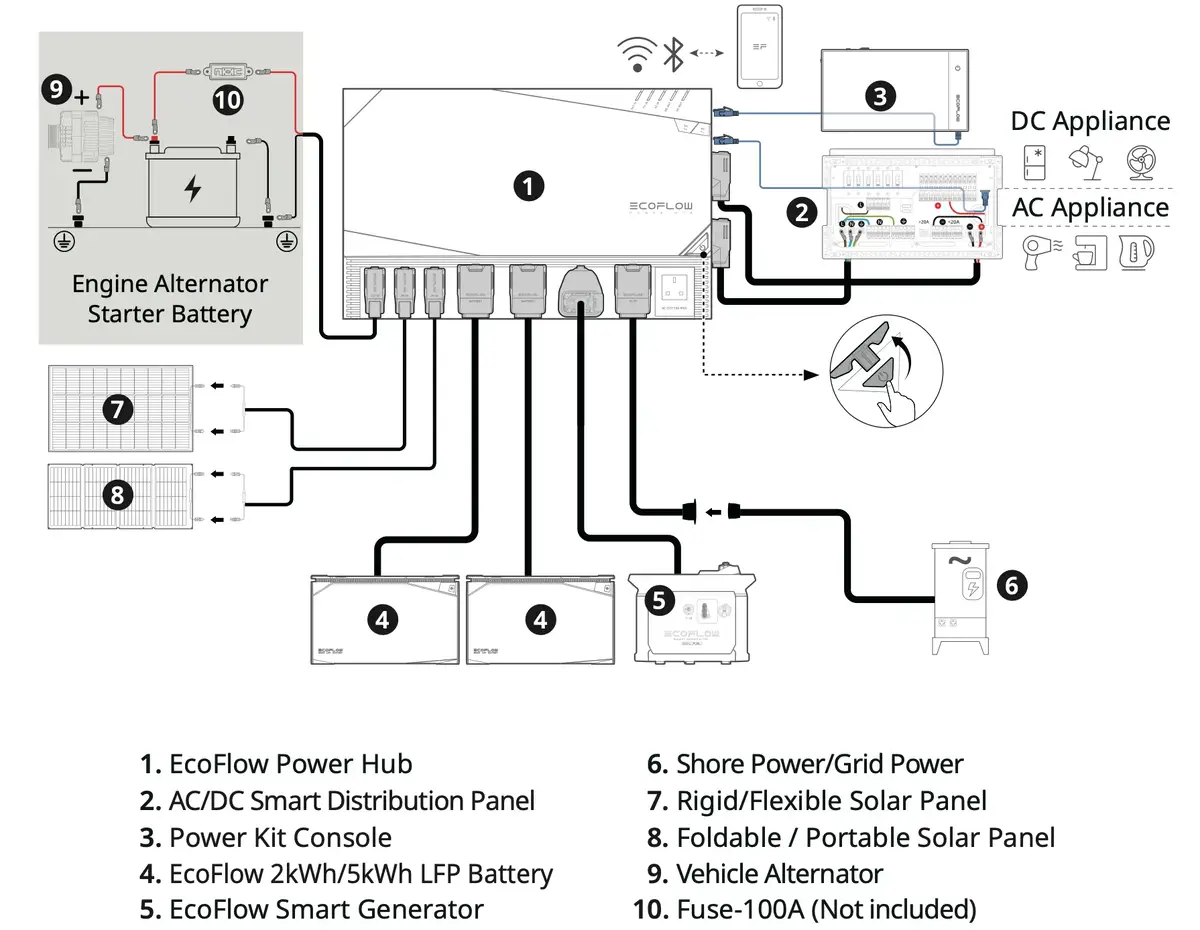
This is why I'm so flummoxed --- a separate charge controller shouldn't be necessary with the ecoflow "power hub" product that the apex has. You should be able to plug in and go. There's three dedicated photovoltaic in ports on the head unit, and they sell dedicated mc4 <==> power hub cables. The charge controller is built into the system. All oliver has to do is provide an easy way to route the cable out for really flexible supplementary solar support. On a fully optioned unit, all three of those ports are filled (roof, awning, awning.) On a not fully optioned one, one or two ports are free. I can drill the door to the battery compartment with some sort of gland or port, which will provide easy routing up to the ecoflow head unit, but shouldn't have to. Importantly, a Zamp external port would be a downgrade vs. arbitrary access, since the zamp panels are heavy and expensive for what they are. https://us.ecoflow.com/products/power-hub-solar-charge-cable-20-feet?variant=40309252390985

-
Thanks, appreciate it.
-
Geoff, Thanks for the detailed feedback. I agree with everything you mentioned in your response. Four-gauge cable is commonly used, even though the voltage-drop calculations and cable-sizing tables show that the loss can be higher than ideal for maximizing the efficiency of the Orion XS. I think a lot of the recommendations stem from camper van installations where the cable runs are much shorter, as you suggested. Victron generally recommends keeping DC voltage drop below 2.5% to achieve optimal charging performance and efficiency. When I run the numbers, review the voltage-drop tables, or even check with AI tools, the results consistently point to 1/0 cable as the size needed to stay within that guideline for a typical tow vehicle-to-trailer cable run of 80 feet round trip. Based on that, it looks like my Orion installation is going to cost more than I originally anticipated, especially considering the current price of quality copper cable. However, I'd rather size the wiring correctly the first time than leave charging performance on the table. I will use terminal lugs a few inch before connecting to the Orion and then connect with 4 gauge wire. Thanks, Dean
- Today
-

Entry steps steel rod, broken weld
srthomsen replied to Olive2Roam's topic in Mechanical & Technical Tips
Take both pieces to a muffler shop and have them weld them back together. -
Thanks SnackChaser! Hopefully this information will help me get my DC to DC charger working properly. I have been struggling with it since it was installed in May. I will try grounding to the body first versus to the negative battery cable. If this does not work, I will try using the 12V+ wire from the 7pin.
-
Krunch and I have reservations for 3-29 to 4-2. Thanks Toni, Mossey
-
Again Geoff, thank you so much for providing your electrical expertise and very well written, btw. I've learned a lot in reading your last two posts (reading them twice)! To extrapolate your math, the 50A Orion is therefore a 600W charger and should produce up to 42A (600/14.2). +42A output (+/-) is a number I've seen often (Orion on Victron Connect app). I've seen high 30s to low 40s regularly, with a high 40s number a few times. Our Orion is set on the full 50A output setting, wired with 4 AWG (I understand it's on the light side). To date I've counted on the fact that we get +40Ah for every hour towing. So, I recently have a different kind of issue... I installed our Orion 50 during March 2025. The TV alternator was also upgraded (output increased by 50A) and we're talking old-school alternator (not Smart). My truck gauges always show readings of 13.8 to 14.2V. We have traveled (exactly) 100 days in 1 1/2 years (LOL, checked the data) always DC-DC charging, always getting +40A until our last two outings. We ran a 5-day trip un-plugged needing a bit of A/C. Then we did a 10-day trip no hook-ups. Both trips we hovered around 50-60% SOC most of the time on 900 Ah total, by adding suitcase solar when camped and we ALWAYS have DC-DC cables connected when towing. We move around a lot, so DC-DC is usually all we need. We have rarely needed our suitcase solar since with DC-DC charging. Near the end of both trips we got down below 30% SOC, so I was checking the Victron app while towing which I had not done for awhile. No longer are we getting a 40A charge, instead recent readings were +29A +/-. I monitored it a few times while towing (didn't think to check history page). When our batteries were very low in SOC% and we needed DC-DC charging the most, it produced less. We used to get +30A sitting at idle, consistently and 40 when towing. Looking back, we only got this low in SOC% because the DC-DC charging was not performing to par! I thought loose connections or ground (because my installation has a truck frame ground), but I checked all connections and they were tight as when installed. It will be a while 'til I get to troubleshooting. We're not traveling until Jan. I need to just hook up, run it at idle parked at home and get the clamp ammeter out! It will be easy to read amps on the wiring from TV to TT (is this even a valid test? IDK). Testing ideas appreciated and thanks again. 😎
-
when its your
-
My wife and I reserved a site. There are plenty available now, but considering it’s near Easter & Spring Break, it would be good to book it soon if you want to go. Looking forward to it!
- Yesterday
-
Dean, I like that fan, it's a great idea and should greatly help the efficiency! I noticed that you're going with #4 AWG, which is undersized for 50 amps at the approximate 100’ or more round trip cable run that you will need. You would be looking at about 1.3V of voltage drop, not including fuses, terminations and Anderson connectors that could add a few tenths more. #4 AWG is even marginal for a 30 amp charger. There is a common misnomer that #4 is the correct wire size because the Orion’s terminals are sized for #4. That’s because most of the installations are in boats, vans and motorhomes with much shorter runs. There are advocates for using smaller wire, but it’s not the best advice for a number of reasons, particularly if you're watching efficiency. You should be considering #2 minimum, 1/0 is ideal. You can terminate the 1/0 cable to a terminal strip on the negative and a fuse block on the positive, then use short #4 jumpers to the Orion. The jumpers won’t contribute much to the overall voltage drop. Cheers! Geoff
-
I must agree, I like my vintage gear onboard #110. I'm sure someday I may regret not being able to run my A/C off batteries, but I will still need a generator to re-charge those beastly batteries, or a truck that can do it IF I drive the next day. When these 2024 AGMs are used up, I'll upgrade the rig to all new Victron & good lithiums. We'll see how my retirement travels work-out for me.
-
Not that I saw, but the entire week for me was a blur.
-
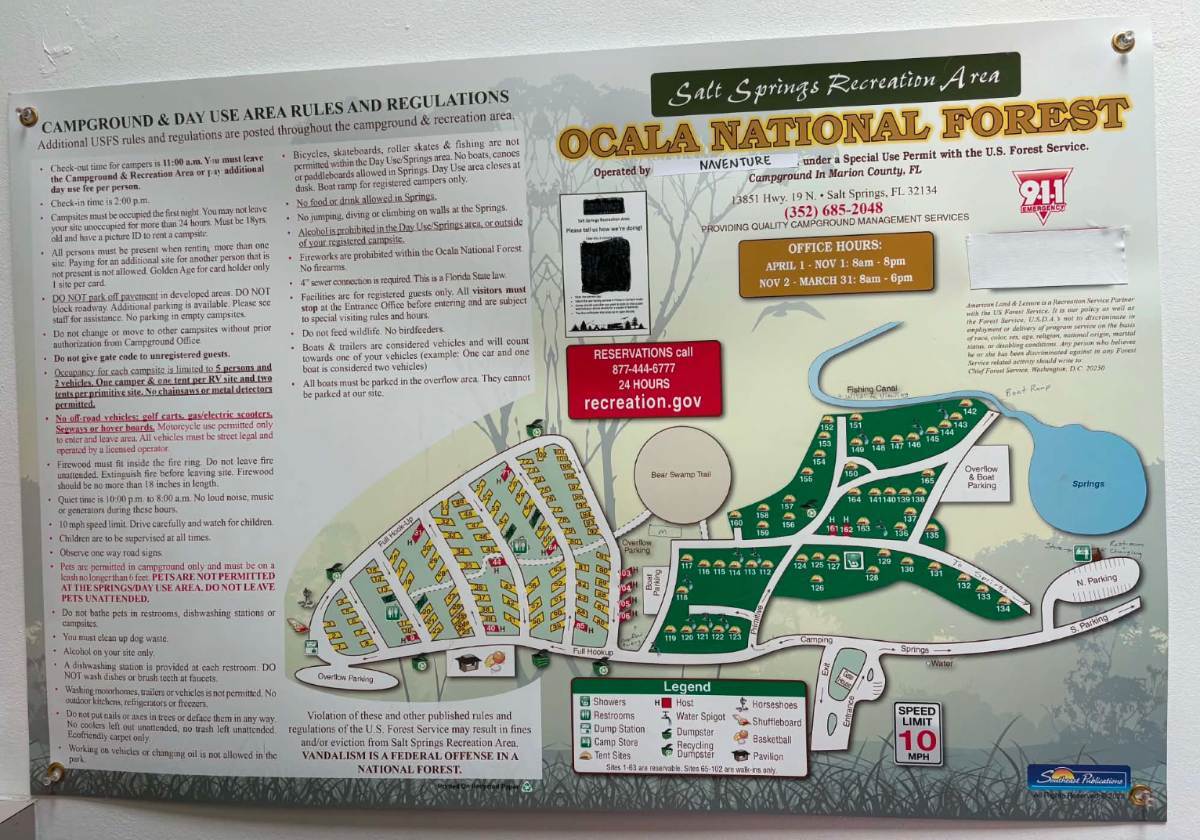
The 2027 Florida Oliver Owners Rally will take place March 29 through April 2, 2027 -- 4 nights, checking out on Friday 4/2/27. This event is being organized by Jenni Rivera @RVera_10 and other Florida Oliver TT owners. The venue will be Salt Springs Recreation Area, located in central Florida. Salt Springs is a recreational jewel in the Ocala National Forest, and features pristine natural mineral springs. Activities at this location include swimming in the mineral springs, plus fishing, snorkeling, hiking and boating. Come join us for a friendly micro rally! Participants will need to reserve their own campground space through Recreation.gov found at this link: https://www.recreation.gov/camping/campgrounds/233920 Spaces are not being held for the event, so early reservations are recommended. Join the FL OLIVER TT MICRO RALLY Facebook group to find more details. This Oliver Forum Post is intended to mirror the information posted by Jenni on facebook, to serve those who are not on facebook. WHEN: 3/29/27 - 4/2/27 WHERE: Salt Springs Recreation Area campground, Ocala National Forest. Salt Springs is located 35 miles east of Ocala (I-75), 60 miles west of Daytona Beach (I-95) and 95 miles north of Orlando, Florida. CAMPGROUND RESERVATIONS: the window is now open for reservations at this location and winter is our prime season, so get your spots reserved now! https://www.recreation.gov/camping/campgrounds/233920 ** Please be sure to read about facility restrictions on their website before making your reservations. ** SCHEDULE OF EVENTS: look for future updates MONDAY 3/29 : REGISTRATION, campground checkin time begins at 2:00pm TUESDAY 3/30 thru THURSDAY 4/1 : group activities TBD FRIDAY 4/2 : checkout Improved venue map, courtesy Jenni. (The black and white PDF is from National Forest website.) Please note: @Boudicca908 does not monitor the OTT forum on a daily basis, and does not have any active notifications for incoming messages. Salt Springs facility map 73853_SSRA.pdf
-
Sorry, I do not have any pics.
-
While gathering information for this project, I also discovered that Victron has introduced a new Orion XS 12/12-70A model. It has the same footprint and mounting pattern as the 50A version but adds integrated cooling fans. Victron also slightly increased the terminal size, which should make it much easier to terminate 4 AWG wire. Getting 4 AWG wire into the terminals of the 50A version can be a challenge, so that is a welcome improvement for higher-current installations. It is pricey and I just recently purchased my 50 amp version, so not for me at this time.
-
Accidental duplication.
-
Thanks, Geoff. I appreciate all the information you've shared. I'm in the process of installing my DC-to-DC charger now, but I haven't begun working on the tow vehicle portion of the project. Your comments about the cabling requirements and the tow vehicle current sensor gave me some useful information to consider before I get started on that part of the install. I agree that the 50A Orion XS is significantly more efficient than the 30A version. Even with the improved efficiency and reduced heat output, I plan to mount my Victron Orion XS 12/12-50A DC-DC charger on top of Mobile Solar Consulting’s Orion Fan Module, which features temperature-controlled cooling. If you’re not familiar with this option, there are several YouTube videos that demonstrate the noticeable reduction in operating temperatures when using the fan module. For me, the added cooling is inexpensive insurance for a component that will often be operating under heavy load. Dean
-
Gj, the short answer is probably not, at least not directly. The smart alternator issues I described above tend to make the Orion cut in and out. A steady maximum of 22 A from a 30 A charger likely has a different cause. However, if your charger’s negative cable goes straight to the battery post and bypasses the current sensor, then it’s worth correcting. Without a record of the current over time, it’s hard to know what your charger is doing at any given moment. I’m assuming that the wiring is properly sized for minimum voltage drop, and that the battery was low enough to accept full charge. A nearly full battery won’t draw as much current and excessive voltage drop can cause other problems with the settings that I touched upon above. So even without knowing your exact conditions, it sounds like a heat issue. The Orion reduces its output when it gets hot. I had this with mine. Even with two cooling fans, my old 30 A ran scary hot at full load (running the trailer air conditioner while driving). That’s why I upgraded to the 50 A Orion XS, which is far more efficient and makes much less heat. Here’s the math. Your 30 A Orion is a 360-watt charger at a nominal 12.2 V output But a lithium battery charges at about 14.2 V. So 360 W ÷ 14.2 V is only about 25 amps (at 104°F). Above that temperature, Victron derates it 3% per degree C. So with the air around the charger at 113°F, you’re down to about 22 A. See what I mean? Of course, this is all conjecture. First, I’d recommend swapping the 30 A for a 50 A and turning its output down to match your cable size and length. I sold mine on Craigslist to a guy with an Explorer van, where it was better suited. Second, if you want to see what’s really going on, run a load with engine running above idle, such as a small heater on low through the inverter. That keeps the Orion working at full output even if the battery is nearly full. Then put an inexpensive clamp-on DC ammeter on the Orion’s output cable to see the real output. The shunt only shows the net current in and out of the battery. It can’t separate the charger’s output from trailer loads or solar. Hope that helps! Geoff
-
RB, just catching up on this. Looks like your’e waiting for a new hull. So this may not be a reasonable request. Do you happen to have any photos of this set up? Particularly the aluminum hangers?
-
Geoff: Could this be the reason that I don't see a charge rate at via the Ollie's Victron shunt more than 22 amps despite having a 30 amp Orion in play? GJ
-

Antifreeze CO2 & Propane Alarm
Geronimo John replied to HDRider's topic in Mechanical & Technical Tips
As have we. Not sure I could blame their demise on our winterization using Super Tech though..... -
Entry steps steel rod, broken weld
Geronimo John replied to Olive2Roam's topic in Mechanical & Technical Tips
typo - Last week
-
😉
-
remember story game
-
Going through what few pics that I took at this year's Owner's Rally, I was reminded of a visitor that was there each morning as I drank my hot chocolate.