Leaderboard




Popular Content
Showing content with the highest reputation on 01/11/2025 in all areas
-
I actually asked Artek these same questions and was told that a switch is not needed. Additionally, they said connecting and disconnecting should be done (as a good practice) when the engine is off and no charge current coming from alternator.2 points
-
I agree. But a switch has only and on/off function. Better is a circuit breaker or a fuse. Either provides protection to down range wiring in both the open and closed position. If you only have a switch, and something damages the conductors going to Ollie, an on switch gives you no short circuit protection on the wires from the TV Battery to the Orion DC/DC unit. My preference to use a circuit breaker and not a fuse at the TV battery. Quality fuses of this size and amperage typically are bolted in fuses. Compared to a flip of a breaker, undoing the two fuse bolts, is far less convenient.... especially when you drop the washer or nut into the manifold and have to wait an hour for it to cool down to fetch with your fingers because you forgot to pack the magnet on a stick at home! 😞 GJ1 point
-
But when towing, you'll have it switched on anyway. Also, I would not run the positive cable "under frame." I will see if I can run it inside of the frame (safest location) or above the frame, up where the truck bed sits. There should be no chance of running over road debris that could damage the cable. Likely the Orion DC-DC charger would be fine connecting with engine ON or OFF. It allows input up to 17V and should have the internal protection to be connected to a running alternator, pushing 50 amps at 14.2V. That being said, I would always have the engine off when connecting. This way the Orion would first be connected at a lower voltage (12.6V lead acid truck battery) and without immediate extra amperage to manage. The charger would wake up, take readings, become ready, and very likely would not start charging until after the truck is started, alternator generating considerable amperage at higher voltage. I always turn the engine off anyway when hitching the trailer once the hitch ball is where it needs to be. I don't like diesel noise and fumes while connecting and with the addition of a DC-DC charger, there is just one more cable to connect!1 point
-
I'm with both of you on this one. I connect my TV to Ollie via a Anderson 175 amp connector. I have a 60 amp breaker at the TV battery. Disconnect the Anderson only with the motor off as well. I like having a breaker at the TV Battery. That lets me not worry about potential damage to the under frame cables in transit threat when not in use. I do not YET have a second 60 amp fuse on the Ollie end. I assume it should ideally be mounted at the B+ terminal on Ollie. I am assuming it's purpose to so kill power should a DC/DC charging B+ cable headed forward goes to ground. Correct?. GJ1 point
-
Must be close enough. If you're running 4/0 wire, which is over-engineered unless you're running A/C on inverter, you are more than OK for a few feet. I would put extra batteries dead center under the pantry. I have our Victron Mp2 Inverter-Charger just 4.5 ft (1.4M) from our Epoch 600AH LiFePO4 batteries and all DC runs are connected directly to the MP2. I could simply add another battery, say an Epoch 460AH and install it under the pantry. The terminals would be only 2 ft from our inverter connection which would make it closer than the 600AH in our battery bay, NP! Hey JD, when you have time, let's talk about your upcoming trip to AZ. Looking forward to seeing you when you get to the great Southwest!1 point
-
True. . . but they were terribly misleading because the circuit is energized directly from the battery, regardless if the alternator is charging or not. Think of it like a jumper cable connected to the battery, if you were to brush the red cable against any grounded surface of the vehicle then you're going to have big sparks like a welder . . . before any thermal fuse will blow. A circuit fused at 60 amps has significant potential and I think it would be somewhat negligent not to have a quick and easy means to disconnect it, as is the law in other applications. It’s straight off the battery, always energized, running the length of the vehicle, with a connector exposed on the rear bumper. Most mechanics wouldn’t have any idea what it is, and may not take precautions to avoid it. I love @Tom and Doreen idea of using a high amperage switch instead of a breaker. The switch is more obvious and it would do a better job at alerting someone of a high potential than might need to be shut-off. I’m keenly aware that I’m too forgetful, and I may not always be around. Cheers! Geoff1 point
-
I always understood this in Residential and Commercial AC power panels, but did not realize this in DC circuits until recently. There are no breakers in an automobile or truck, where is my experience. When I relocated ALL the breakers and fuses from under the streetside bed to the rear dinette seat, this became obvious from the terminal markings on all DC breakers. OTT had wired the 40A breaker in our hull, powering the rear positive bus (leveler jacks and more attached to this bus) in the wrong direction. After all of your excellent feedback, I decided to go with MRFB fuses on both sides vs. ny sort of DC breaker> Blue Seas is the gold standard! However, their fuse today are made in Mexico. I found this company, made in South Bend IN, USA with a 4.7 Amazon rating (not easy to achieve) NP, I have a good 4" above the starter batteries in my old Dodge! Also have nothing but room above the positive bus that connects all solar chargers, etc.1 point
-
Some historical perspective might be useful in the discussion of standardization of the early trailers. Those of us who ordered our trailers in 2015 recall that a small number of trailers were being made by a small group of workers. The production of trailers had just started back up after being shut down for a number of years. Most trailers were ordered by the future owner, with different features and options. It was common to call and request installation of a desired accessory or to change the installation of something else. You could call and ask that electrical outlets be moved or added here and there. Oliver was trying their best to accommodate buyer desires and requirements which resulted in some “one off” work and installs and prevented the standardization that is being discussed today. Mike1 point
-
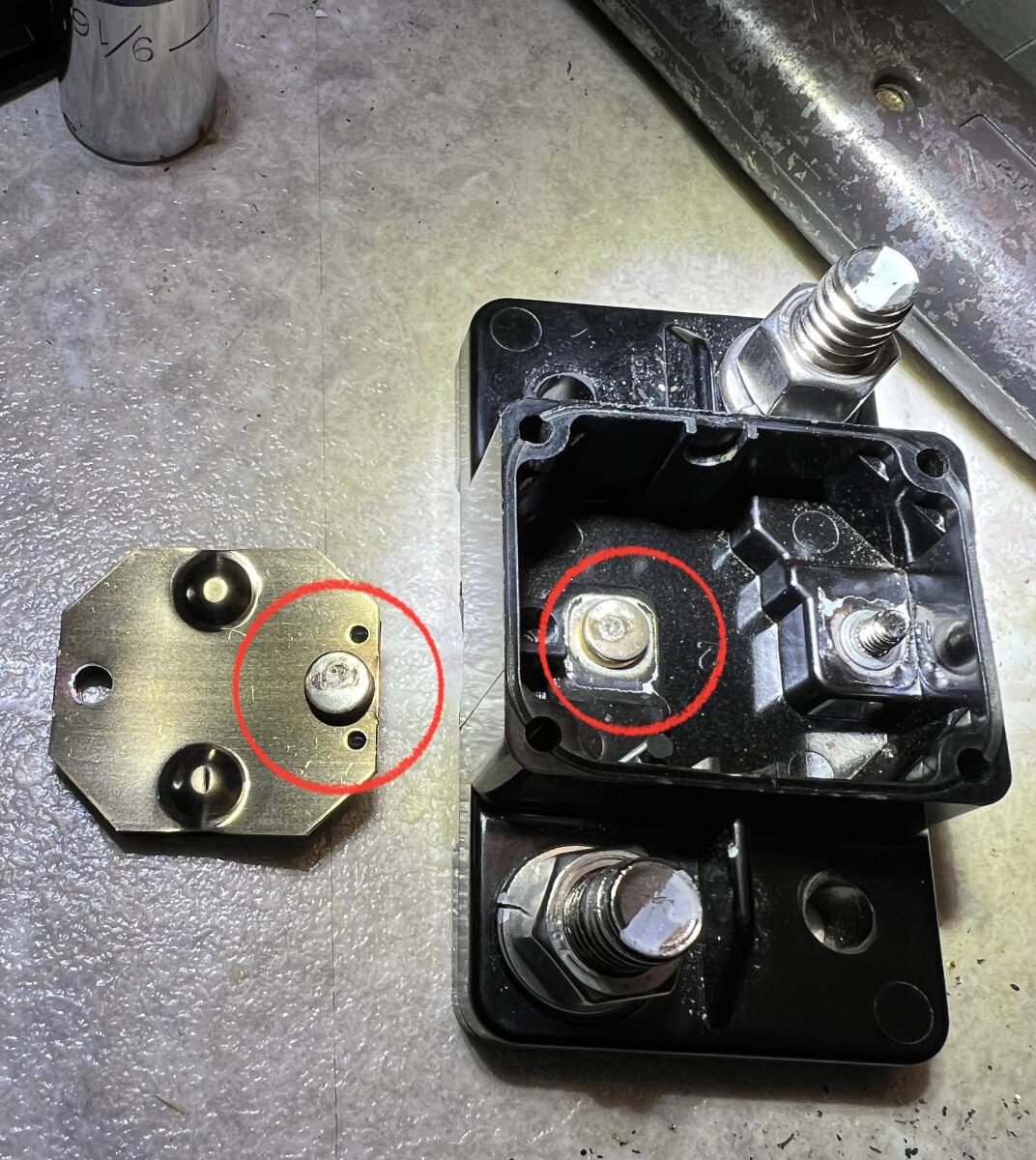
That's a really clean installation, great work! One word of caution though is that manual disconnecting / connecting with an active load applied can cause contact pitting and heating of the contacts in breakers of this type. A heavy duty marine spec. switch with larger contact areas would also fit the bill since the circuit breaker is redundant in this application.
 1 point
 -
@jd1923 There are a number of inaccurate statements in your post above. Specifically, please refer to any number of prior posts here on the Forum regarding the issues and whole story (to include Oliver's involvement ((or lack thereof))) relative to the fresh water tank issue. Hopefully a review of the entire situation will help with your (and/or anyone's) concerns in this regard. March 13, 2018 October 26, 2017 May 5, 2024 Note your participation in this May 5th, 2024 thread. With regards to the "cutouts". I believe that it was sometime in 2018 when Oliver "standardized" their wiring for all Oliver Travel Trailers. Prior to that - for both your Oliver and my Oliver a certified electrical tech was hired to do the wiring on each trailer. Since there were more than one tech (I've been told that there were as many as three at any given time) and since it is doubtful any of these tech had specific RV experience, the wiring and connected "cutouts" were dramatically different from one trailer to the next. Yes, perhaps Oliver should have had a QC person go back and check each tech's work. But, it is fairly obvious that Oliver didn't believe this was necessary given that the tech's were "certified". Once the "cutouts" were "hidden" by cover plates the only way they could be seen would be to take things apart - as you and many of us have done. Same thing (I believe) applies to the circuit breaker issue you mention. While not "perfect" my Oliver continues to serve me extremely well after ten years. If I had not purchased an Oliver I would be on my second or third RV by now and still dealing with trying to make those things into an Oliver. Yes, it is frustrating to deal with someone's carelessness and/or lack of proper technique/skill but it is a fact of life and Oliver through its own quality control system tends to limit most issues of this nature. Finally, From my experience, Oliver has always bent over backwards in helping many owners correct any issues with the trailer. And this extends well beyond what the stated warranty period may reflect. Bill1 point
-
Ditto. Just make sure you have the head room under hood for them. GJ1 point
-
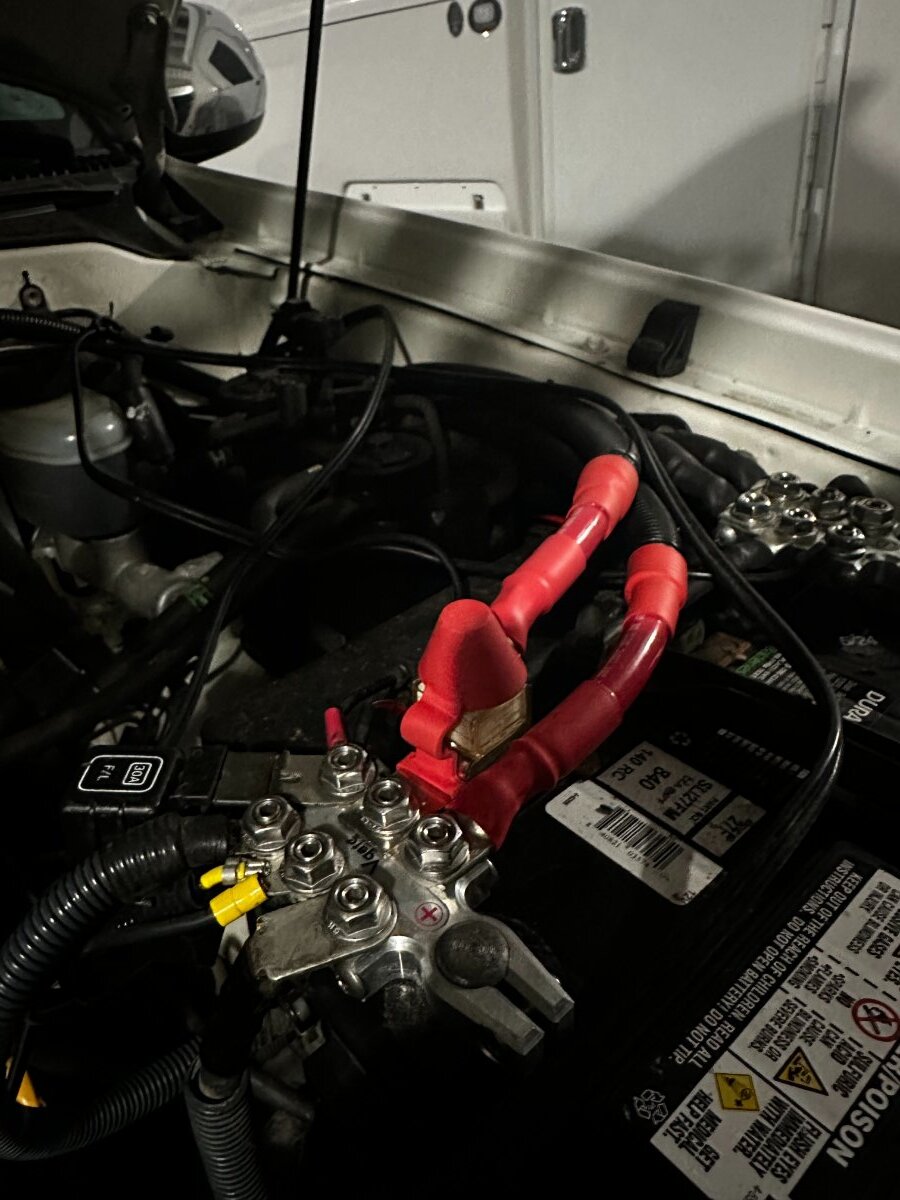
I used the following that were recommended by Artek. 1. Blue Seas MRBF Terminal Fuse Block and a MRBF 60 amp Fuse. 2. Blue Seas Series 187 Surface Mount Thermal Circuit Breaker 60 amp. I have attached photos.
1 point
-
This is consistent with my experience as well. Oliver's factory quality control could be significantly improved, although review of comments on other RV forums suggests it is still much better than its competitors, including Airstream. What sets Oliver apart even more is its top-notch Service Department run by Jason Essary. Jason and his staff spend much of their time correcting mistakes made, and dare I say sloppy work by, workers at the factory. That is the reason I had an inspection list nearly 100 items long when we picked up our Hull #1291 in 2022. My inspection, and initial "shakedown," revealed only a couple of issues that were corrected by the Service Department before we towed our Elite II from Hohenwald back to Idaho. Thanks for the reminder to retorque electrical connections after the trailer has been towed a while. The electrical connections in our "homes on wheels" surely get rattled loose more than those in our homes.1 point
-
That's one way of looking at it. Another is 25% is going through the frame because it has less resistance than pushing more current through the 4 AWG wire at that amperage. Yes of course, the path of least resistance. My plan it to use the truck steel frame only. One solid piece of frame steel, not the back path of Oliver Aluminum frame through the Bulldog and Anderson hitch, etc. What will allow for more current, 4 AWG of copper or the huge beam of frame steel? I do not know this answer, but I believe it will be fine as every automotive system is body or frame grounded, with ground straps connecting body to frame (including the Alt). Notice the grounds in the wiring diagram. Also notice the bottom left corner of the diagram showing the truck alternator. Running B+ and B- 4 AWG wire to the truck battery only as good as the B+/B- wiring between alternator and battery. Your truck alternator is only grounded by contact through the engine casting and then a ground strap to the body. Your truck battery is also grounded by a ground strap to the body. I suggest running 4 AWG cables from battery B+ to Alt output and a B- cable to one of the Alt mounting bolts directly. This alone should improve your numbers (decrease resistance in the charge circuit). An interesting test would be to see @Geronimo John's number with and without the hitch connected running the truck at idle. It appears the frame ground is helping and without it charge numbers should drop. Another good test would be to see improvement after adding the additional cabling to the alternator. Make sure you have purchased a HO alternator which I believe everybody here has done.
1 point
-
If you are referring to the end of the pipe that is inside the fresh water tank and is used for pickup then I don't think that there is supposed to be one in that location. The screen in/on the water pump takes care of that issue. Bill1 point
-
As far as I know - the answer is yes. Bill1 point
-
Exactly! We also always park Ollie a bit nose high to: Keep the Refer door closing vs. free swinging to a hinge lock out. Allow the Houghton over roof drainage to mostly miss the street side rear window. I need shoulder room so sleep head forward. I also like to sleep up hill. Even if you are hyper vigilant with water sources, stuff will accumulate in any fresh water tank. Especially if boondocking, or using well, or rain water. I have alwlays considered the last 4 or 5 gallons of fresh water in the tank as the "Sludge Zone". It was designed with an elevated pump draw tube. This is a standard "Good Engineering Practice" for all freshwater tanks. So for some of us getting those last 4 or 5 gallons would result in getting "Stuff" into our fresh water distribution systems. But for ALL of us, regardless if you do or do not do the mod, it is extremely important that you filter every drop of water you onboard. Even if you only fill out of your special home tap. Not doing so will result in silt and other "Stuff" accumulating in your tank. Now here is where I'll stir the pot: We all are aware that the drain port on these tanks is way too small for effective flushing. So if I were to choose a FWT mod, for a new trailer, it would have OTT put a 1" drain line in, and not mess with the draw tube design. GJ UPDATED: Spoke with experienced OTT Tech's and Art: The Fresh Water Tank is a PITA to get out. So the recommendation should say that for new trailers, a larger drain port and valve would make a lot of good sense.1 point






-
Recent Achievements
-