
Geronimo John
-
Posts
2,398 -
Joined
-
Last visited
-
Days Won
68
Everything posted by Geronimo John
-

F350 and occupants saved by their safety chains
Geronimo John replied to John E Davies's topic in Towing an Oliver
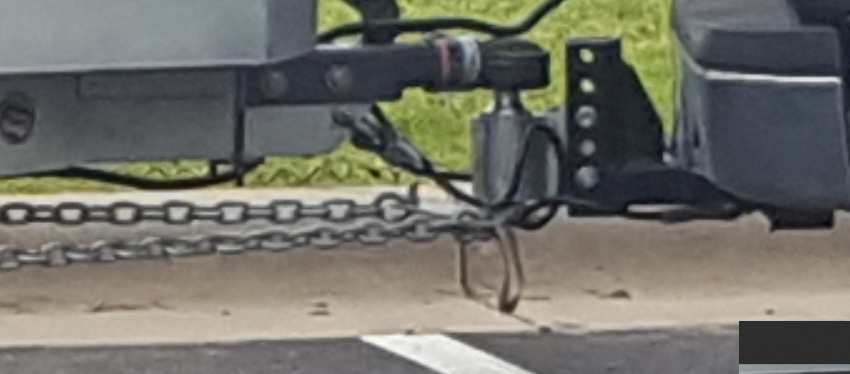
Ok a relook at my OE2 and Anderson with respect to safety chains. With the two large WDH chains installed to the plate, which is part of the Anderson Receiver system, it would appear that we have four safety chains in effect. So long as the pin holding the system in the truck receiver stays in place. Your thoughts? Geronimo John
-
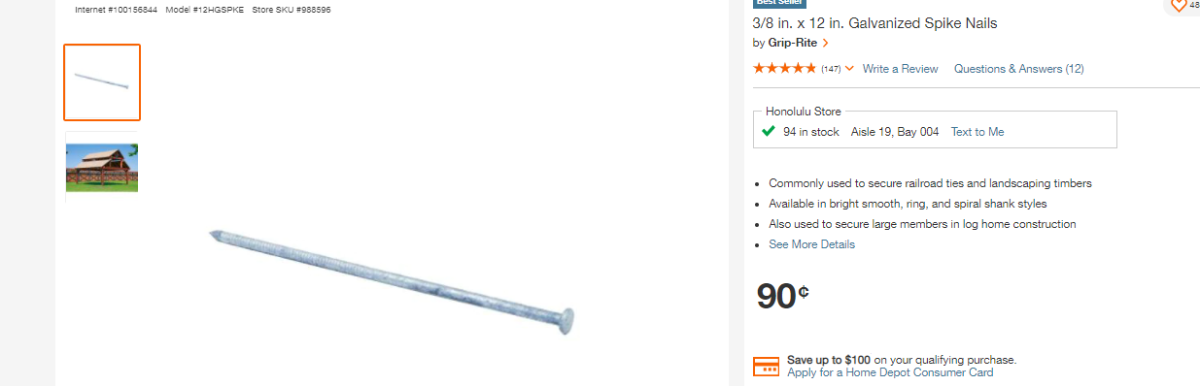
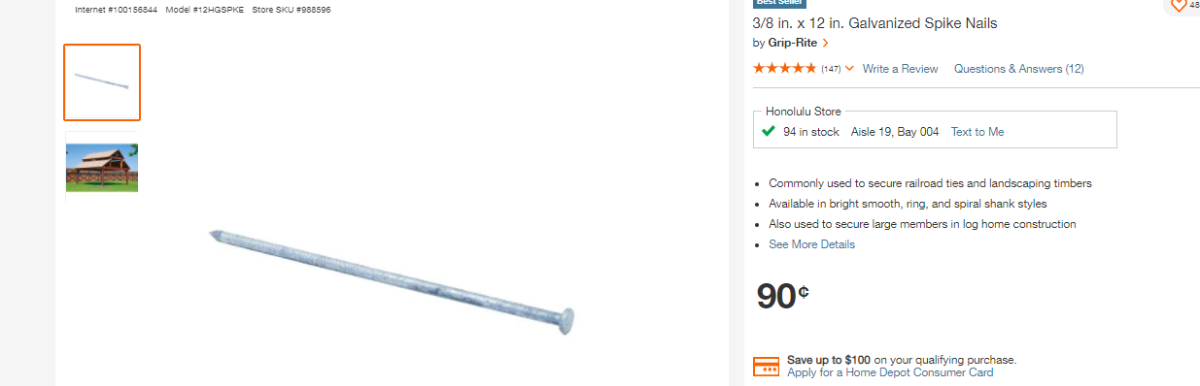
I prefer my multipurpose, strong as nails, self defense throwing spike, the ever popular 90 cent landscape nails at Home Depot. They don't require a brass hammer, break rocks, and if lost are easily found by the next guy. And, they don't require oiling for at least 15 years! However, I have found that by wearing red sketchers they are an eye catcher. But most wise campers don't generally comment when I have half dozen of these in my nail belt.
-
@ Patriot: Which model number Action Packer did you use? I really like your solution. Thanks for posting it.
-
How Long Did Your Oliver Duralast Battery Last?
Geronimo John replied to Geronimo John's topic in Mechanical & Technical Tips
Thank you all for the above thoughts. A follow-up questions for those who HAD DURALAST, and CONVERTED to 12V AGM: Were the standard Oliver battery cables able to be reused with the new AGM 12V batteries? Are the AGM's really worth double the cost of the Lead Acid Marine Deep Cycle batteries? Thanks John -
How Long Did Your Oliver Duralast Battery Last?
Geronimo John replied to Geronimo John's topic in Mechanical & Technical Tips
-
My Ollie is a Spring 2018 egg. At purchase I decided to run with the standard Duralast 12V Marine Deep Cycle batteries. They are approaching their fourth season. For those with the same standard batteries, how long did yours last? I am considering going AGM, but solar is not in the cards. If you upgraded to AGM, what was necessary, and what would you recommend. Thanks Geronimo John
-
Failed Andersen tension chain coupler - ideas?
Geronimo John replied to JRK's topic in Towing an Oliver
When I was using a Toyota Sequoia as my TV, I needed all seven threads on the Anderson chains to level things out. During year two, I approached a parts store entrance where there was a significant grade change from the road. At less than 5 MPH, when my TV went nose higher, I heard noise from the trailer that caused me to stop. I saw that the Anderson chains were really really really tight. I gave them the 245 pound bounce test, they did not move at all. I backed out of the driveway, and loosened the Anderson chain nuts 4 threads and tried again. I stopped at the same place and did another bounce test. This time they could be moved just a bit. To get into the driveway, I had to loosen them to full slack. Point is that a quick grade change will increase or decrease your Anderson chain tension. If your chains are set real tight, and you add to their load a grade change, it can be enough to damage your quick link(s). -
On the other hand, here is the Dexter AWG wire sizes chart. With an OEII, we would be on the 4 brakes, under 30 feet = 12 AWG. So the text book answer is 12 AWG. But I still think that 14 AWG would work very well. That said, when my time comes to replace the cable.... I'll ponder it a bit more. 🙂 For those wanting the full Dexter Service info, it may be found at: http://www.dexterpartsonline.com/files/2036913/uploaded/600-8K Complete Service Manual.pdf GJ
-
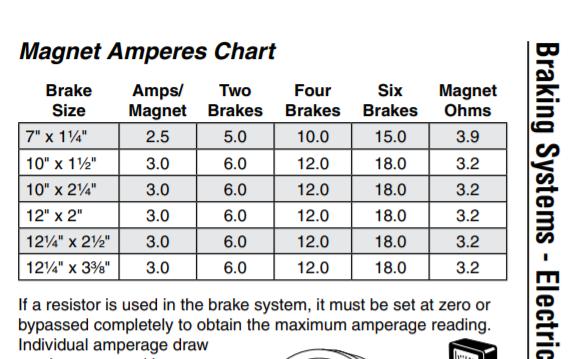
@JRK: Here is the Dexter chart that reflects what I thought concerning amperage to their dual axle brakes:
-
@Scribe With A Stylus: We had the 4 cylinder with the 7 speed trans. Single rear wheels. I think they were 15 PAX machines with about a 4+ foot equipment storage area in the rear. These MB vans were slated to be driven by younger coaches, mostly hauling our athletes and their gear. This setup would not be my recommendation for pulling an Oliver Elite II. Just not enough power. The sleeper recommendation for a TV on the cheap would be a Toyota Sequoia with the 5.7 L engine. I still have our 2005 with the 4.7 and towed Ollie for my first 12,000 miles or so. It needed more power. In 2019 I upgraded to a F-150 Lariat, 3.5 EcoBoost, FX4, Heavy Duty Tow Package. Now that truck is a beast! But the cost difference over a good used Sequoia 5.7 is not something that a lot of folks would want to entertain. Good luck, GJ
-
Another preventive reason to downsize the receiver hitch on the back of Ollie is to prevent potential Darwin Award winners (idiots) from towing their jeeps behind the trailer.
-
Long ago I upgraded to the 2 5/16 hitch. Glad I did. Would do it again. Lots of discussions on this topic. Suggest you search the blog.
-
F350 and occupants saved by their safety chains
Geronimo John replied to John E Davies's topic in Towing an Oliver
Funny, I was looking on line at the very same chains! Thanks for posting. I was thinking of using my curly safety strings to connect up to the real safety chain attachment points, and run them back to a second attachment point under the propane tanks. Sort of a safety cable to the safety chain approach. No point in tossing them. -
According to E-trailer, they state in their "How much power do electric brakes use?" the following: While there is no absolute standard for amp requirements on trailer brakes there are common practices between trailer component manufacturers. This creates a defacto standard. We’ve determined amperage requirements based on extensive testing, customer experience and information gathered directly from trailer component manufacturers. We’ve found the most common amperage draw on a 7-inch brake magnet to be 3.2 amps maximum. The increased amperage of a 10 or 12-inch brake magnet tends to max out at 4 amps. This means that a double axle brake system would be drawing a maximum of 16 amps for a full emergency stop. So, I'm thinking that when replacement or repair time comes around, that AWG 14 is likely to be a reasonable choice. Your thoughts? GJ
-
Xtend and Climb Pro Series 780P 12.5” telescopic ladder
Geronimo John replied to Patriot's topic in General Discussion
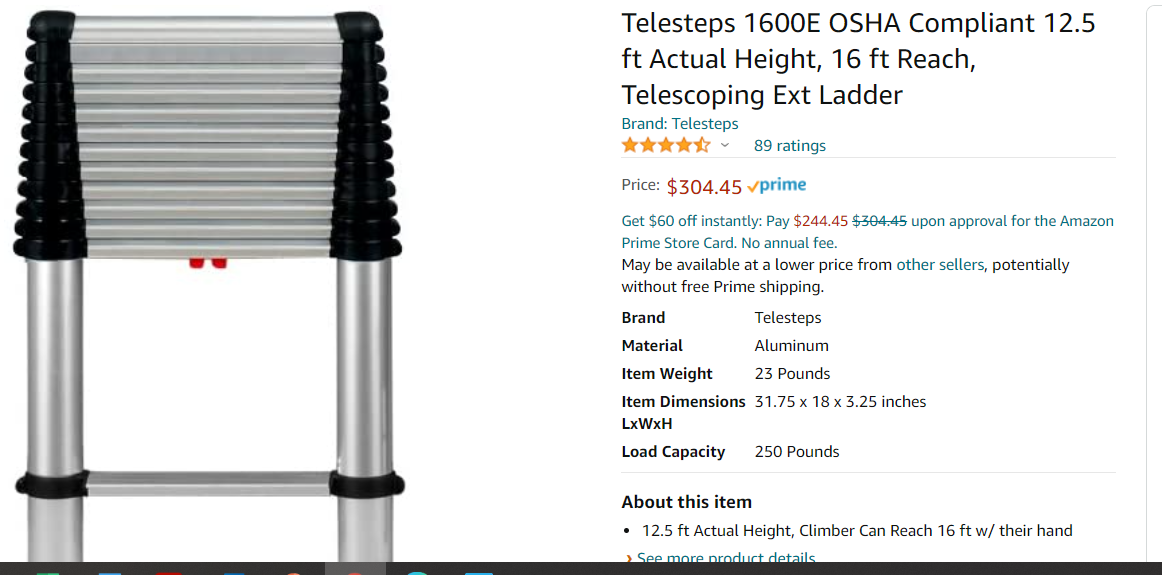
Three years ago, I purchased at Home Depot the Telesteps ladder shown below. As decked out, I'm about 245 pounds so I really liked the stronger version of the TeleSteps Climbing Ladder, Type 1, Model 1600E. If you are over 190 pounds or so, you may want to consider this heavy duty OSHA Compliant version. This firm was one of the original telestep providers and their product is first rate. When I get up on top of Ollie, I extend it out the full length and it gives me a high hand hold to then slide off the side to the roof. I would not recommend getting anything shorter than 12' actual ladder length. Don't be confused by how high you can reach, just go by the ladder actual height. I have been all over the roof of our Elite II every year for detail cleaning (Typically twice a season) and waxing every season. It is easier to wax the center section from on top. Safer to wax the lower top side sections from the ladder. First couple of times I was on top, I was a bit worried. Now not so much any more. This model collapses down to about 3' and fits very nicely in the front side (Behind the hanging cloths) of the coat closet as you enter Ollie. I cover it in a blanket to protect the fiberglass.
-
F350 and occupants saved by their safety chains
Geronimo John replied to John E Davies's topic in Towing an Oliver
Figure that a fully fueled and loaded 2004 F-350 probably is in the 8,500 to 9,000 pound range. The impact loading on the chains would likely be at least 4 times this. I'm assuming that the tearing apart of the axle unit and other parts mitigated some of the shock loading. So, for round numbers, the momentary shock load would be in the order of about 45,000 pounds. I have not seen an advertisement for our curly safety strings. But similar ones are rated at either 3,500 and 5,000 pound ratings. My opinion is that the our curly safety strings and/or their attachment bolt would not survive this test. Granted, using something like 1/2" yellow steel Grade 70 steel transport & logging chain (Working load: 11,300 lbs) would be over kill, but some lighter versions would be worth looking into. @JD: This is begging for a JD how to "Hang Proof our Oliver Tow Vehicles"! (There is your thread title!) . 🙄 GJ -
@JRK: I share most your thoughts. Some more pondering on my part is in order for the below: I am wondering how the brake controllers wires for millions of brake controllers, from the drivers position all the way back to the rear RV axles, are handling the max braking events? None of my many TV's and Trailers I have owned have had mega sized cables as suggested. I suspect this is the case for lots of reasons. In our case, my first one is that the max amp pull of 12 amps (3 amps X 4 brakes) is rarely a long duration continuous load. Secondly, modern brake controllers sense when a vehicle is stopped and back off the power flow to the magnetic coils when stopped, again shortening the duration. As such, maybe these ideas contribute to having used smaller wires for many many decades in millions of TV's. Using commonly used American Wire Gauge Cable/Conductor Sizes and Properties as a guide is not commonly practiced for short runs such as a TV and Ollie. For example, it lists a #12 AWG wire (assumed to be copper) as only carrying 9.3 amps. Where as they are allowed a continuous use rating in residential of 16 amps, and 20 amps intermittently. Hence they are protected by a 20 amp breaker. A #10 conductor is listed with a max current of 15 amps. Yet our Oliver, and about a million other similar trailers use these as 30 amp conductors and breakers. My experience as an engineer suggests that 14 ga would be a sufficient choice. However, your 10 ga would certainly work! Overkill, but it will work great! All that said, when it comes time to replace my brake assemblies, I'll certainly upgrade the wiring, not to 10 ga, but for sure larger than that which Oliver used. And as JD pointed out, it will not be run inside the axle. Finally, and it is a very rare occasion that I have ever suggested taken a JD suggestion even further. But here I go into unchartered regions....., My recommendation is to also run the larger replacement wires through a gray plastic (UV Resistant) conduit (Maybe 3/8") across the back side of the axle. Where the cable inters and exits the pvc, I will heat shrink wrap the cable with a 4" section (2" inside and 2" outside the PVC), and seal both ends of the conduit with a suitable Silicon sealant. These extra precautions are to protect the line from physical road damage, hungry rats. BONUS SUGGESTION: Spray all exposed wired outside the hull (IE under the hull, in the front basket, and for the cables going to the TV) with peppermint oil and water solution. Most wire insulation eating critters (Mostly rats and mice) hate peppermint. It is also useful to spray tires, and jacks to dissuade those critters. I look forward to your and our owners thoughts. Thanks, Geronimo John
-
Size of Generator needed to run Oliver ii AC
Geronimo John replied to Imelda's topic in Mechanical & Technical Tips
Sherry: your suggestion of AI Generators , at $386 each (Amazon.Com) is far less expensive than the Honda 2200 ei. One could buy two, almost three, and it would still cost a lot less than the Honda 2200 does. The competition to the Honda's is heating up nicely. One down side is that the AI's weigh 50 pounds and the Honda is 40 pounds. On the plus side, the two AI's make 4,000 watts of power vsl 2200 for the single Honda.... -
Size of Generator needed to run Oliver ii AC
Geronimo John replied to Imelda's topic in Mechanical & Technical Tips
Jairon: He is using a telescoping ladder with pool noodles attached to protect Ollie. Home Depot and Lowes sell several models. As decked out, I'm about 245 pounds so I really liked the stronger version. It is a TeleSteps Climbing Ladder, Type 1, Model 1600E, OSHA Compliant. When I get up on top of Ollie, I extend it out the full length and it gives me a high hand hold to then slide off the side to the roof. This model collapses down to about 3' and fits very nicely in the front side (Behind the hanging cloths) of the coat closet as you enter Ollie. I cover it in a blanket to protect the fiberglass. Telesteps Climbing Ladder _Type 1_ Model 1600E _OSHA Compliant.docx -
Size of Generator needed to run Oliver ii AC
Geronimo John replied to Imelda's topic in Mechanical & Technical Tips
Sherry: OMG, I am falling out of my chair laughing at my silly mistake. My apologies I totally miss-read your suggestion. I thought you were spoofing Imelda and you were not. I know some computer artificial intelligence code writers (generators). One works at NSA. So when you suggested getting two ai generators, my mind thought you were saying Imelda should get two Artificial Intelligence code generators and connecting them up with parallel cables to provide the trailer power. It was so funny that I had to pull your chain. I have deleted my OOPs. Forgive me. 🙂 -
Size of Generator needed to run Oliver ii AC
Geronimo John replied to Imelda's topic in Mechanical & Technical Tips
SeaDawg; good suggestion! -
Size of Generator needed to run Oliver ii AC
Geronimo John replied to Imelda's topic in Mechanical & Technical Tips
Search "Generator" and you'll find about 1500 opinions. Personally I use the Honda EU2200i. Many use the Honda EU200i, some Yamaha's, and recently the Harbor Freight inverter line (Predator's) is gaining acceptance with a bit more power (3,00 to 3,500 watts). Honda have as many believe the best reputation, but they are also expensive. Lots on options and opinions already here on the site. -
TPMS -Tireminder App version
Geronimo John replied to TexasGuy's topic in Mechanical & Technical Tips
JD: On your recommendation back i 2018, I purchased the same TPMS. It works really well. One thing that I previously had no idea was occurring is that tire pressure changes A LOT from cold mornings to hot desert crossings at speed. Also, the tires in the shade side can be ten PSI or more lower than those basking in the sun. This info, and bouncing dishes and flying dinette cushions encouraged me to reduce tire pressure from 60 to 50 PSI cold pressure. Don't get quite the MPG, but do believe that it is a better highway tire pressure for wear and impact damage perspectives.. A nice tool to have is a battery powered air compressor. I especially like the DeWalt 20V one. -
My Ollie sits for about 8 months in a dark barn with the batteries hooked up to a 1.5 amp battery maintainer. As I don't have a Nature's Head, and I always service the batteries both at the end of the season, and again before my first trip........... I just disconnect the negative battery cable. I'm down to zero phantom electrical loads guaranteed.
-
This is my $5 solution. Not real high security, but it would sure slow down the bad guys. The three pack costs about $15 at Home Depot. Nice part is that I use the other two on my generator. If I need the third one, it is in "storage" at the propane tanks. 🙂 GJ