
Hokieman
-
Posts
355 -
Joined
-
Last visited
-
Days Won
6
Everything posted by Hokieman
-
Welcome! We bought a lightly used 2019 Elite 1, had it a few years. We never used the rear table and kept the bed made. It had a custom made mattress from Southern Mattress the previous owner had installed. It was OK, but it was heavy and tall. I reluctantly sold the Elite I and bought a new Elite II with twin beds (my wife won that battle:) Before we took delivery we ordered custom fit memory foam mattresses from Tochta, we really like them. They can probably make one for the E1 if you want. We prefer the single piece foam mattress over the multiple layers. . As you know, there is a large space under the bed in the center. This is where our dog bed was, our large Labrador liked sleeping under there. It can also be used with a storage bin, or a 12V auxiliary refrigerator. We carry one of those in our truck, fill it with frozen food. https://southernmattressnc.com/ https://www.tochta.com/
-
 I received email reminders from Josh White @ OTT. Last one was 8/20. You may not be on the list or maybe being flagged as spam. Perhaps they closed it down early because it’s full. But there are always cancellations, so give them a call and check on your email situation.
 -
There should be 3 fuses under the street side bunk, one for each jack. They are easy to find if you look there.
-
Appreciate your feedback Chris. I recall reading that too, but several owners in your post report otherwise. Please explain. Apparently Oliver is satisfied with Dexter parts durability as that is what they are using on new Apex model. Perhaps you misunderstood my comments. I would never suggest re-using old and/or worn parts. @DanielBoondock has a 2026 model, and has said he lubricated his wet bolts. They should be inspected of course, but there should be essentially no wear on the bolts or shackles. If any wear, it will be the bronze bushings in the springs, which of course are being replaced. I’m not knocking Alcan, I am a customer, just haven't received my springs yet. I’m only summarizing what I’ve read. All of these reported shortcomings are not deal breakers, they are just not ”optimal”. Working together, we can do better, but it’s important to get the facts straight and pay attention to the details on our running gear. We are moving in the right direction, and have Oliver’s attention.
-
Elite 1 reasonably towable with 2026 4Runner?
Hokieman replied to JackStraw's topic in Towing an Oliver
Yes, it’s built on the Tacoma chassis. It’s a light vehicle. The 2026 non-hybrid has a 2.4L turbocharged engine, which works just fine as my wife’s grocery getter. -
Elite 1 reasonably towable with 2026 4Runner?
Hokieman replied to JackStraw's topic in Towing an Oliver
I own a 2026 4-Runner, and I used to own an Elite 1. Even if the numbers indicate it’s possible, I wouldn’t recommend it. -
I am reluctant to add yet another lengthy post on this endless thread but there are concerns that I don’t think have been settled. They are not a big problem, but worth considering since it’s a simple, free solution. For those that have already had their Alcan springs installed, I think this is worth reading, as you might want to check on your setup and avoid premature wear on your system. I have not had time to replace my springs yet, but I’ve read every post on it to ensure I do it right, since I will be doing it myself. Some folks that have installed Alcan shackles and wet bolts seem to have changed their recommendations somewhat after having some experience with the hardware. See the attached related thread started by @Wayfinder. https://olivertraveltrailers.com/forums/topic/11183-alcan-springs-quote-for-jan-2026/page/2/ On Page 2, @Geronimo John raised several concerns, all of which I think are valid. Subsequent posts by others on pages 2 & 3 further support the concerns, but no consensus, and I’ve not read anything about it since. Alcan shackles and wet bolts are a different design than Dexter. Alcan seems to have an acceptable design, but if used, then it has been suggested by some the maintenance procedure be changed from the one that Alcan recommends. Specifically, the wet bolts should be set by clearance, not by torque. Read the posts to explain why, but there have already been a few problems posted. Periodic re-torquing could be making matters worse. I called Alcan to order my springs, and I discussed these concerns with Tim. He seems relatively knowledgeable about the design, but really couldn’t respond one way or the other, except to say that’s just the way they do it for manufacturing simplicity. He said he’d pass on my concerns to management, but I have no idea if that will result in any changes. I also called Oliver and spoke with Scotty in Tech Support. He confirmed the new Apex model has Alcan 5-leaf springs, but uses the Dexter shackles and wet bolts that are standard on all of our trailers. That makes sense from a production standpoint, and the Dexter wet bolts are set to a torque of 30-50 ft-lbs. The clearance is handled by the design, because Dexter wet bolts have a shoulder. I’ll repeat, these comments are coming from someone that has not yet had my hands on an Alcan spring, so I could be way off. Those of you that already have them, please check your install and provide feedback, supportive or otherwise, because you may save yourself and others some repair hassles. Call Alcan if you’d like, and discuss it with the expert that sold you on their version, and let us all know the outcome. If the Alcan springs, shackles and bolts need corrective action, it seems a simple fix to me. Just check clearance, and re-adjust the wet bolts to get adequate clearance between the bushings and the shackles or hanger tabs. Should make greasing easier and more effective too.
-
@DanielBoondock Do you plan on re-using your Dexter OEM shackles and wet bolts? If not, why not? They should in good shape since your mileage is low. If you are, then use the Dexter torque values (30 min, 50 max), as the design is different. Also wanted to remind you to re-use the dished washers from your Monroe shocks and install on the opposite side of the rubber bushing from the Bulldog washers. This will support the rubber bushings better and they will last longer, provided they are not overtightened. Details and pics about this are in several threads on the bushing subject, Attached is one of them. https://olivertraveltrailers.com/forums/topic/11302-cracked-bushings-on-monroe-struts/#comment-124349
-
Alcan quoted me $145/hr, 2-3 hrs max for installing entire D52 axle assembly, springs, shocks, equalizer, erc. Lots of folks have stated they were in and out of Alcan around 2 hours, with rave reviews about quality of service. I too am a retired engineer and I plan to do this myself first chance I get, because I don't plan to go to Grand Junction CO for maybe a year or more. Saves money, aggravation, is not difficult, and does not require any special tools. I look on the bright side and consider these tasks kind of fun. I’m just going to do the Alcan 4-leaf springs, U-bolts, & Bulldog shocks for now, I’ll replace the axles later when I need brakes. I am re-using my Dexter Shackles and wet bolts, and may keep the EZ Flex too if it’s in good shape. I already replaced bearings with Timken.
-
@johnwen I’m wondering if there are some misunderstandings of your original question. I understand your issue is the connectors are shaking loose. Yes, that’s happened to me on my 2021 model as well. My pipes are white, Sharkbite brand PEX-b, with the same plastic connectors. I assume yours are too. The problem isn’t the pipe type, it’s the connectors. I have replaced many of my plastic connectors and used PEX copper crimp rings, because I already had the tool to do home repairs. This solves the loose connection problem, but sometimes the plastic elbows break. I’ve only had one break while camping, and fortunately a Home Depot was within an hours drive. .There are also other types of clamps such as stainless PEX clamps, which require a different tool. Since my crimp ring tool is really big and heavy, and I cannot get it into some small spaces, I leave it at home and carry a half dozen various Sharkbite push-in quick connects and a few spare pieces of PEX-b pipe for campsite repairs. There are threads in this forum where some owners have replaced elbows with brass, some have replaced all with Sharkbite quick connects, available in plastic or brass. There are several ways to fix your loose connection problem, just depends on your preference, but you should not need to replace your pipes.. All of these fittings and pipes are readily available at stores like Ace, Lowes, Home Depot, etc. Sometimes we are camping too far from such conveniences, which is why I carry the spares. I haven’t had any clamps pull loose yet, but that shouldn’t be difficult to repair on the road. It’s got me thinking about better ways to do it though.
-
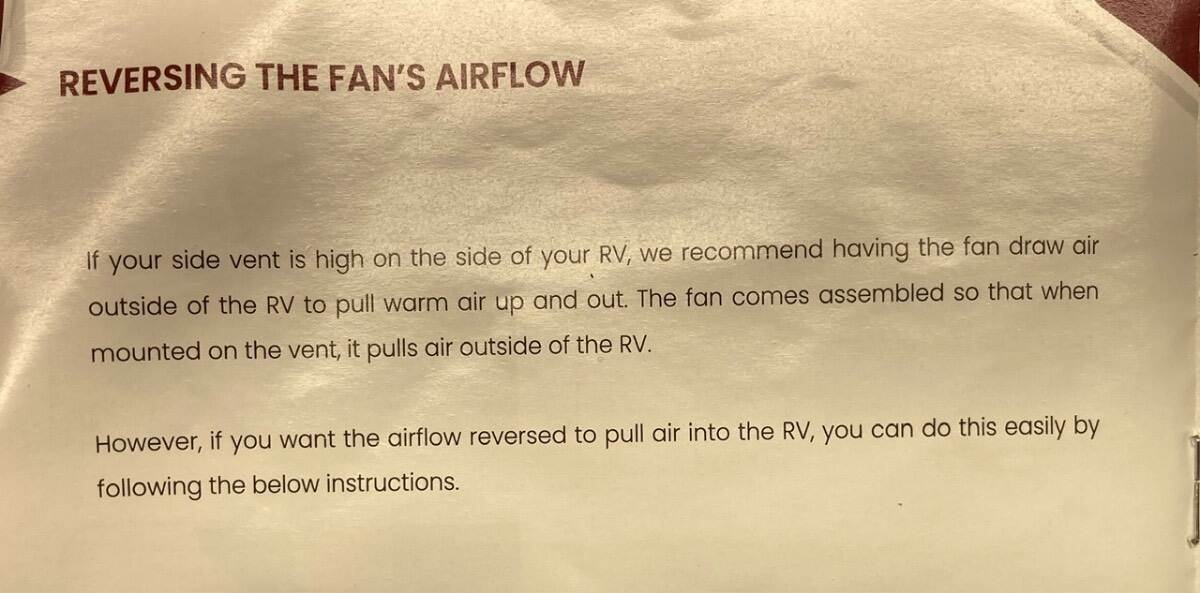
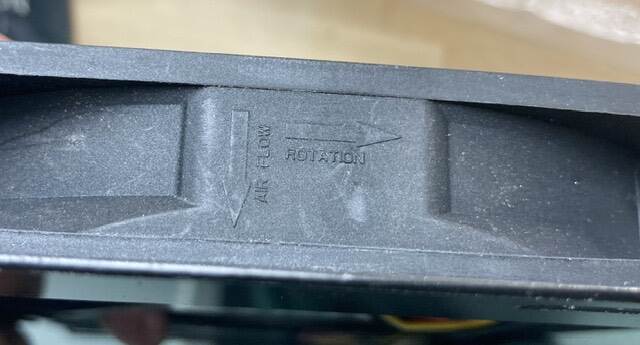
For those considering installing the Beech Lane fan, the instructions advise to mount it on the upper vent, blowing outwards. There is a small diagram on the side showing fan rotation and airflow direction.

-
Spare Tire wobbles inside the fiberglass cover
Hokieman replied to Dirt Duff's topic in Mechanical & Technical Tips
Same with mine. I just put the rub pads on to prevent the tire from scuffing the gel coat. My wheel fits firmly. It’s in storage so I couldn’t tell you if it has one nut or two, but I vaguely recall just one. The pads won’t help your wobble, something else isn’t right. -
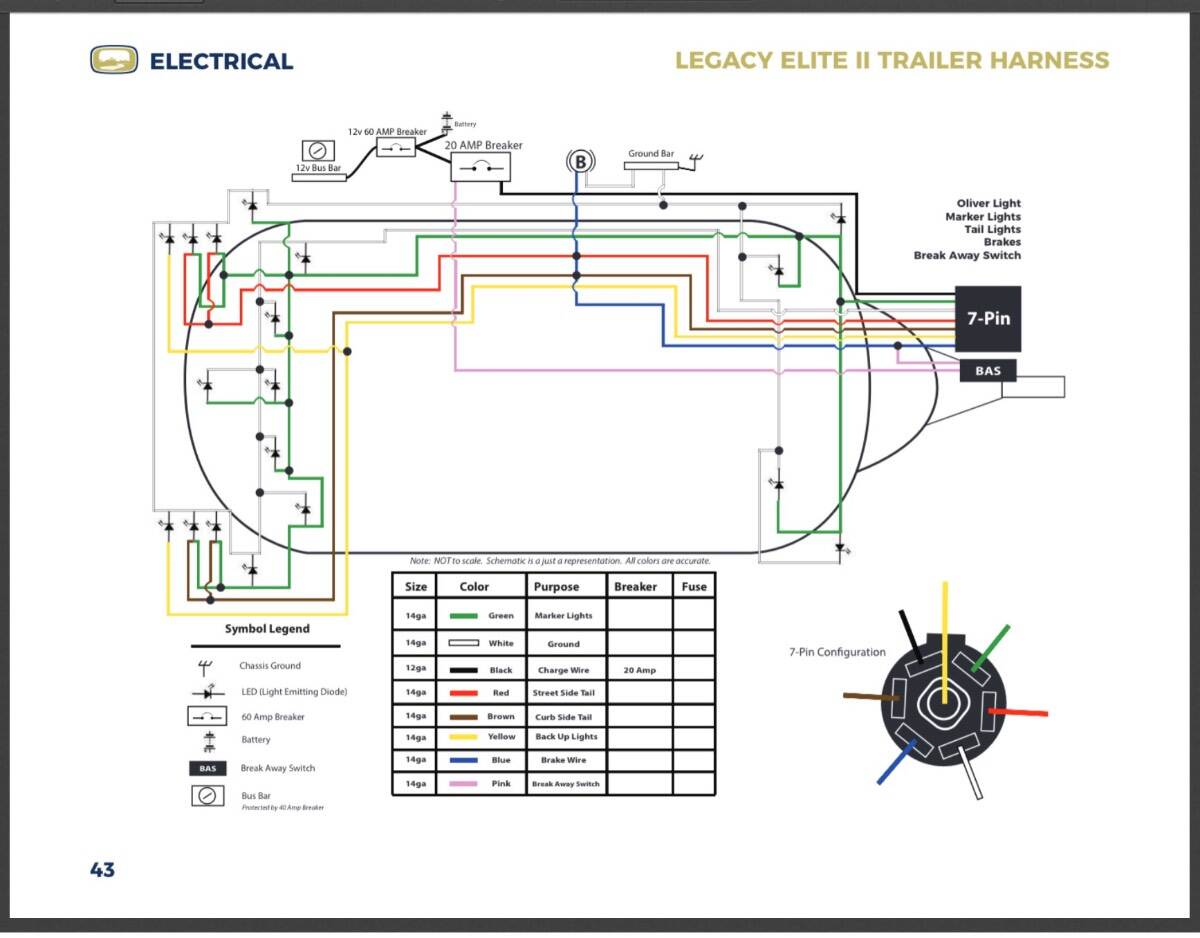
My 2021 E2 has an OptiFuse 12V 60A breaker under the street side bunk. The best wiring diagram I have found that’s close to my model is the 2019 manual (page 43) from the Oliver University. See the breaker in the upper left side. Another quick check is the CO monitor under the dinette. That usually is always on, does not go through the circuit breaker. If that has a light on, you have power coming in, so it is likely the breaker.
-
Spare Tire wobbles inside the fiberglass cover
Hokieman replied to Dirt Duff's topic in Mechanical & Technical Tips
Yes I put those on there. I got a roll of stick-on UHMW from Rockler. People put it on tablesaw fences. I did something similar but less elegant to keep my hull from getting scuffed. I used 4 plastic adhesive door stopper discs from Home Depot.
-
Reset 2.0 has started squeeking when backing up
Hokieman replied to DunnYet's topic in Mechanical & Technical Tips
There has been several threads on the shock bushings being over compressed. Following is one of them, with good pics on how it should look when the nut is tightened correctly. My suggestion is to take the dished washers from the old Monroe’s and insert them between the metal frame and the new bushing on each shock on top and bottom. This will better support the bushing to help keep it from hanging over and getting stress cracks. On mine, I had to grind off a bit of the upper dished washer to get it to fit snugly. No need to replace the bushings, they are still good, just loosen them up. Easy to do. https://olivertraveltrailers.com/forums/topic/7138-any-tips-for-leaf-spring-maintenance/#comment-77118 -
See this thread where several have tried these type ramps and they worked, and for others they did not. In that thread, the topic was about changing a tire. Either way, I think one of these ramps would take enough weight off one wheel to allow grease to enter the uncooperative wet bolt. https://olivertraveltrailers.com/forums/topic/3630-jack-points/
-
Alcan Springs Quote for Jan-2026
Hokieman replied to Wayfinder's topic in Mechanical & Technical Tips
That would be Geronimo John. See this thread for “Hex Head Capture Washer”. https://olivertraveltrailers.com/forums/topic/3665-dexter-axle-loose-bolt-at-the-equalizer/page/2/ -
I cut two 2” holes in the battery box for venting, no fan. I also plugged the vents in the door and insulated with two layers of Reflectix. Used 3M heavy duty spray adhesive, it’s been holding well for 5 years. I did the same on the Basement door. I measure battery compartment temps with my Victron BMV712 monitor, and also a remote temp sensor that I move around in the basement depending on ambient temps. I have not needed to open the battery door, the small vents keep the battery box relatively cool in Summer, warm in Winter. I have camped in 100+ temps and below 10F for several consecutive nights with no problem.
-
Alcan Springs Quote for Jan-2026
Hokieman replied to Wayfinder's topic in Mechanical & Technical Tips
Geronimo John and myself had similar questions about this design too, so I called Alcan and asked. You’ve probably seen my lengthy post from March 18 in this thread. Tim @Alcan told me the bolt splines have an interference fit with the shackle hole, so they should be held strongly, not rotate. I have never seen the parts in question, so I have tried to visualize. You have the parts in hand, so the problem you describe seems to be legitimate and contrary to what I was told. If the bolt head is not kept from rotating, the lubrication port will rotate. Alcan is obviously not worried about it, but Dexter makes it very clear in their instructions to get the lubrication port oriented correctly. This may or may not be a big problem, it’s just not optimal. Dexter shackle bolts are designed to be under tension, using 30-50 ft-lbs torque to approximate that tension. As you pointed out, since Alcan shackle bolts don’t have a shoulder, putting them in tension by tightening the nut also creates a clamping force that can squeeze the EZ Flex and the hanger tabs, therefore limiting movement and creating friction and wear. Wayfinder pointed this out in that other endless thread. It seems to me this is the reason Alcan uses Nylock nuts, so that they can be tightened up just enough to provide adequate clearance, but also not to work the nuts loose. I see no problem with the strength of the Alcan bolts, they have some advantages. The clearance needs to be factored into the installation, I wouldn’t just put a torque wrench to it and call it good. I agree, but I’m just armchair quarterbacking here. I have never seen these Alcan components, and do not know what their installation instructions are. I’d like to understand this better as I am one of those still on the original Dexter springs, and considering the Alcans before my next big trip. Perhaps these bolt concerns are not a problem, obviously Alcan has their reasons for doing it their way. -
FYI those with later model 16” Sumec wheels. I checked an older photo I had from my 2021 E2 and can see weight rating is 3300 lbs. I cannot see the max pressure rating on the photo but will check next time I have the wheels off. Although not as beefy as the older 16” Sendel wheels, it’s re-assuring that they are more than adequate.
-
If you are interested, here is the link to BB Technical White Paper. https://battlebornbatteries.com/technical-note-on-the-safety-and-design-of-the-battle-born-100ah-positive-terminal/
-
Confirming Sway Control with HD trucks in 2026
Hokieman replied to Wayfinder's topic in Towing an Oliver
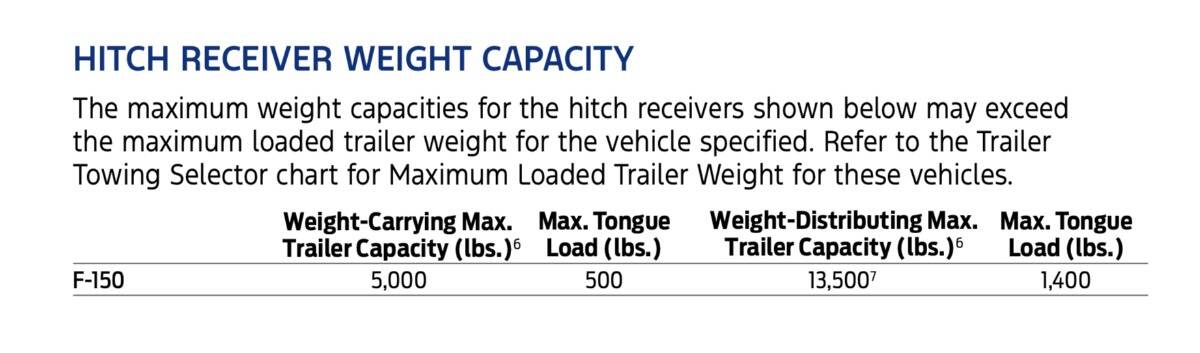
Just to emphasize another point, your receiver hitch may not be rated to carry the tongue weight without a WDH. I don’t know about 2016 Dodge RAM 1500, but in the case of newer Ford F150’s, the max tongue weight without a WHD is 500#, which is lower than your Oliver’s tongue weight if you’ve got it loaded properly. Sure, it works fine, but if you are ever in a crash, you may be exposed to liability regardless of who’s at fault. See snip from Ford Towing Guide that Galway Girl attached.
-
Confirming Sway Control with HD trucks in 2026
Hokieman replied to Wayfinder's topic in Towing an Oliver
I believe you are correct Chris, and in my situation with an F250 it tows very well without an Andersen hitch. One point I’d like to make on the term “Sway Controller”. I understand you are referring to a simple mechanical friction system such as the Andersen hitch system. You are probably aware, modern trucks are fitted with electronic Trailer Sway Control systems. Just distinguishing between types so there is no confusion. See Ford video with details. https://youtu.be/6MRZ50cOVaw?si=RXUWESNdq99zIM2q -
Local web page to search Oliver forums via Google
Hokieman replied to Wayfinder's topic in General Discussion
Thank you Chris! You have gone above and beyond on this task. For those that haven’t tried it, the Oliver forum search tool is a tremendous help. -
Thanks Chris & John. I plan to crawl under my Oliver soon and check the wiring. I may pull it out of the D35 axles to inspect. John Davies had significantly undersized brake wiring in his 2017 Oliver. https://olivertraveltrailers.com/forums/topic/2685-how-to-brake-wiring-is-undersized-some-answers-and-partial-solution/