2008RN
-
Posts
289 -
Joined
-
Last visited
-
Days Won
1
Everything posted by 2008RN
-
Good Call. I didn't put it together until you said something. I lived in Colorado for 40+ years. Low rust, and you had to take extra care with rubber revitalizers a few times a year.on the cars. In Arizona I'm sure it's much worse. In Oregon rust is a big problem. My Dexter Axles tubes started rusting in 9 months. When I put the Alcans on, I sanded down the Axles, put a rust inhibiter on, Primed and painted. I finished by coating the tubes and backing plates with Cosmoline, In Oregon we rarely see the sun for 8 months of the year with very high-cold humidity and I don't see weather checking, but I had rubber softening on 12 year old tiers on a truck I bought.
-
I have been lucky, I have only had to place one O'ring over the years. I use Eley silicone grease on the Male fitting O'ring at the beginning of each season. I like the Tee on the 6" extension coming from the RV hose bib. Great when you need water for another need.
-
thanks @topgun2
-
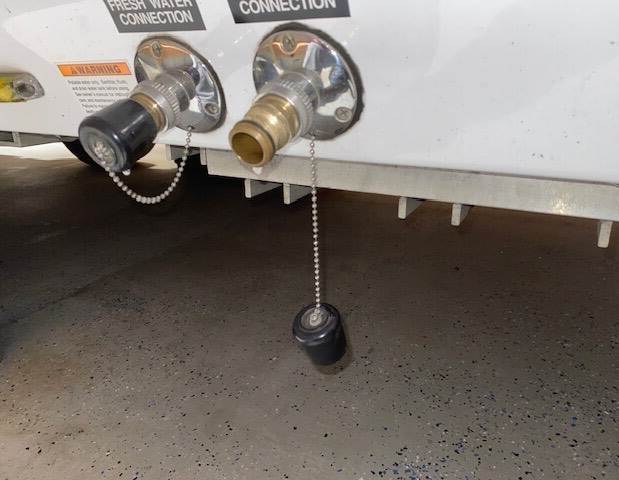
I used Eley Hose quick disconnects. I have used Eley products for around 15 years. They are superb products although expensive. I used the hose leader as shown above to hook to the RV Hose bib. Then the other side is the Female Quick disconnect. I have 3 different hoses of differing lengths with the quick disconnect fittings on them. I have a 2 stage filter with dial pressure regulator and eley shutoff valve and Eley quick disconnects. Finally the city water, Fresh water, and boondock fill all have the Male disconnects on them. I removed the screw in stoppers and connected 1" rubber Chair leg Caps to the chains to seal the male quick disconnects. With all of the disconnects I am able to connect everything up in just a couple of minutes. I do have to lean over for about 10 seconds, but that's it. Sorry for the upside down picture. Just an Eley plug. We have 2 acres, and we bought 2 Eley hose reels with one with 175 ft hose and the other 200 ft. (My wife does want automatic sprinklers) I went through several $150 reels lasting a couple of years each before failing before finding Eley. All of my hoses have Eley shutoffs and sprinkler accessories all have Eley quick disconnects. Everything Eley is 5/8" inside diameter all the way through and my hose bibs are 3/4" with 1' pipe feed from the well. I have never had a problem with any Eley products. In the long run, I have saved money on not replacing hoses and reels on a regular basis.

-
That is a great thing being able to talk to someone. Difficult with the Dometic
-
We updated our Dometic last year when Oliver was giving a deal on the Truma Adventa units. My wife hated to spend the money, but she was happy after the unit was installed. We have a Lagun table, so it has become the table we eat at, play cards, and holds drinks and snacks while we watch Movies. The difference was incredible. We can carry on a normal conversation without raising our voices sitting on the beds at the Lagun table. Watching a movie is no problem. Sleeping with the AC on is a little loud, reminds me of staying at hotels with the AC units in the wall. you don't really notice them until all is quiet. As @Boudicca908 said there is information about different AC units on the forum. Some have even included -dB noise levels.
-
I am trying to plan itinerary to go Alaska through British Columbia (BC). I was looking at trying to go on the Sea to Sky highway going North and then pick an alternate route coming back. We are looking to start our trip in July. Has any one traveled the Sea to Sky highway with our Oliver, and what was your tow vehicle?
-
This has been mention before. The ride is stiffer, the ride smooths out as the springs get worked out. I noticed this at first, I got used to it, then after a 1,000 miles of a 8K trip I paid attention to the ride of the trailer and roads we where on, and noticed a nicer smooth ride. The only thing that are still a problem is larger imperfection in the road, cause movement front to back. as the truck hits a large bump/ pot hole and then the trailer hits the bump and you get that front to back movement and feel it in the truck. Heavy washboard dirt roads are still tough. I just no long get the side to side just front to back movement.. The Oli on the original leafs was like a drunk sailer doing the bob and weave, and that was on nice highway. Inside the truck on rough roads it was like the truck became a bucking bronco. I did upgrade my shocks on the truck when I did the upgrade on the Oli. Now I like it, and you almost forget the Oli is behind you.
-
I left after the split, after I had to let go of my first employee. The head over IT for the Corporation came out in 2000 and said, We where going to be getting rid of 50% of the end user systems next year and we needed to figure out what system and legacy procedures/systems we needed to sunset. Not what I signed up for. I had a friend At IBM that had been trying to get me over to IBM for several years. I gave him a call, and I had a job within 3 months helping to designing network and system security, also some software testing and integration for the Government. In the late 90s HP was the 2nd largest employer in Colorado, the largest was the state government. Agilent/HP in Loveland, CO had 3500 employees when I left. Within 5 years they had 300 people left. The site was empty by the end of 2010. The HP site in Fort Collins, was over 3200 people in the late 90s and are now down to about 1000, between HPQ and HPE. The Greeley site was shuttered in late 2000, losing 1000 employees. Some were absorbed by Fort Collins. There is no way I was staying around for all of that blood letting.
-
I started in 1978, It was referred to as Bill and Daves Daycare center by some vendors. I remember Beer Bust about 10-15 time a year depending on how the company and division was doing. I thought one of the best benefits besides health care was Hermit Park, a big chunk of land with cabins and Boondocking sites for employees close to Estes, Colorado. We also had the family picnics there. Well enough reminiscing. I worked with both the Test and Measurement in Loveland, and the Desktop Computer Division in Fort Collins.
-
Ya, I remember those days. Never meet Bill, but I met and talked with Dave a couple of times when he came out to Colorado. Really down to earth person. Dave would fly into the local little airport. Some low level person would drive out and pick him up. Dave would then take one of the Fleet Ford Taurus to drive around. Many places in HP treated people like family with a common goal. Many employees would sacrifice their time with their family to help out HP in a crunch. I remember in the 80s when financial times where tough and no one was laid off, We all worked one less day every 2 weeks. Compared to Carly Fiorino that showed up with a bullet proof Limo and body guard entourage, with all meeting being locked down.
-
Sorry, I didn't remember this in Statics 101. But Then I am not an Engineer. I moved to CS after my first year. I figured working at Hewlett Packard I was better off with a CS. Which worked with my time at HP and IBM. I still love looking at bridges and building structures.. You are correct that this is YOUR thread and as such I respect that. Also the other thread is extremely long. I will remember this in any further post.
-
When I installed my wet bolts I started with the Alcans and torqued them to the spec. I was unable to get grease in them unless I loosened the bolts. I did not matter on what pressure was on the wet bolt from fully loaded, slightly load to all pressure unloaded. I was unable to get grease in them unless I took the loosened the nut on the wet bolts. I also noticed that the ez-flex did not move freely when they were torque down, but it did move freely when the wet bolt nuts where loosened up. BTW the hangers on mine where spread apart some without the nuts tight. tightening the nuts cause to bring the hanger ears back to together. I dropped a leaf spring back down. I measured the width of the hangers, the bushings and then the shackles. I added up the hangers and bushings then I measure the depth off the shoulder to the base of the bolt on the Dexters and the measurement was .010 more than what I added up. I did the same thing for the shackles and bushing. I got the same results the Dexter shackle wet bolt was .010 more. I really was surprised they were both .010 longer. I would have thought with the galvanizing on the shackles it would have been different. I measured the old Dexter shackles and the Shackles I made and painted (A whole different story, I covered in the gigantic thread I believe) The width was within a .001. Note I did not measure every shackle, hanger and bushing. I just did the ones on the one leaf I lowered. I decided to use Dexter wet bolts instead of the Alcans . After I did that I was able to get grease in all wet bots. A couple I had to still jack up the trailer to remove some weight to get the 2 wet bolts to take grease, I am OK with that. The ez-flex moves freely now. As for the dexter wet shoulder bolt and smaller thread. The way they designed the bolt all of the downward pressure is on the 9/16 thickness of the bolt. In order for the step down to break you would need a lateral force again the Assembly, or the nuts on the wet bolt being overly tight, then extra lateral force could snap the step down section off. I have heard of rumors that The Dexter bolts have snapped, but I have never read of an occurrence happening on the Olivers. I torque the Dexter wet bolts to 40ft/lbs. Over the last 12K miles they have not loosened up.
-

StarLink mini with StarLink router mini.
2008RN replied to 2008RN's topic in Mechanical & Technical Tips
There are many on Amazon, and several on other place outside of Amazon. My problem is finding one high enough customer ratings, that has a large enough sample size to give statistical significance. Found one with 125 reviews, but I didn't like the rating number, and the comments on the reviews. I found one that had 4s and 5s on the reviews and all of the reviews were good. Problem is that there were only 24 reviews. I may take a chance and go with this one. https://www.amazon.com/dp/B0GLF9D2LD/?coliid=IHZS5CRM8MBZM&colid=27T05FXN4KH1E&psc=1&ref_=list_c_wl_lv_ov_lig_dp_it Our dog has all of the standard shots and my wife keeps good records. We usually do NOT Border the dog, So we haven't done the Bordetella (kennel cough) vaccination. There is a large nice RV parks for the 55 and older that requires them. Going to Canada we probably would not need then But I may do The shot just to be safe. -
StarLink mini with StarLink router mini.
2008RN replied to 2008RN's topic in Mechanical & Technical Tips
Thanks for the info to Run route off of DC. Since we are in the PNW we camp with a lot of tree cover (Canopy). Usually close to the roads/pavement will have less trees overhead. Like you said You really do not need the router.... until you do. I think you have convinced that router is a great "what if" backup. Thanks for the heads up, just checked my AT&T plan, and treat Canada just like the US. No roaming charges. Secondly, Crossing the border(s) with food stuff/ETOH. I know going into Canada they charge for ETOH over a very small limit, and their regulation about beef, chicken, most produce. If you have already cooked meat/vegges, is that a problem. Going back into the US we haven't looked anything up. So we not only have to travel the mainland US/Canadian borders, but we plan on going to Skagway and back by highway. that is another crossing back and forth. Then we do the AlCan Highway back and forth. Aree all 6 crossing going to be like this? Not taking produce/ meat/Etoh across the border could be a pain. We like to eat fresh fruit. Eat a fair amount of cook fresh veggies, and some meat. I would also like to pick up a bottle of wine in Washington, wine and whiskey in Canada, Spruce pine needle beer in Skagway if they got it. Have not thought about what we will buy in Alaska yet. This could really become a Pain in the..... We bought a fair amount of ETOH on our trip last year to Kentucky/Tennessee and up to the great lake and back west across highway 2. We had planned to jump across the border to the Hope BC Egg rally and then see Vancouver then back home. With all of the ETOH we accumulated seeing so many states and staying at harvest host breweries, Wineries and Distilleries we decided we would forfiet Hope and Vancouver because of the steep fees for the ETOH. If fact we still have not drank everything we bought last year crossing most of the USA. -
StarLink mini with StarLink router mini.
2008RN replied to 2008RN's topic in Mechanical & Technical Tips
Ya, I like the cord is 3.2 ft (1meter). I did find 1 couple of Dewalt adapters that have Low Volt Cutoff they cut off around 15V. That might help to not torch a battery. Some adapters also have other features as SOC or voltage display, and on/off switch alarm, etc.... That might help to not torch a battery. I just looked at prices they are little pricy, but you're paying for twice the Ah. Just read some complaint with the Dewalt 10Ah batteries shipped with their mowers. Very short life. one guy dropped back to the 6Ah batteries and liked those had a better longevity they just have to spend more time charging to get lawn mowed. -
I totally agree I had the same problem. Having the opposite side down I noticed that the axles were slanted side to side, but also skewed a little front to back. If I had to do it over I would have raise the whole trailer up and level with no pressure on all 4 hubs/tires. I did buy 2 cheap scissor jacks from Amazon to fine tune the height of the axle I was working on helped a lot. I could adjust the height of the scissor jack by hand and get things exactly where I needed them. here is the jack I bought https://www.amazon.com/TCE-AST10202SU-Torin-Cross-Scissor/dp/B0CP78MZMK/ref=sr_1_1?crid=2H17OYSVYKERR&dib=eyJ2IjoiMSJ9.bwqlOzBbCSEQIvYLwTJphg.4A7CLcc1r9OBfO4aqVO_k8xMRyWPESElnwC8J8uQsm4&dib_tag=se&keywords=TCE%2BAST10202SU%2BTorin%2BWide%2BBase%2BCross%2BCar%2BScissor&nsdOptOutParam=true&qid=1789315759&s=automotive&sprefix=tce%2Bast10202su%2Btorin%2Bwide%2Bbase%2Bcross%2Bcar%2Bscissor%2Cautomotive%2C238&sr=1-1&th=1
-
StarLink mini with StarLink router mini.
2008RN replied to 2008RN's topic in Mechanical & Technical Tips
Hi, Thanks for everyone for your input. You filled a lot of blanks in my knowledge, and allowed me to research several things dealing with the Starlink Mini and accessories. Here is where I am starting. 1. I found out that StarLink is starting production runs of the Mini V2 Sattelite dish. It will use very slightly less power, and includse a 4S lithium battery integrated in to the back of the Dish with 71Wh battery. Most likely the back will change due to the battery and the attachments will need to change, so 3rd party stuff will need to be redesigned. They will be using a USB-C for external power. After reading about the new version. I do not think I want the new version. I think I will stay with the current version, with so many accessory options out there. I think presently I have seven 5Amp (100 Wh theorically, 90Wh in real life) DeWalt batteries at home and 3 chargers. I could free up 2 batteries and 1 charger. Or if I bought new batteries, I could buy two 5 Amp batteries. There are always places having sales on them, and it would probably be cheaper than the newer version Mini batteries. Anyway, I placed an order today for the current Starlink Mini and 100GB Roam plan for $55/month. 2. We are going out to the beach for 5 days, it would be a great time to do some testing of the Mini the distances from the trailer and internet speeds with 120V hookup. After I do the distance/up and download speed testing I will make a decision on router needs. 3. I haven't made a decision on mounting yet. I have a 2 tripods, one normal size and small Joby Gorillapod, they take up little space. The Joby is very configurable for uneven terrain like on boulders or slopes. I will test them, looking at stability and ease of set up. I expect JDs setup to be extremely stable and quicker setup. I think I might be able to hook the battery adaptor to the PVC pole on the stand, The Umbrella Stand just takes up more physical space in the truck. 4. After I get back home I will do functionality test of the stand by mode. I had problems with the Starlink AI Bot purchasing a the Starlink plan and Mini. I wanted to pay the cost outright. The bot just signed me up for payments over 12 months. The Bot couldn't cancel the order and the order was locked in before I could get logged in (minutes). The Bot tells me I can cancel upt o 3 hours after ordering, but the system won't let me. Boy was I pissed. I got tired of hearing, "I am sorry, that's on me". I left a scathing anti-AI review. The only saving grace for Starlink is a real person called back 5 hours later and fixed it so I could call back after receiving the Mini, and they would allow me to pay off the Mini. About 10 minutes after purchasing the mini, a youtube video popped up about Starlink charging large service charges, $200 - $1500, for any changes to their account. These charges have been in high data traffic areas where area is overloaded and they are constantly degrading customers bandwidth. He said these charges should go down/away after the Gen3 satellites start taking the load off (64x increase in throughput) off which will be placed with the upcoming starships. Their hope is to deploy twice as many Satellites per load with the starships. Also some good info on life cycles of the satellites. Thanks again Everyone for your input, Bob -
StarLink mini with StarLink router mini.
2008RN replied to 2008RN's topic in Mechanical & Technical Tips
That is nice knowing you can still do some minimal data functions, like phone calls over wifi, and I am Assuming text, and emails in standby mod -
StarLink mini with StarLink router mini.
2008RN replied to 2008RN's topic in Mechanical & Technical Tips
Was it the router a mini? Did you use the mesh wifi or did you do RJ45? If you used the mesh wifi where did you put the router. Living in Oregon we are often under a tree canopy, and the cell reception is very spotty at best on the coast, along the Cascade mountain range and in eastern Oregon prairie land. I still have a problem calling something a mountain range in Oregon after spending most of my life in Colorado Rockies. I do have a hard tonneau cover, but no tongue box . My preference would be to set it on the tonneau and then to disconnect it before take the truck on a outing and store it somewhere. -
StarLink mini with StarLink router mini.
2008RN replied to 2008RN's topic in Mechanical & Technical Tips
That stand looks pretty cool. What parts did you use to make it work. Also the battery looks like a Dewalt 20V battery. How did you wire into the battery. I like the idea of not using cables if possible and if I use a cable I only what to use one. Either RJ45 or Power. I have a tonneau cover so placing it on the cover when needed would be great, when not possible I would like the stand instead of just sitting it on the ground, and the stand had weight in the base it would be even more stable on the Tonneau. Thanks for letting me know that you arrived at your current setup through a process. I liked to know that. I know your setup is more complex than I want now, though it works great for your needs and you arrived at that over testing and growth. Sorry but what is NIB"🤔 I have a question for you and @Todd B how can you mount the mini on a pole or a tripod, Most tripods are 1/4-20 threads and I have know idea what the pole size @jd1923 uses. Special Addapters or does the mini come with all of those mounting options? Sorry for basic questions, When I was a machinist/ automated equipment tech, and then IT, I usually tried to wrap my head around a situation before I would implement. I am kind of anal retentive at times. I like seeing things from different angles before I purchase something. I do not mind fabricating/ buy adapters to make things work, but it nice to have an idea which way I will move before I purchase something. Sometimes it works and sometimes it is working through a problem/situation to come up with a solution. If someone else has a good solution that works, I do not mind leveraging those solutions. Why reinvent the wheel if someone else has already done it. (Off topic) I built a 42' x 16' free standing awning off the back porch with plastic corrugated roof special ordered from the east coast( my wife's idea), I want a plywood with metal roof. The awning roof cantilevers over the roof on the house . Living in Oregon in with many trees and 90+ humidity in the winter I needed a way to clean the awning roof, because of the debris, moss and lichen growth. When I first tried to do this I made a 3 nozzle sprayer on rollers to hook to my pressure washer. It failed miserably. I ended up recruiting my son, and we both stood on our metal roof, one sprayed the roof with water as the other used a micro fiber mop head on a 16 ft paint roller pole to clean the roof. This worked but it was very labor intensive. I found an old high end pressure washer at an estate sale this year. My son and I made the base so I could tow it with the mower and put a removable hose real on the base. I went over every part of the sprayer. It looks like brand new accept for the dented Honda gas tank. It took a 3 iterations with the old 3 nozzle sprayer, but I got it working great, and at half throttle. Had some fun at full throttle where the sprayer was floating 4ft above the roof because of the spray pressure. When I got it dialed in it took 1.5hrs by my self without getting any over spray on the metal roof, as compared to 4hrs for 2 people and both of us getting wet on a metal roof. The point of the story I may be slow and with limited resources, but I never gave up on finding a solution. -
I am planning a 8-10 week trip in British Columbia,Yukon and Alaska for next summer. I started to think about internet access, and being able to communicate with kids. So I started looking at Starlink posts in the forums here. I am thinking about the Starlink mini and the Starlink Route mini with the mesh network then doing the Pause anytime with standby mode to lessen the Starlink charges. I am not at the point of wanting to drill holes in the Oli or install a satellite in/on the truck. I know others here were talking about going with the Starlink mini and StarLink router mini in order to able able to get the satellite receiver out at the 50 ft limit and still get decent reception back inside the Oli. I was hoping to get some feed back on how this is working out. Thanks, Bob
-
I wish my main electrical setup looked this clean. My 2020, is all over the place.
-
Wow, twice in 2 years that is not very comforting. I wonder how bad is their failure rate?
-
I can neither agree or disagree with your theory or info. There are a lot of engineering factors that go into making the best ride possible and I am not an Engineer let alone a mechanical engineer with Dynamics and materials theory. If the theory is correct, then their are more questions : 1. According the the tire manufacture info I believe that the pressures should be 45 PSI due to the weight of the trailer. I try to run between 45-50. I use to run around 55psi more of a safety factor in my mind since I do't use TPS system. I would think the stiffer tire would create less heat, but could also cause uneven wear. I just changed the tire this year, due to age and not wear, 25K miles. I old set didn't show any abnormal wear and still looked almost like new My tires also only see the sun 60-80 days of sun shine a year. When in storage my tires are on concrete, I am planing on putting the Oli on Jack stands and getting most of the pressure off of the tire. I was reading that with large vehicles sitting in one spot for long periods it is hard on the tire, causing flat spots in the belts. 2. The Ez-flex probably needs to move as it was designed to move freely. I don't know what is the latest from Alcan for the torque specs for the wet bolts. But the way the Dexter bolts are made to allow Fairly free movement of the Ez-flex coupling. 3. The leafs. We know that the Dexter 4 leaf was under sprung in their design. The next question would be is Alcan 5-leaf the proper leaf spring, or would it be the Alcan 4-leaf or the Dexter 2200 lbs. I personally have the Alcan 5-leaf and like the ride. there is still movement but it minimal. Last Item: I know this is your mod thread, but should this be posted in the mammoth thread on leaf spring that might get more attention? This could end up causing several more pages of posts.