
Snackchaser
-
Posts
210 -
Joined
-
Last visited
-
Days Won
11
Everything posted by Snackchaser
-
Sounds like click bait, but it’s true! During a recent trip, the master switch on the main panel started flickering on and off, and that caused the blue LED indicator lights for other switches to flash. It turns out that one of the spade terminals for the switch had loosened from the strain of the tangled mass of wires that were tightly stuffed in behind the switches. Many of the wires were individual grounds for the LED switch indicators, and there just isn’t enough room for all of them. The wires are oversized and stiff, and they used bulky splices to connect them all together. So I cut the mass of yellow wires out and replaced them with a single smaller wire that was daisy chained to each switch. That space is much less tangled now, and there is more room and less strain on the switches. Now I have room for a new switch for a future project. While I was in there, I decided to address another peeve. I’ve always thought that those blue LED’s were too bright, so I soldered a 47K ohm resistor on the termination end of the new LED ground jumper. This dimmed the LEDs by about 50%. . . so much better! If anyone’s interested in doing this, Amazon carries a 525 piece resistor assortment for $8 so you can experiment with various levels of dimness. Only one resistor is needed for all the switches, so you could do a little twisted resistor art with the leftovers. I hope that someone finds this useful. Cheers! Geoff

-
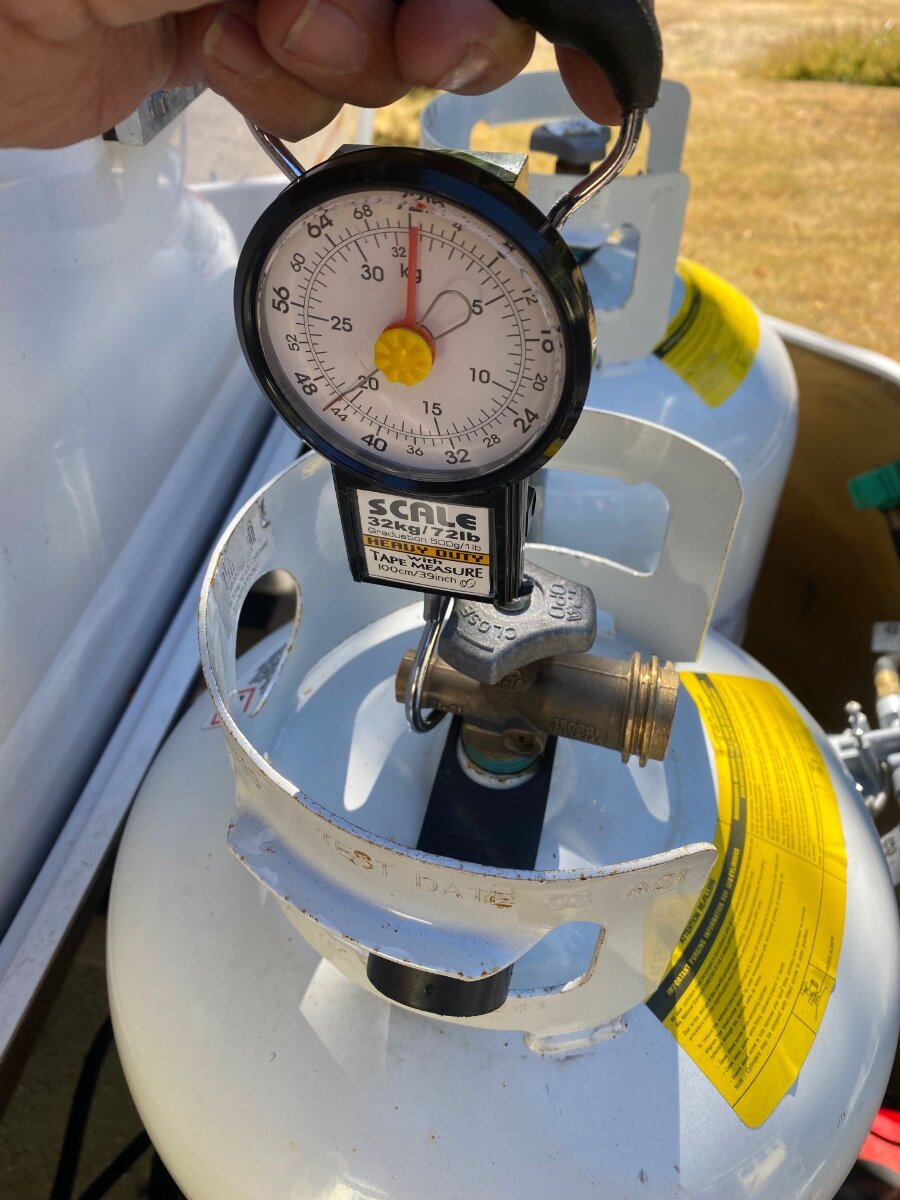
Although there are several ways to check propane tank levels, I’ve found the easiest way for me is a luggage scale. They have large hooks that balance nicely when hooked on to the fill valve, and they remember the weight so you don’t have to contort yourself to see the scale. Mine has an analog dial with a memory needle, and thankfully no batteries. I’d recommend these over ones with batteries that always seem to be dead when you need them. Flame King sells a more expensive scale made for this purpose. It conveniently reads in percentage, but it’s battery operated too. A 30 pound tank weighs around 55 lbs when full, and about 25 lbs when empty. A 20 pound tank is around 37 lbs full and 17 lbs. empty. I’ve labeled my tanks with their weights and I can determine exactly how many pounds are left with the scale. The tanks can be weighed in place with the spin-off clamp loosened, and it helps to put a stick or bar through the scale handle to lift with both hands. I know some people swear by the Mopeka ultrasonic level detectors, and I heard the newer ones work pretty good. But I’m still not over the problems and uncertainty of my old ones, so I’ll stick with my trusty scale for now. Cheers! Geoff
-
Hey John, Chat GPT is often wrong because it relies on opinions like mine🫢 My opinion is that Gen-3 has slightly better reception because of the larger surface area and its motor driven alignment. However, I don't think it is a significant difference, certainly not enough to offset the benefits of the Mini. When there are too many obstructions, neither one is going to work well. But I agree that the Gen-3 is faster, I think probably because of a better Wifi signal, hence I recommend using the Mini Mesh Node Router with the Mini Dishy. See my post: "The new Starlink Mini router, for what ails you." We used to turn-off the power hungry Gen-3 at night to save our battery, the Mini stays on 24/7, a big benefit. Also, the dishy spends most of its time on a mast, and the heavier Gen-3 on the same mast used to rock the trailer in breeze. The mini is small and light as a feather in comparison. See my post "Tacky Starlink mast." BTW, I see folks buying padded cases and protectors for the Mini, but they're pretty rugged and mine just lives in the hidden drawer below the pantry when traveling. It's more challenging to route the Gen-3 cable into the trailer, I've posted some designs on this too, see: "Great news! Starlink Gen-3 is here and it has Rj45 connectors." Other folks have posted ways to power it from DC, but I've never looked into that. The Mini is easy to power, and there are portable power supplies available that can be taken on hiking trips. I make a 3d printed version with built in battery charger, hit me up if interested. I also have a post on powering the Mini from 12 volts with a 12-48 volt Victron converter, this was for one of the early Mini's and before any commercial solutions were available. See my post: "Starlink Mini installation, cracking the 12 volt barrier... or not." That post also includes a clean method to get the power cord into the trailer. I still use that power supply today, but there are cheaper power supplies now available. Albeit, not as good or energy efficient😆 Hope that helps with your decision process! Cheers, Geoff
-
Hi John, We cut the cable years ago, and I’ve used the larger units, Gen-1 and Gen-3 for the Oliver. Now I use the Mini exclusively with no complaints and we still keep the Gen-3 active at home for security devices and guests while we're away. The Mini, with it’s built in Routrer, looses speed the farther away it is. This is due to the WiFi signal dropping off. So if you go with the Mini Dishy, then I recommend getting a Mini Mesh Node Router for $40 because there are times when you will need to move it farther away to find clear sky. See my post: The new Starlink Mini Router, for what ails you. Starlink Beam Switching keeps improving and there are increasing numbers satellites so reception keeps improving and the Mini seems to work as well as the Gen-3 in that regard. My Mini isn’t quite as fast as the Gen-3, but it’s still blistering fast, and way faster than most cable connections. There are a number of options to run the Mini from the trailers 12 volt system. You just can’t use the included 50’ cable because of voltage drop without boosting the voltage. You can do that with a voltage converter to increase voltage, or one of the available power supplies, or use a shorter cable. Hope that answers your questions! Cheers! Geoff
-
Typically it's a GFIC receptacle (outlet) with a reset and test button, not a breaker. It will be the first receptacle closest to the breaker panel that daisy chains to feed the others, mine is the one under the dinette.
-
All the comments are right on the money. But for a little more perspective of why you fell short of power, consider this: My guess is that you have about 400 Amp Hours with your 4 AGM batteries, which gives you about 200 AH usable power without going below 50%. You stated that your inverter stays on. A Xantrex Freedom inverter uses 72 AH per 24 hours of standby power (turned on without a load.) The Victron Multiplus is better at 40 AH a day with standard factory settings, and as low as 16 amp hours a day with power saving settings. These are both zero AH when turned off. The batteries are being supplemented with an assumed 320 watt solar system, which is under 30 AH a day in sunny conditions. You mentioned a coffee maker which burns a lot of power, typically about 20 AH to brew coffee, and more if your keeping it warm. That could cancel out the solar contribution. Now add in the AH values for whatever else you're using, and you can figure out how long you can last when boondocking. Hope that helps! Cheers, Geoff
-
The Oliver’s fiberglass body is the majority of the 4900 lb dry weight. I’d conservatively guess the aluminum frame is around 2000 lbs, not including the running gear and hardware. So given their claim of 30% weight savings, it would save about 600 lbs. However, I’d question whether that 30% weight savings is compared to a conventional steel frame. If so, then you're looking at closer to 20% weight savings compared to aluminum, or 400 lbs . . . which is not significant IMO. If the frame costs more to make, and it’s a selling point, then just make sure that corners are not being cut elsewhere. Food for thought! Cheers, Geoff
-
Furnace Duct Modification for Improved Air Flow and Circulation
Snackchaser replied to jd1923's topic in Ollie Modifications
Hey John, It might be worth checking out my post Bathroom Heat - a more direct approach! It's an easy and significant improvement to bathroom heating. It won't help with your dust issue, but it includes replacement of some of that problematic flexible duct. It would be near impossible to replace that long duct going to the bathroom, but I think with a filter installed the dust problem should go away. Since I've done that mod, I've added more semi rigid duct from the furnace to the kitchen. It's tucked up out of the way into the space above the return air register as seen in the photo, and it eliminated some restrictions and puncture hazards. I also cut a vent hole in the wall on the left side of the toilet through to under the dinette seat as others have recommended. It helped a lot! Afterall, bathroom heat is a nice luxury, and it helps with the wet bath humidity too! Cheers, Geoff
-
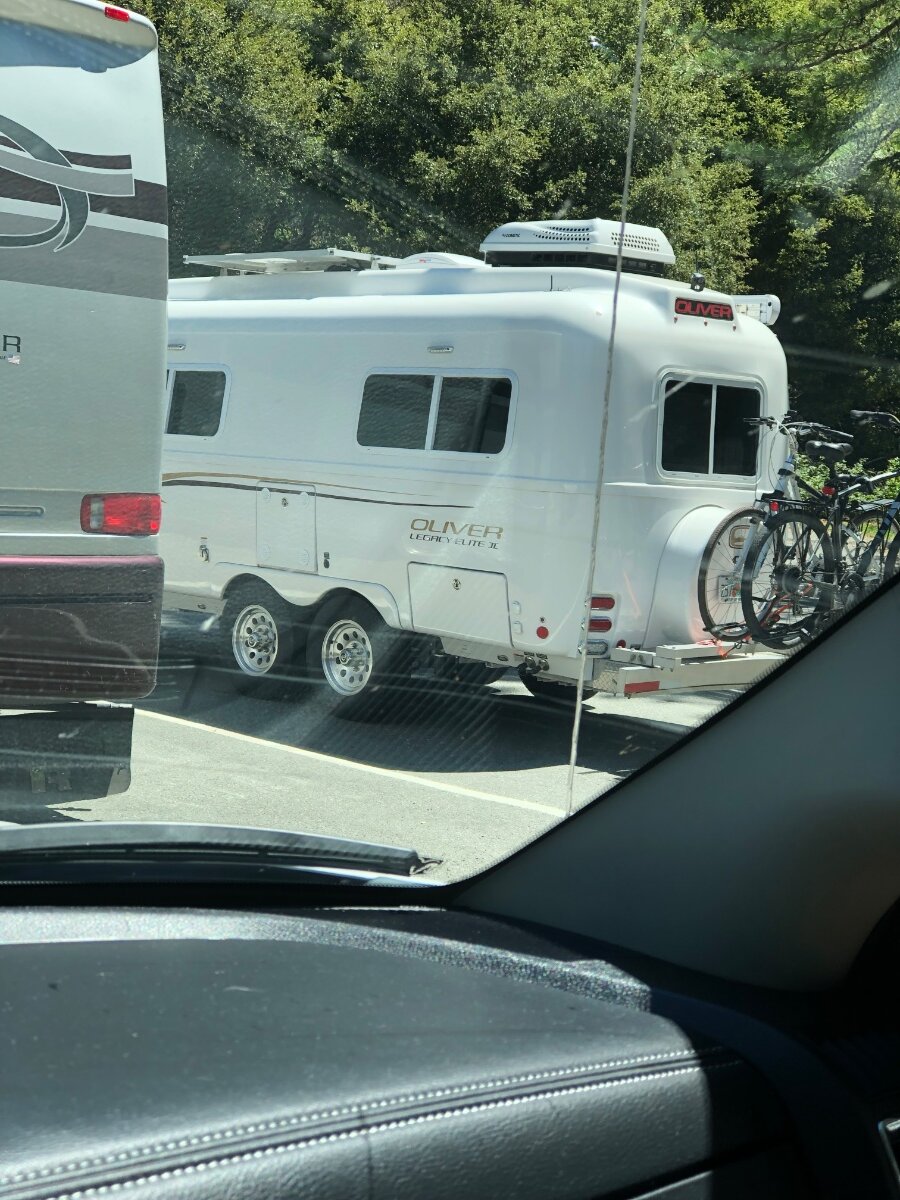
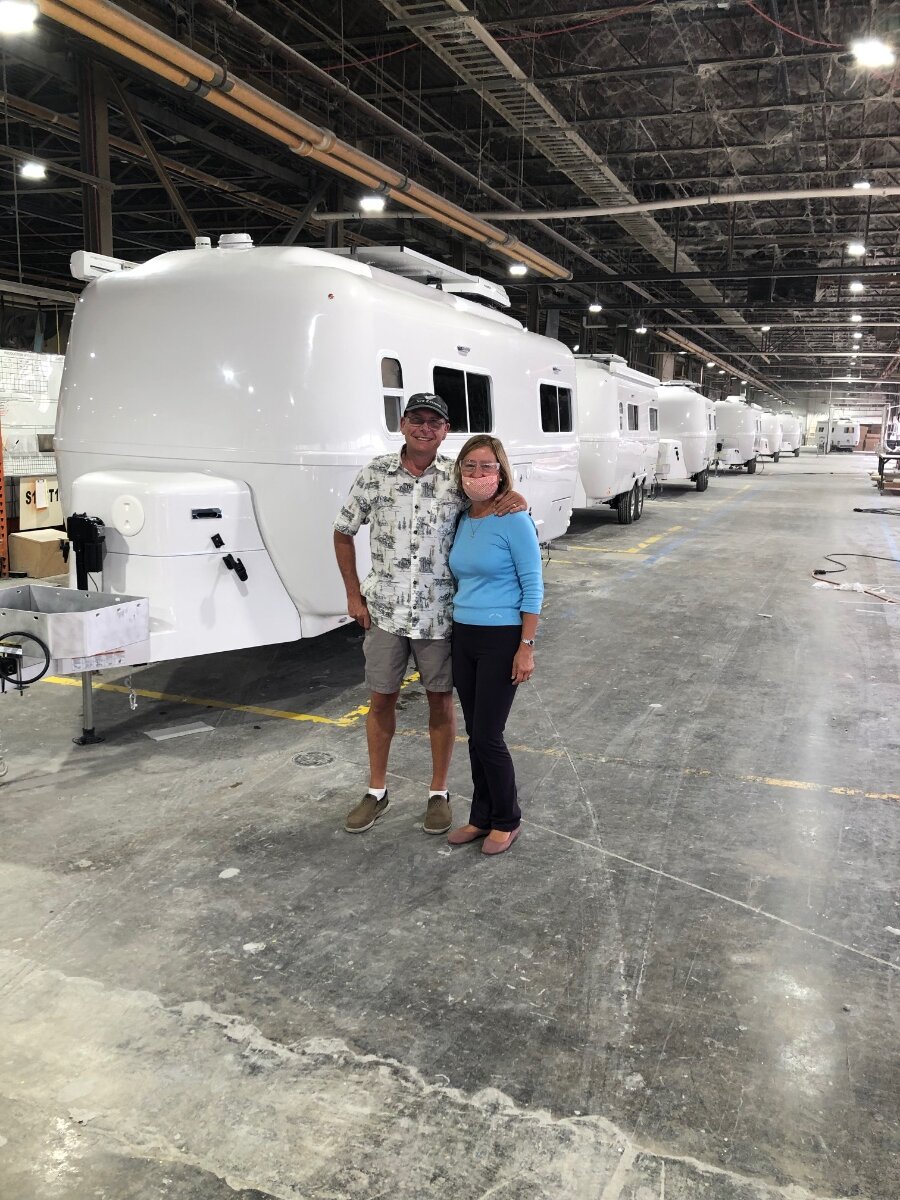
It was June 26, 2021 when we pulled into a rest stop and sighted our very first Oliver. As fate would have it, we had just been talking about selling our 5th wheel and down sizing to a smaller trailer. We hung around for awhile, but the owners didn’t show up. So we took a photo to remember the Oliver name, and we looked it up as soon as we got home. I came across that photo recently and thought it would be fun to post it and see if anyone recognizes their trailer. It was taken at the tunnel rest stop on Hwy 199 between Crescent City and Grants Pass. When zoomed in, you can just make out a Florida License plate beginning with Z57. The second photo was taken September 9. 2021, just over two months later when we toured the factory and placed an order. Happy days... except for those ridiculous covid masks! Do you have a first sighting story? Love to hear it. Cheers, Geoff and Tanya
-
This is interesting! I'm assuming that the "tricky" part is installing the larger 12 volt wire, and he seems to imply that it could be done?? It would be nice if he could expand on that because myself and others have previously dismissed this as an option. Perhaps there is a way, and I'd be very exited to hear about it. But a word of caution for your installer. Unless there is some sort of adaquate void or channel that the existing 120 volt wire is routed through, then be very wary about using the existing wire to pull in a new wire, or using a fish tape. It's well known that wires can get hopelessly jammed and stuck when doing this in any location, and the Oliver is particularly challenging because of the tight space between the roof and ceiling with curves and pinch points. Make sure your installer has plenty of Wire Pulling Lubricant and experience in this regard, because there is some risk that the 120 volt circuit could get fouled up without being able to get the 12 volt cables in. I'm looking forward to any news on this, and good luck! Geoff
-
Trailer Brake Disconnect Warning/Message
Snackchaser replied to Mike and Carol's topic in Mechanical & Technical Tips
Your 7-pin pigtail has to terminate somewhere in the trailer. Mine is a 2022 and they should be somewhat similar. Trace the pigtail to where it enters the trailer through the penetration, likely behind and under the propane tanks. From inside, it probably enters under the bathroom sink and from there you can trace to where it terminates. It has to be in an accessible location. Mine is in a standard junction box under and to the right of the bathroom sink, on the floor. It is somewhat obscured from vision by the heating duct. -
Trailer Brake Disconnect Warning/Message
Snackchaser replied to Mike and Carol's topic in Mechanical & Technical Tips
Based on the breakaway switch working okay, and the F-350 working with the Airstream, I'd take a close look at the Oliver's 7-pin plug. It could have a loose connection within the molded rubber plug. It could be a hard thing to test, but your best bet would be a continuity test between the plugs female pins and the other end where it terminates... while twisting and pulling it to be sure the circuit break is not intermittent. You might just replace it if there is any doubt. My 7-pin cord terminates in a electric 4" x 4" junction box under the sink, could be loose or shorted in there too. I didn't read the entire post, so apologies if you have already done this. Good luck, Geoff -
I've used epoxy before, but it's rather permanent and overkill IMHO. I've had great results from ACE construction glue. There are plenty of inexpensive and high strength construction glues that would be more than adequate. These come in caulking tubes that require a cheap caulking gun for super easy application. It's tacky enough that clamping is not required, just push it firmly in place and prop the board up so it doesn't slip. It appears they originally used this type of construction glue from your photo. I've also had original glue failures, and I believe it was caused from glue application on dusty surfaces, and it looks like yours was barely touching both surfaces. There is a surprising amount of dust on the interior surfaces, so be sure to clean surfaces before using glue. Also, I think you could just add more glue to that surface and save yourself a lot of scraping of the old glue. Cheers! Geoff
-
I added a top and bottom vent for the closet, but it's hard to know or measure how much airflow has improved. But you can be certain that it has improved over having no vent at all. At the same time I added a vent in the bathroom that allows the pressure from the heater duct to flow out under the dinette seat, then through the basement back to the furnace intake. This was a significant improvement for bathroom heat. You can feel air flow through the new vent, and it actually holds a tissue in place from the back pressure. FYI, I used a hole saw and taped the surface to prevent chip out. It worked great! Cheers! Geoff
-
Just before leaving on our current trip, I covertly made a new cherry table and installed it to the surprise of wifey. She had wanted to keep the Oliver’s stock modern look, which is understandable considering that the house is already full of custom wood pieces. But after using it on this trip, we both absolutely love it! If I were to choose to have only one Oliver modification, it would be the enlarged table! The original table was small to fit between the seats for a third bed, and it is barley big enough to fit much more than a two piece place setting. The new table is 28” x 37” (about 10” longer and 5” wider) and it makes a huge difference to have the extra tabletop space. We can now fit the computer and our place settings. I realize not everyone has access to a wood shop to build such a table, but there are consignment woodworkers just about everywhere that could easily do it. As wood working projects go, it doesn’t get much simpler to joint and glue planks together and sand them flat. Many hardwood lumber shops even have wide belt sanders available to flatten tabletops. You could even have a lumber shop cut a nice piece of hardwood plywood, round the corners with a saber saw, and dress the edges with real wood self-stick or iron-on edge bands, just like they do for kitchen cabinets. I recommend experimenting with a cardboard template to determine the optimum size to fit your body types. I also remember a guy who advertises wooden accessories on this forum who might sell larger tables. Anyway, it’s a worthy project or expense to think about! Cheers, Geoff
- 5 replies
-
- 11
-

-

-

-
I wouldn’t reset your TV. Starlink is amazing fast with clear sky most of the time. The router should help when you move the dishy to find a hole in the trees. The times you don't have clear sky will be few and you will just have to accept no service or the buffering blips.
-
This has been our experience from several years of using Starlink in the forests of the Pacific Northwest. We often had to move the Starlink Mini the whole 50' length of the cord to find a clear sky hole, but then the WiFi signal was so weak we couldn't stream. Now with the new Mini Router, a bargain at $40, the WiFi signal is much better and there is a big improvement in speed and streaming. The USB-C power supply has been working great for the router too!
-
Went through the border again today, after about two hours waiting in line with only two of the many gates open. I handed the US border agent our passports and cell phone with the CDC letter. He snapped back that the didn't want the letter. Gees, a little grumpy . . . go figure?
-
Battery and Solar Disconnect Install Questions
Snackchaser replied to Tony and Rhonda's topic in Ollie Modifications
This is the hatch I'm referring to. Instead of mounting the switch next to it, mount it right on the hatch cover. It will make the drilling and wiring a breeze! -
We filled out the on-line form that @John Dorrer kindly linked. It was just some simple questions. We then received an Email reply from the Center for Disease Control (CDC Dog Import). We entered and exited Canada for a 3 hour visit to White Rock, BC yesterday, and will be going again today! When entering Canada, we declared our dog and they did't ask for anything. When returning to the US, I gave them our passports and my cell phone with the CDC Dog Import email. They looked at the email and said thank you, and let us pass. Thanks again to John!
-
I need help with my Norcold 412.3 refrigerator please.
Snackchaser replied to Copycat Carlton's topic in General Discussion
You didn’t provide much detail on the symptoms or what all has been checked, but I looked at the manual that @Galway Girl provided and there are very thorough trouble shooting guides, test procedures, fault codes, and schematics. Even three internal fuses. I think the big RV outfits are more likely to recommend replacement than repair. So, not knowing what your comfort level is for electrical troubleshooting, I think you could find some old school appliance repair guy in your area that could probably figure out what’s wrong and fix it. You already replaced the boards, so it's likely some other electrical component. Although parts are scarce in the US, they seem to be more abundant in Australia. Also, besides the boards that you already replaced, many electrical parts are off-the-shelf and can be substituted. For $4800, I’d be using the manual and a multimeter to run all the tests, or at least paying someone else to do it. Wish you luck! Geoff -
Battery and Solar Disconnect Install Questions
Snackchaser replied to Tony and Rhonda's topic in Ollie Modifications
Have you considered mounting it on the hatch cover? At least if you mess up, then you can just get a new one. Cheers, Geoff -
The statements jive okay. This question was originally about the virtual load setting, and it's morphed into why not more solar input. The solar charger data looks good for the 36 watt input. However, the question of why the input is not higher is a whole different discussion. There could be a number of reasons why: I'd first look at the "History" feature of the App, it will show the solar input over several days. If it was charging at more watts in periods of more sun, then that will give you a better idea if it's sun related. Cleaning the panels will always help, but not that significantly... unless they are really really dirty. Next I'd review the Solar Charger settings, particularly the battery type, as they can also impact the output. Also, whatever device you are reading the 40% SOC from, I'd review those setting too. You might actually be at a higher percent charge and the charger is ramping down the output. There are probably some charging curves out there to see how it ramps down, and that can provide clues. Let us know what you find and we will see where it leads to from there! Cheers! Geoff
-
Thank you! We will be crossing into Canada in a few days. We have her vax papers but didn’t know about the form. Cheers! Geoff
-
JD, I was looking at these units too. The new ones can have both AC and DC connected at the same time. It automatically prioritizes to AC when the AC is energized, regardless if connected to DC. I personally wouldn't connect it to the DC to DC charger, unless it was a really convenient place to connect the circuit. I'd just run a dedicated fused wire from the battery via a relay that is mounted close to the battery. From there it would be easy to trigger the relay from an ignition-on circuit or a manual switch inside the cab. If your truck has an up-fitter option, you can program the switch to work only with ignition on. Cheers! Geoff