Leaderboard



Popular Content
Showing content with the highest reputation on 05/13/2019 in Posts
-
Ok here is what I have been informed, in my case I had what is called production holes, it’s how the hull are mold work together in some fashion. I also had a twist” of a air pocket formed and blew out. Bottom line things were not done correctly. A correct hull should be smooth and white with a clear coat of gel coat. To correct this deficiency the holes must be enlarged and fiberglass layers should be used for repairs. Then gel coated to match. If not completed correctly then the issue would resurface. So what I got out of them for you guys with exposed production holes with no cracks, it’s a matter of a coat of Gell coat, And for those such as me with blowout holes it more extensive enlarging the holes and filling with layers of fiberglass. Hope this helps.......Yukon2 points
-
Since it appears that my request for a factory lift is going nowhere, I will have to do it myself. It will be a while, and I will definitely try out the stock suspension first on unimproved forest roads. I'll fully document the lift process, when I do it. I forgot earlier, I also plan to carry a couple of replacement spring packs. They are inexpensive and if you bolt them to the frame somewhere, out of the way, they take up no cargo space and they are there when you really, really need one. I've had a full set bolted to the back bumper of my utility trailer for 13 years and have never needed one. https://www.etrailer.com/Trailer-Suspension/Universal-Group/SP-218275.html Stories from the Outback: "I reckon over the years I must have seen at least 50 trailers broken down on the side of the road while out touring, I know a few personally that have issues and have spoken to a few on my travels that have suffered a breakdown. In every single case I can think of it was suspension / Axle problems." ... http://www.pradopoint.com/showthread.php?27716-Camper-trailers-What-stops-them&s=2904af9b8126a863ef26d5ef4a1a515f Good general info about leaf springs and maintenance: .... http://www.suspensionspecialists.com/tech0004.html John Davies Spokane WA2 points
-
First a disclaimer. I had never heard of a torque wrench before I started researching travel trailers. Overland recommends a Precision Instruments torque wrench, which is probably a very good one, but at $155 it seems quite expensive to me. I have not used my torque wrench for anything but the lug nuts on my car and trailer. Based on my research, before I picked up Ollie I bought a Tekton torque wrench for $38, along with the Tekton socket set for $23. They have very good reviews. I liked the fact that the Tekton torque wrench came with a hard plastic case, as I had read it is important to protect the wrench during storage (and to set it to zero before storing). The socket set comes with a 3-inch extension bar; a 6-inch extension bar, as mentioned by RnA, would probably be preferable. But this one gets the job done.1 point
-
A "spring over" would definitely give you more travel and you could install a nice rubber bumper or Timbren donut. But It would be so much lift that it might affect stability. I don't think there is much we can do to significantly improve the "utility trailer" suspension system on our Olivers when compared to the fabulous systems on the Australian off-road campers. A nice compromise might be to modify the suspension truck with longer spring hangars as Overland suggested. But what a hassle. You'd have to pull out the truck and grind away the galvanizing to do it. Another idea is to do a spring over, but use a drop axles. This would give you approximately the same ride height as now, but with the springs over the axles for more travel. Then add the Timbrens for a kinder stop. You could keep the same soft springs we have now. It would probably work best with about a 2" drop, which would net about a 2" lift and give room for the wheels to go up farther into the wheel wells. If you chose to do that, you could upgrade at the time to 5200 lb axles and get the bigger brakes. I think this is the method I would pursue. If you just added a leaf, the ride would get stiffer. But if you could find a spring pack with the same number of leaves, and more arch, it might be a reasonable compromise. You may just have to stomp off in disgust and go buy a Black Series Caravan! I think the spring-over with drop axles, Timbren stops and stock springs, is the best I can come up with.1 point
-
Given the size of Steve - that would be a bunch of minutes.1 point
-
I will get. Back to you as soon as I have some answers, the 3m stuff works well they have many different types, our situation seems much worst, as the hole is really jagged....... drop the Oliver off Monday..........thanks john1 point
-
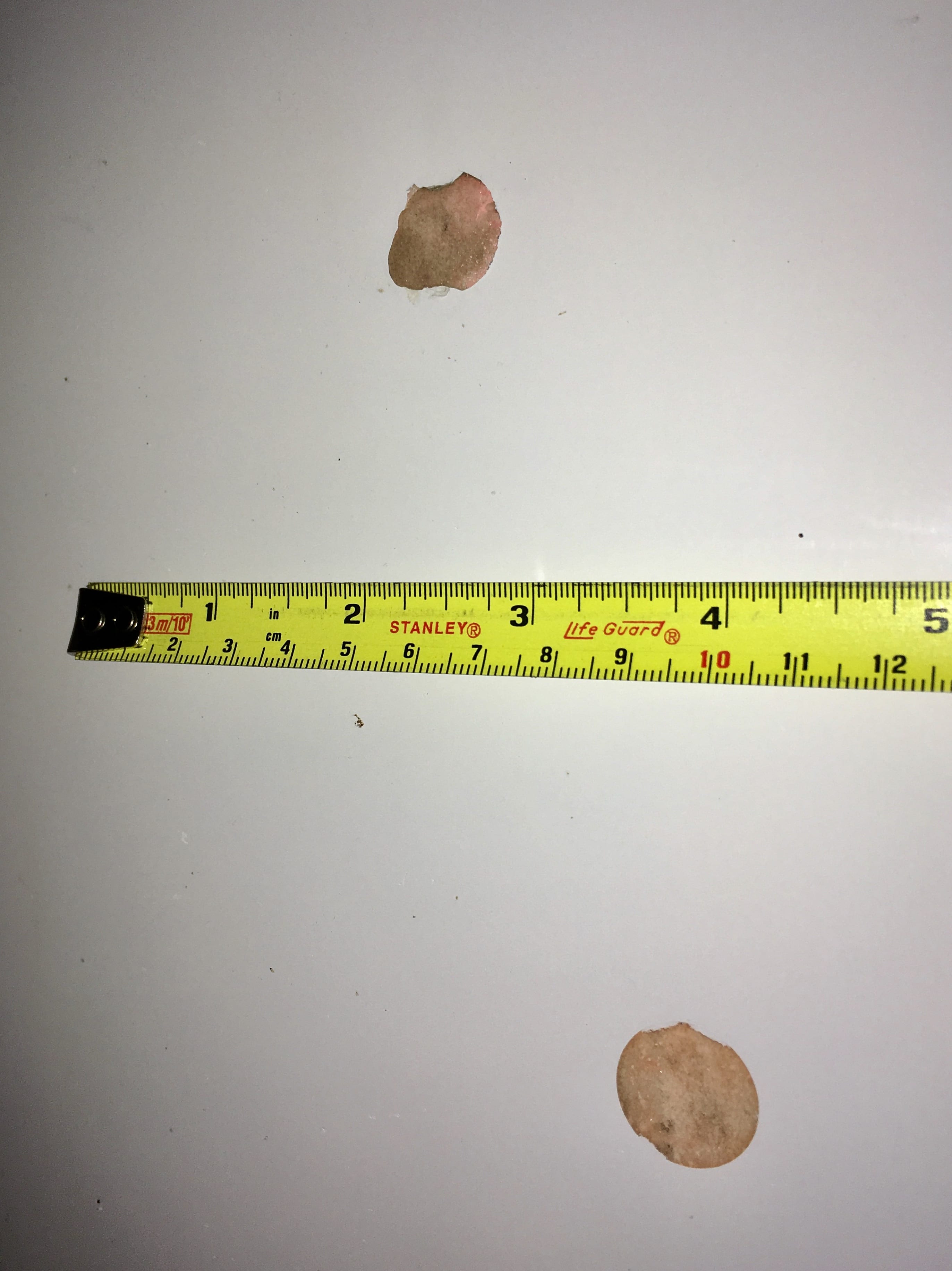
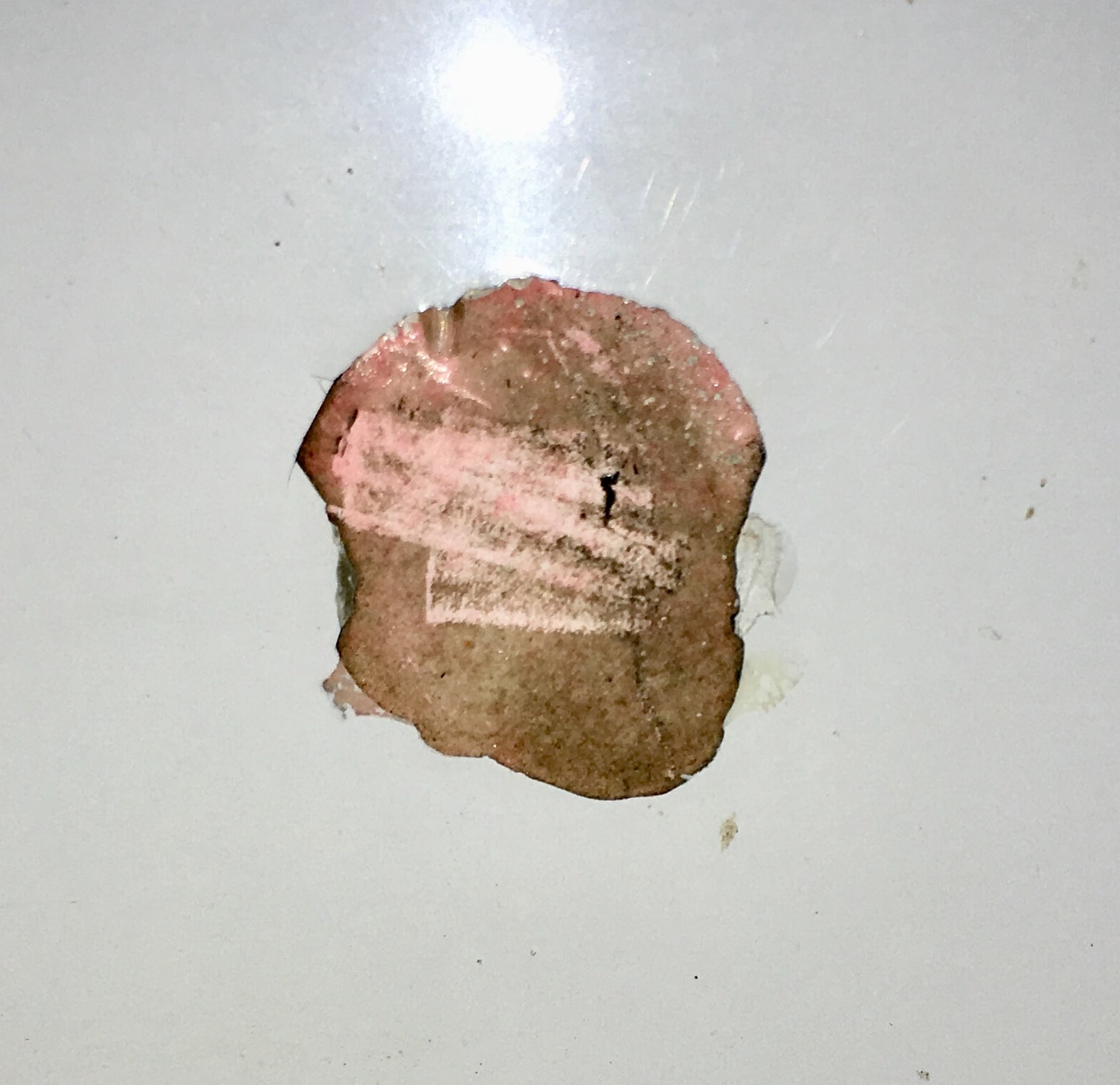
I just spent an hour crawling around under my trailer, looking things over and then lubing the suspension. Guess what I found 3 inches behind the centerline of the front axle, about in the center of the hull (left to right).... One hole is filled and sanded flush, the second one is more more ragged and you can see chipped gelcoat. The second pic shows what it looks like after I scratched it with my fingernail. It is really soft and appears to be similar to Bondo, which is not a material I would use to patch a misdrilled hole that is exposed to a high pressure water spray when towing. I would really like to hear the story behind these holes, and what is directly above it. A tank support perhaps? I will probably leave mine as they are and if they start to get worse I will drill them out neatly with a step drill and patch them with some 3M 5200 and send the receipt to Oliver. John Davies Spokane WA
 1 point
 -
This is the adapter I used. I cut off the extra threads and then had to drill out the inside diameter to make it fit the existing hose. I actually think that the threading was slightly off, but it doesn't leak so I'm not swapping it. I used a rubber O ring as a washer. The problem is the custom connector on the existing hose, which is why I say it's probably better just to replace the whole thing. I thought that I might be able to replace the hose, but I couldn't find a way to get either end to go through the faucet and come out. Maybe someone can figure out an easy way to do it, but I couldn't. Replacing the faucet wouldn't be hard, but it would require taking out the insert on the front of the vanity, which I didn't have time to do before our trip. I think this summer I'll try to tackle that job, more because I'm having ideas about the sink than just wanting to do a better job on the faucet. I can't find the exact faucet on Amazon that I bought, but it was essentially this one with the grip handle. I bought mine directly from High Sierra. The chrome handle probably looks better. Most people would probably want the brushed nickel, but I've been slowly swapping out all the brushed stuff in the trailer with chrome/stainless, since I think it matches the trailer better.1 point
-
That shower head sounds nice. I might come over to your trailer some morning during the rally and try it out!1 point
-
Well, my situation 'is this: I was exactly 200 miles away from the Oliver facility in Hohenwald, between Jackson and Cape Girardeau, Missouri when the event transpired. One hub''s lug bolts sheered off (possible over tightening), I think this wheel came off first., I felt a jolt here, and that makes sense. ~1 to 4 miles later, the other hub's lug bolts appeared to have not been tightened or loosened up possibly, and those lug nuts came off lug bolts, followed by the wheel at 70mph on I-55. I thought i hit a pot hole, but further thought, I think it was highly probable that that was a wheel that came off (the sheered bolts), because i recovered the single wheel that appears to have had the lug nuts work their way off (as has been analyzed by a few mechanics already). I've never lost a wheel before. I am very happy that no one was hurt, and that I calmly and brought the trailer to a stop on the far edge of the shoulder without any additional damage to the trailer or another vehicle (the hitch performed very well), since the left wheels were off, it could have been potentially pulled (it was leaning left). The Mo State Trooper gave me an adaboy for how i' parked it square on the shoulder's edge..which was nice. The tow truck did a good job of minimizing damage as they put it on the flatbed..which had to be done. it's currently in storage on a lot in that area. I want to get this resolved one way or another very quickly. I have an upcoming vacation and i have a lot of deadlines at work in the next couple weeks. Hopefully, it will go smoothly, but if not I'll deal with it best I can. I appreciate all of the positive and insightful comments ya'all have made here. I enjoy being a part of the Oliver Community and enjoy this Forum as well as the FB page. Thank you. Vector.1 point
-
I might also add that if you don’t have an internal TPMS sensor, whatever way you’re measuring the tire temperature is a bit of a kludge since what you want to know is the internal air temperature. Valve sensors, regardless how accurate they may be in themselves (I doubt very), will always show a lower temperature since the air in the valve stem is constantly being cooled by surrounding air. Getting the sidewall or tread temperature with an infrared thermometer is surely more accurate but arguably less relevant (outside of F1). I’ve also read vastly different figures given as safe, everything from 250 degrees to the oddly specific 122. So I think you have to take it all in context, not read too much into individual readings, and if some reading makes you nervous then just stop and check to ease your mind. For what it’s worth, I don’t think my valve sensors have ever read anything over 95 or so and they certainly vary a good bit at times with no real indication as to why. Maybe other systems are better, but thats my experience. I always feel the sidewalls of the tires at fuel stops and heck if I could ever say if they’re anything but “warm”, and always less so than the truck’s tires, both front and rear. Maybe there’s something important that can be inferred from that but I doubt it.1 point
-
FYI, rule to return the wrench to zero is only relevant to spring type (micrometer) wrenches. The split beam design, like the Precision Instruments that I linked to above, doesn’t require that. By the way, Snap On sells the exact same wrench with their name on it, if anyone wants to pay double. ;)1 point
-
Don, Look at my post, a few posts back, that shows the actual measured weights at each tire and the tongue. The rear axle is carrying more weight than the front one and my trailer is nearly perfectly level when towing. This is puzzling because of the equalizer suspension system. It seems to me that the axles must carry the same weight, but they don't. If you are noticing a temp difference, it might be good practice to run the rear axle at 5 PSI higher than the front. I check my tire temps at every stop and have not noticed any difference between the rears and the fronts. I'm hoping to have some discussion about all of this at the rally. Vector's experience is going to open this subject up and I want to carry it on so we can all be on the same page, and in agreement with Oliver. See you at the rally. John1 point
-
Vector, Happy to hear no one was hurt! Talking about torque wrenches, have not thought about this since retirement (tried to forget about ISO) :) . We were certified to ISO standards in our rebuild/manufacturing facility. All of our torque wrenches and many measuring devices had to be checked and/or re-calibrated on set dates. If a torque wrench was dropped, it was not allowed to be used until it was checked and/or re-calibrated. Something RnA mentioned earlier. We had several grade 8 bolt failures in the field due to torquing nut/bolt assemblies to dry torque values with oil on the bolt threads. After finding this, we educated everyone in the facility on proper torque methods and followed up annually with this type of training.1 point
-
Thanks Townesw. Great info sheet from a great tool manufacturer. Per their sheet you should store the tool at “the lowest setting”. I don’t know if any go as low as zero. I store mine at the lowest setting on the wrench of 20lb-ft. - Randy1 point
-
I think the most likely answer is that your trailer probably runs slightly nose down. Even with the equalizer, that will put a bit more pressure on the front set of tires. I’ve noticed the same on mine, even though my trailer is only pitched down an inch or so, depending on what other load I have in the truck. On mine, the temp difference is only about 5 degrees, and so I haven’t worried about it (though I’m actually doing some suspension modifications after the rally that should lift the rear of the truck a bit). The closer you get to the minimum pressure, or the bigger the temperature difference, the more important I think it would be to correct the problem, either by leveling the trailer (if that’s the issue), or compensating by running a different tire pressure on each axle. You also might make sure that you regularly rotate the tires front to back to give them equal wear. Another thing to check for is that the shackles haven’t flipped on one of the axles, which can happen if the trailer has been lifted completely off the ground. That will put considerably more load on one axle and also bind the equalizer so that it can’t do its job.1 point
-
Spike, You probably already know this but I won't ASSUME you do. Tighten the lug nuts by going back and forth from one side of the wheel to the other (tightening the next lug across the axle). Do not tighten in circular order around the wheel. - Randy1 point
-
Spike, No success with the pdf right now. Here's what Jason Posted a couple of years ago. Same as what is on the pdf. """""""""""""""""""""""""""""""""""""""""""""""""""""""""""""""""""""""""""""""""""""""" March 10, 2017 at 12:34 pm #46879 JEssaryKeymaster@essary17 TORQUE SPECS WHEEL LUG NUTS STAGE 1: 90 LBS STAGE 2: 110 LBS STAGE 3: 120 LBS BULLDOG COUPLER: 80 LBS AXLE/U-BOLTS: 70 LBS SHACKLE BOLTS: 40 LBS ---------------- Jason Essary Service Manager Oliver Travel Trailer Sales, Inc. 866-205-2621 """"""""""""""""""""""""""""""""""""""""""""""""" For lug nuts, go around each with torque wrench set to stage 1, then do all nuts to stage 2 and finally do all nuts to stage 3. For periodic checks I just use stage 3. The reason to tighten incrementally is to not warp the wheel. - Randy1 point
-
In preparing for the 2019 Owner's Rally I thought that it was time to actually get my new metal tire stems because of my new TPMS and at the same time have the tires rotated and balanced. Two days ago, when I brought TWIST home from the storage facility I noticed that the chrome "plug" in the center of the front driver's side wheel was missing. Upon closer inspection I found that the hub/spindle cap was simply rattling around in the chrome cover on the wheel. Apparently that was the reason the plug was missing. Yesterday I took Twist to a local tire shop and they installed the metal stems, balanced and rotated the tires. They also tapped the hub/spindle cap back on. Total price - $53.00 - not including the tip I gave the two guys that did the work. When I got home I emailed Jason Essary and told him about the missing plug. Not only did he get a replacement in the mail right away, but, he cautioned me to make sure I checked the wheels for "play" in that it was possible that the nut securing the bearings was not torqued properly in the first place. While I've greased and re-packed bearings on boat and camper trailers ever since I was about 12 years old, it never crossed my mind that this just may have been the reason for the loose cap. A big thank you goes to Jason for reminding me. Bill p.s. upon checking the wheels for "play" - everything was OK.1 point
-
Saw this and thought of you guys and this discussion.1 point
-
John, Just a few more thoughts to throw in the mix: I had a spring over on my toy hauler of the same length and with tandem axles . it was more of a pain than benefit with the higher steps, higher hitch and extremely limited times I really needed it. Ollies are really good in stock form when off road because they have no hanging down pipe and are tandem axles. I've already taken mine over some surprisingly rough roads and watched very carefully how it did. The springs on these axles are just really for utility trailers and are very low tech. They don't seems to be able to take a lot of abuse in other situations and bending them farther than designed is not a good plan. Asking Oliver to accept responsibility for reducing the stability is asking a lot. It is probably better if you do it yourself or have it done somewhere else. You might try it out first in stock form and see if you really think it's necessary. A relatively short trailer with tandem axles is very good on rough roads. Given all of that, it would be a cool mod for more extreme use.1 point
-
That is a grand project, and the results could be astonishing, but I would not like to be the beta tester. What sort of suspension design are you considering? Please keep us all informed. There are some great trailer suspension systems in Australia, I don't know a lot about all the variations, but I do know that if you go with a fully independent A-Arm type tandem design, you will have to grossly upsize the tires in load capacity since there is no load equalization and you will overload a tire in many situations. It would be very cool to have a foot of well controlled wheel travel...... have you seen this Adrenaline trailer "test"? It is insane. John Davies Spokane WA1 point







-
Recent Achievements
-