Leaderboard




Popular Content
Showing content with the highest reputation on 11/04/2024 in all areas
-
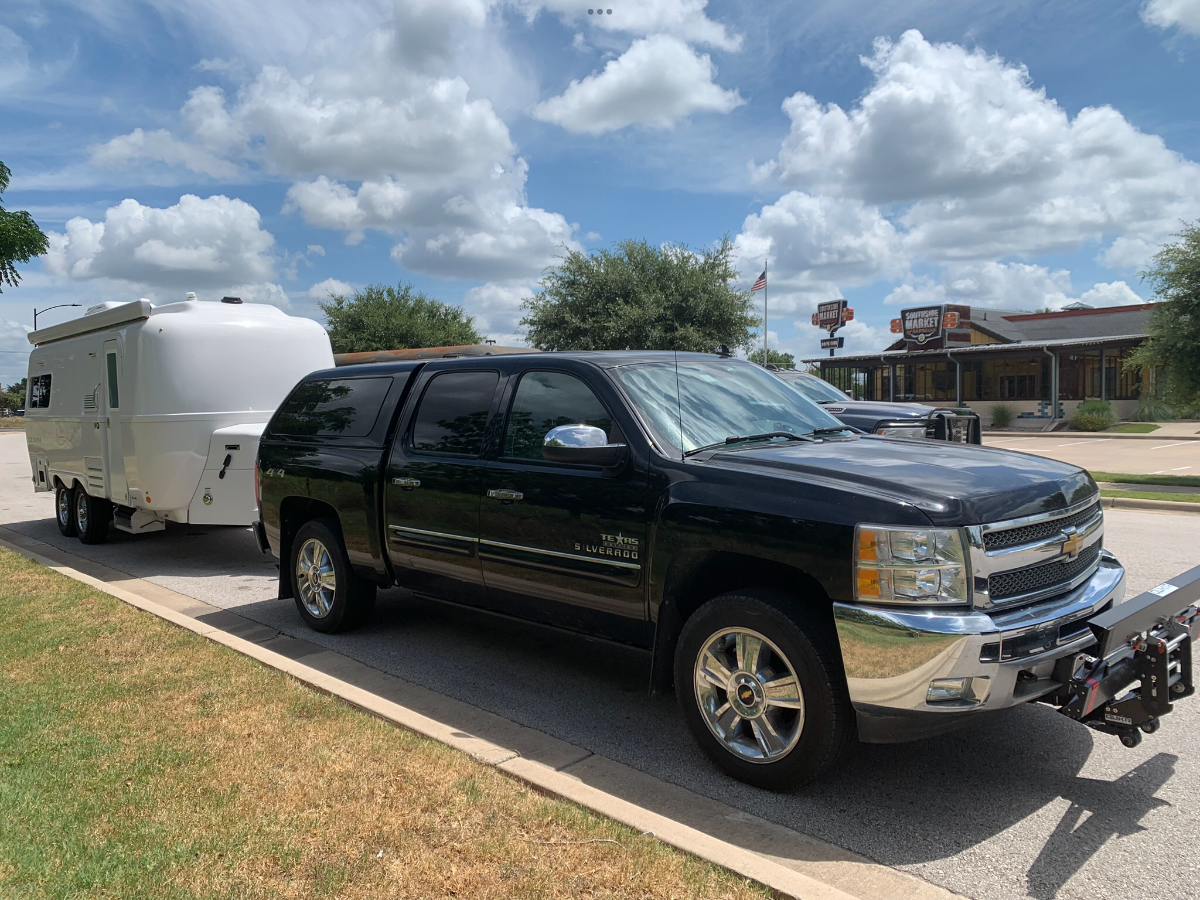
A change in vehicle type, but not in looks; truck vs van. 2012 Chevrolet 1500 Silverado 4x4, 144” wheelbase. 2019 GMC 2500 Savana Cargo Van, 135” wheelbase.
 2 points
 -
I drove an 18-wheeler for six months helping a friend with his transport business, some of which while hauling grain up through Palo Duro Canyon in north Texas and into Oklahoma. Saw many a truck runaway ramp and quickly appreciated their purpose. These ‘big-rigs’ have air brakes which can fail if applied too often on extensive down hill slopes; a situation wherein air demand exceeds the capability of the onboard compressed air supply or even a malfunction to the air system (compressor, air tank, air lines) itself. These off ramp structures are comprised of a deep bed of sand or gravel, an effective method of safely slowing heavy vehicles like trucks and even buses to a stop. The sign displayed in @jd1923’s pic reads ‘RUNAWAY VEHICLES ONLY’, guess that includes an Oliver TV, as well. Safe travels!2 points
-
Two of these 1/2" Sharkbite valves with drains (one for hot, one for cold) plus a PVC pipe cutter, should be all that is needed. Depending on how much room you find around the Pex lines, I recommend making just one cut and trying to insert the Sharkbite fitting on both sides of that cut. If there is room, that is best. If some of the Pex must be cut out because there is not room otherwise, cut no more than 1/2 the length of the new valve out of the Pex pipe, to ensure enough Pex remains for insertion into both ends of the Sharkbite fitting. FWIW, when we camped with Hull #1291 with outside ambient temps of 9 degrees F, the lowest temp in the bottom of the hull was near the outside faucet. So, be sure there is no water left in the flexible hose to the shower handle as well.1 point
-
Our fuse is under the street side bed by the inverter. It is a small black inline fuse holder.1 point
-
Go to the back side of the detector and follow the wires. Shortly, you should run into a black round thing that is the fuse holder. Bill1 point
-
John, I just txted you. David1 point
-
I would consider a shutoff valve with a drain vent like this SharkBite; available in 1/2 and 3/4”.
1 point
-
We use a similar one from Amazon, In our humid environment the tank fills up in about a week. Has worked very well. Prior to this I was buying damp rid every 2 weeks.1 point
-
Thought I saw one near Sunriver, OR but it turned out to be just a shiny dumpster!1 point
-
Maybe for the male version, the female is a costly upgrade; some things never change!1 point
-
Using the formula “Volts x Amps = Watts” it is relatively straightforward to estimate how much using the convection/microwave will draw down your batteries. If the convection microwave is 1,450 watts, then the formula is: Volts x amps = 1450 watts If you assume that your lithium batteries will reliably deliver 12.5 volts to the inverter under heavy load, the formula becomes: 12.5 volts x amps = 1450 watts, which is the same as (amps = 1,450 watts divided by 12.5) 1,450 watts divided by 12.5 volts = 116 amps The last thing you need to account for is losses through the inverter which are typically around 10% or less. Assuming 10% losses through the inverter: 116 amps divided by .9 = 128 amps. So, if the oven runs at full power continuously for 1 hour (which it won’t), you will use about 128 amp hours from your batteries, or about 2.1 amp hours per minute. (128 amp hours/60 minutes) A microwave on high will draw continuous power, so if you microwave something that takes 10 minutes to cook, it will consume about 21 amp hours. (2.1 amp hours per minute x 10 minutes) If you bake something for an hour, the oven will run continuously until it heats to temperature and then will cycle on and off to maintain temperature. Assuming the oven is actually heating for 30 minutes of that first hour (complete guess), then the oven will use about 63 amp hours over the course of an hour (2.1 amp hours x 30 minutes). So Topgun2’s popcorn, potato and hot tea at 9 minutes total probably consumes a little under 20 amp hours (9 minutes x 2.1 amp hours per minute = 18.9 amp hours)1 point
-
I can’t comment on the newest trailers, but mine has that outlet shared with all the other 120 VAC ones on a 20 amp circuit. If yours is like this 2019 diagram, you won’t have any worries about overloading it, as long as you are careful not to run other high load devices at the same time, like a toaster. You could use any of the outlets. I doubt that you will be able to operate it inside that cabinet due to ventilation and heat concerns. The LE2 has a bare minimum of counter space. You could get a (slightly) larger Foy dinette table top for extra room and do your prep there. It seems overly complicated to me, for such a small interior volume, but I think you could figure it out, if you are determined. My wife loves to bake bread, at home she uses vast amounts of counter space. There is no way she could do that in our trailer. She would start screaming in frustration.🤬 Storage for all those pans, utensils, components and so on is another problem, but they could go in a great big bin and store in the truck. There isn’t room in the Ollie, and cleaning all that bulky stuff in the galley will be challenging.. John Davies Spokane WA
1 point
-
Like Bill said, talk with Foy about making a larger tabletop for the Lagun. I’d highly recommend a foldable one so that it will be out of the way for sleeping. You could take down a larger, one piece table at night; but we tried that and it was a pain, plus finding a place to store it was impossible. I believe that Foy will also make the mount that I designed, so the only thing you’ll have to do is screw the mount to the side of the bed rail. In fact if you are just getting the bed rail on one side, you probably don’t need the mount at all, since you can attach the Lagun directly to the side wall of the sofa base. On the cushions/pillows, the standard 4” back pillows won’t be deep enough to work on the mattress side, since the mattress is wider than standard seat depth. You’ll need two layers of cushions, or 8” total, for them to be anything but decorative. What we had made was a slightly shorter, floating back pillow for each side, that we use as an extra layer. Essentially a throw pillow, but dense enough to provide back support for sitting upright. More of a problem for you will be the height difference between the sofa and mattress sides, and the fact that the mattresses will just feel a bit odd to sit on while eating. Plus just feeling like you’re sitting on your bed. Also the back pillows on top of the thicker mattress will be higher than the window sill, and I think you’ll find that the thick casing for the blinds will keep the pillows from sitting neatly against the wall. So I’d highly recommend thinking about cushions both sides, and either finding just the right compromise in foam density for both sitting and sleeping, or making them stiff enough for sitting and the getting a memory foam topper that you can roll out at bedtime.1 point
-
The box slides off the mounting "sliding rack" to lighten it significantly. OTH it is still a two man operation, and both must be pretty fit. It is not necessarily a good match for your average "mature" Oliver owner. No offense intended to anyone here - I include myself in that category. I want to see video of one hopping down a corrugated freeway at 75 mph. I do like the idea of enclosed hard-sided storage for bikes tho. But not for $3000. John Davies 'Spokane WA1 point
-
That would as close to a slide-out as you could get with an Oliver!1 point








-
Recent Achievements
-