Leaderboard
.thumb.jpg.780a61c48108d06558e15f745dfe9b5e.jpg)


Popular Content
Showing content with the highest reputation on 09/27/2017 in Posts
-
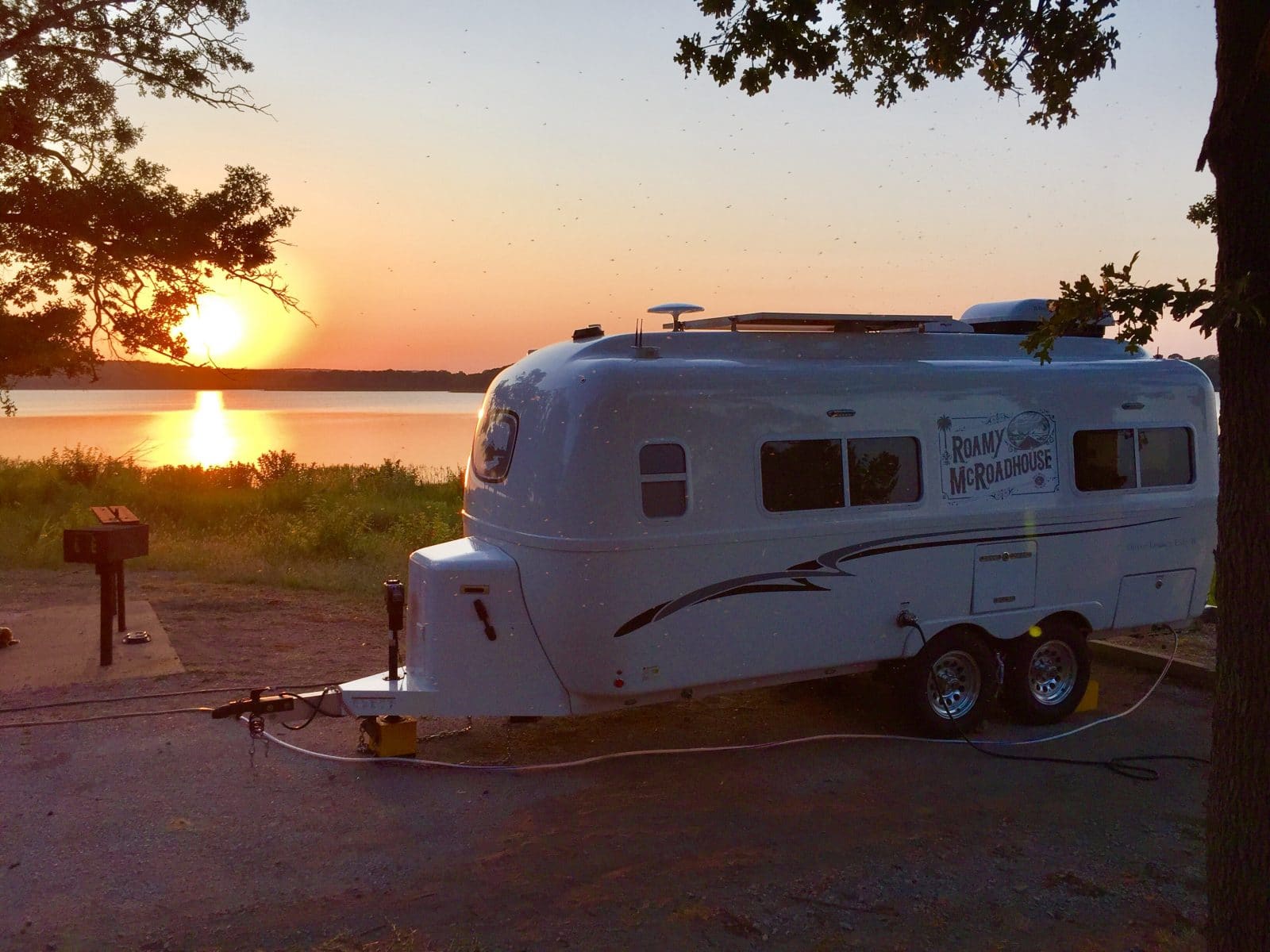
We picked up our Oliver in June and planned a service call for Monday, September 10th to address some small issues (always a pleasure to see Jason and Richie.) Six days before that, it was looking very questionable if we would be traveling at all. Glued to the weather channel, watching a category 5 hurricane marching right up to our front door. Growing up in Florida in the '60s we had both been through some of the worst – Hurricanes Betsy and Andrew come to mind of the same magnitude. Boarding the house up and bring in everything that was not nailed down took two days. Not having a safe place to park our Oliver (Roamy) we hooked up with a plan to drive 5 hours north and stay a night in a state park on the Florida/Georgia border. From there we would head north to Hohenwald for our service call, standing out of harm's way. God laughs when people plan. Gas was already like hens teeth in Florida on Thursday and I decided to take 3 five gallon gas cans that I was lucky to get filled, as a back up. Thursday night and into Friday morning was anything but a 5 hour drive. The Florida Turnpike rest stops turn the roads into stop and go traffic that stretch for miles, as people needing gas backed up in 10 mile lines, effectively closing a whole lane. Fourteen hours later, with an hour to go to get to the state park, they called and said the park was closing and that we would not be able to spend the night. Looking for other options proved futile and with our only option being our second plan stop, Point Mallard Decatur, AL, we drove on. Rest areas, gas station, restaurants, hotels and any small island of comfort, looked like besieged kingdoms ready to fall. We drove on. Sometime not moving for 10 minutes, other times doing the speed limit. The governor of Florida eliminated all tolls and opened the northbound emergency left lane for travel, this helped but is would soon come to a massive standstill at the Florida/Georgia board with the governor of Georgia not allowing the emergency left lane to be used. We had burned 40 gallons of gas to go 303 miles. The 15 gallons I loaded in cans made the difference from being on the side of the road and reaching Tifton, GA where we found gas with only a 30 minute wait. We drove on. 26 hours past and we felt the miles willing us to stop but as the signs for Decatur came into view, it was like a second wind blew in to help us along. We pulled into Point Mallard RV Park Friday night 11:30 pm. Like so many people we would meet in the coming days, the camp hosts came out to greet us. They make sure there was nothing we wanted or needed. We parked under a canopy of trees and rested for two days. As Monday’s sunrise came into view we pulled out like we had woken from some bad dream that only parts of it could be recalled. We headed to Hohenwald. Roamy was scheduled to get a reading light, backup camera, water tank upgrade and to fix our door which we rubbing the top jam. I cannot say enough about the team at Oliver. We left better then we arrived and more importantly, knowing this company and people care about us. Monday afternoon, with the hurricane marching up the west coast of Florida, we were getting calls from our friends and neighbors telling us we dodged a bullet and that our house was safe. They told us there was no power and no gas, it would be a week before either returned. With our service call at Oliver completed by Wednesday, we decided to spend the next two weeks enjoying our Oliver and would travel as far north as Pawhuska, OK. We stayed in some beautiful parks like Birch Cove State Park outside of Barnsdall, OK right on the lake and Roosevelt State Park in Mississippi’s Bienville National Forest. By the time we came home to Florida we have added 4,000 miles of memories. The storm left us with a week of yard cleanup and as my wife and I turn out the light last night, we both asked “When do you want to go again?”
 4 points
 -
My daughter knows pretty much all about the systems, but she will be hosting a couple of her adult friends for two nights. I am a worrier by nature, so I wrote an Overnight Visitor Checklist to educate them on how everything works. It is two full sides of an 8.5 x 11 sheet, and I laminated it so I can leave it out on the table for them to HOPEFULLY read and understand. It's a Word doc, if you want to use it you should edit out the stuff that does not apply to your trailer, like the composting toilet, and add any extra info specific to your Ollie. Oliver-Legacy-Elite-II-VISITOR-CHECKLIST.docx I hope this is helpful. John Davies Spokane WA4 points
-
Maverick, I just fixed mine (Hull #92). The brakes had a negative wire to the bus bar but no wire from buss to the ground lug on the frame and no wire from the umbilical negative to the buss or the ground lug. Nothing connected to the frame ground lug at all. The umbilical negative had three small wires which I suspect were light negatives, but they were not brakes. Not sure as they disappeared in the maze. So, I ran a #10 from the umbilical negative to the buss bar and two #10s from the buss to the ground lug. I also kept the small (light?) negatives connected to the umbilical. Before this I had no continuity from the TV negative to the frame and no charging current to the batteries while plugged into the TV. Now it is charging. Thanks for the heads up! I've been working on other items and did not notice the charging problem. I also had no trouble with the brakes. John2 points
-
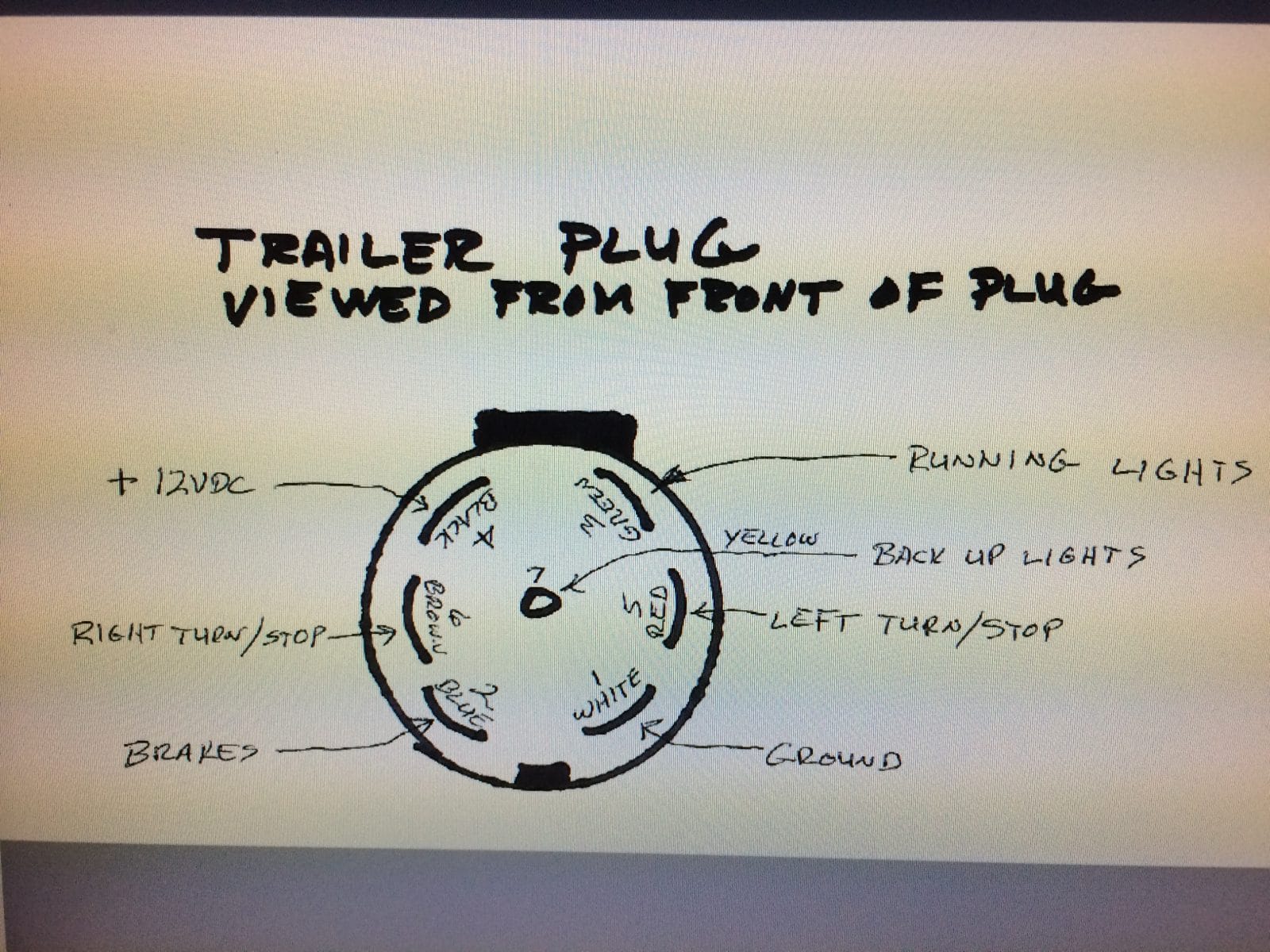
Reed: The seven wire cable that attaches to the tow vehicle is located under the front dinette seat; which is easy accessible. At that point I cut out all of Oliver’s connectors and installed an additional 10 gage white wire and quality electrical connectors. The 10 gage white wire that I installed was run to the rear dinette seat area. If you open up the access cover under the seat, just behind the electrical panel is a ¼ - 20 bolt where Oliver grounded to the frame the on board battery negative. Oliver used a 6 gage yellow wire from their battery negative buss bar. Their 6 gage yellow wire is about 14 inches long. I just attached my 10 gage white wire to the same ¼ - 20 stud; this way both the on board battery negative and the tow vehicle negative are bonded together at the same point. As I said in my original post, go to the trailer plug with a multiple meter; one lead on the trailer frame and the other multiple meter lead on the plug that goes to the tow vehicle. At that point if everything is wired correctly you should have a short; which means everything is correct. But is you have an open circuit that means the two negatives are not bonded or connected together. I have attached a sketch of the end of the trailer plug for reference.
2 points
-
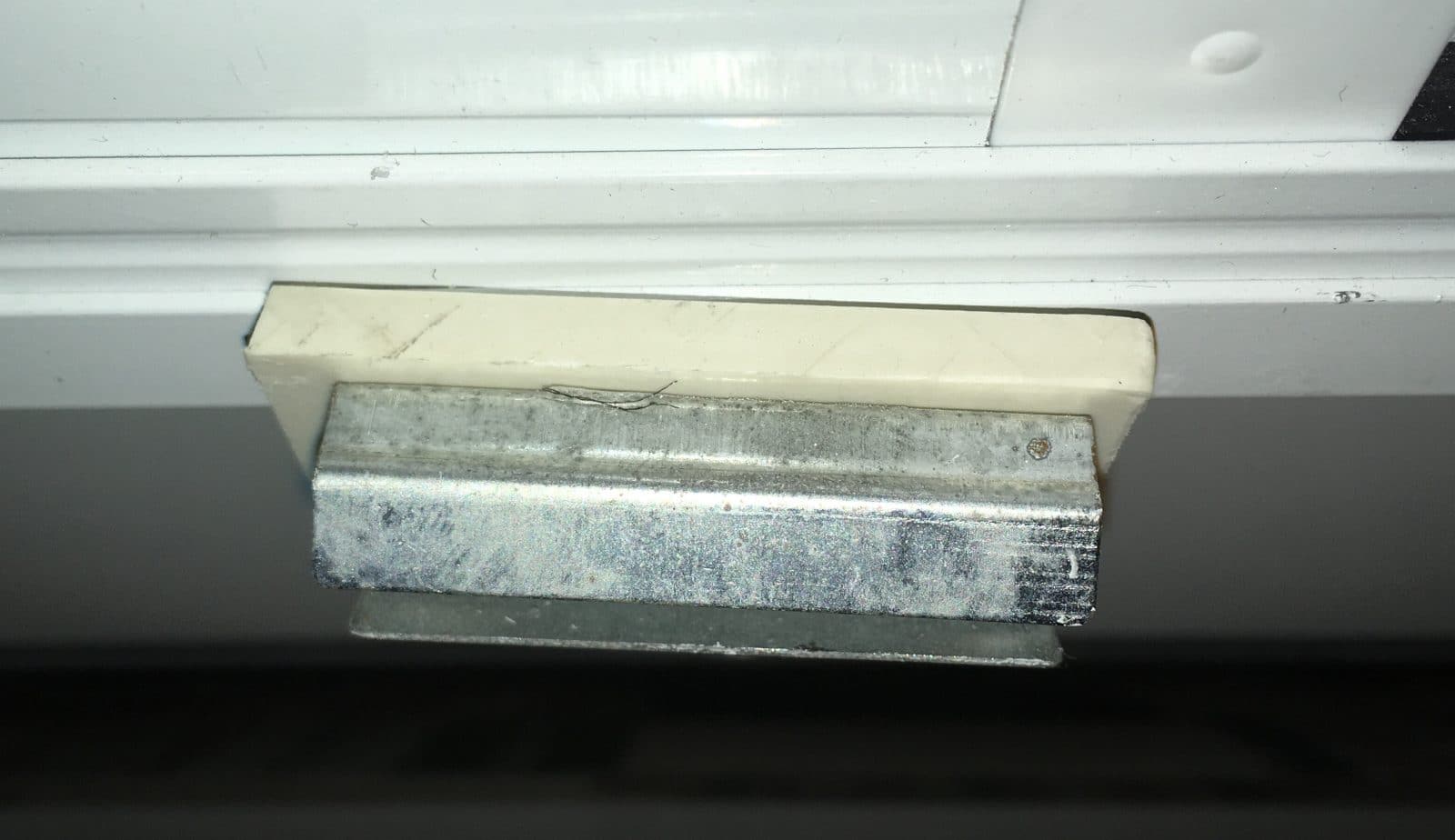
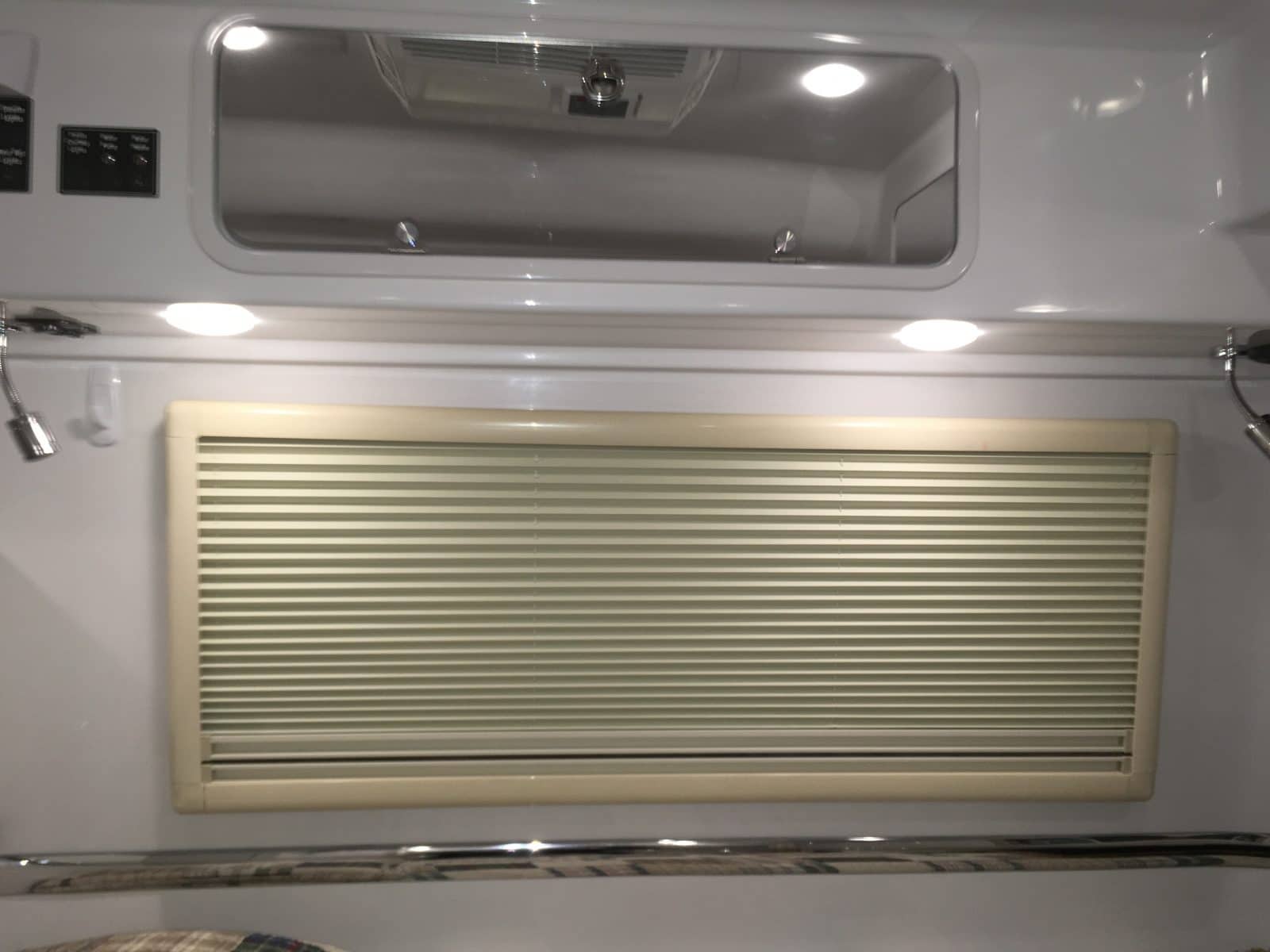
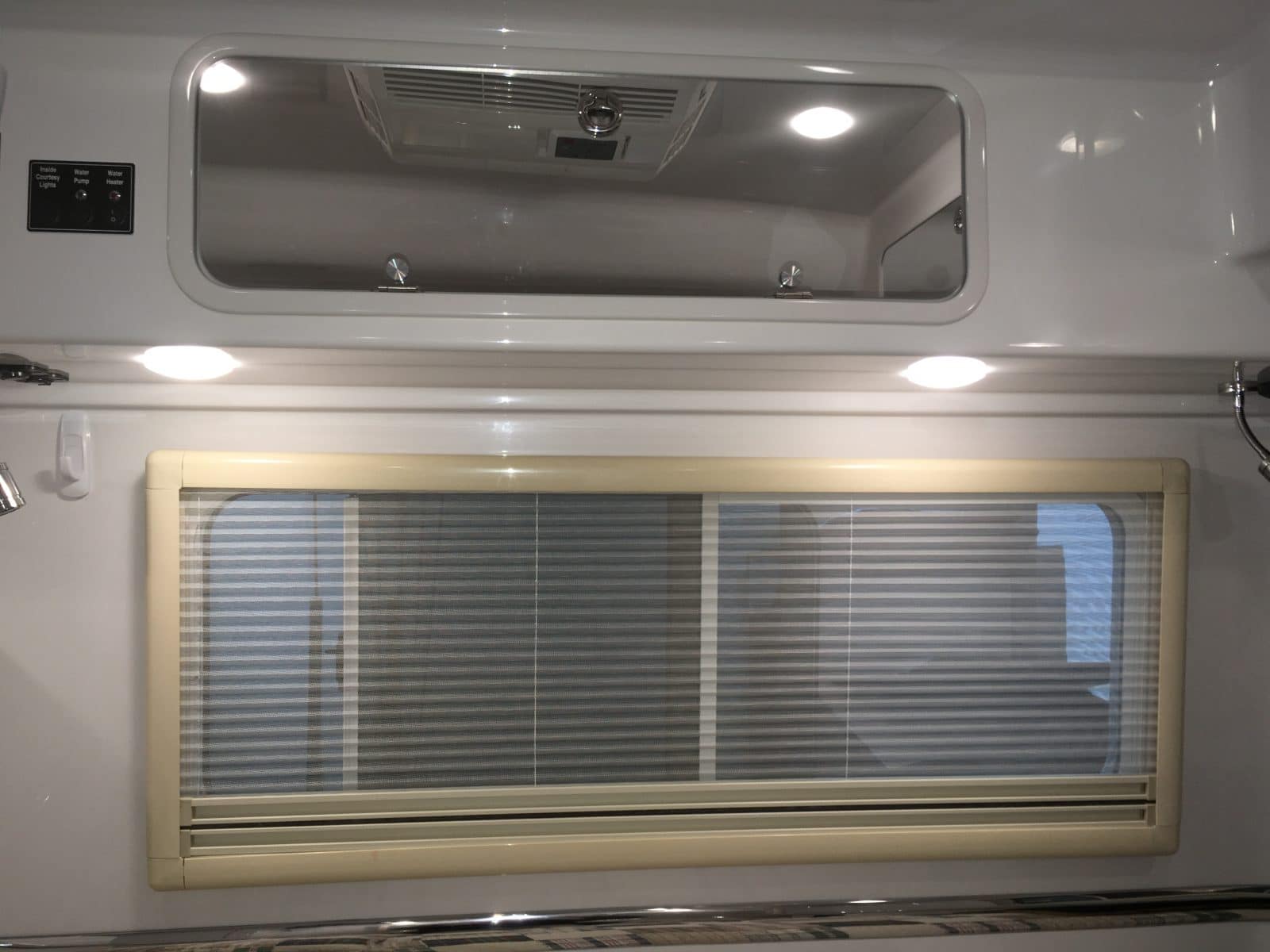
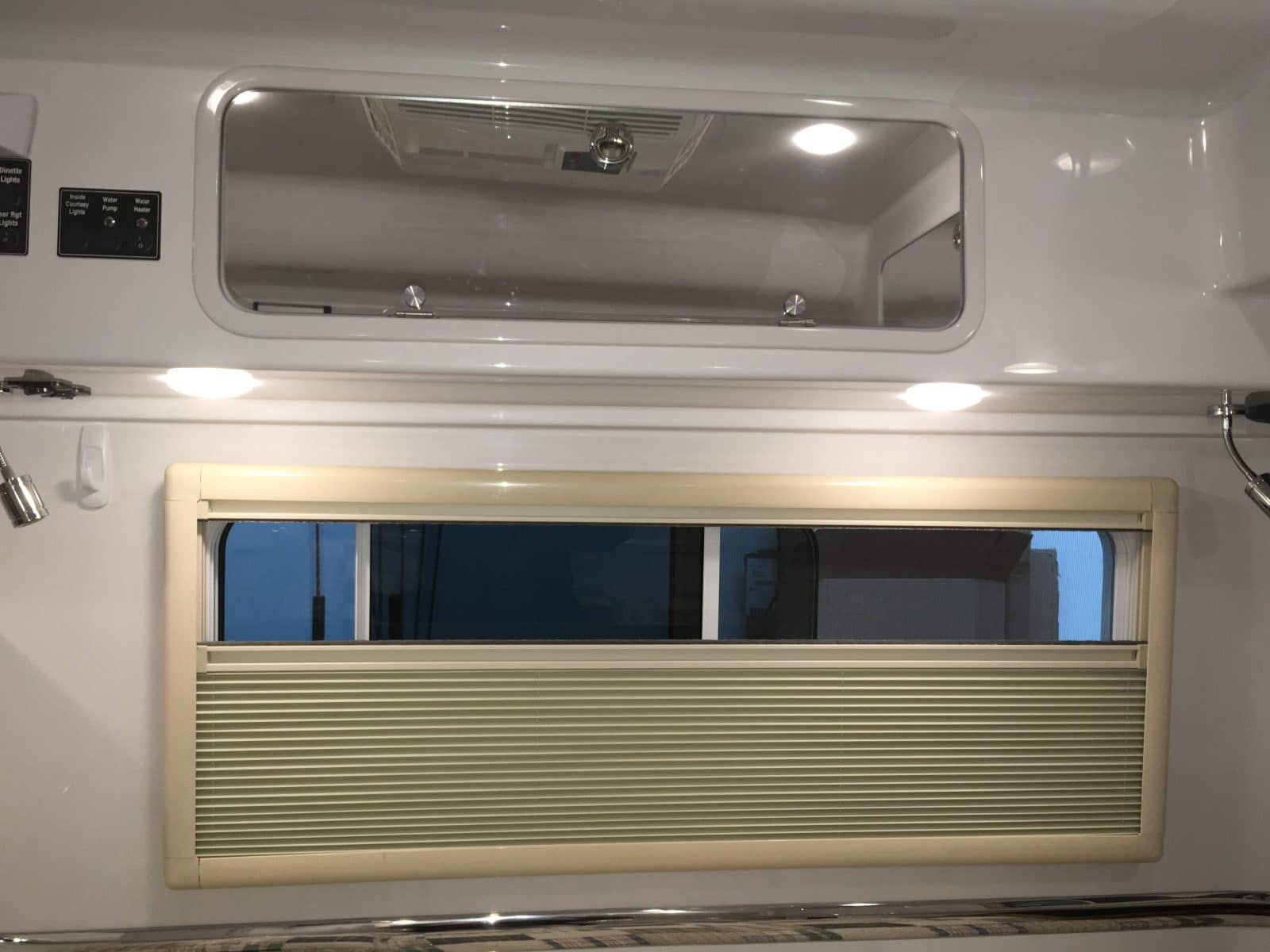
The blind are not secure and you may find one lying on the bed or floor, and it is due to improper installation of the steel brackets. On my trailer, in many cases the bracket did not sit flush and parallel with the others. This is due to the hole in the hard spacer being drilled too small. The hole must be bigger than the screw diameter, so that the screw will pull everything into position. You need to remove all the brackets and open up the spacer holes. Removing the blind frame is simple, grab at the top and bottom and pull hard toward you. When reinstalling, center the frame in the window (left to right), align the bottom brackets with the slot in the plastic, and smack the area at each bracket with your fist. Then do the top side. When the brackets are parallel and aligned, the frame will go on easily and it should stay in place. You can tweek a bracket by bending the two ears, if you find a loose one. Before: After: SAFETY NOTE: when removing a bracket with a power driver, keep your fingers away from the part since it will spin and might slice your fingers! If you want to make your blinds more functional, flip them 180 degrees, so that the dark section is on the bottom. As postioned by the factory: Rotated, now you can tow with the blinds down and the lighter shades will let lots of light into the interior: And you can raise the lower section a few inches for privacy when camping: It's easy to try this configuration and switch back if you don't like it. Now we can talk about the ugly frame color..... John Davies Spokane WA
1 point
-
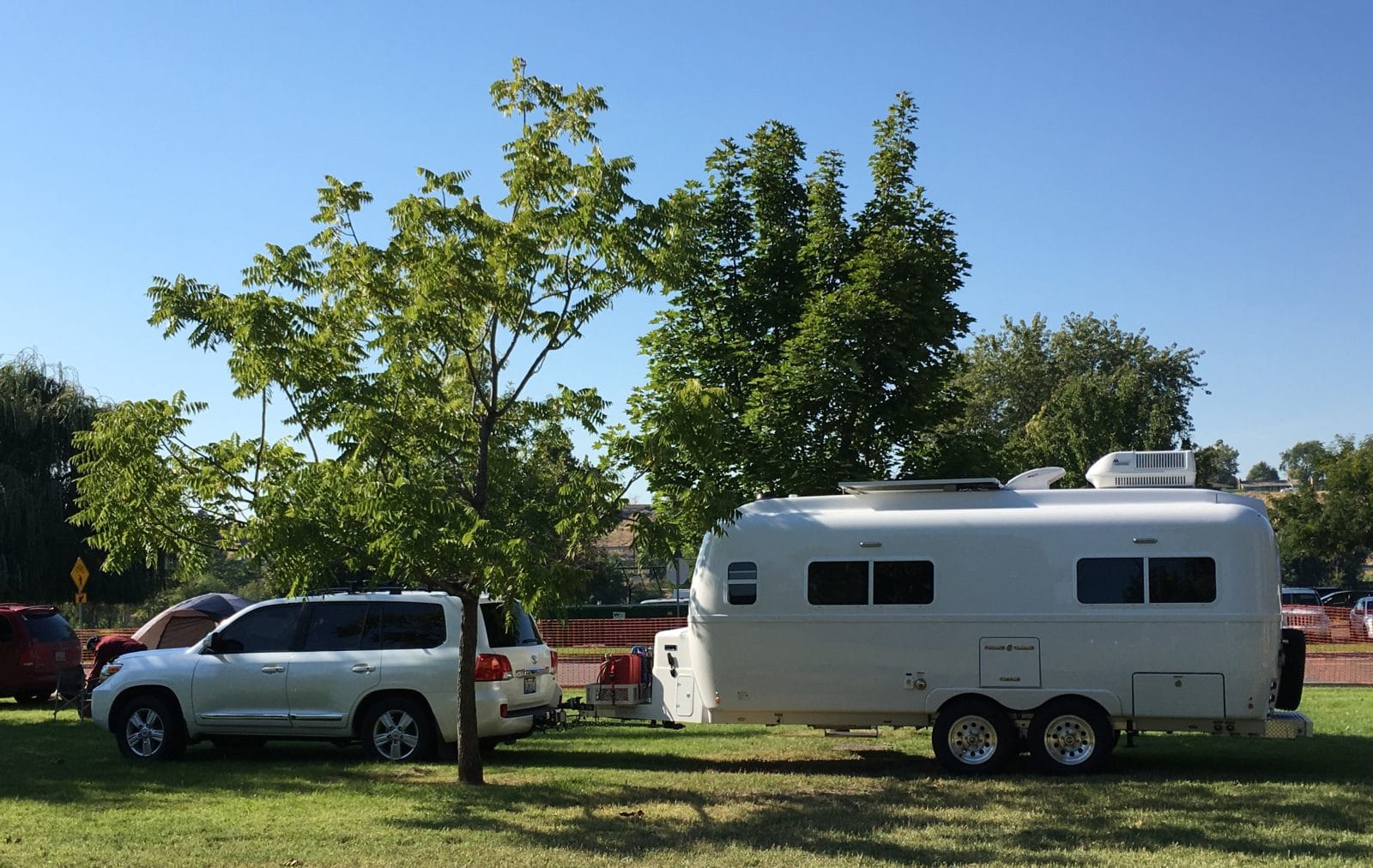
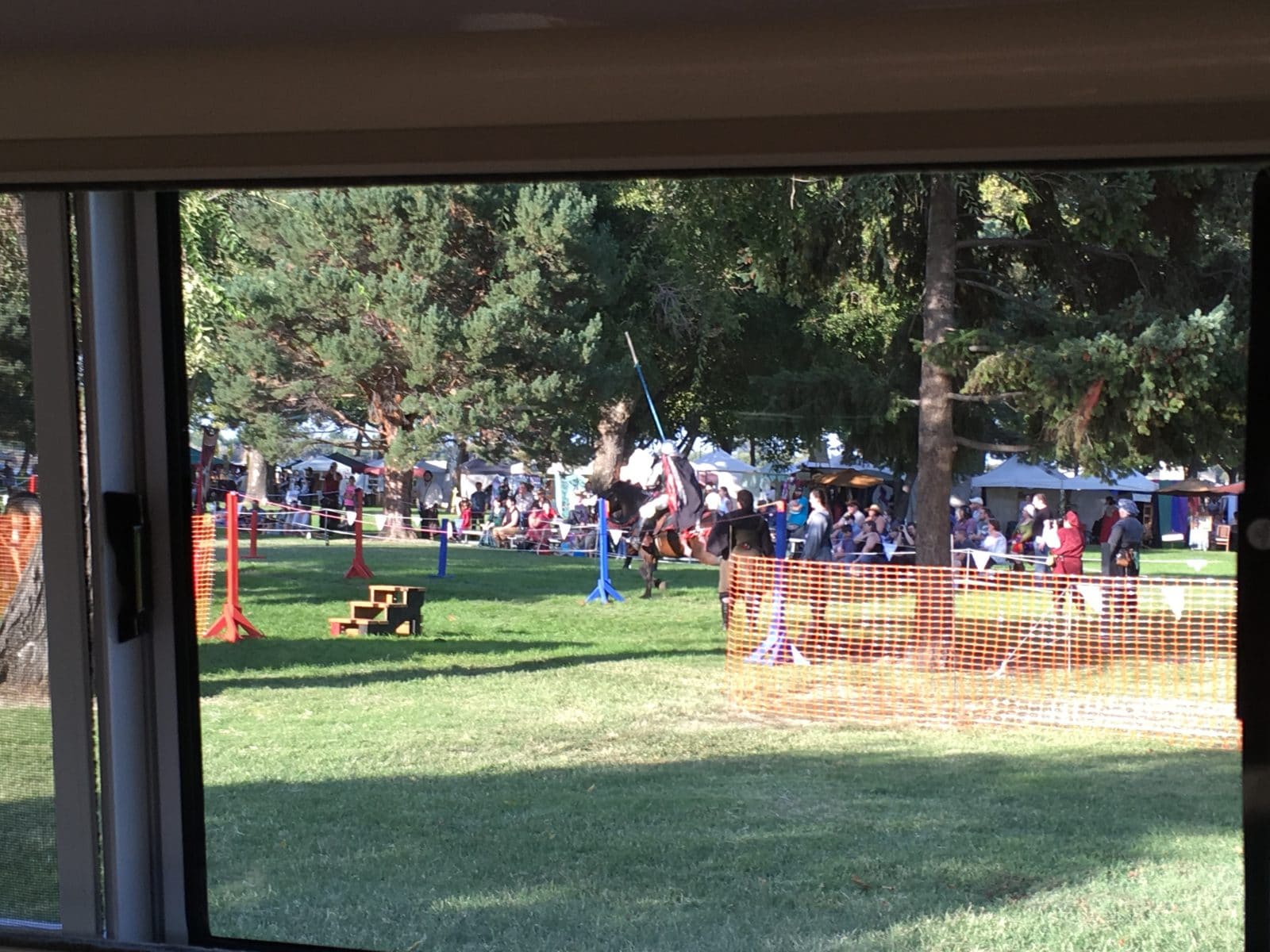
This weekend my daughter and I boondocked in Kennewick (Tri Cities) WA. She is a member of a jousting club that performs at medieval faires. She does not ride, thankfully, she is a "squire" who assists on the ground, handing up new lances and picking up broken shards after the knights impact each other with a splintering crash. This is the spot I picked at Columbia Park, where the hydro races are held each summer: Here is the view out the back window, most unusual for a boondocking site! The List was about 200 feet away. Here is her group, they will be performing in Spokane in two weeks. https://www.facebook.com/joustalliance/ If anybody is in the area Oct 7 or 8, consider stopping by for a visit. It's a little silly but lots of fun. Look for my Ollie in the Actors camping area, near the horse paddocks and field. https://www.spokanerenfaire.com She also participates in another group called Combat Corps. She does sword fighting displays, Hollywood style. https://www.facebook.com/combatcorpsspokane/?ref=py_c Mouse is a wonderful help to her. Previously she was sleeping in the back of my Ram pickup or her Outback. John Davies Spokane WA
1 point
-
2015 Oliver Elite II 12 VDC “NEGATIVE” Connection Issue After replacing the battery tray and the stiff wiring going to the batteries in our 2015 Oliver Elite II trailer; I checked out the trailer electrical system. I discover that the trailers on board battery negative was never bonded to the negative coming from the tow vehicle. Because the two negatives were never connected together it created two problems. First the tow vehicle would never charge the trailers on board batteries. Second the trailer brakes negative lead was connected to the trailers on board battery negative buss bar. Second the trailer brakes were obtaining the negative connection only through the trailer ball when connected to the tow vehicle. The tow vehicle’s negative lead was only connected to the exterior lights on the trailer (marker lights, turn signals and back up lights). Up until the past two months our trips have been a max of a day or two travels. During July and August we travel throughout the west, after the first couple of weeks I started logging the start of the days battery voltage and then logging the end of the travel days battery voltage and all of the time it was about ½ a volt lower at the end of the day (we don’t have solar); for all of the other travel trailers we have owned the tow vehicle would keep the trailers on board batteries charged. I have bonded the two negative systems together, which has corrected both issues. I located several pictures of wiring diagrams that Robert Partee – Oliver TT Sales Manager at the time we purchased our trailer gave us. The pictures were so bad you could not read anything. After blowing up the pictures, there was one of the tow vehicle cable and how it routed throughout the trailer and it did not show any connection between the two 12 VDC negative systems. Also it did show that the brakes negative lead was connected to the trailers on board battery negative buss bar; as I described above. I have discussed this issue with Richie Carroll at Oliver Travel Trailers. There is a simple test you can perform to see if your trailers tow vehicle 12 VDC negative lead is connected to the trailers on board battery negative buss. Using a multiple meter at the tongue of your trailer and the cable that connects to your tow vehicle; connect one lead from the multiple meter to a metal point on the trailer and the other multiple meter lead on the ground terminal of the trailer cable. If the two systems are connected together you will read a shorted connection; if not your meter will show an open connection. If you obtain an open connection, I suggest you correct the issue.1 point
-
Steve: Thank you for getting involved with this grounding issue on the Oliver Travel Trailers. This is a major safety issue that could result in a life effecting condition. When Oliver Travel Trailers first learned of this problem, they should have contacted ALL trailer owners about the problem and a solution. I understand that most of the time the trailer breaks would work to some extent because of being connected to the tow vehicle, obtaining a ground through the trailer ball. If you are only obtaining a ground through the trailer ball connection, which is high resistance there is a reduced voltage being delivered to the trailer breaks. Hopefully Oliver Travel Trailer Management will contact all owners of trailers affected by this grounding problem very quickly; with directions on how to correct this problem. Not all trailer owners are electrical engineers or have the ability to correct this grounding problem. I like our Elite II trailer and I believe that Oliver Travel Trailers provides good customer service; but a safety issue needs attention ASAP.1 point
-
Horace, you are correct in that not all the trailers were being corrected in a timely manner. I should have stated "They were supposed to be repairing them as they came back into the factory for any work..." I agree that this was/is a problem because ours had been back to the factory at least a half dozen times before it was fixed. I drove 4500 miles on a trip listening to our truck almost constantly beep a warning of a brake disconnect. A half dozen calls to the factory during that trip yielded us no relief. When I took it in, Justin immediately knew what the problem was. It took all of 5 minutes to fix it. Obviously not everybody knows to look for that particular issue. I spoke with Richie Carroll this morning and he will be addressing this situation with management today. A solution will be worked out quickly.1 point
-
I also just checked continuity between trailer frame and the ground on the 7 pin plug and it is grounded. This is a recent build and I have found very few issues so far. This is a good check for all owners to perform. Thanks for the heads up.1 point
-
Forgot to mention earlier, our Tundra operators manual requires a trailer sway control device with trailers above 2000lbs. Needed to replace the hitch ball (chrome in poor condition) so ordered a new ball yesterday with new 8.5" shank forged ball mount, overall length 14". The new ball mount will add 1" between the rear bumper & ball compared to existing ball mount. Will post photos with Ollie connected with trailer/TV straight and LH turns with new ball mount installed. Have not had SwayMaster clearance issues in LH turns with 7.5" shank forged ball mount so far, but interested to see how additional clearance works out in LH turns with SwayMaster installation.1 point
-
Thanks for the thread, Just checked continuity between trailer frame and trailer 7 pin plug. Our trailer has continuity between the plug's ground pin and trailer frame. Also checked trailer batteries disconnected from TV at 12.75V and connected to TV with engine running at 13.26V. The original owner took our Ollie back to Oliver to have some warranty issues corrected before we purchased it, may have been corrected then. I replaced the PD 4045 converter section about a month ago due to trailer battery over charging while connected to shore power, but did not modify wiring.1 point
-
I had the same issue with my 2015 Oliver Elite II. The tow vehicle was not charging the battery. We were on a month trip out west when we discovered this. I got a plug diagram and checked the tow vehicle battery charge and was OK. I checked the ground lead at the plug and it had continuity to the truck frame. Between the battery charge and ground was 12 volts, proving that the tow vehicle was not the problem. I then checked the mating connections on the Oliver plug. I discovered that the ground connection at the plug was not grounded to the trailer frame using the multimeter test. I disassembled the plug and checked all the connections. All was OK. I then traced the ground wire from the plug all the way back to the grounding bar beneath the rear dinette seat and found it not connected. It just continued to the rear of the trailer. After the trip, we took the trailer to Oliver for some other issues and to correct the charging problem. They told me the problem was in the tow vehicle and asked me to bring it in so they could check it. They did the same checks that I did and agreed with me that the tow vehicle was OK. I went inside with the technician and asked him to show me why he thinks the trailer is OK. He showed me that he had 12 volts between the battery lead and the trailer frame. That's because he's measuring the voltage across the battery terminals. I asked him to check the voltage between the battery lead and the ground connection in the plug and it read zero. Then we checked continuity between the plug grounding lead and the frame and it showed none. The ground lead coming from the plug through the trailer was NOT connected to the grounding bar. The technician said that during manufacture, it is cut in two and both leads are supposed to be on the grounding bar terminal. He made the fix and we always have a charged up battery when we get to our destination. Oliver makes a high quality product and something as simple as this should have been caught before it left the factory. A little bit of quality control testing of all circuits would have caught this simple mistake.1 point
-
Steve: I disagree with you about your statement that Oliver repairs the grounding issue when these trailers come back to the factory. We delivered our trailer to Jason Essary at the Oliver factory on May 16, 2017 at 0700 and it was not returned to us until Thursday May 18, 2017 after 1800. During this time Oliver installed the EZ Flex system and repacked the wheel bearings, plus replaced the bike rack; if they knew about this grounding issue it should have been corrected at that time! Jason and his staff had time they could have corrected the grounding issue at that time. This morning conversation with Richie Carroll, he said nothing about Oliver was aware of this problem before I made him aware of it last week. Our trailer took about five feet of cable to correct the ground issue like it should have been done when the trailer was constructed. Oliver Travel Trailers’ failure to properly connect the tow vehicles ground wire (battery negative) to the trailer is a MAJOR SAFETY issue with the trailer braking ability and I suggest everyone check their trailer to see if they have the problem, if so it needs correction immediately.1 point
-
Spike I have a 2016 Elite. At that time, Oliver manufactured Ollies with a tongue that could be extended WAAY out and could even be removed. Every 6" is a hole that could be used to adjust the length the tongue is extended. I have my tongue extended 12" and it rides very well. My TOW is a Toyota Tundra V8. Unfortunately, Oliver no longer has the extendable tongue. They currently have a "fixed" tongue on new Ollies. Look at Bills mount. He used some aluminum flanges he made from Aluminum stock. I did the same, used the stock, marked where the bolts were and drilled holes in the stock to fit. I went to Fastenall and bought bolts that are longer than the Ollie stock bolts. I then put the longer bolts back in with the appropriate hardware and torque. I still had 1.5 inches of thread on the bolt so I then put the aluminum stock on that I previously had drilled matching holes in. I put the Sway Master on the aluminum stock, centered the Sway Master bracket and marked the holes. I then drilled the holes in the top part of the aluminum stock and mounted the Sway Master with stainless steel bolts. I put a second nut on top of each bolt. Now the Sway Master is parallel with the tongue, I drilled no holes in the tongue, only in the Alumnium stock. I bought two black lots that were 1.5 inches longer and more threads on the end. If you go this route, make sure you get the hardened steel, usually #8 sold at Fastenall. Hope this helps. If not, I can send pictures when my daughter returns with my trailer1 point
-
All the early trailers (say, below hull #100) were wired with the tow vehicle ground not bonded to the trailer. Ours had that problem. The white wire (ground) from the vehicle (thru the umbilical) must be connected to the buss bar in order for the brakes to work properly. They repaired them as they came back into the factory for any work, but most likely there are some still out there that have never been addressed. So, if your trailer is wired this way, it has everything to do with the trailer disconnect (brake) issues. Putting a six inch jumper from the white wire to the buss bar will solve that. As was stated previously, the only ground for the trailer from the vehicle was thru the ball mount and this was the case in those early builds. That worked pretty well when everything was brand new. As the ball was worn down, the connection became intermittent (thus the connect errors.)1 point
-
http://Thetford RV Toilet Seal Lube & Conditioner 36663, 24 oz. Bottle https://www.amazon.com/dp/B002NSU0ZW/ref=cm_sw_r_cp_tai_exVYzb0N90AZS http://Thetford RV Drain Valve Lubricant 15843, 24 oz. Bottle https://www.amazon.com/dp/B000BGK2L0/ref=cm_sw_r_cp_tai_PzVYzbJMHWTNE One per year...1 point
-
Horace, I just checked mine an there is no continuity between the frame and the plug negative. The buss bar has no negative from the plug pigtail. I do have a white ground wire connected to the pigtail, under the forward dinette seat, and heading aft, but I can't see where it goes. Not to the negative buss. When hooked up to the TV the trailer voltage does not change. So, I'll continue the negative TV wire to the buss and get better brake continuity and trailer battery charging. I think my TV plug is always hot, so I'll have to be careful not to run the TV batteries down while parked. I'm also planning to install an inverter, so all the #6 household wire has to go. Your choice of marine wire is a good one for standard amp draw. Thanks for the heads up.1 point
-
Thanks, Clair & Kathy. Once I get mine, I'm sure I'll have lots of questions. I RV'd from 1978 until about 1994 in travel trailers and a motorhome. I found I liked trailers better. No thanks to cancer, I travel solo these days. My wife of 47 years passed away three and a half years ago. I have traveled all over the world and just want to ramble and do some in-depth revisits of places we traveled in all of the lower 48. We never quite made it to Hawaii or Alaska. Alaska may just be on my list now.1 point
-
Agree with Coy, sent Hayes photos of my installation and they said it would work fine. SwayMaster will not work with all tow vehicles, I called before installation and Hayes confirmed the SwayMaster would work with our Tundra. The SwayMaster uses GPS to sense speed and the sway feature activates at 45MPH. If GPS signal is lost, the Sway Master goes to default mode with the SwayMaster active at all speeds until GPS signal is reacquired. This is why I did not mount the SwayMaster under the LP tanks, like Coy said, did not want to block GPS reception. Leave the Ollie outside 24/7 until I build Ollie a garage. The SwayMaster is built to be out in the elements.1 point
-
Spike I have the Sway Master and have used it for more than a year. I am pleased with it but honestly did not have any problems with sway BEFORE I purchased it. I did so because of the reduced insurance premium. Because the Sway Master has some internal electronic sensors, I would hesitate putting any type of covering over it, especially metal. I have an Elite and it is mounted on the tongue. I used stainless steel hardware, no discoloration and very strong. Not here, but in another area I used a piece of Oak as a filler to keep the Fiberglass from squishing. I extended the tongue and used the open holes to mount the Sway Master. I do wonder about the Sway Master being mounted at an angle not parallel with the direction of travel. I am not an expert but would suggest calling a technical advisor at e trailer and discussing the mounting and your concern with water pentatration.1 point
-
Jeff, wanted to share additional information with folks here that aren't familiar with the SwayMaster, hope you don't mind. Hayes intended the SwayMaster to be installed on the trailer tongue A frame normally made out of carbon steel. The position Jeff shows is consistent with Haye's intended installed angle. Hayes said my installation location was fine for the SwayMaster operation, too. With the mechanical talent here, hope ideas will be shared to help Jeff with his SwayMaster installation. Here's my SwayMaster installation without WDH, our Ollie weighs in at 4950lbs with empty water tanks. Used 1 1/2" x 1 1/2" x 1/4" aluminum angle and have additional detailed photos, too. Have not had any clearance issues with my installation so far and really like the SwayMaster unit for Sway control with our Tundra. It has activated a couple of times applying trailer brakes before I noticed sway, once coming down a mountain when I was going too fast through a curve and once during high cross winds. Jeff, Hope this helps!1 point
-
I have a large tool bag behind the seat of my truck all the time with general tools like mechanics stuff and electrical stuff. It also has teflon tape, electrical tape, bailing wire, ohm meter, 12 volt probe tester, fuses, various pliers and screw drivers. Then, inside Ollie I have a junk drawer with tools that will be used on Ollie during the trip, like electrical polarity tester, 6 in one screwdriver, batteries, etc. In the compartment over the microwave I have a small bubble level that I set on the sink counter for leveling. It's a round one about 2 1/2" in diameter that reads in all directions with a center bubble. Then there is a large plastic box that goes into the truck with stuff, like a small shovel and pick, a roll of 1/8" paracord, a serpentine belt, 1/2" ratchet with sockets for the suspension nuts, fuel filter and wheel lugs, fuel filters, screw jack and handle, a 12 volt air compressor, WD 40 and a tubeless tire plug kit. I like to carry a small tube of grease so I can put a dab on the ball once in a while. The WD 40 gets sprayed on the step mechanism, the bulldog hitch clamp, the 7 pin plug and the rear bumper pins. Plus, it's great for cutting heavy grease that may get on my hands. I also always have a spray bottle filled with Windex for washing hands at the gas station and general cleaning. I also always carry a long and heavy gauge set of jumper cables. On the last trip I used these to charge Ollie's batteries instead of my generator and it worked better than the generator. So I'm thinking when I get the large inverter installed, I'll just leave the genny at home. Then in the rear side compartment I have a large plastic box with the water hoses and a smaller box with the regulator, pressure gauge, various water adapters, extra hose washers and some ball type bungee cords. The truck door pocket, the dresser drawer, the junk drawer and the overhead rear compartment all have flashlights. I always have numerous flashlights wherever I go. And a tape measure lives in the door pocket too. In the overhead rear inside compartment I have 120 volt household extension cords, a small cigarette lighter style inverter, a splitter, computer and phone charger cords, HDMI cord and large flashlight. The truck glove compartment has a couple of tire gauges. I have three modified jack stands that are used under the leveling jacks and the front jack. The two rear ones have a welded flat plate on top and the third one has a pipe that accepts the front jack round tube. There are a few blocks for cases where I need something under the tires or if the front jack stand is too high. And finally, I always have a Swiss Army Knife in my pocket.1 point






-
Recent Achievements
-