Leaderboard




Popular Content
Showing content with the highest reputation on 06/16/2018 in all areas
-
Not sure if this was one or not but it was damn cool.
 2 points
 -
I think you’ll be fine with 200, but of course it depends on how much you consume otherwise. I mentioned above that we added a National Luna 60 liter fridge freezer to the truck for extra storage. It uses the same danfoss compressor and I run it off a single lifeline battery and a 200 watt portable panel. Over our three week trip I never saw the battery dip below 80% but we were lucky and saw very few cloudy days. I have the option to charge the battery via the alternator but I disconnected that after a few days since the panels worked so well. Speaking of heat and fridge ventilation, I just went and checked the fridge in the truck. It’s 97 here and the truck has been parked in the sun all day so it’s baking in there. The fridge is indeed struggling a bit but still reads 43 degrees. The freezer is at 8. Not surprising since it’s probably 120 inside the truck.1 point
-
They’re beautiful for sure - man I’d hate every scratch I got on it. I’ve always been intrigued by the front door floor plan also.1 point
-
I understand the concern and even had in mind that we might have Oliver add the top vent back if needed. I’m sure that, depending on the relative temps inside and out, there would be an efficiency gain at times with an open vent to the outside. In practice however, we’ve had no issues with the fridge keeping cool. I even kept the fridge running for a week here at the house with the temp topping 95 degrees inside the trailer and the fridge never struggled. In fact, before I added in the interior fridge fan, our main trouble was keeping things from freezing inside the fridge. Maybe if I could find a vent that could be manually opened and closed, then I might be tempted to give it a shot, but at the moment it works so well that there’s no real motivation to make any change.1 point
-
We were in Ouray last week and had to leave a day early because the smoke was so bad. We had ash falling on us June 9th. No smoke over in Utah but we could see it again on I 70 coming back across but nothing like it was in Ouray.1 point
-
I have some experience with sailboat refrigeration too. I went from ice to a Danfoss 12 volt compressor system that was built into a highly insulated, top loader box. The box was much better insulated than anything in an RV. The compressor was 12 volts in, but it had it's own inverter system and was actually an AC hermetic motor. The compressor and condenser package was mounted under the galley sink and the lines went to an evaporater plate in the box. It got rid of it's heat with a typical air heat exchange coil and it was remote enough to have no affect on the box. This system worked well as far as keeping the box cold, just as a home refrigerator does, but it used a lot of power over time. IIRC, it took about 3.5 amps and ran about 30% of the time. This meant it ALWAYS had to have power, 24 hours a day, and that is a problem on sailboats. It's also a problem in RVs. Solar works during the day, but having enough to dedicate to the fridge and keep it going reliably all night, every night becomes a problem. A fan in the box really helps cool everything down, but it's not always the best thing, or has to be sized right, because it tends to make everything the same temp, including the freezer section. My next home built system, on the boat, was a holding plate system with a true 12volt motor and belt driven compressor. I mounted a skid with the equipment in a locker near the fridge box and got rid of the waste heat with a heat exchanger cooled by sea water. This was much more efficient, but the water cooling system was troublesome because it required a thru-hull fitting below water level that was also not likely to get air bubbles while sailing. Plus the pump used power and did not last long in that situation. So I went back to the drawing board and designed a submerged heat exchanger for the fuel tank. This delivered all the waste heat to the fuel in the tank and required no pump or sea water system. Excellent! It reduced the power draw and eliminated all the associated other problems. I was also able to manage the power use because it only needed to run about 15 minutes every six hours or so. This meant I could time it to run when hooked to shore power or with the engine running, a lot of the time. No more near constant draw. The difference was a relentless, but low power draw that always had to be on vs a manageable, occasional draw. The constant low draw is much harder to deal with and is the way it is in RVs, unless you have relaible solar and batteries or a shore tie. Absorption has it's shortcommings too, such as slow operation and a lot of waste heat, but I can't see how 12volt systems are enough better to warrant the change. Before deciding on a truck fridge, look at a small office fridge or your home fridge. They run a lot because they don't store cold. And they make noise. Consider how a constant energy draw will be managed in poor weather, or at night or in the shade. Those passive condenser coils are a poor way to get rid of heat, are mounted right on the fridge and must have ventilation.1 point
-
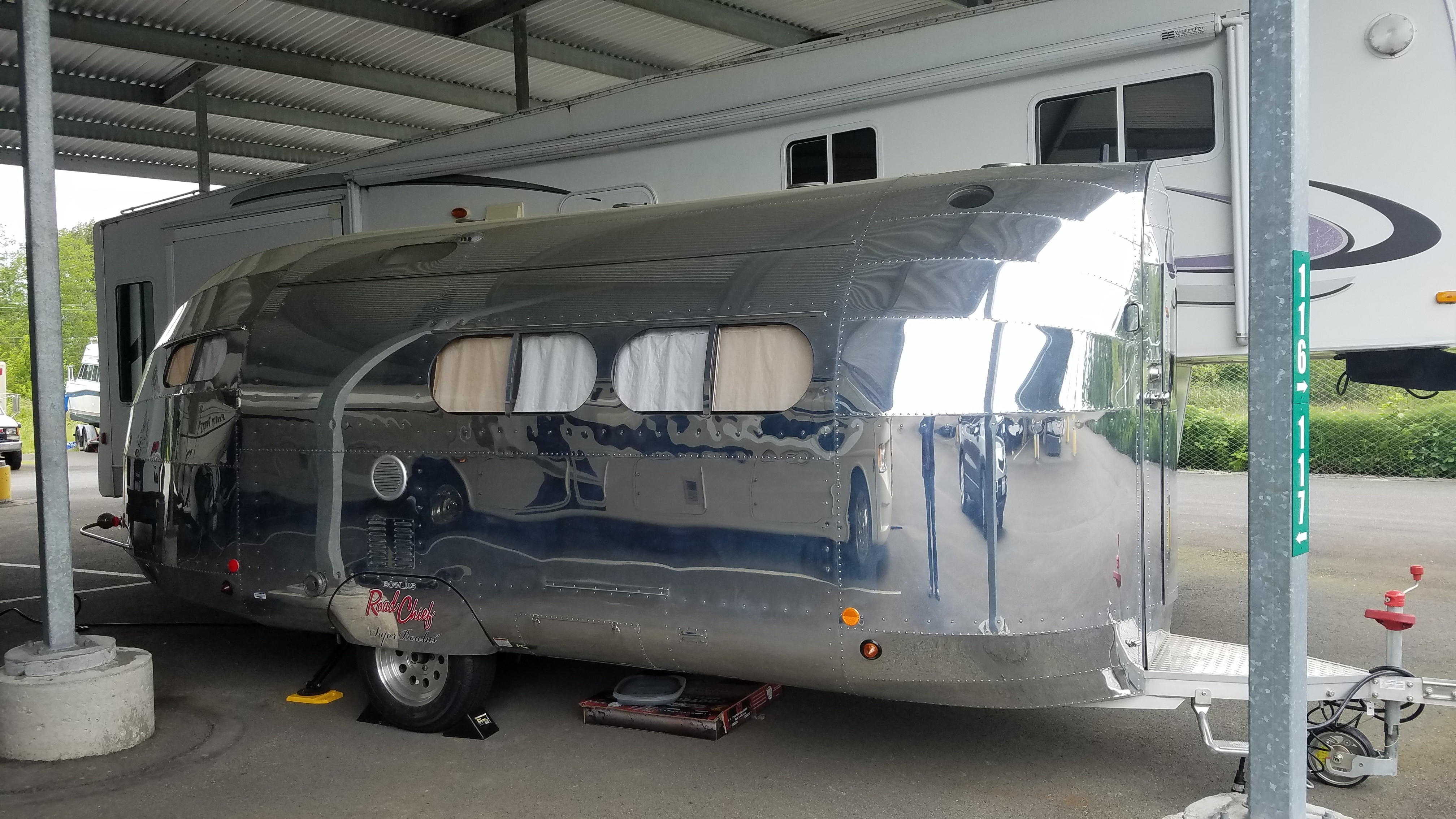
Yep, That's a Road Chief!!!! Would like to see one, but I can't afford one. https://www.bowlusroadchief.com/1 point
-
I see there is a strong desire in some quarters to seal the exterior vents on the Ollie, and that is at least in part a motivator to shift from absorption refrigeration to compressor refrigeration. We have had great luck with Danfoss compressor refrigeration on our sailboats and are considering making the change. Of course on the boats the compressor was physically remote from the evaporator plate in the ice box, located in an aft sail locker. The key to efficiency and low amperage draw was being able to move the heat away from the compressor. The compressor had to either be in a very large compartment, be supported by forced air venting of the compartment, or as was the case in our installations, have salt water cooling. The question I want to throw out is this. Why seal off the exterior vents? The unit shown in John Davies photo looks like it is ideally suited for ducting hot air from the fan cooling the compressor directly out the upper vent. That would do a lot to keep the ambient temperature down in the compartment, promote efficiency, and reduce the amp draw. Why not take advantage and duct out that heat? Is there something I am missing? Please advise. John Shkor, SailorsAshore1 point
-
I read the service instructions, and all I can say is it would be a PITA to take care of, especially if the water has any substantial mineral content. I would steer well clear of this unit, but you might be willing to spend hours and hours on your knees taking it apart and reassembling it..... Whole house humidifiers have a similar maintenance regime, but they are way easier to get to and don’t require a prolonged praying position. John Davies Spokane WA1 point




-
Recent Achievements
-