Leaderboard




Popular Content
Showing content with the highest reputation on 04/14/2026 in all areas
-
We finally got a window (and the courage to drive through PDX traffic) to visit the Oliver dealer in Salem, Oregon. It took about 30 minutes, and the tech seemed professional. Atta boys for the service team We also took a few minutes to look at the new Olivers that were at the dealership. They’re nice, but I suspect we won’t be buying a new trailer. I did like the compressor fridge and lithium batteries, but I don’t think it will be enough to sway us.4 points
-
Just received our Alcan Springs 5-leaf with heavy duty hardware. We will be having them installed as 4-leaf. Scheduled for first of June around a short Indiana trip. Will do the two 50 mile drives same day and they will re-torque, and then after our Indiana camping trip for the 500 re-torque.2 points
-
Some people are really smart. @Snackchaser You sir, are really smart.1 point
-
Interesting! Are you starting a waiting list for your production model? 😁. Mike1 point
-
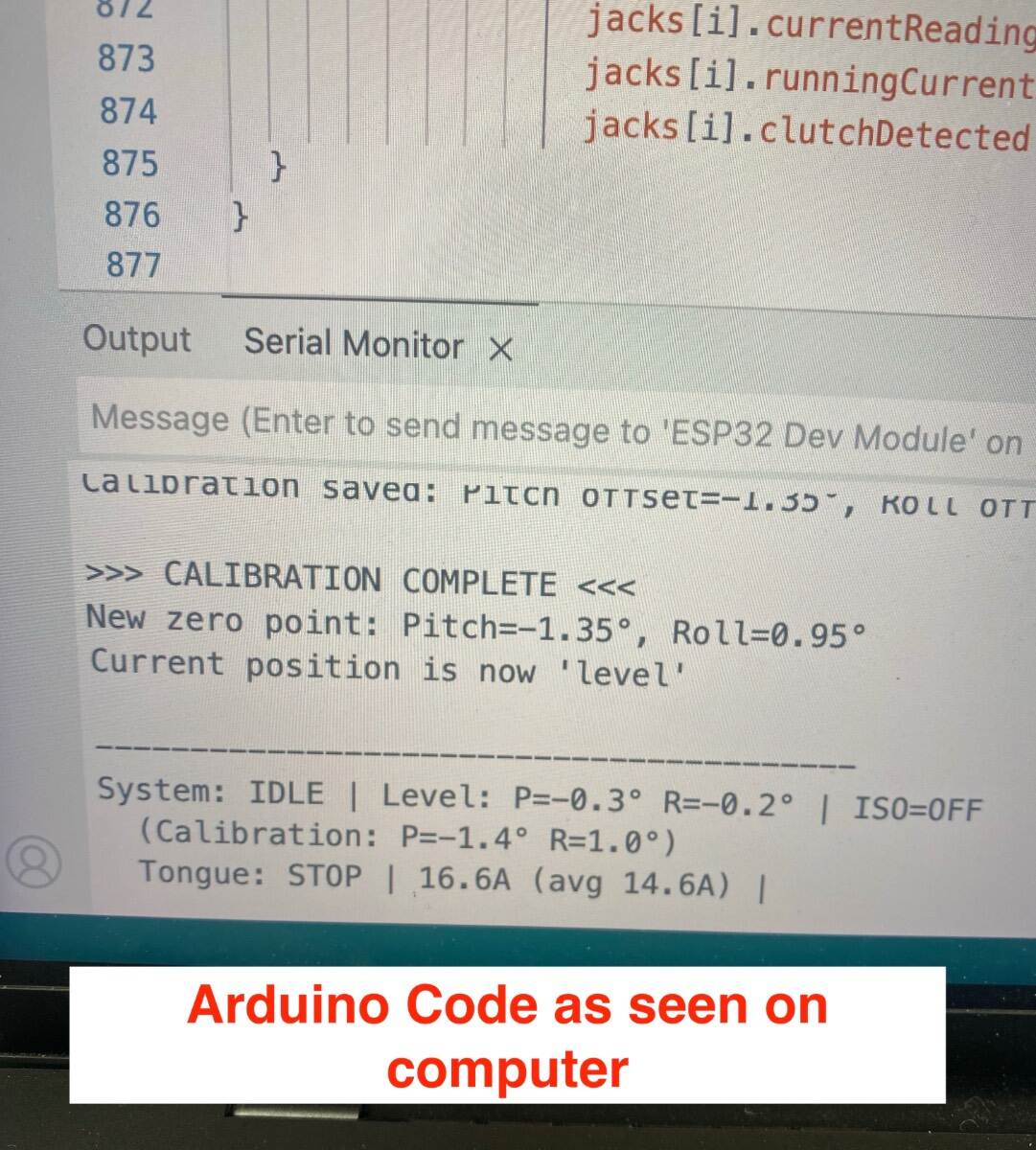
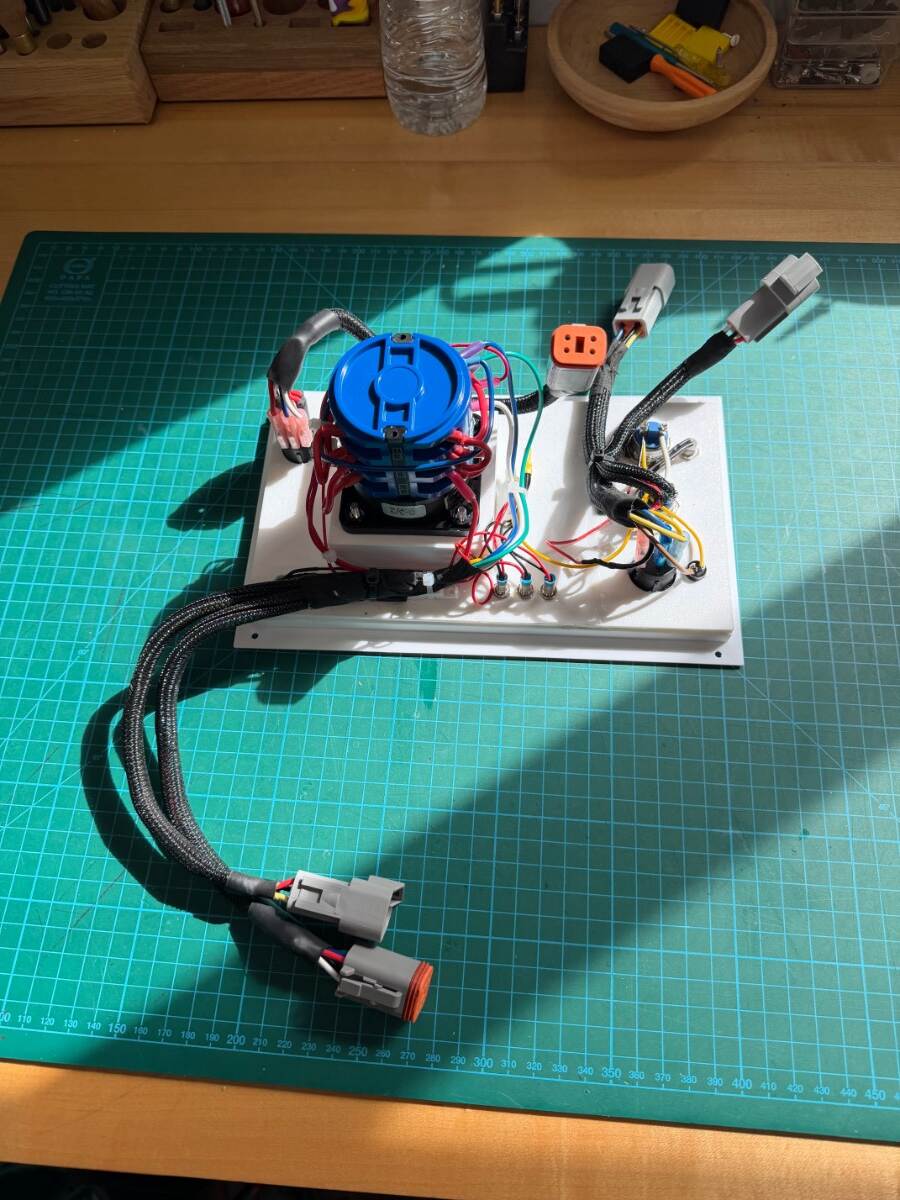
Custom Automatic Leveling for the Oliver's Barker Jacks — Part 2 Here is some more detail of the automatic leveling project as it transitioned from an idea to a working prototype. The project evolved from concept with safety and trailer protection as core design priorities. Limitations were built into the software including current-based motor cutoffs and maximum leveling offsets to prevent over-stressing jack capacity and minimized frame stress. On the mechanical side, the design incorporates fail-safe circuits, redundant shutdown methods, and four levels of overcurrent protection. A side benefit is the electronic monitoring of jack condition where abnormal current can reveal lubrication issues, mechanical wear, or circuit degradation before they become catastrophic failures. First step was writing a program script with open source Arduino software, and then uploading it to an ESP-32 microprocessor. The ESP-32 is basically a $10 miniature computer with programmable memory and integrated WiFi module (I might develop a Leveling App later). It receives inputs from a Inclinometer and two 50 amp current sensors, and it sends outputs to a status LED, a piezo buzzer for audible tones, and a 8 channel Darlington driver that converts digital inputs to 12 volts for relay coils. Six 30/40 amp Bosch style automotive relays are wired in an H-Bridge configuration to run the jack motors in forward and reverse. With a basic design plan and software, a test board was needed for proof of concept before anything could be installed in the trailer. The test board included potentiometers to simulate jack current, and LEDs to indicate the jack's up and down movement. It had a status LED, an isolation relay LED, a piezo electric buzzer, and a circuit board mounted with the microprocessor, inclinometer, drivers, and power supply. These standalone plug-in modules are wired together with soldered jumpers on a generic printed circuit board. Testing resulted in many design and software changes as the bugs were worked out. During this time it became evident that the tongue only needed the inclinometer for leveling, no current sensor required. I also realized that the jacks should be run in decreasing intervals with a limited number of leveling attempts before timing out. Another improvement was to run the jacks uninterrupted in free air until they were firmly seated on the ground for stabilization — before starting incremental leveling movements as needed. Current values are easily adjusted if more or less stabilizing pressure is desired. Testing found a flaw with the inclinometer. Thankfully they came in three-packs and I replaced them because they wouldn’t stay calibrated. The inclinometers have accelerometer and gyroscope functions, and it turned out that the accelerometer has known drifting issues. After turning off the accelerometer in the software, it worked great! In the end, the Arduino script grew to over 1,000 lines of code. With a lot of trial and error, a sequence of operation was developed: When the Level button is pressed, the rear jacks lower without interruption until they are seated on the ground in a firmly stabilized position (phase 1). If the trailer is level at this point, then there is no further action and an audible “happy tune” indicates successful level was achieved. If the trailer is not level after phase 1, then the left or right jack is cycled in intervals starting at 1.5 seconds (~1/2” travel) depending on how close to level it is. As the trailer gets closer to level, the interval shortens to account for coasting and fine adjustment to within 0.2 degrees of level. During the roll leveling sequence, a pitch limit of 5 degrees prevents the rear jacks from inducing too much pitch. It's a safeguard that temporarily interrupts roll leveling while it moves the tongue jack to bring pitch back within limits. Phase 2 pitch leveling begins, if needed, after roll level is achieved. When roll and pitch are level, the “happy tune” is played. The system allows up to 20 level correction attempts per axis before declaring unsuccessful leveling with a “sad tune.” The operator can stop the leveling at anytime with the On/Off switch or by re-pressing either momentary button. The “Retract” function proved difficult to program because of the mechanical clutch. Originally it was programed to shut off when the mechanical clutch actuated in the parked position, which is 13 amps. This didn’t work because the jacks had a current spike when coming off load, and there were oscillating current spikes during the clack-clack of the clutch that caused shutdown before before a clack was heard. These spikes hadn’t shown up in the time compressed current chart, but they were picked up by the current sensors. This was resolved in the software with a current delay when coming off load, and a longer delay when the clutch actuated so a few reassuring clack-clacks could be heard for audible confirmation that the jacks were fully parked. The leveling system was designed so that the jacks manual switches could remain fully functional. However, the H-Bridge relay configuration reverses the motor polarity for the up or down direction, and that could cause a direct path to ground when using the manual switches. To prevent this, I used a normally open relay to isolate the ground when the leveling system is not being used. I used a single 250 amp generic lawnmower starter relay on a common ground bus for all 3 jacks. It seemed reasonable. .. what could possibly go wrong? Hope this is still interesting…Cheers! Geoff Please excuse poor photos, I just didn't take very many!
 1 point
 -
A 2' level does the job. Set on the rear bumper for side to side. Add levelers as needed, chock and disconnect. I take the 2' level up against the belly band and raise or lower to get level Actually a good idea to have the tongue raised slightly to allow flow in the tanks toward the back. Very simple1 point
-
It's getting up into the high 80' here this week. We're going for a one week trip next week so I'll be testing things out. The big trip this summer starts out with a week in Cade's Cove, TN, where there are no hookups. This will be the real test of running the Chill Cube off the inverter. I'll be doing some test runs at home this week to see how long the ac can run on the (640 ah) batteries. With the unit on 50% (gear mode) and low cool its seems to be near 250 watts!1 point
-
Excellent, appropriate response to the subject @topgun2 . I would like to add my thoughts along those lines. Likewise I have traveled some really rough roads, backcountry gravel and dirt without a scratch so far. By no means am I stupid enough to take the Oliver down serious overland roads made most famous in the desert southwest, ie White Rim Trail, The Maze and so forth and so on. There are other rigs better suited to this endeavor such as MDC from Australia, Escapod, Bean Teardrops, Pause, and especially the Emperial Outdoors made in WI. I've seen and been in those and there is nothing like them made in this country I am aware of. Like the Olivers they are expensive, even more so, but built to the extreme made to go anywhere and are a true 4 season camper. Many RV's claim 4 Season, they are not in most cases. Regarding hitches and suspensions there is one reason why we still have leaf sprung suspensions and traditional ball hitch mounts on travel trailers. They are inexpensive for the manufactures to produce. While it may make sense to put leaf sprung suspensions on trucks due to their ability to carry very heavy loads installing them on a travel trailer makes no sense at all other than cheap manufacturing cost. Same goes for the traditional ball hitches. From a safety standpoint this was the inspiration for the invention of the Hitch-Ezy due to the designers wife having rolled over completely with her trailer and TV. I've lost count of the number of YouTube videos I've seen of trailers rolling over and taking the TV with it. With a fully articulating hitch this would not happen. While I don't have any personal experience using an articulating hitch it is my understanding the implementation allows for easier maneuvering, backup, and safer towing and traversing even mildly rough terrain. I don't know what the flex angles are on a typical ball hitch but on more than one occasion I've avoided going into backcountry BLM/USFS due to some very steep angles of approach. The BLM Overlook campground west of Grand Junction is a classic example where 99% of the jeep trail is easy to navigate with an Oliver until the final drop off which is quite steep. I would not be comfortable taking the Oliver through this. Otherwise a fabulous campground for tenters, vans, and small RV's with more accommodating hitches and suspensions. Leaf spring suspensions are rough, stiff and harsh period. Again they might make sense for utility trailers carrying very loads such as horses, construction equipment and supplies but for RV's it's simple and cheap to manufacture. There really is no other compelling reason to build an RV this way. There is a reason the automotive industry went to 4 wheel independent suspensions decades ago, it's safer, more comfortable allowing for greater dexterity while driving. I know of no one who has transitioned to an independent RV suspension with a desire to return to leaf springs and same could be said for the articulating hitch. For me, I would love to be able to go a little deeper and bit further off the beaten path safely without being an extreme overlander thus the interesting in different hitches and suspensions. As a final note on the leaf springs, just recently came across the Road Master mod kits for leaf springs and by all accounts appears to be far superior to the Dexter Easy Flex and other such flex kits made by Lippert and Morryde both apparently better than the Dexter version.1 point
-
Apparently the answer is a "qualified" - yes. However, I've never actually observed an Oliver in what I term "really rough terrain". Perhaps there just might be some "definition" issues of what is really meant by really rough terrain but when things get to the point of possibly damaging my Oliver - I simply bail out and refuse to proceed. I do not take these situations as a challenge to be overcome. I'd rather park the Ollie and then take the truck with its 4 wheel drive out into the more "interesting" stuff. Having said this - I do believe that there have been a handful of owners that have tested the limits of our Ollies. I'd guess that at least a few of these owners then decided that they agree with your statement about not having a "off-road suspension" and/or other accoutrements of trailers actually designed for the serious off-road crowd and swapped the Oliver for something they thought to be better suited for what they wanted to do. Bottom line for me is that the Oliver is robust enough to get me to all of the places I've ever wanted to go and sure does beat any other RV I've ever owned in this regard. I really do not enjoy traveling at speeds of between 2 an 5 miles an hour (I can just about walk that pace) while at the same time being concerned about what is going on inside Twist, worrying about a rock putting a nice gouge in its side, etc.. But, if that kind of activity is what "floats someone else's boat" and they have the coin to fix whatever damage occurs because of it then I say have at it - but - be careful. Bill1 point
-
Can you post a picture of your fuse box label panel? We might be able to guide you to the correct fuse to start troubleshooting...1 point
-
Under the dinette there are 125V AC circuit breakers and 12V DC blade fuses in the Progressive Dynamics 125V/12V power supply. The water pump has a 12V 15 amp blade fuse #6 on our 2015 LE2 Ollie. 12V fuses might vary in number, so look at the number on the left side of the fuse to match with the 12V fuse list.1 point







-
Recent Achievements
-