Geronimo John
-
Posts
2,398 -
Joined
-
Last visited
-
Days Won
68
Everything posted by Geronimo John
-
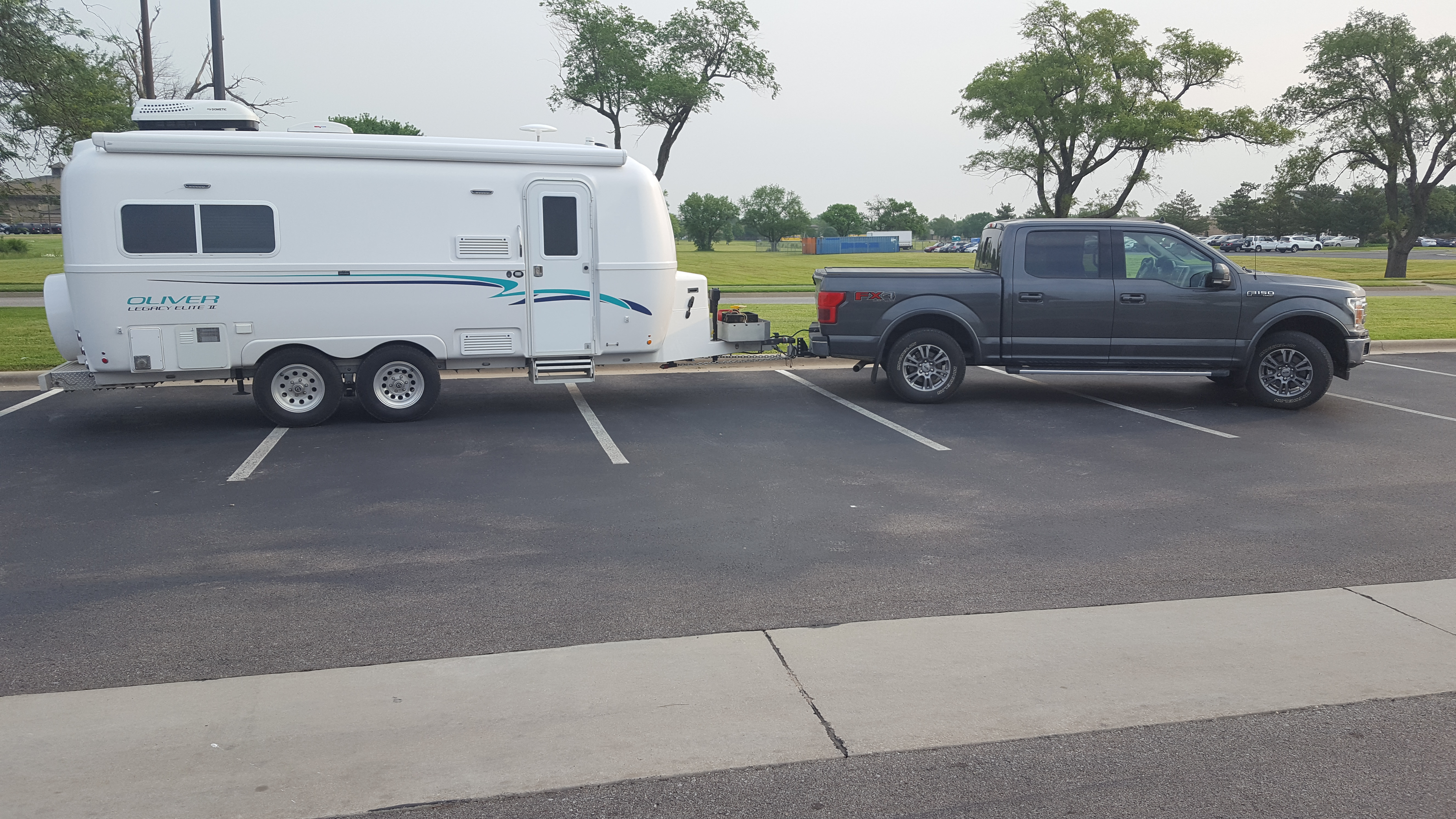
Ok Snake, you asked for it. First our rather detailed total travel inventory of EVERYTHING we carry when out for 3 to 5 months up to 4,400 miles from "home". Granted you likely will not be carrying two paraglider kits (Deduct 100 #), or maybe as many tools. But you will find dozens of items you have not yet taken into account I suspect. Our Tow Vehicle ("The Beast") is a 2019 FORD F-150 3.5 EcoBoost, LARIAT, 4X4, FX4, SUPRCREW, 145” Wheelbase, with a 5.5’ Box. Per Ford requirements we MUST use, and do always use the Anderson. The Squat numbers without the Anderson is just for grins to demonstrate the impact on ride height. So, below is how the inventory with my wife and I included and a full tank of fuel, wet tanks half full looks like: UPDATED ANDERSON BALL HEIGHT RANGE: 23.5” to 25” Below from F-150 during the Summer 2021 Truck mostly loaded Ball Height: 24 ¾” Ollie hitched without Anderson: 22 ¼” Ollie hitched WITH Anderson Set 23 ½” Truck squat reduced to 1 ¼” AGRICULTURAL SCALE: Summer 2021 Fuel Full, Truck Fully Loaded, Ollie Tanks 50% (This is our Highway Travel Loading) The BEAST OLLIE Front 3,000 Axles 5,350 Rear 3,550 Truck 6,650 Truck 6,650 Actual CGCW 12,000 Max GCW 16,200 Under GCW 4,200 POUNDS UNDER Below are the Ford max loadings for our vehicle. As you can see, we are well under all of them F-150 Tow Info: Max Payload = 2030 # MAX Tow Rating = 12,700 # (With WDH) Front GAWR = 3,450 # Rear GAWR = 3800 # GVWR = 7,000 # GCWR = 16,200 # So, as you can see, our Beast is not being stressed to the max. I have towed our 2018 OEII 24,000 miles and have no regrets with the capabilities of our TV. However, if I were another thousand pounds heavier, I think it would no longer be suitable for our mountain adventures. So, in summary for mountain boondocking: Based upon 57 years of towing experience in general and having a CDL for moving heavy permitted loads, and having now four safe seasons with an OE2: A. Your list of "Stuff" needs a major overhaul. B. If you are going to use a compact truck to haul an Oliver, it will work well for the smaller 18 foot version in flatland. But not for mountain boondocking. It frankly eventually will put you into a dangerous situation. Geronimo John 2022 Trailer Inventory and Packing List (16 FEB 2022 Version).xlsx
-
I'm 6' 3" and the twin works best for us all things considered. (No dog, great night stand drawer and counter top, etc.). We had OTT only provide one set of couch pillows. They store nicely on the kitchen table/seats. If we had two sets of them, that would a PITA.
-
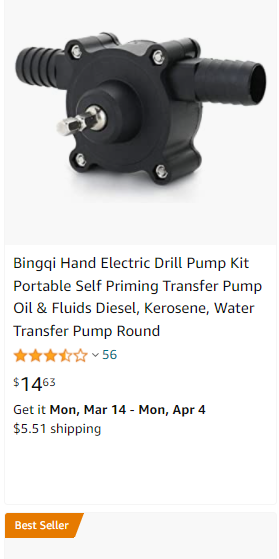
 I like Galway Girl's pump in a box idea. Looked at it several times and decided that it takes up more space than I can afford. Since I carry a 20V DeWalt Air Compressor, and a DeWalt 20V Impact Driver just getting a Bingqi Drill Pump and some very short hose connections was the path taken. I also carry a Fortiflex 20 QT (FB-120) bucket. It has our garden hose coiled up inside. The Bingqi Drill Pump and two sort sections of hose bibb fittings fit nicely in the space in the middle of the coiled garden hose. The existing OE2 Shure-Flow pump is slow in onboarding water. It also balks at using a filter to filter the water, and has AT MAX a 3' suction head. However this setup has no problem pumping water through a blue filter directly into the water tank. Less costly, less space, leverages things already on board, and FASTER as well. GJ
-
Those will certainly work well. I just like having a "Full Metal Jacket". 🙂
-
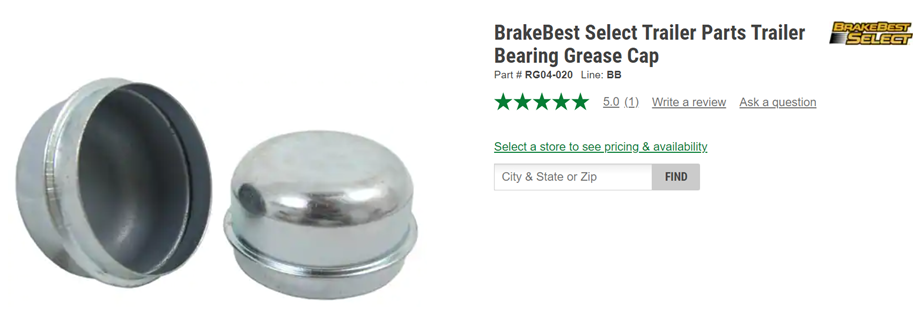
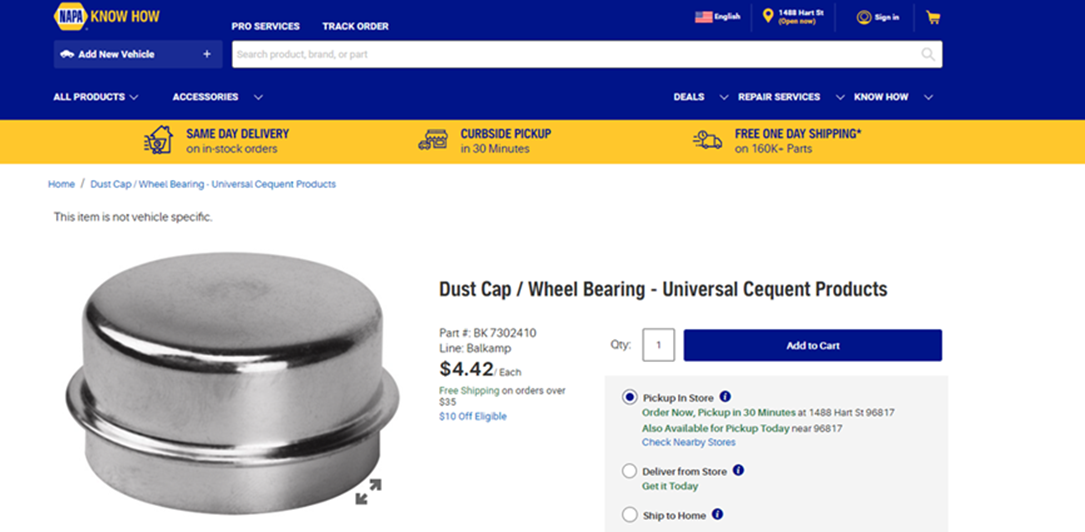
Bill: I also lost two of my "Hub Caps". The grease caps should not be coming off. I spoke with the Service/Warranty Department at Dexter about grease caps. They are aware of the wimpy metal of some of their grease caps. They are stamped from sheet metal that is either .021” or .029” thick. The thinner ones have been known to come loose. I have the .021” and two of them fell off after my fourth annual bearing service effort. Recommendation from Jason E. is to replace them with a heaver metal grease cap. I looked at dozens of grease caps, often having to call the manufacturer to get the metal gauge. So if you have experienced this problem, below are two that I would consider using. The BrakeBest is .030" .027", and the NAPA is .032". 16 FEB 2022: JPR UPDATE: Just got a follow-up E-mail from Reiley. They stated that the BrakeBest Select Trailer Parts Trailer Bearing Grease Cap thickness is .027". As such, if you have "loose caps", I would recommend the NAPA version.
-
Is your Maxx Air fan partially open? They are "Stiff/Tight" only when open or fully closed. GJ PS: Fried another brain cell. How about the bathroom exhaust fan. Maybe a bearing squeak.
-
Our Team’s Favorite 2022 Oliver's Features
Geronimo John replied to JWalmsley's topic in Oliver Blogs
My post was whimsical about a problem that Oliver is actively working to correct. Your post was intended to be satirical, I get that. However, your above statement, even from a satirical perspective, is disrespectful to OTT, as well as all the owners who have taken time to research, solve, document and then post their work. Not to mention their time freely given to answer scores of PM's about it from new owners as well. These senior most experienced owners, like your self, represent a cadre of the very best and most helpful people on earth. I am sure that your intent was not to offend or slander OTT, or the members of this forum. None the less.... -
Any possibility it could be from the A/C unit? Other than that, there is not much up there in the ceiling.
-
Dexter EZ-Flex zerks not accepting grease
Geronimo John replied to Fargoman's topic in General Discussion
Please do take note that the bolt has splines on the head end. It is not designed to be turned from that end. If the splines are damaged, the suspension bolt WILL turn, and the nut will fall off. This is how some of the EZ-Flex center bolts have worked loose. -
I use a 1/2" ratchet, a short extension, and a socket, with some Teflon tape. No need for the heavy tools.
-
I use my 4X4 multiple to get to most of our camping and almost all of our Hang Gliding and Paragliding launch sites. I would not even consider a 2X4 for an Ollie Hauler out west or anywhere there was snow/ice conditions.
-
And they took more than a few ques from the Land Cruiser as well!
-
Oh my. You just turned my head 720 degrees! Have you seen any tech spec's out on it? Glad they went back to the Tundra frame and power train like the 2005 generator was. BTW, after about 260,000 miles, 12 years of crawling up mountains heavily loaded with hang gliders and crew, and then both of my sons for another couples of years each, we sold the family 2005 Sequoia. Driven hard, fast and long, but maintained it was hyper reliable, and my most favorite tow and heavy off road vehicle for hauling. Drats... you got me thinking again!
-
Sneak peek at the new LE 3. Would you buy one?
Geronimo John replied to John E Davies's topic in General Discussion
OMG! Please don't show this to Jason in Service. He will for sure stroke out!!!!!!!!!!!!!!!!!!!! Oh, the question: Nope not for me. -
John: First, welcome to the Oliver Family! I need to clean up my documents, but they are 95% done. PM me with your E-mail address and I'll send you a materials list showing sourcing and costs for my entire Lithium project, as well as my edited version of pirated copies of other members many suggestions. (Galway Girl, Minnesota Ali, John Davies, Overland, etc.) I am using 4 AWG stranded premium copper cable from BatteryCablesUSA. Found them to be the best price. Also they are VERY helpful in calculation the actual voltage drop. that size cable is also what the voltage drop will be. As far as return back yes on the run both out and back. Also use high temp wire loom as likely it will be passing by your turbo's and/or exhaust at some point. For my 3.5 EB turbo area, I will also be wrapping the loom with heat shield. You want to minimize connections and also the higher resistivity of the frame. Yes, for the hull penetration, use the same method that Galway Girl documented in her report. It runs below the bathroom floor. You can see the path from under the front dinette seat. Yes on the clean up and removing all not required cabling from the battery box. GJ
-
October 2022 Post Project Edits in BOLD. A With three lithiums, I am assuming you have at least 300 AH capacity. With that in mind I was wondering why you have chosen the 18 amp Victron? The incremental cost to their 30 amp one may something to consider. B. Your cable length of 30 to 35 feet warrants a re-look. For my "Little" F-150 Super Crew to OE2 will require cables ( plus and minus) ffrom battery to battery of right at 110 feet of #4 AWG. This is due to needing to run both cables from TV battery to Oliver LiFePo4 battery box. C. The voltage loss is calculated for both the out and back length. It likely will be in the 100+ foot range for your big rig. At that length I would have concern with just using #10 AWG for 18 amps as well as the voltage loss at that distance and cable size. May want to re-look at that. In my case I went with the Orion 12/12 - 30amp and with a 54' run both ways (108' Total Cable Length Used) the 4AWG was strongly suggested by BatteryCablesUSA. Should my above thoughts actually apply to your project, the logical conclusion is that you'll be running new cable front to back. Should that be the case, with your three lithiums, I would go with the larger charger and power it up with twin AWG #4 stranded copper cables. Concerning mounting the Victron in the front dinette under seat cabinet, that is where I have posted and where I plan on mounting my 30 Amp Orion 12/12-30. My thoughts are that since the only time that the charger will be generating heat is when I am on the move. I will be removing the cushion and under- seat storage cover to allow the heat to escape to the trailer cabin. This solution does not add to the under bed heat build-up issue mentioned above. Good luck.
-
I have used a Tire Tracker for 4 seasons. Don't need the repeater with my OEII. Works well.
-
Replace AC and fan to lower height?
Geronimo John replied to Gliddenwoods's topic in Ollie Modifications
Keep in mind that the approach/departure slope from the garage can substantially change the altitude of the A/C unit. -
I also collect the A/C condensate and use it as the FINAL rinse. Eliminates the hard water spots really well!
-
Delivery Day Dilemma- Winterized or De-winterized?
Geronimo John replied to dhaig's topic in Towing an Oliver
dhaig, Best of luck and congratulations on your new Ollie. RV Antifreeze: Cheapest place I know of is Super Walmart Centers. Get three gallons as you may make a mistake or two and having the spare gallon is really nice. It's only a few bucks a gallon. It is nowhere as expensive as car/truck radiator antifreeze. Travel safe, -
Delivery Day Dilemma- Winterized or De-winterized?
Geronimo John replied to dhaig's topic in Towing an Oliver
JD: I am assuming that these tank rings are non-conductive. Would electrically isolating the tanks from the frame be a good or bad move? -
Compressor Refrigerators in 2016 Oliver LEII
Geronimo John replied to Southbird401's topic in Ollie Modifications
I have camped for a couple of weeks in 106 degree full sun with my OE2 OEM Dometic. We keep the Dometic pretty full and try not to open it up a lot. Also, we mitigate the heat for the refer by parking the trailer so the entry is on the north or NE side to keep the refer in the shade as much as possible. Some folks deploy their awning to make the shade, but we spend a lot of time away from Ollie and have concern about winds launching the awning. -
Cargo basket: tight turns and tailgate
Geronimo John replied to Steph and Dud B's topic in Towing an Oliver
You must not park your trailers where I on rare occasions out of necessity I have to. Idea is to back up the trailer only as tight as you have to. If you don't have a tight spot with poor or no turning radius that's great. But sometimes stuff gets in the way and bringing the box close to the bumper is the only way to get it into the space. Going slow and watching the angle on the back-up camera can be very helpful... and several times made the difference in getting my Ollie into a tight situation. In my re-read, I failed to mention that getting out of the truck and taking a look is part and parcel with the process... when alone, or with a spotter. My bottom line is that I feel that nothing beats a "YOUR eyes on" approach first, and periodically when baking. My comment about the rear view cameras was more of a joke as I don't find them real useful (Like using my eyeballs at the hitch or rear of Ollie. The cameras are nice, but not effective enough for me to risk crunching Ollie or the TV. But for the TV and Basket issue, my F-150 tail gate camera is very effective in giving me an idea if I need to pull forward and re-adjust the angle. If the tongue is at 90 degrees to the bumper, most likely you have already damaged either your box or your bumper. -
Cargo basket: tight turns and tailgate
Geronimo John replied to Steph and Dud B's topic in Towing an Oliver
I'm often alone when parking the trailer. So finding somebody that I can trust can be a challenge. My solution is to back up a bit, then stop and put my truck into reverse so that it's back-up camera shows how close I am to a Box and Bumper MMA match. Doing so also slows me down a bit so that I can also look up at my Ollie tail mounted camera that I have powered up from the parking light circuit in the attic. So if you are following me, and I turn on my trailer lights, I've got an eyeball on you! 🙂 -
Cargo basket: tight turns and tailgate
Geronimo John replied to Steph and Dud B's topic in Towing an Oliver
On the other hand, the tongue basket is very handy for all those goodies that are not suitable for inside Ollie. Some of the things I carry in mine are: Ground plates for three jacks 2" X 6" wood shims to reduce wear of jacks, but more importantly to give me a slip point so that if I drive off with a jack down there is a chance that I'll hear the thump before I brake the jack. I've seen this with my own eyes by other owners making that mistake. One was at OTT in the service yard! Spray Lithium Grease for my Anderson Ball Long range wasp spray and Cutter/Deep Woods bug repellant 2 gallon jerry can of gas for the generator Anderson chain and whale bone, pins and trailer lights when parked Old rag to wipe of my hands after puttzing with all of the above That said, I admit that I have a damaged left rear bumper as a result of this issue. It would be nice if Bulldog made a longer coupler. This would also eliminate the interference of the Anderson upgraded ball mount that sits just a bit higher than the ole one. Drop my F-150 tail gate and the tailgate camera and the Bulldog release lever end up saying bad words to each other. But alas Bulldog does not seem to have one. They do make a lever less release (Slide Coupler) that will resolve the tailgate/Bulldog issue, but would not fix the bumper/box issue. Any metal experts out there know if an extension could be welded onto the bulldog to fetch about 4 inches? That likely would be a lot less expensive than replacing the Oliver Aluminum behind the bulldog. Your thoughts? GJ