All Activity
- Yesterday
-
😉
-
remember story game
-
Going through what few pics that I took at this year's Owner's Rally, I was reminded of a visitor that was there each morning as I drank my hot chocolate.

-
that hopefully will
-
Bob, as you already figured out, conventional alternator voltages can’t be applied to a smart alternator. They use a current sensor on the battery’s negative cable that signals the engine computer, which throttles the alternator down once the TV battery is charged. That saves fuel, and 12.4 V while driving can be perfectly normal. Based on what you’ve described, there are several possible causes for your problem. First, I’d verify that the DC-DC charger’s negative cable isn’t connected directly to the TV battery post. If it is, the Orion’s current bypasses the current sensor, the computer never sees the extra load, and it never raises the alternator voltage… unless for other reasons such as a low TV battery. Some manufactures specifically say to ground accessories to the body for this reason. Many vehicles have a ground stud on the far side of the sensor for accessories, otherwise use the chassis ground point where the battery’s negative cable attaches. Even if it worked before, it could be because the current sensor was seeing other TV loads that caused the alternator to increase voltage, and it wasn’t noticed when it stopped charging. If the truck can see the charger’s load independently from the truck loads, then the alternator should keep the voltage raised well above all of the thresholds. So it could have been charging when the truck called higher alternator voltage, but not otherwise. Second, the Orion’s engine shutdown detection works on voltage. My abridged explanation is that with the default “smart alternator” settings, it starts charging at 14.0 V. A smart alternator idling at 12.4 V never gets there, so the Orion thinks the engine is off. There’s also a separate input voltage lockout setting (default 12.5 V) below which charging stops. At 12.2 to 12.4 V, you’re under that too. These thresholds are adjustable in VictronConnect, but there’s a limit. Set them too low and the Orion can stay on and drain the truck battery when parked. Every vehicle is different, so some trial and error may be needed. It sounds like the Nissan system might have some unique quirks, but disabling the voltage control might be extreme. If fine-tuning doesn’t work, an “engine-running” signal on the Orions Remote L Terminal will force the Orion on. It’s there for this very reason. You must leave engine shutdown detection enabled when you do this, so it still turns the charger off when the engine stops. Victron describes several signal sources and recommends a true engine-running signal over a plain ignition wire. For your situation, a wire that goes dead with the key off is the best approach. In a trailer setup, this gets more complicated because it needs a third wire between the truck and trailer. Fortunately, the +12 V wire in the tow harness should work in most cases. Check it with a meter. It must be dead with the key off, and must not be live from the trailer battery with the truck off. Oliver doesn’t connect this wire on lithium systems so you should be okay. Ideally, it would also be off with the key on and the engine not running. Otherwise it could drain the TV battery if key is left on. This wire is usually capped off near the inverter and it’s typically a #10 or #12 wire. Also be aware that undersized cables, poor terminations, and corroded Anderson connectors can cause “additive” voltage drops that only show up when the charger is pulling heavy current. Corrosion builds over time, which could explain why it worked for a year and then stopped. This is where the “Input Voltage Lockout” setting comes into play. It’s set it so that Vlock-out ≤ Vshutdown − Vcable. The Vcable is the voltage drop in the wiring at full current. Victron’s manual provides an example voltage drop at 50 amps over a specific length of heavy cable. It’s a surprisingly high voltage drop, so if you add any additional resistance from undersized wire, corrosion or poor connections, you can add tenths of volts more, and that can push you under the set point where charging stops. You or your installer can measure your actual Vcable with the Orion running at full current (Turn on Oliver’s air conditioner and use a temporary +12V signal on the remote L trigger). Confirm its running full amps on the App. Vcable is the truck battery voltage minus the Orion’s input voltage. Many people wing this and get lucky, but it can become a latent problem especially with marginal wire sizing. Another way to get around this it is to de-tune the Orions maximum output amperage. For example: I have wiring sized for an old 30 amp charger based on the length of the run. When I upgraded to a new 50 amp charger, I reduced it’s power output to 30 amps to match wire size, otherwise Vcable could be too high. Mine actually worked at higher amps, but the wire was getting warm which meant the efficiency was suffering and I was burning more fuel. Finally, it’s worth load-testing the alternator. Turn on all the big loads (headlights, rear defrost, blower on high) and check that voltage climbs to around 14 V and holds. An alternator shop can do a more definitive carbon pile test. Also do a ripple test, which detects a burned diode that would reduce output. You can check it yourself with a meter on AC volts, with the loads on. There are YouTube videos showing how. If the voltage won’t rise even under heavy load, a Nissan dealer can scan for codes to tell whether the problem is the alternator or the current sensor. Again, it might be true that the Orion has never worked to full capacity and it was just not noticed. It probably worked periodically over long drives enough to charge a partially drained battery. The Victron has a history function where you can verify its performance over time. It's a good tool for problems like this. Anyway, it’s been fun trying to write this out in layman terms. I hope it helps, Geoff
-

Entry steps steel rod, broken weld
ScottyGS replied to Olive2Roam's topic in Mechanical & Technical Tips
Let me guess..... The person you spoke to has the initials MS... -

Antifreeze CO2 & Propane Alarm
Steph and Dud B replied to HDRider's topic in Mechanical & Technical Tips
According to the product page, Supertech RV Antifreeze contains Glycerin (Glycerol): An additive that helps lubricate and protect plumbing seals. Also Propylene Glycol: A non-toxic (to humans when used as directed) organic compound that lowers the freezing point. So, it's not all ethanol. Never had an issue ourselves in the past 27 years. On the other hand, we have had a CO/gas detector become overly sensitive and need to be replaced. - Last week
-

Entry steps steel rod, broken weld
topgun2 replied to Olive2Roam's topic in Mechanical & Technical Tips
"colors" ? -

Entry steps steel rod, broken weld
BackofBeyond replied to Olive2Roam's topic in Mechanical & Technical Tips
At the very worst, you temp use two bolts in each end. Available almost anywhere fine bolts are sold. -

Plastic Swivel Adaptors starting to fail - likely age
Galway Girl replied to Wayfinder's topic in Mechanical & Technical Tips
similar problem during our 2023 Alaska trip documented below: -

Entry steps steel rod, broken weld
Geronimo John replied to Olive2Roam's topic in Mechanical & Technical Tips
There is some concern that the steel rod threads will "eat" the aluminum slot. A smooth rod of steel with colors or washers and cotter pins would likely serve you best. GJ -
Good observation. Any chance that the pipe and faucet had been hard frozen? That could account for both issues.
-

Filling the freshwater tank from a container
jd1923 replied to Brian H.'s topic in Welcome to the Oliver Forums
Interesting change. Makes sense to have 2 vs. 3 inlets given the valving can provide the same 3-way functionality. What seems odd to me is the newly-chosen location of the City Water inlet. Water inlets should both be on the service side, the street side of the trailer. I often use our 10 ft hose to connect to City Water when a campsite has a water hookup. With this configuration I’d need to get out the 25 ft hose. Too bad they didn’t keep the two inlets together as they’ve always been and deleted the rear inlet. I'm also thankful to have all 3 jack switches in one location up front. It would be painful to level the trailer activating switches from 2 locations. A lot of walking back and forth, and the second location being behind the rear basement door is not at all helpful. Some changes are not deemed “improvements” by all! 😎 -
Antifreeze CO2 & Propane Alarm
Geronimo John replied to HDRider's topic in Mechanical & Technical Tips
Great post and thank you Cindy! Below is a long version with a couple of alternate RV products than the Super Walment Center Super Tech version that many of us have been using. Owners: If there are other less expensive sources please advise all. Have we seen any long term damage in our OTT's? (I have used it for 9 winters and have not experiencned any). If none by others then maybe the topic is over-blown. GJ RV ANTIFREEZE (Keep).docx -

Plastic Swivel Adaptors starting to fail - likely age
CRM replied to Wayfinder's topic in Mechanical & Technical Tips
Did they remove the pressure regulator from new units? -
Wow I'll need to digest your post a bit. By chance will our Pre-2020 trailers best use Sharkbite fittings and Pex - B pipe? With zero plumbing leaks in 9 seasons, I'm think for our 2027 season that it is for sure time to get to the Big Box store to acquire a small stock pile of the proper fittings. Here is a starting point for discussion: (Assuming all are 1/2" sized.) Half Stick of Pex-B pipe (One Each) Female Swivel adaptor (See above, Two Each) Coupling 90 and 45 degree elbows (2 Each) Support fixture for fixing the Pex-B pipe (See above, One Each) Stainless Steel Hose Clamps? (Needed? Number?) What above is not needed or is not listed? thanks, GJ
-

Plastic Swivel Adaptors starting to fail - likely age
Rivernerd replied to Wayfinder's topic in Mechanical & Technical Tips
Great suggestion, as Sharkbite fittings require no tools. NOW I plan to invest in a couple of 1/2" Sharkbite fittings, for the next long trip. A "heads up" with regard to the difference between Pex A and Pex B : The photo below includes both "Apollo Pex" and "Pex-A" fittings. The bags labeled "Apollo Pex" contain barbed fittings which are also known as "Pex B." Note that the barbed portion of the fitting that is inserted into the Pex pipe is slightly different on the Apollo Pex fittings than the "Pex-A" fittings. They are not interchangeable. They use different pipe and different connection methods. Pex B uses a metal crimp ring with crimping tool, and is commonly sold at hardware stores. Pex-A (also known as Uponor, Wirsbo or Aquapex) is less common. Pex-A uses plastic expansion rings, not crimp rings. Pex-A requires an expansion tool, which temporarily expands the plastic ring, which ring is then quickly slipped over the Pex-A pipe+fitting, then shrinks within about 30 seconds to create a tight seal. I plumbed my entire home with Pex-A with the plastic expansion rings, using a cordless expansion tool. But, my Oliver Elite II was plumbed with Pex B using crimp rings. My Pex-A fittings left over from plumbing my home are not compatible with the Pex B pipe and fittings in my Elite II. So, when purchasing spare parts with which to repair the plumbing in your Oliver, avoid anything labeled "Pex-A". Or, just buy the more expensive brass Sharkbite fittings, because they do not require installation tools. And, when buying pipe for your Oliver, be sure to buy Pex B, not Pex-A, pipe. -
 For those without a PEX crimping tool, a repair with a comparable all-brass sharkbite fitting is arguably easier than a PEX fitting. Mine broke last week and that is what I used to repair it. It took me about 5 minutes.
-

Inside an Apex with Ecoflow
Dean and Mary replied to Wayfinder's topic in Mechanical & Technical Tips
I hope to be at that point within a year or less. -
Filling the freshwater tank from a container
Dean and Mary replied to Brian H.'s topic in Welcome to the Oliver Forums
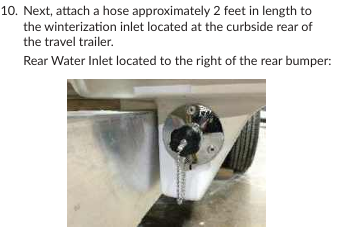
I see the source of the confusion now. There are only two water inlets on the OTT-2025 vs three inlets on my OTT-2022, and the rear inlet and city water inlet are actually the same connection. As I mentioned earlier, the fresh water inlet and rear inlet are not the same. The attached diagram from the OTT 2025 manual illustrates this more clearly, showing that the rear inlet and city water inlet are one and the same.
-
Filling the freshwater tank from a container
Dean and Mary replied to Brian H.'s topic in Welcome to the Oliver Forums
Mossemi, Providing the electronic manual for the OTT-2025 should help. From that manual, the rear inlet appears to be in the same location has my OTT-2022 model. Cut and pasted from the OTT-2025 manual.
-
 There is another valve configuration for winterizing through the boondock inlet. The diagram is pasted under the curbside bed plate. It is not in the 2023 manual even though it says it is.
-
I aired out the Ollie overnight and the alarm is off and that pretty little green light is bright and shiny.
-
I wanted to alert you guys that when you winterize the antifreeze might set of your CO2 alarm. We never had it happen before but we sure did yesterday. I reset it a bunch of times and kept scratching my head. Cindy found something via the Google about it. The antifreeze has alcohol in it and can set off the alarm. I just found these other little tidbits about RV Antifreeze - Drying Rubber Seals: Repeated long-term exposure to high-concentration ethanol can dry out or degrade rubber O-rings, pump diaphragms, and toilet blade seals over time. Taste & Odor: Ethanol leaves a distinct alcohol smell and can impart a persistent chemical taste to PEX lines and vinyl hoses that takes extensive flushing to remove in the spring. Flammability: Because of the grain alcohol content, some low-cost ethanol-blend antifreezes are potentially flammable in concentrated liquid or vapor forms when exposed to an open flame.
-

Filling the freshwater tank from a container
Tideline77 replied to Brian H.'s topic in Welcome to the Oliver Forums
I’m pretty sure there was a change on the city water, fresh water and the boondocking inlet ports around 2024 or 2025 I do not remember the details and I am not a subject matter expert