Leaderboard




Popular Content
Showing content with the highest reputation on 07/02/2018 in all areas
-
We keep the fan on low, too. If we have to go to sleep with it running I will usually get up after midnight sometime and turn it off, open the windows and turn on the max fan. Then we can enjoy silence the rest of the night! Mike2 points
-
If you have a smartphone you can download an app. The one I have is appropriately named dB Meter. On low fan, I get 65dB- 70dB standing directly under the AC and 60dB-65dB at both bed height and the dinette. Add 5 dB to those numbers when the fan is on high. So, roughly the same level as a vacuum cleaner for reference. That’s with around 35dB background level without the AC running - the trailer is pretty quiet which makes the noise seem even worse. I believe the Honda generators are rated at under 50dB, so yes these suckers are really loud. The odd thing to me is that it’s the fan and not the compressor that makes most of the noise. Seems to me like Dometic could stand to do a bit more engineering.2 points
-
Just received the Valterra valve from Amazon, it's marked with Valterra's part number tag, but wrong valve. Contacted Valterra and alerted them to the problem. They're sending another valve and correcting the problem, good folks to deal with.1 point
-
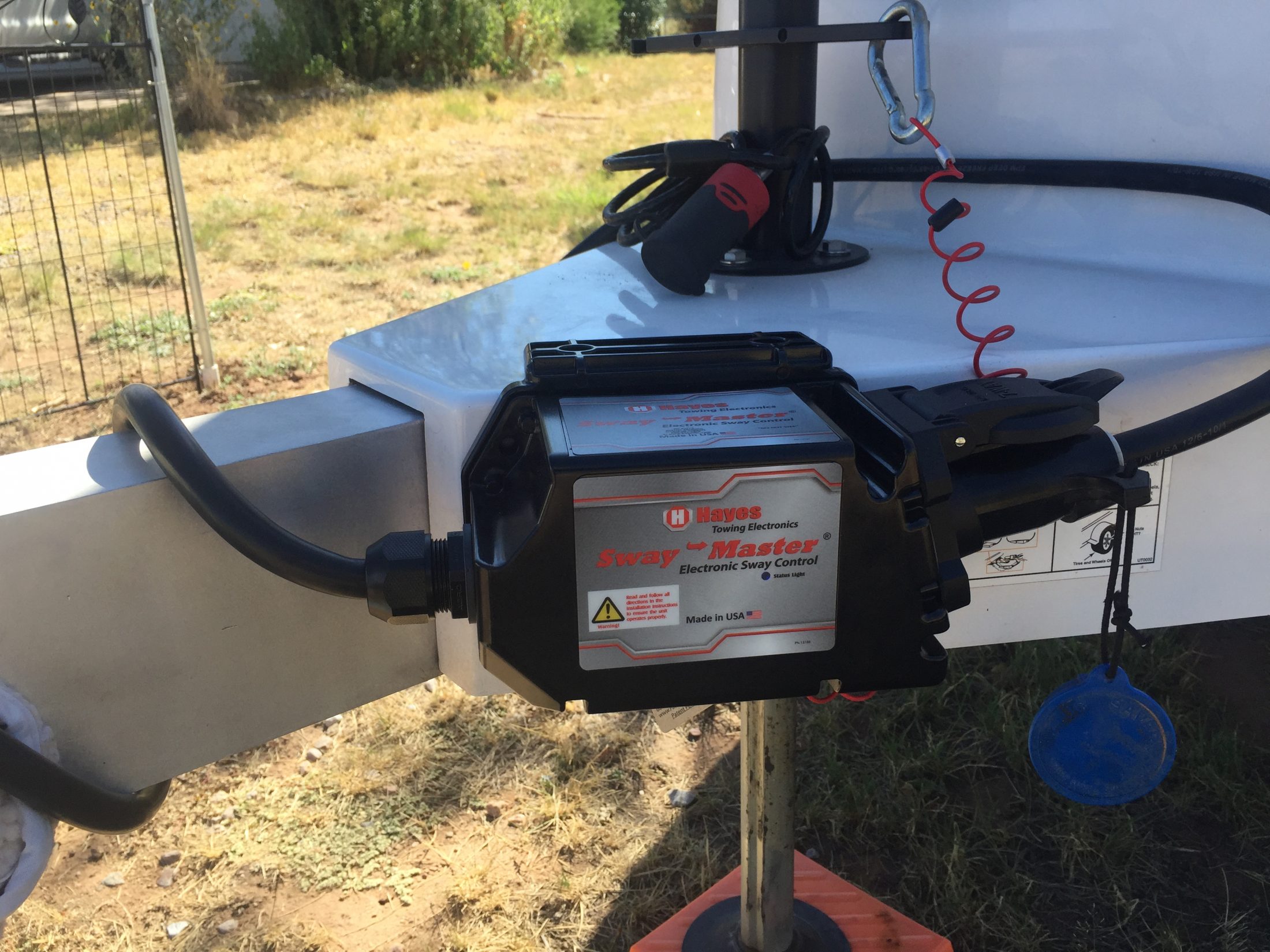
Yes, and just in case I don't have the time or the quick thinking needed to apply those brakes, I bought and installed the Hayes Sway Master, as have a few other Oliver owners: https://www.amazon.com/Hayes-81775-Master-Electronic-Control/dp/B01GT91SY2 It seems to have helped us once already. We were in heavy traffic on a freeway in Scottsdale, AZ, when a teenage girl gabbing on a cell phone swerved into our lane. I swerved to avoid hitting her, and the Ollie's brakes were immediately applied. I don't know if the Sway Master avoided a disaster, but it sure feels good to know it is there.
 1 point
 -
Our fan on auto is super annoying. It switches back and forth between high and low constantly and whenever it does the entire unit has to switch off while it thinks about it. It's really a very odd contraption. It does seem to cool the trailer off pretty fast though, but I think that's more thanks to the small volume of the trailer than it is the AC. I'd be interested to know the real life dB levels of the Attwood. Maybe @john-e-davies can measure his.1 point
-
Foy, The first night we tried to sleep with the unit on, I felt like I was sleeping on a runway! Ours is also terribly loud and I can’t watch tv when it is on or sleep with it on. I did find that manually lowering the fan to low rather than leaving it on auto made a big difference for me - the low setting was much more tolerable. I feel lucky to live in Colorado where I’ll probably never use the air conditioner again! Alison1 point
-
I don't know of anyone claiming Olivers are better simply because they are likely to survive a rollover better. A rollover simply helps demonstrate how poorly some trailers are built. This doesn't have to be borne out by actual roll-overs. Just look for yourself at the construction of so many stickies and look at the construction of an Oliver. If it is not apparant that the Oliver is vastly superior, and you can't see it without an actual roll-over, then you should just buy the sticky and be done with deciding. I certainly did not buy mine so that I could roll it and keep on going, but general sticky construction leads to so many deterioration problems over time and so many stuctural failures from normal use. I suppose you could hold a piece of paper in one hand and a piece of steel plate in the other while arguing that you had insufficient data to show the paper was not as strong, and therefore you were unable to make up your mind which to hammer on. That's fine. But at some point, a common familiarity with materials is enough to favor the steel. Same with general trailer constuction. Just look at examples all around. Older ones that are falling apart. Rot problems, total destuction in wrecks, comments from owners that tow them. Go on a factory tour. In other words, do your own research and believe in what you see for yourself. Are stapled wood strips as strong a molded and re-inforced fiberglass? Are stapled aluminum strips as strong as a fiberglass outer shell? Is a rubber sheet roof as durable as fiberglass? Where will you find believable repotrs that demonstrate to you that a rubber sheet is as durable as heavy fiberglass? And why would you need such data, when you can simply hold each in your hand and see for yourself? Seriously though, and again, if you feel there is no demonstable differences in strength and usefullness between an Oliver and a normal sticky, don't buy an Oliver. Why buy something that is twice the price and no better? Your decision must be based on what you think is best. Not us. And it seems we are not able or willing to supply you with sufficient data to support the idea that a sticky is structurally weaker, more prone to rot, UV damage, etc. What happens if nobody ever rolls an Oliver and you have refused to buy one until you can compare rollovers between a sticky and an Oliver? You'd be stuck, unless you used your own common sense and noticed the differences in construction. Or, you can assemble your own report by buying a low priced sticky, and then another one and then another one, like so many of us have, and finding out how it goes over time. If you use them regularly, put a lot of miles on them, vist cold or wet climates, or keep one for a longer time, you'll have ample opportunity to form an opinion. I had three stickies before an Oliver. Maybe you should too. As far as brakes are concerned, Olivers use a conventional Dexter electric brake system on solid axles with shocks. Same design as many others. But they are Dexter which is likely the best manufacturer. Oliver has recently upgraded to greaseable bushings and an Easy-Flex equalizer too. Airstream uses torsion axles. Most stickies us conventional axles with non serviceable nylon bushings. Oliver has an aluminum frame that is unique in that it is specifically designed with the body and not just a platform to build on. It cannot rust. The frame works with the inherant and designed in strength of the body structure. There is no exposed wood underneath, just a fiberglass bottom exposed to the elements. All pipng and tanks are enclosed. You should know most of this by now if you have been doing any serious research. Proving why each of these features is superior to most sticky designs is beyond the scope of this reply. Some things are obvious. Good luck in your quest.1 point
-
For me, need to turn volume up when using 4 speakers while in bed area compared to dinette area where I don't need to increase volume when AC is operating. Have to admit lost some hearing in the past due to loud activities. May be the difference of locations of front speakers compared to rear speakers for me. Going to experiment with headphones while watching TV from bed area.1 point
-
Foy, my response at this point would be to remove the lines to all of the faucets, toilet valve etc.., and blow out the lines at the source I.e. Fresh water inlet and water pump. Steve1 point
-
The ducting in mine is so flimsy that there is no way a new duct could be pulled through it. The attempt would simply wad it all up and destroy it. This hose makes a dryer vent look strong. It's a good idea to restrict the flow in the main cabin to maximize the flow to the bathroom. This is not a system that is balanced on it's own, by it's design. By design, it gets balanced by restricting the lowest restriction vents to bring up the flow in the bathroom. It seems they all must have limited flow to the bathroom. Mine does too. Since the probelm that set off this discussion was contamination in the ductwork, that was free to blow out into the room. And since the replacement of the forward duct seems very difficult, I think it might be a good idea to increase the velocity enogh to blow out the loose fiberglass and cure it that way. This could be done by removing the restrictor in the bathroom and connecting a high powered industrial dust collector or a shop vac to that port. Then turn on the heating fan and the vac at the same time, while shutting off all other vents. This action would increase the flow beyond any normal rate and extract any loose fiberglass. You might also disconect the duct back by the fridge and just use the vacuum to maximize the flow. While doing this you could throw rags into the open duct to help vibrate the duct and cause more turbulence on the way through, knocking any stuck particles loose. you could also reverse the process and suck from near the fridge to backflush it. After this, there will be no loose strands waiting to get blown through by the low velocity heater fan. You should also contact Oliver to get their advice on this and to help them understand that they need to be more careful about contamination. Just blow it out with high velocity air and hope that the low velocity heating air won't be able to send any residual into the room. A "return air" vent, which is simply a hole in the wall between the bath and living area will really help to lower the restiction on the bathroom circuit too. Leaving the bath door ajar lowers the restriction even more than a vent and costs nothing, while still being able to close off the bath from the living area simply by closing the door. It might be nice to have a closeable vent there that could be left open while heating, but closed the rest of the time. Even the bathroom vent fan would work better with that vent open, but the best place for that fan to get air is the side window.1 point
-
Roger, I think it's a false assumption that just because a trailer is built better, the rate will be lower. Olivers are much more expensive than a lot of other brands and that difference could easily offset the potential lower cost for quality. Airstreams are built better than a lot of others too, but they have vunerabilities that could make them more of a risk for insurance companies. An example of this is how easily they are damaged by hail. The differences in quality and design are apparant with even a casual look and don't really require a lot ofsupporting data. Just take a look. The picture of the wreck bares this out well. Diesel braking is a very nice feature and saves a lot of wear on the truck service brakes. It also means less brake fade. But it does not contribute to stability. If a trailer has a tendency to sway, any braking by the TV is likely to increase the problem. Swaying trailers are stabilized by applying the trailer brakes, either alone or at least more aggressively that the TV brakes. Trailers should never be towed without trailer brakes and all drivers should understand how and when to apply those brakes independently of the TV brakes. Engine braking is a completely separate issue. I think you'll find you'll have a better experience here if you enter into a friendly discussion and not expect people to provide documentation for their opinions in order to gain your belief. You can take or leave any comments as you see fit. Most of us have had a lot of experience and picked Oliver for many good reasons. We've made a number of improvements and happily shared those. We've been through the factory and know the peole who work there. We've been involved in improving the trailers. In other words, we are not just blowing smoke or blindly promoting a poor product. You also must make a lot of decisions for yourself, based on facts you gather and weigh, that are not simply based on others comments. Welcome aboard.1 point
-
While some people scour RV forums for information, reviews, and the millions of opinions they provide, others gain their experience through hands on ownership, actual walk throughs (a weekend in one), perhaps spending hours at the factory. In either case, opinions are formed, all valid, some not very accurate. Some of us, having spent decades in high end manufacturing, some with experience actually building van conversions, and living in them thorough out North America, can separate the wheat from the chaff, when perusing the various opinion sites., some never do. The numerous Oliver owners I have actually talked to, and questioned, were as a group very well informed and educated about their RV and the competition. Many are what I call experienced tinkerers, with backgrounds in engineering, trades, etc. They are always looking to make something "better", a sort of - if it isn't broke, break it - mentality. I too suffer from this malady, and have slowly learned to accept less than ideal.....somethings are just not that important.... As we began to understand what we wanted in a RV - one that would be as versatile and accommodating for our travel/explorer lifestyle as we envisioned, I started with a checklist, highly set on a super C with off road capability, one with good attention to detail, and quality construction. I ended up at Oliver, as it fit the bill for everything I wanted except for being a 4WD, with a chassis of its own. Unfortunately, all the others I considered, and looked at, were just second rate attempts at building a quality product. My comments after viewing the build process "If I was to build a TT, it would be similar - Oliver meets about 90% of my design criteria" After leaving the Oliver factory tour we visited several RV dealers, to compare product. Validation is a powerful tool. We ordered an EII. And I'll pull it with a well matched off road capable 4wd truck. Gives us what we wanted - in a little different setup. Oliver's are not perfect, thus the tinkerers, they are expensive, they are scarce (less than 400 on the road), and like the early Fords, you get them this way, or that way, with few options. Don't like it, buy something else. Want a used one - if you can find one - it will still be expensive. That's the market speaking. Oliver owners, and the participants on this forum, in my view anyways, try to tell it like they see it -have experienced it - - It would be inappropriate, I feel for me to second guess them, perhaps - even petty. I get the pic's John posted, it wasn't an engineering evaluation. Having viewed the mating process of the two out and inner hulls of an Oliver, I'll put my money on any Oliver in a roll over verses a conventional similar size TT. Respectfully, a future Oliver owner. #359 due very soon. PS: I reserve the right to revise and Extend My Remarks ... RB1 point
-
I suggest we stop the combative posts right here. This isn’t that sort of forum. To answer your first question, I doubt there are enough Olivers on the road or for long enough for insurance companies to have evaluated their relative risk and be able to offer discounts. And I doubt that the market is valuable or competitive enough for them to do so anyway. Frankly, I wouldn’t look at insurance rates to tell you how roadworthy one trailer is relative to another. Likewise, you will have to accept logic and anecdotal evidence for the stability and strength of Olivers. If you need statistics to make your decision, then you’re going to be out of luck since none exist. As posted earlier, we do have evidence of one Oliver that slid into a bridge railing in the snow, which did flip and I understand was able to be repaired. We also have stories of a bear unsuccessfully trying to get in an Ollie, though I have to question how motivated of a bear it was, lol. Plus I think it was trying the wrong door if I remember the story. As for stability, all I know is that I’ve had zero issues and have heard nothing but the same from other owners. I’ve never read nor heard of anyone encountering sway with an Oliver, regardless of what tow vehicle they use. That doesn’t mean it can’t happen, but it’s good enough evidence of their stability for me.1 point
-
I don’t know if John meant to imply that an “Oliver would not flip over” but I do know I didn’t gather that. Of course, simple physics would dictate that anything will flip over if enough lateral force is applied. Obviously, any manufacturer that claimed in writing what you said would be opening up a can of litigious worms. But to add some information as to what would happen to an Oliver if it were involved in an accident I can offer a few facts. There have been “several” incidents involving Oliver’s. One accident involved the coach flipping over and sliding down the pavement for some distance. When the wrecking company personnel finished putting the Oliver back on its tires they commented that they had NEVER seen a trailer survive an accident that took it off its wheels. In fact, the owner continued on his way albeit with some serious road rash. So yes, there is evidence “that an Oliver is better or any less destructible than any other trailer when it comes to mishaps...” We understand that you are looking to buy and are (wisely) exploring choices. An Oliver Travel Trailer is different from other trailers in so many ways it’s hard to enumerate them all. We are all here to answer any questions or address any concerns. Good luck in your quest.1 point
-
The main things I got out of it were: John jokingly mentioned the easy access to the brakes while the trailer is upside down. And he pointed out the very poor constuction. These seem to be the two points he wanted to make, while sharing a dramatic photo. Sorry you are having trouble understanding. That trailer was poorly built. Demonstrated not only because it came apart in a crash, but look at the poor frame, the poor subfloor and the total destruction from rolling over. I would expect an Oliver to be totaled to, in a rollover, but not turn into a pile like that. That sticky would never last, under normal usage, like an Oliver. Looking at the differences in the quality of construction brings that fact home. Who knows why that trailer got out of control? Olivers are known for being very stable. We don't know the details or the TV, so we can't conclude much there. Having working brakes is critical and knowing how to use them is also critical. Sway was mentioned and brakes cure sway. Your attack on John seems unreasonable. Challenging him for an explanation on what he meant, with supporting data, while he merely showed a destroyed sticky and pointed out some obvious problems with it. I find it interesting and sobering to see how a cheap sticky just collapses. Don't you?1 point
-
http://olivertraveltrailers.com/blog/is-travel-trailer-insurance-necessary/ Reading the below from the Oliver website, I see no representation that an Oliver is better or any less destructible than any other trailer when it comes to mishaps or that an owner can not suffer a total loss. If you want to argue that Oliver owners are better at choosing appropriate towing vehicles, better drivers, better at avoiding accidents, and maintaining their Oliver, will never have to worry about fire, rust damage, water damage, totaling their trailer in an accident, that would be an interesting discussion and the trailer is probably worth twice what it costs new. "When considering new travel trailers for sale, many people forget to take insurance into consideration. Although it is not a requirement in any state for fiberglass travel trailers to carry insurance, they can be very expensive assets. It would be very foolhardy for anyone not to properly insure one, no matter what the value or the size. If the trailer is being purchased with any sort of financing, the finance company may require insurance. Even if it doesn’t and the trailer is a total loss, the finance company will still be owed the entire outstanding balance of the loan. Some automobile policies will provide basic coverage for a trailer, for others it needs to be specifically added on. Some auto policies specifically exclude trailers. Before looking into what additional coverage may or may not be needed or wanted, it is important to check with the existing insurance company to find out exactly what the policy covers. Once the limits of the existing policy are known, consideration can be given to what additional coverage is appropriate. For a small, secondhand pop-up trailer which costs a few hundred dollars, it may not be worthwhile to purchase additional insurance. However, some fiberglass travel trailers can cost tens of thousands of dollars, often more than the value of the vehicle towing it. For these, a fully comprehensive trailer policy is the smartest option. As with any insurance, you hope you never need it, but it is essential to have in place if you ever do. There are several different types of travel trailer insurance offered which depend on the usage. There are policies which cover extensive road use, for example, and others where the trailer is occupied full-time for all or part of the year. The only situation generally not covered by a specialist trailer insurance policy is where the trailer is parked full-time. After determining the appropriate type of policy for the trailer’s intended usage, the items which can covered are similar to those in an automotive insurance policy. These include: – Total loss replacement – Liability coverage for personal injuries – Collision coverage – Comprehensive coverage for loss from fire, theft or severe weather – Coverage for personal possessions – Roadside assistance – Emergency expenses – Parked trailer coverage The last item is especially important to consider. Parked trailer coverage provides insurance while your trailer is parked in an RV site or campground and everyone is away, hiking or biking for example. This is not intended to be a comprehensive list of all of the reasons that insurance should be considered when looking at new travel trailers for sale. It is also not intended to be a comprehensive list of all of the reasons to have trailer insurance or the risks to be insured. What it is intended to do is to provoke some thought about how best to get some peace of mind while enjoying a new travel trailer.1 point






-
Recent Achievements
-