Leaderboard




Popular Content
Showing content with the highest reputation on 09/19/2018 in all areas
-
Add to all this the initial cost of a diesel versus a gas engine. Will you be keeping that truck the "required" number of miles with its better gas mileage in order to get a decent return on your investment? Perhaps many of John's comments really do get down to the most important point - just how do you see yourself actually using this truck. If you want to tow only on paved roads at relatively low altitude on the flats then larger tires, bigger engines, higher axle ratios, four wheel drive, larger margins of safety, etc., etc. are simply not "necessary". However, once you start adding altitude or mountains or dirt roads or more serious off road then you start to complicate the issue. Only you can decide and/or know which of these factors might be on the horizon for you. Certainly one of the things you mention is one that I regard as a MUST and that is a bigger gas tank for any of the engine options you may decide on. This is certainly true if you plan on towing in the western part of the US where gas stations tend to be a bit further apart than they are in the East. Bill2 points
-
I average 19mpg not towing and anywhere from 12mpg to almost 15mpg towing, depending on wind and elevation. I average 60mph on secondary roads and 65mph on interstates. In west Texas on I-10 where the speed limit is 80mph I go 70mph just to avoid being a nuisance. Mike2 points
-
I agree with everyone above, but do yourself a favor and weigh your setup when you're ready to camp, where you need to be careful is with your gross combined vehicle weight, and your individual axle weights, olivers are very well balanced trailers to pull , but you need to keep mindful about how your truck and trailer are loaded. Steve2 points
-
Those are logical reasons to choose the Elite I. My wife and I went thru the same logic and decided on the II. Tough choice. We have a puppy who is 65 pounds and growing. This will be our first time RV'ng, so everything is new to us. We are enjoying the process. We got a 250 diesel which I'm driving. It's comfortable and is averaging 19.2 mpg over the 8000 miles we've had it. I got the diesel because I like the power, the diesel braking, and I had a good experience with a 2002 VW Jetta Diesel. I averaged 52 - 63 mpg with it and very low maintenance. The only maintenance was change the oil and filters and the timing belt. Tires now and then. I had 30% left on the brake pads and never changed the clutch out. After 275,000 miles I traded it in for the truck. After I got the truck, we thought about getting some land clearing equipment. Then, I wished we had got the 350. I learned a lot about towing capacity then. Even though vehicles can tow something, you need to make sure you are legal in the event you are in an accident.1 point
-
We had a 2008 Elite I for 5 years. We sold it and bought a 2014 Elite II, the first to roll off the line. We did it simply to have more room. We travel a lot, with several dogs one of which weighs over 100 pounds. He needs a place to sleep so he gets the side dinette made down into his bed every night. We liked the Elite I but we love the Elite II.1 point
-
I'd love to have a slightly larger bed, but the original legacy is still our choice, 11 seasons later. We're not motivated to move on to something larger. Both trailers live really big on the outside, which is where we spend most of our time. Either model has everything you need... Sherry1 point
-
If I was single or if I traveled alone I would have purchased an Elite. Since I travel and camp with my high school sweetheart we got the Elite II. Pretty simple decision for us! Mike1 point
-
I don't pick up my Ollie until November but my tow vehicle will be 2016 Nissan Titan XD Crew Cab /w Cummins 5.0L V-8 Diesel Engine. This truck has been marketed as a "5/8", something between a 1/2 ton and 3/4 ton truck. I get between 18-20 mpg in this truck just driving around. I'm sure that will go down with an Ollie in tow but impressive none the less. The sticker price is real nice too.1 point
-
Jim, I do not have an Elite II. My Elite weighs in at about 4000 lbs, loaded. Mileage over the last 10,000 miles towing (from Hohenwald, to around Lake Superior, to Fairbanks, AK , to the Rocky Mts of Colorado, yadayadayada, has been 13.4 mpg. At 60-65 mph, I've seen as low as 10.5 traveling up a long mountain grade and there was one fortunate 150 mile stretch of flatland where I had a 20 mph wind from the rear and achieved 17.5 mpg. Yippeeee! More important than + or - few mpg is the safety factor of your rig. Do you have enough overhead capacity or are you maxing out your TV capabilities? Do you have adequate braking capacity for those very long descents down mountains, so you don't overheat your brakes? Both of these will effect your driving comfort and the longevity of your TV, if you intend to keep it for a long time. It is easy to find and download the owner's manual for any new vehicle you may intend to purchase. The manual will have a very informative section on Towing that will aid you with your decision. Good Luck, Pete1 point
-
The performance numbers for the 2.7 are impressive, but I always like to have a bit of breathing room between what is "required" and what is safer, more comfortable, and easier to live with. Therefore, I got the 3.5. Its faster, and can tow more. However, if I had planned to keep a truck for more than 100,000 miles, I would have given very serious consideration to the V8. I never really consider diesels simply because I do not normally keep a vehicle long enough nor do I put enough miles on them to come anywhere close to having a diesel pay for itself. I've said it numerous times before - I do not believe that there is a "bad" 1/2 ton truck on the market at this point. Find the range that satisfies your "requirements" for what you are going to use it for and then pick the one that gives you the most overall value for what you are going to have to spend. Bill1 point
-
I too have the larger gas tank on the F-150. Usually I stop because I want to versus because I have to. The MPG with my 3.5 Eco-boost is right at 22 not towing on relatively flat interstate with the cruise at 65. On my recent almost 7,000 mile trip to Idaho and back to North Carolina towing my Elite II Oliver I got 13.1. Note that once in Idaho I really didn't do very much high mountain driving with most elevations well below 7,000 feet. The braking nor the acceleration with the Ford have never been an issue of any kind. The 10 speed transmission downshifts automatically to maintain whatever the speed that is set via the cruise control. And, there is a tow/haul mode that will maintain lower gears longer on uphills (in order to help prevent "wandering" between gears) and downshift more aggressively on downhills. Frankly, I virtually really never notice what it is doing - it is that smooth. Having said that, there are times when I see a long decent coming that I will shift the trans into manual mode and take care of the downshifts myself - this is mostly because I still miss standard shifting and get boarded when I'm not interacting with the vehicle. Bill1 point
-
If you are really wanting a long range, then a diesel is for you. When I towed with a 2006 Ram Cummins 5.9, I loved the loooong times between fillips. I got 14-16 towing unless in really steep terrain or high headwinds, and the tank was 36 gallons. Empty it got 20 to 22. My Land Cruiser gets 10-12 towing and 16 empty at 60 mph, with no mods except for "plus 2" mud tires and a roof rack, both of which kill fuel economy. I can live with the poor range because I wanted a tow vehicle that was superior offroad and uber reliable, for exploring remote areas. I compensate by carrying extra fuel, so I can top off if needed from the cans before I go exploring. Or if I should run dry, which has never happened. You can get bigger replacement main tanks or aux tanks for diesels, no problem, so you could cross the country without refueling if that were your goal. You cannot get an aux tank for a gas truck due to emissions laws, mainly the evaporative system. I think that is a stupid law. It is MUCH more dangerous transferring gas manually from a can than from an under-bed tank with a built in transfer pump. Anyway, it sounds as if a diesel would be a really good fit for you, especially since you have owned one in the past. Have you checked out the Nissan Titan XD "heavy half ton"? That might be a good fit. Depending on the rear suspension, you might not need the Anderson hitch, which would be a big plus IMHO. I am not sure what the tongue weight limits are. https://www.motortrend.com/cars/nissan/titan-xd/2016/2016-nissan-titan-xd-pro-4x-diesel-review-long-term-verdict/ John Davies Spokane WA1 point
-
I definitely concur with Bill's statement about opting for a bigger gas tank. My F150 (5.0 V8) has the 36 gallon fuel tank. As I travelled through Yukon and Alaska this summer it was very comforting to look at the "Distance to Empty" calculation and see it read 488 miles after topping off the tank. Not only are some fuel stops far apart from each other, more than a few times I came upon gas stations that were closed. Didn't bother me a bit.1 point
-
I think you might be OK with the 3.55 ratio, but I 110% KNOW that the truck will be much livelier, satisfying to drive and get better mpgs towing with the 3.92 axles. Changing the drive ratio by that much makes a serious increase in power delivered to the wheels. The only real downside will be slightly reduced mpgs when cruising empty. If you are getting 4wd, and you should, and you also expect to install larger diameter or all terrain/ mud tires, get the 3.92 without question. Bigger or heavier tires kill towing performance. No matter how much you like that truck you drove, the tow package will make it run significantly stronger in stressful conditions, like hot, high 12% mountain grades. Are you sure you want a diesel, and are you aware of the emission issues (DPF and urea injection) and the high long term costs of repair? If you definitely want one, buy a good extended warranty. If I were buying a Ram today I would be looking at the 2500 6.4 liter Hemi. I have owned a couple of diesels and never plan to go down that particular road again. John Davies Spokane WA1 point
-
I know you didn't ask, but I have a 2014 f150 5 liter v/8 2 wheel dr with 3.31 rear axle ratio. Our last trip took us over the Rockies twice, we averaged 13 mpg over a 5,000 mile trip, normal highway mileage is 19. Steve1 point
-
That sounds like exactly the one we almost bought Jim. Just make sure that a front passenger can sit comfortably. We almost bought the 2017 fully loaded crew cab ecodiesel Laramie but the floor of the passenger side was uneven and not suitable for extended driving times for the front passenger.1 point
-
Jim - Like Mike I'm no expert with regards to towing vehicles. I just figure getting something I like that has plenty of "safety" margin regarding capacities and I'm good to go. For virtually all 1/2 ton trucks there really is not much need for towing mirrors in that the Ollie is basically the same width as the truck. Therefore, you can easily see down both sides of the camper without difficulty. Having said that, I've found that a camera off the back of the Oliver is helpful both in traffic and when backing into places. An integrated brake controller is great. If the Ram offers one - get it. Certainly many of the after-market ones work well, but, having it integrated allows for a cleaner installation and the reading from the controller (as Mike mentions) show up on your dash where they are easily seen. The 3.55 axle will be no problem. Keep in mind that you will probably have to have the Andersen weight distribution hitch - primarily due to the hitch tongue weight limit. While I've never driven that motor I would not think that it would have any problem what-so-ever in pulling the Oliver anywhere you might want to go. Good luck! Bill1 point
-
Jim, I have a 2016 Ram 1500 but with the 5.7L V8. I asked my dealer to find one that had the 3.92 rear end, big gas tank and integrated brake controller, so I have all that. It has a max tow capacity of 10,300 and I’ve had no issues towing through the Rockies. I can say for sure that you don’t need tow mirrors. I have the regular mirrors and I can see straight down both sides of my Oliver. I like the brake controller position and the fact that status is displayed on my dash. I’m no expert but think you’d be fine with the diesel. Towing is a popular topic so you should get lots of input! Mike1 point
-
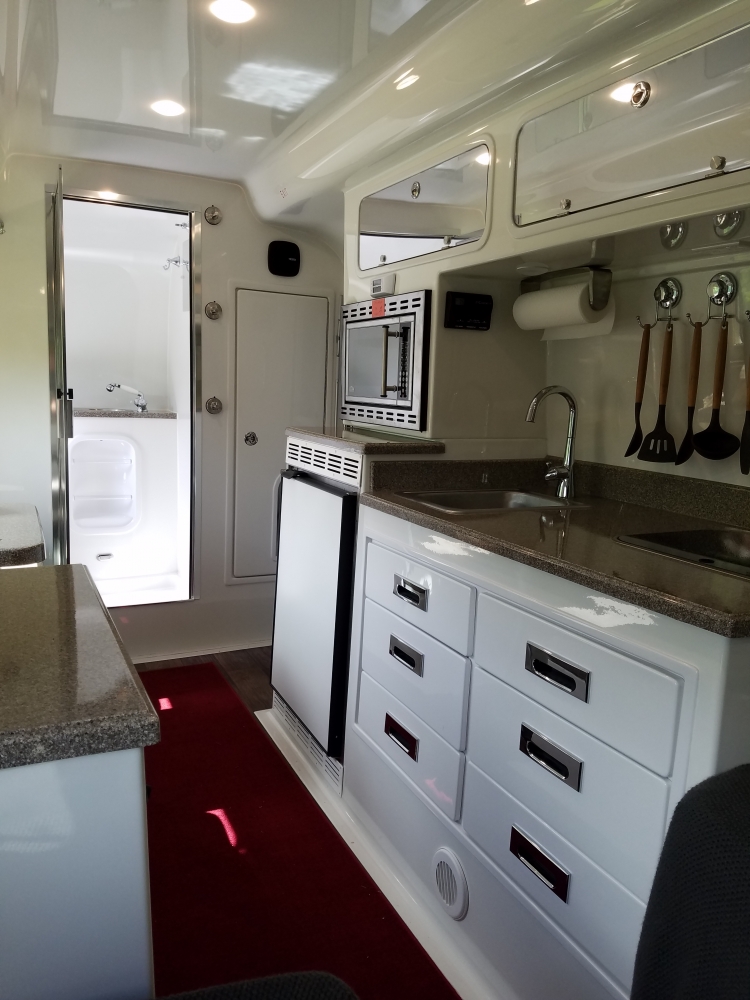
I'm happy to report that I have finally replaced the stock Dometic with a NovaKool 5810. The swap out wasn't too complicated, however getting the Dometic out (the door) proved to be fatal (for it). The 5810 is a larger volume, but smaller footprint, width and depth are almost perfect the height is approx 4" shorter, which is also perfect for the space and my process. Upon removing the old one, I sealed off the two exterior vents and layered 5 sheets of reflectix, to cover the entire exterior wall, I also ran 2 new higher gauge wires for power. The 5810 comes with a 40mm fan mounted directly over the compressor, which is controlled to turn on when it runs, I removed this and replaced it with two quieter high volume fans mounted on top of the unit to draw the air from the rear of the unit. The extra 4 inches of height allow for the unit to be mounted on 2x1" aluminum channels and leave the remaining space at the top, this the fans draw the coolest air in the trailer in the bottom, up the back and exhaust it out the top, this exhaust air is barely even warm, so it does not really add to trailer temp. Performance wise, it is a WORLD of difference. One day I let the trailer cook, inside temp 94° held steady at 38° and 19°, cycling on and off as necessary. Unplugged it for a week to see how it affects the battery, no problem handling it, where it's parked is a late sunrise and early sunset, due to hills and trees, morning voltage 12.8 and bluesky monitor indicating 23 amp hours from full. The temp hold is rock steady, all of this was done with a completely empty fridge, so once there's mass in it it should run less and hold even better. Max indicated current draw is 4.3 amps on the system. Personally, I would consider this a completely worthwhile investment and effort.
 1 point



-
Recent Achievements
-