Leaderboard


.thumb.jpg.780a61c48108d06558e15f745dfe9b5e.jpg)
Popular Content
Showing content with the highest reputation on 01/20/2020 in all areas
-
From pictures I have concluded that the supplied wheels are Ion 71 alloys with machined finish. http://www.thewheelgroup.com/?products=style-71 Is this correct? If so, here is warranty and care information. I don't recall seeing this in the manual. Corrosion is not covered, and is due to what they call "improper care". RECOMMENDED WHEEL CARE Wheels should be cleaned by hand regularly to remove contaminants like road grime, salt, ice/snow melting chemical, dirt, and brake dust. Automatic spray and touch free car washes do not completely remove contaminants, these can cause harm to the finish, hand washing is highly recommended. Many areas of the country use road salts and chemicals during the winter months that can cause adverse effects on your wheels, it is recommended to clean more frequently during this season. Failure to do so may greatly reduce the life of the product. Avoid using automatic car washes, the cleaning agents and brushes used to clean tires can damage the wheel surface. Never wash your wheels when they are still hot from driving. Do not attempt to cool hot wheels with water, this may cause damage to the finish and can warp the brake rotors and/or drums. For PVD and Chrome plated wheels, a simple solution such as car wash soup and water, will keep it clean and maintained when applied regularly. http://www.thewheelgroup.com/warranty/ If you drive through deicers will these pit and corrode immediately? There is no indication that they have a clear coat. I love the look but wonder how they hold up long term. Could those of you with older units, especially those in northern areas, post closeup pictures? How do the wheels stand up to gravel rash? I am seriously considering replacing them with steel wheels that can quickly and easily be refinished with an aerosol wheel paint as they get scarred up.... I would store the originals in pristene condition for a future resale of the trailer. http://www.ebay.com/itm/2-Pack-Trailer-Wheel-Silver-Rims-16-x-6-Modular-Style-6-Lug-On-5-5-/182531823775 BTW steelies are WAY stronger than those Ions: these are rated at 3760 lbs. The Ions have a very low 2200 lb load rating. If one tire on your loaded down Elite II blows, you have immediately severely overloaded the other Ion wheel on that side. Not good! Thanks for your comments. John Davies Spokane WA1 point
-
I'm still a little green having purchased ours in October, but I feel like I've read every thread (although only retained a fraction of the information). Depending on timing and location, I'm happy to meet you when you're picking it up to answer any questions I can. Darren1 point
-
djpinaz - Drop Matt Duncan an email at - mduncan@olivertechnologies.com - I'm sure that he will be able to help you get your hull # plate. Bill1 point
-
Not a problem.... I don’t really care for it here either. I prefer your side of the mountains... which is a big part of us wanting to be able to hook up and get away. Initially, my plans were to sell and leave after I retire, but the grandkids have come (9 in 6years) and grandma is becoming reluctant to leave. I guess she can always come visit me : )1 point
-
Welcome! There sure are a bunch of us here on the Forum that are jealous of how close you are to Hohenwald. Since you are getting your Ollie in April, you will be seasoned veterans by the time the Owner's Rally rolls around in mid May. Certainly you should have a bunch of questions for the presenters at the seminars and for the rest of us around the grounds. It really is a good time in a very nice location. In the meantime - let us know if we can help. Bill1 point
-
Cathy, Carol and I are both native Kansans (Pittsburg and Leavenworth). Carol graduated from Emporia State so we know the area well. This forum is a great resource to help in your decision process. Mike1 point
-
If you really want the "expert" answer, I'd give a call to the Service department - click on the tab at the top of this page. On the other hand - I've used a product called "E-6000" with great results for both interior and exterior problems of this sort. E-6000 can be obtained at Walmart, Ace Hardware, Lowes, Amazon, etc. Make sure that the area is clean, apply E-6000, use painters tape to secure the band while the E-6000 dries. After 12 to 24 hours remove the tape and be on your way. E60001 point
-
I too dropped my pressures to 55 for the 6 1/2 hour drive to the Owner's Rally. No problems on the way west with a bit of rain - pressures stayed within a 10% gain from the cold setting. But, on the way home with air temps approaching 90 and not a cloud in the sky, the pressures in all four tires came very close to the upper temperature limit I had programmed into the TPMS - a 20% gain. Therefore, on my next trip I will increase the cold pressure to 60 in an effort to see if I can slightly decrease this temperature build-up. Bill p.s. Both directions was mainly 4 lane/Interstate driving at 65mph. Elite II with no water is about 5600 lbs.1 point
-
1. I use a 1/2" drive with 6" extension. The extension lets you get the wrench out past the sidewall of the tire. A shorter extension may work but I'd have to check. You want at least 150 lb-ft limit. If you got the socket / lug nut wrench that came with my Ollie, you can use the appropriate sized socket in the kit with the 6 inch extension. There are 3 basic types: 1.) Manual with a dial (least accurate and least precise). Accuracy is important to ensure you are getting the right load on a given lug. Precision is important to ensure the loads are consistent from lug to lug. 2.) Pur mechanical. On these you set the target torque value (make sure you are reading the scale for lb-ft!) As you tighten the bolt you will feel a very distinct "click" when the torque value is reached. 3.) Mechanical electrical have digital readouts. I have type 2 and it works fine. Get a good case to put it in. It is important to protect it from being damaged or knock out of calibration. 2. See attached PDF. Oliver publishes these values. They may be different for different configurations. The site may have some other values. 3. After a wheel change I torque at 20/ 50 and 100 miles. Yes I do stop, get out with my torque wrench and check the lug nuts. I also check when I start out on a trip and usually before I leave the campground for the next site. I don't check every stop however try to do a walk around the trailer and truck at every stop which includes a good look at the lug nuts to see if any are backing off. I have discovered loose lug nuts on my truck by looking. 4. See PDF. I'm sure there are more though. I check the spare tire nut occasionally and the wing nut hold down the propane tanks. I probably should check the jack bolts once or twice a year. 5. Don't use lubricants on the lugs. If you ever have to use liquid wrench or such to get a rusty lug nut off, the lug nut must be thoroughly cleaned of lubricant. If lubricant is on the lug when the torque is set you will over-torque the lug. The torque values are based on the amount of friction between the threads of the nut and the lug. If lubricant is added the friction becomes significantly reduced to reach the torque value. The bolt "yields" or stretches and becomes much weaker. If you over torque a lug, it should be replaced. Not that expensive considering the amount of damage a failure can cause. Hope that helps, - Randy Olliver-LE2-Torque-Specs.pdf1 point
-
When lug nuts are torqued the aluminum creeps under compression of the lug nut. This lowers the torque on the lug nut. Thus the requirement to re-torque a couple of times after an aluminum wheel is reinstalled. I have had multiple instances of both under and over torque on the lug nuts of my cars and trucks. The most recent being last summer when I had my Tundra checked and serviced at the Toyota dealer before heading to TN for my Ollie. About 100 miles into the trip the front end started shimmying real bad. About 1/2 of the lug nuts were loose. Some were not even on finger tight. Now I check the torque whenever I get a vehicle out of the shop. On the trailer coming out of the shop at Oliver I would hope that it wouldn’t be required. However you still need to check and reset torque periodically. - Randy1 point
-
WOW! I'll bet THAT caught your attention! Glad to hear that everyone was OK with the possible exception of nerves. Can you tell us how the Oliver performed given the circumstance - did it sway, did it lurch, did it bounce, did it etc.? How far did you have to tow it after the wheels came off? Did any "parts" hit the pavement other than the hubs? How fast were you traveling? Did anyone stop to help you? ETC., etc. Bill p.s. Where are you? Do you need help? There just might be another Oliver Owner nearby that could offer assistance.1 point
-
Having used a dead weight hitch on a Ram 3500 and an Andersen on my Land Cruiser, I have to say I prefer not using it, but it is necessary for many lighter trucks. I have used a Drawtite WD hitch in the past, and compared to that the Andersen is lovely, light, simple to store and easy enough to use. It still can be a PITA at times. I think it is important to keep the tongue as light as possible (avoid the cargo tray) and use only enough chain tension to stabilize and take away jounce. If you really crank down on the nuts, the system won’t flex. The ball wears weirdly, but all heavily loaded hitches do that. The Andersen ball assembly is a lot more expensive to replace than a $10 ball fro Walmart. The sleeves wear out, if you buy an Andersen be SURE to get the newest version which has improvements. And buy a spare sleeve. I would much prefer to throw mine away, if I could, but unless I downgrade to a HD Detroit truck, that won’t happen. John Davies Spokane WA1 point
-
Trainman - The Andersen is the only WDH that will work with the Olivers without cutting away some of the fiberglass at the front of the camper. where does this problem occur, is it the adjuster, or the hitch" - the answer is YES. Since you have used the "normal" type of WDH you probably are aware that there are times that these hitches can be a bit of a problem. This usually occurs when the camper is at a fairly severe angle to the tow vehicle - the ground is very sloped in one direction or another. When un hitching and then re-hitching the Andersen it is particularly sensitive to having the tow vehicle and the camper in the same alignment for both operations. Most times, this is easy to do - but - there are those times (think rain, you are in a hurry, its dark, etc) when it is not so easy. Andersen changed the design of both the "whale tail" and the hitch ball housing a couple of years ago and the old design is no longer produced. Having used the Andersen for over three years it is my belief that as long as you pay attention to Andersen's instructions for removal and application you will encounter very few problems with their hitch system. On those occasions when it does not cooperate, it helps to stand back for a moment and figure out exactly what the problem it and then correct that problem. In virtually all cases - if you can not figure out what's wrong - you can simply disconnect the chains, drive to level ground and then (using Andersen's instructions) replace the chains and drive off. This is nothing very different from placing the torsion bars on an old style system when one simply can't lift it far enough up to get it in the proper place. I would recommend that you take a look at the Andersen video's on YouTube to get an idea of how their system works: or Bill1 point
-
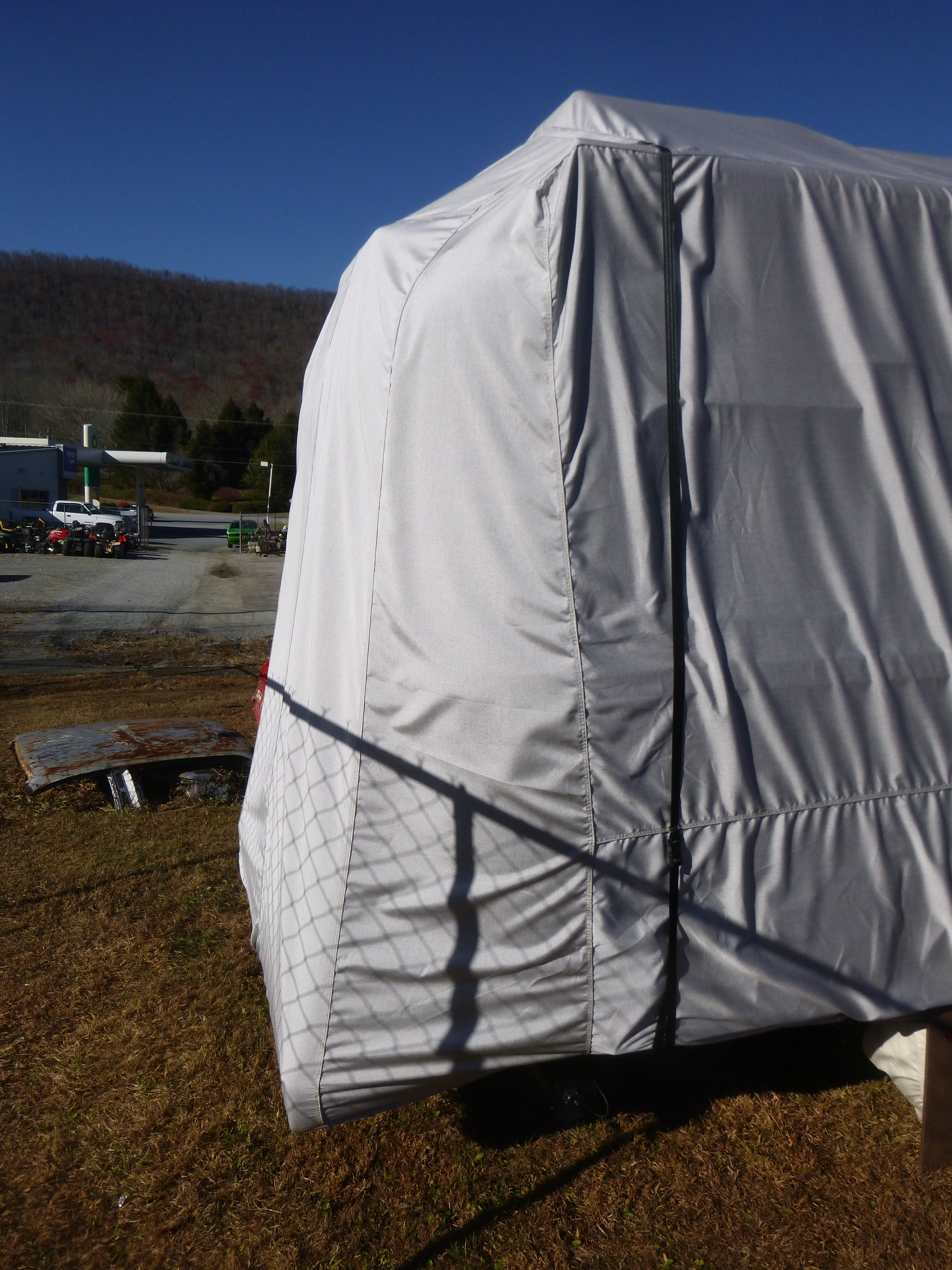
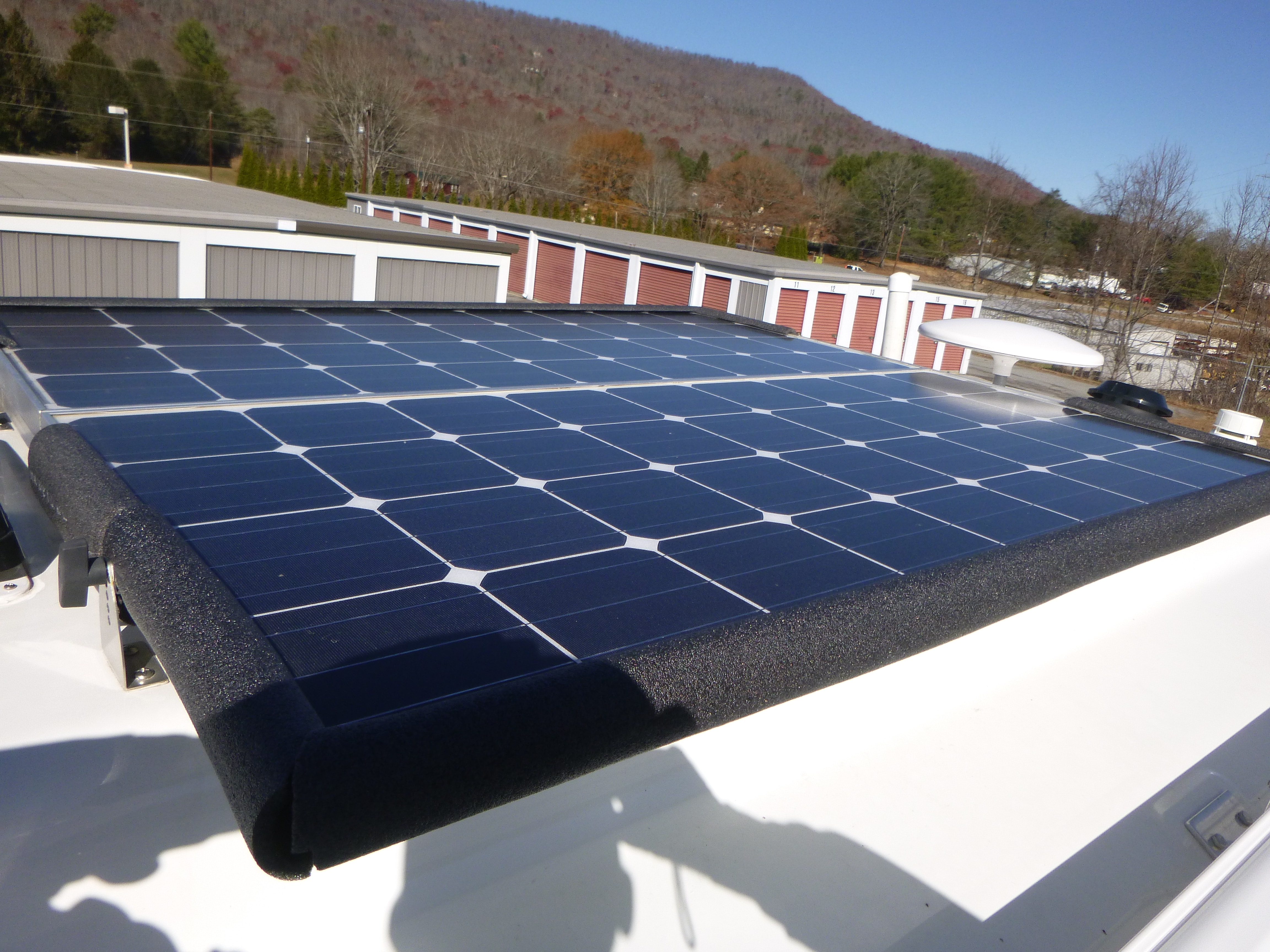
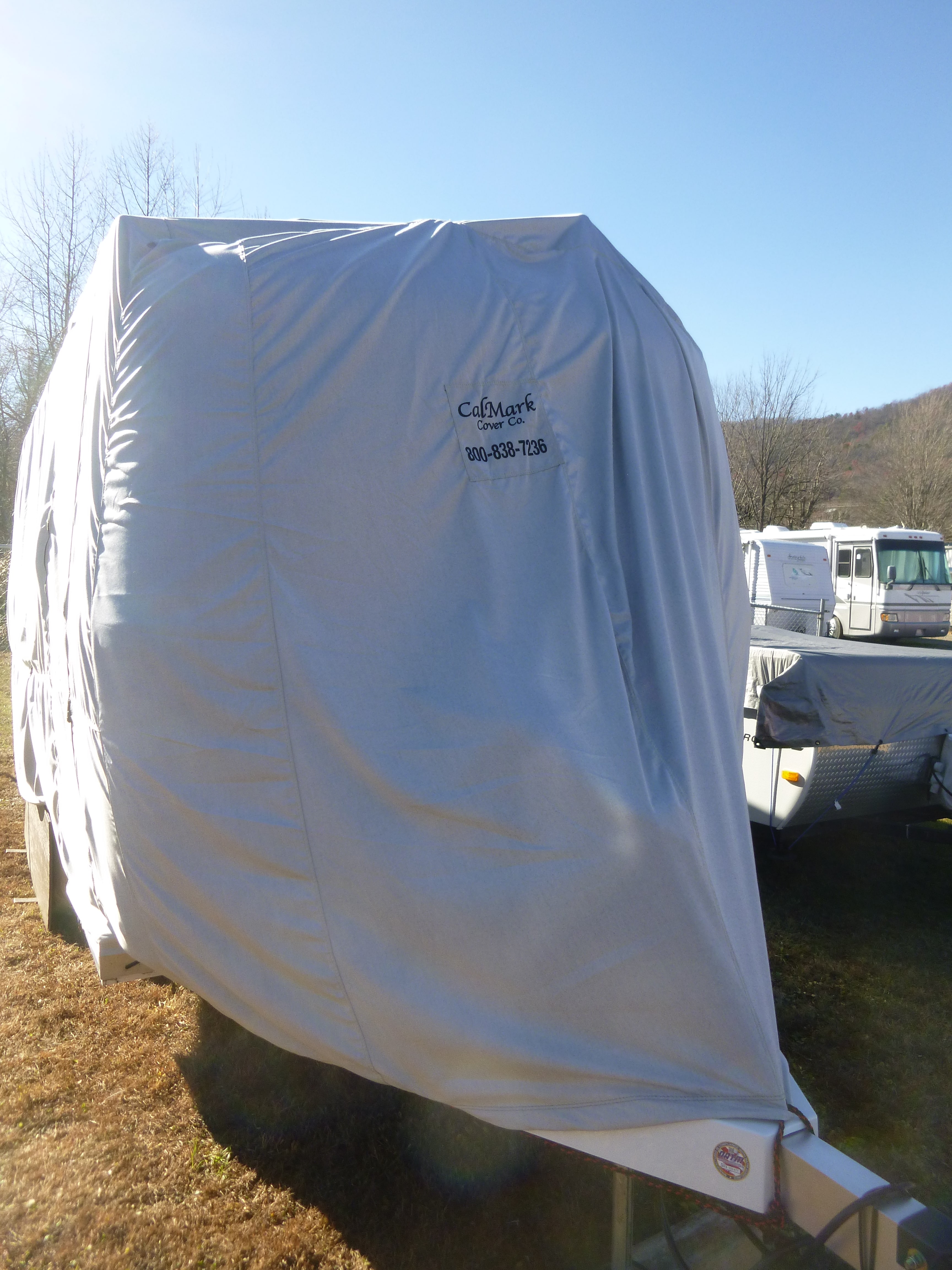
They keep the dimensions on file so ordering one should be simple. However, if they claim to not have them just PM me and I'm sure that I have them around here somewhere. No, the cover is not form fit to the solar panels or antenna or Max-air vent or air conditioner. I use pool noodles on the edges of the solar panels and the bumper to keep them from tearing the cover. Everything else just has the cover draped over it. I do make sure that the camper is a bit high in the front and high on the curb side so that water will run off the cover. Works great - no rips in three years - but they do include some patching material and glue just in case. Both of these pics were taken before I cinched the bottom tight with the included rope in the bottom hem. There are also eyelets in the bottom if you want an even tighter fit and I use these when storing it for the three months of winter. This shows the solar panels with the edges covered with pipe insulation - I've since switched to pool noodles but they fit very much the same way. This shows how the cover fits on the front. It really is not as loose as it might appear and when you cinch it down everything is tight with no rubbing of the cover on the Ollie.
 1 point
 -
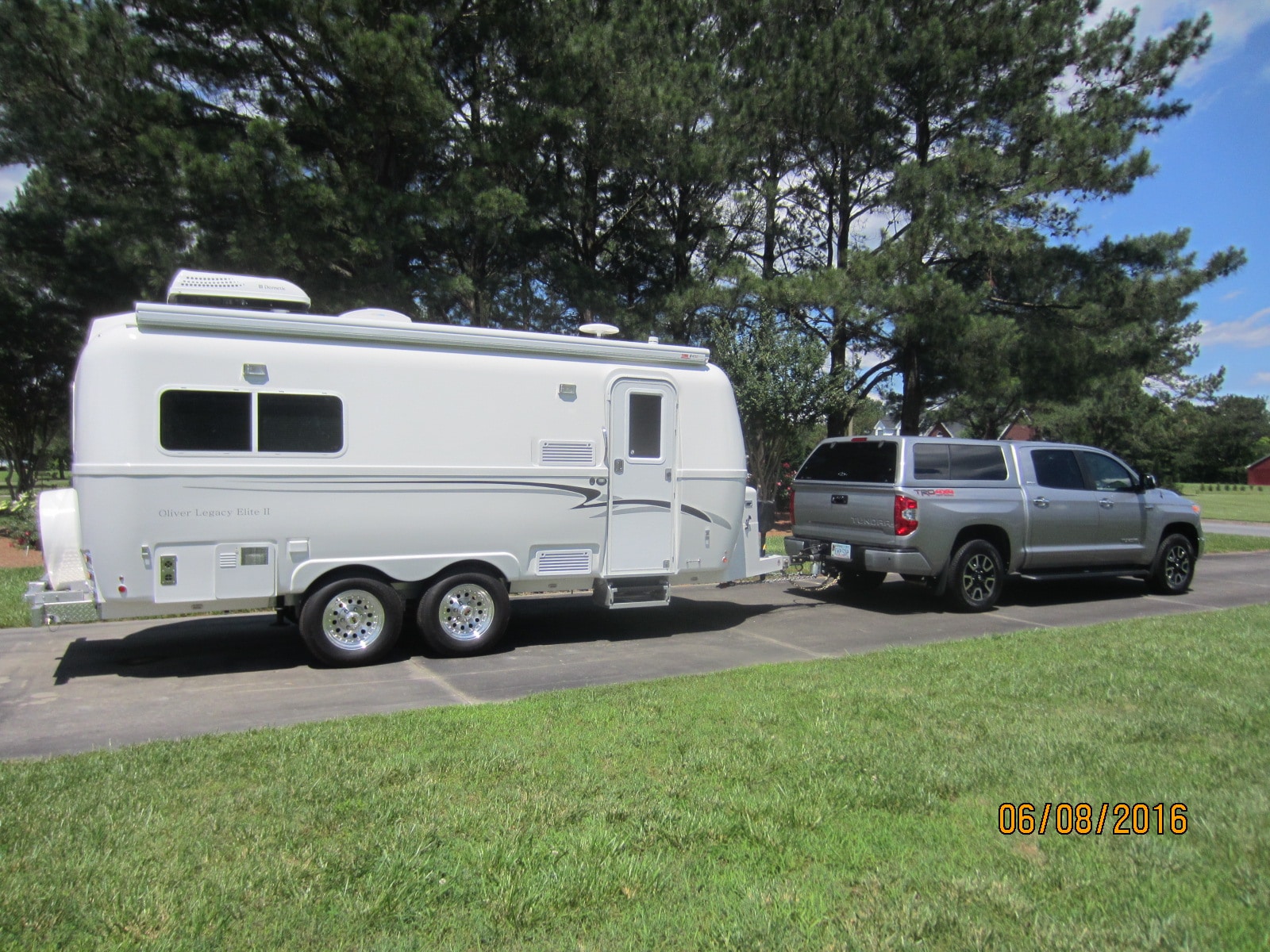
[attachment file=37680] Bill: The 2016 Toyota Tundra truck is an excellent tow vehicle for the Oliver Elite II Travel Trailer. Our Tundra is a 2016 Crew Cab Limited 4x4 and it does an excellent job. Good luck with you new Tundra.
1 point




-
Recent Achievements
-