Leaderboard




Popular Content
Showing content with the highest reputation on 11/26/2025 in Posts
-
I carry pretty much the same roadside kit. I also carry a Dewalt 20V air compressor. GJ4 points
-
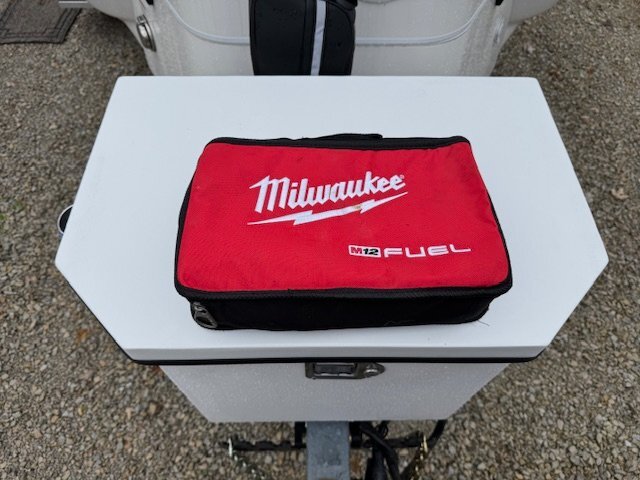
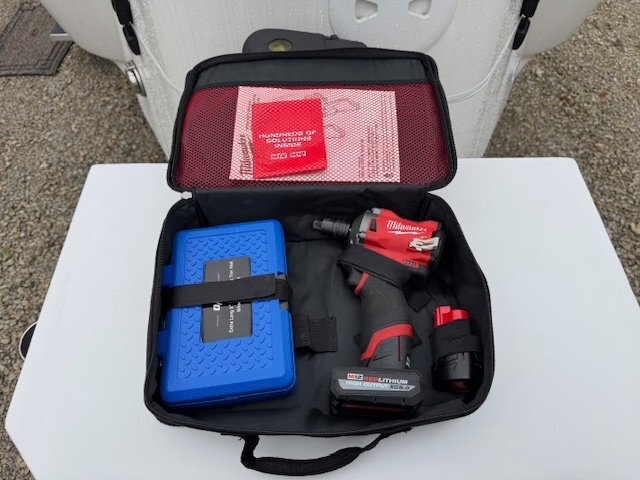
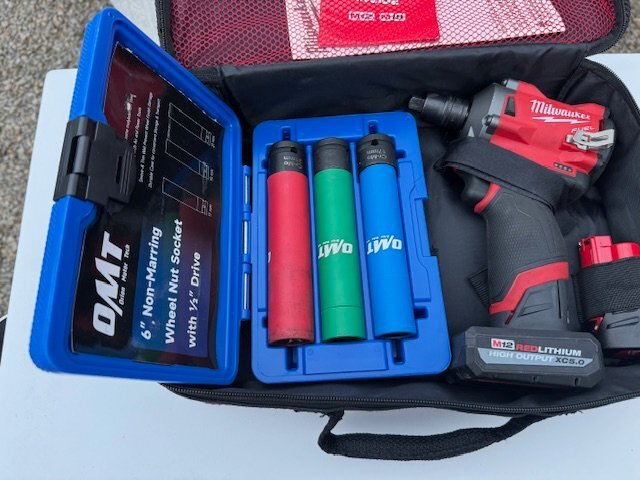
My emergency tire service kit includes the following. The reason I carry these items is they take up little space and stow in an easy access location like under the back seat of the truck or in the front tongue box on the Oliver. The Milwaukee charger is mounted on the side wall of our truck bed for anytime access. With that out of the soft case, the impact socket set fits nicely inside the soft case with the light and impact wrench so everything is together. I like having a tire plug kit along because a screw or nail in the tire is the most common cause and as mentioned earlier is the easiest fix and can be done with wheel still mounted to trailer. All these items fit neatly in a small space and are invaluable for getting you safely back on the road in a tire emergency. The most important thing is to try if possible to do an emergency repair away from traffic on a hard level surface. There are other tools you can have along to do a more thorough repair, but this set of tools will get you back on the road and safely to the closest tire shop if needed. This wrench fully charged has enough charge to remove all four wheels on your truck or trailer. The batteries will stay charged for many months in storage. https://www.homedepot.com/p/Milwaukee-M12-FUEL-12V-Li-Ion-Brushless-Cordless-Stubby-1-2-in-Impact-Wrench-Kit-w-2-5-0Ah-1-2-5-Ah-High-Output-Batteries-2563-22-48-11-2450/337134504 The sockets are extra deep so you won't need an extension even with a torque wrench. If needed you can remove the protective sleeve on the socket to fit the lug nut in the wheel. Three sizes to fit most automotive lug nut sizes. https://www.amazon.com/dp/B0C98ZHKQX?ref_=ppx_hzsearch_conn_dt_b_fed_asin_title_7&th=1 12V Milwaukee work light is indispensable in many ways and uses the same battery as the impact wrench. https://www.amazon.com/dp/B0BRZ31ZFS?ref=ppx_yo2ov_dt_b_fed_asin_title Tire plug kits come in many types and sizes. I personally like the mushroom style plugs. https://www.amazon.com/dp/B0FK4SNRBG?ref=ppx_yo2ov_dt_b_fed_asin_title&th=1
 4 points
 -
Other than adding a device to change 120 volts to 12 volts, as far as I know you will have to put the (or at least one 12 volt battery back into the Ollie in order to get 12 volts to the water pump (or anything else that runs off 12 volts for that matter). As long as it is charged up, basically any old 12 volt battery will work for your purpose. I always have one or two 12 volt AGM batteries laying around in order to use with a small trolling motor I have. This would be more than adequate to power that water pump. Unfortunately, you are in Pittsburgh and I'm in the mountains of western North Carolina. Good luck! Bill3 points
-
Happy Thanksgiving, everyone.3 points
-
Happy Thanksgiving to all! Mike and Carol3 points
-
We wanted to wish everyone here a Safe and Great Thanksgiving! Best Regards, Bill and Debbie2 points
-
Happy Turkey Day. Happy Camping. Hull #1045, Jolli Olli1 point
-
Steve: Thanks for the correction. I updated my post accordingly to "Chrome Plated" steel. Our 2018 OTT rims came with the “bulge acorn” style. Replaced them with the same style as recommended by Frank and by MaxBurner sold by Summit. They have worked very well and my standard sockets work with them. I do use a Dewalt 20V impact to remove and snug up. But for the final three tightening stages by torque wrench. (Retorque in three stages (60, 80 and 95/100 ft-#). GJ1 point
-
Your hull #124 was built before that buss modification was added. All of the early models were fused at the jacks, just like the front jack. You should find an inline fuse in the power wire near the rear jack heads.1 point
-
1 point
-
A point was made in the vid not to run the generator on eco mode.1 point
-
Absolutely! I went to the Oliver Texas rally as wellon the way out to Big Bend.1 point
-
I was lucky, we had a slow leak so we could fill and get home. We went to a truck tire place and they vacuumed out balance beads and installed metal valve stems.1 point
-
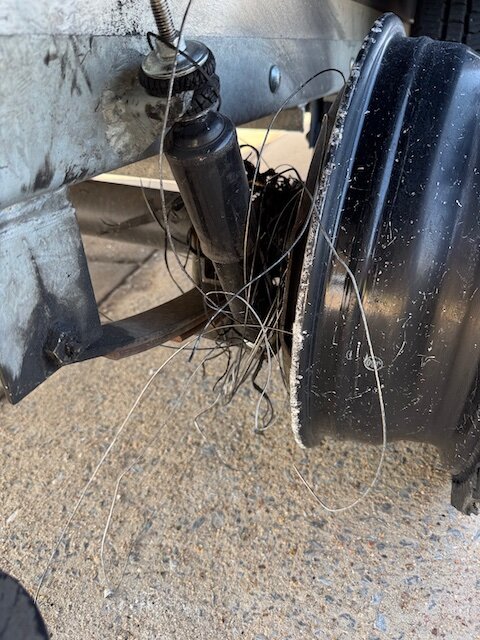
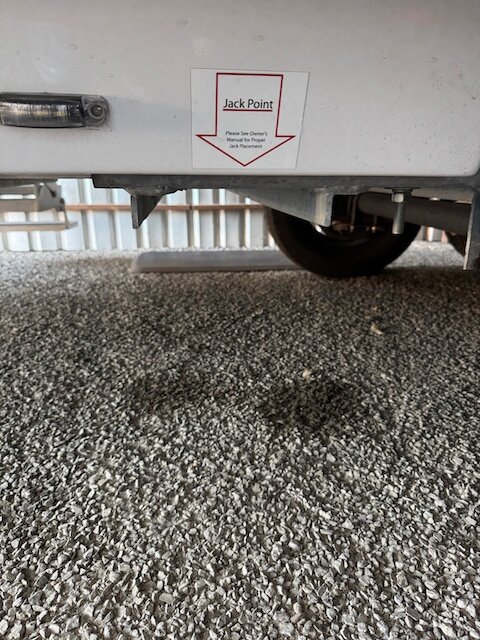
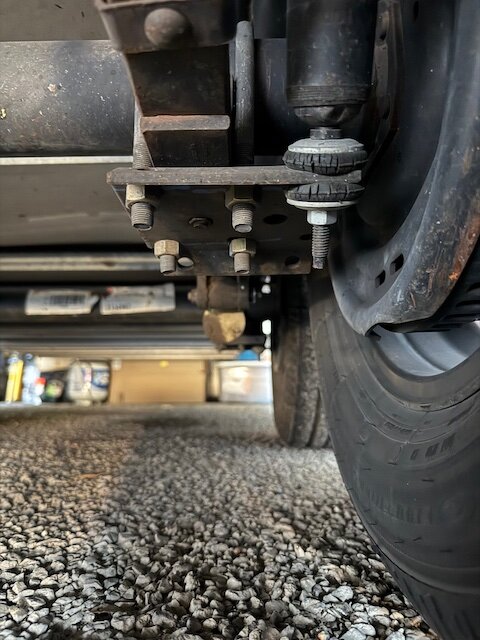
Rob is absolutely correct! Use your onboard Stabilizer Jacks! It's the easiest and safest way to change a tire. Using the labeled "Jack Points" and the trailer weight shifts and then you have other issues. OTT got legal (not engineering) advice on not using the stabilizer jacks. I have posted before what Oliver wrote in the 2017 User Manual, where they detail the tire change procedure using these jacks. I also carry a bottle jack and jack stand, for more major repairs. Hard to imagine any of this on a 3-year-old hull. I expect and have never seen tires self-destruct in less than 7 years, except for China-made ST tires. If you are original owners, I would think about what may have caused or led to these failures (two tires). The steel cable must be the cable from the blown radial tire The shock bushings look awful. Remove one shock to see if it has compression along the full length. My guess is you need 4 new shocks and if I were you, I would be buying four (4) brand new top-of-the-line LT tires, mounted and balanced at a reputable shop. I'd like to ask again re your tire make-model and running tire pressure. Use your TPMS and "see something, hear something, say something!" When you hear any odd noise, get out immediately and inspect all 8 tires, leaf springs, shocks, etc. Look under to see if you're dragging some road debris, then look again. 😎1 point
-
Good grief this is quite a story and horrible experience. Glad you made it through unscathed. May I ask what tires (LT or ST and or brand) you have or had on your Oliver? PSI setting? I can't imagine what would cause so many tire failures in such rapid succession. To answer your questions I suspect you will receive a variety of different answers but I do not carry a jack along and use the built in electric leveling jacks if needed for an emergency. Oliver no longer recommends this but people have been doing it for years. If I were to bring an extra jack it would be a bottle jack stacked on platforms if needed. I have used bottle jacks directly under those plates exactly where the tech used his jack. BTW looking at those rubber grommets on you shocks they seem over tightened and cracking pretty bad. Might want to consider replacing those too. I have an impact wrench which makes for quick work with tire and wheel work but have never carried it along on trips, though I have thought about it for this very reason. Perhaps I should reconsider this. Good luck getting this all figured out.1 point
-
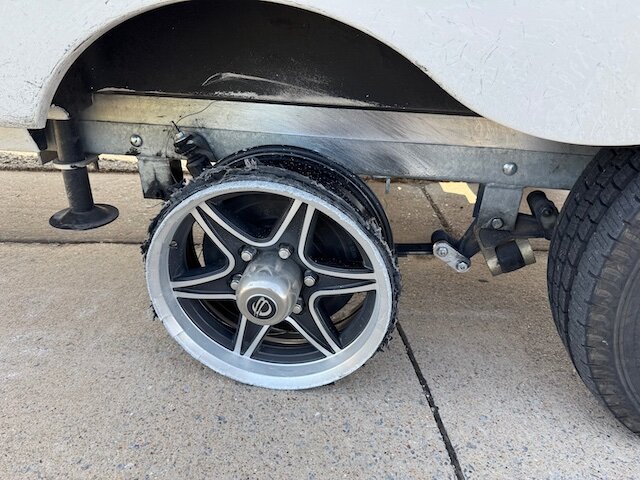
On our last trip, we had significant tire issues (we replaced two tires, one valve stem, and one wheel), so I wanted to share a little of what we experienced and hope to hear from others on ways to make the next time easier. What happened: Entering Wichita Falls, TX on US-281 from the south driving around 60-70 mph, we heard an unfamiliar noise that we couldn't place or locate. The noise would come and go. Five miles later we exited the freeway onto the frontage road, stopped on the shoulder, and hopped out to make sure everything was alright. It wasn't. The right (curbside) rear (RR) tire was gone. Its wheel was an aluminum nub. Some thoughts: Our LE2 handled fine. I think the weight distribution hitch/anti-sway really helped. The noise coming and going was due to us driving near concrete barriers on the side of the road that reflected the noise back to us, such as on a bridge. When we were on straight road, we couldn't hear or feel anything. We were lucky. No damage other than scratched gel coat. There was a considerable amount of steel cable wrapped around the axle and brake area. Taking the tire off: The first task was to get the trailer "jacked up". We pulled forward onto our Andersen Rapid Jack to elevate the right, front (RF) tire. This worked well until the RF tire went flat also. In addition, taking the weight of the trailer off the RR wheel made it more difficult to remove the lug nuts. Fortunately, a passerby stopped to help us and had a powerful impact wrench and an extender since the lug nuts are recessed quite a bit and the center dome got in the way of the wrench. Also, my personal wire cutters were no match for the steel cables. We needed heavy-duty snips to remove all the cables. It was apparent that we were not fully prepared for this situation, so we called a mobile RV repair person. He ended up using a low-profile hydraulic jack to hold up the trailer. Some thoughts: If we had simply run over a nail, we would have been fine. The Rapid Jack would have been all we needed. I have to upgrade my wire snips and am struggling with choosing a hydraulic jack. A low-profile jack is bulky and heavy, can get into places with low clearance/uneven terrain, and has extended lift range. Bottle jacks are smaller and lighter, but have more limited lift range. Any thoughts on what you use? Where to place the jack? The trailer has a jack point for the frame, but, rightly or wrongly, the repair guy put his jack behind the wheel near where the bolts are in the photo below. Getting to our spare: This wasn't a big deal. We do have the rear bumper receiver but it slid out easily. I was glad that the spare had good pressure since I hadn't checked it in about a year. Some thoughts: Check your spare. I had even installed a tire valve extension (something like this) to make it easier to check and fill. Put this task on a checklist to do periodically. Putting a good tire on: A full light truck tire is bigger and heavier than a passenger tire. Also, a full tire has a larger radius than a flat tire which means the tire may need more clearance. Changing it on uneven ground introduces clearance issues if the axle is not up high enough. Since we had lost our tire, once we put the new one on, we spun the tire and checked for brake operation. We found a 3 second delay from the pedal push to the application of the brake on the wheel. This caused us some concern at the time, but both our technician and myself confirmed that the delay was due to the truck's brake controller. It's probably obvious, but put the wheel on and hand-tighten the lug nuts with the wheel off the ground and then tighten the lug nuts to the proper torque (we did have a torsion bar) when the wheel is on the ground and won't spin freely. Some thoughts: If you are going to check your trailer brake while the wheel is jacked up, use the manual control on your brake controller, not the floor brake pedal. A second tire went flat: Our hearts sank as we watched the RF tire lose pressure as the RR tire was replaced. We only had one spare. The technician's fix was to pull out a can of fix-a-flat and refill the tire with air. It was enough. Again, we were fortunate to have pulled off the road 2 miles from a great RV park, so we headed over with the technician following us to ensure we arrived safely. Some thoughts: Carry a can of fix-a-flat. Purchasing tires on a trip: The next morning the tire "repaired" with the fix-a flat was flat again. This time we refilled the tire ourselves and drove the trailer to a Discount Tire for a replacement. This store had a limited selection so we only replaced the one bad tire and risked driving to our destination one hour away with no spare. Before leaving, the store manager offered to "top off" all our tires. In the process of putting in air on the left (street) side tires, the TPMS sensors were very difficult to remove. To make a long story short, they were finally removed, the tires topped off, and we were off to our destination (Lawton, OK). Upon arriving in our campsite, a camper remarked that one of our left tires was low. It was flat. We don't know for how much of our hour-long drive it was flat. The next day I brought that tire into a Lawton Discount Tire where they replaced the damaged valve stem and I bought the only compatible wheel they had and a spare tire. Some thoughts: Fix-a-flat works for emergencies, but only to the nearest tire shop. Although limited by the store's available tire selection, it will be a cold day in hell before I ever drive the trailer again without a spare tire available. Lessons Learned: As we pulled away from home, all four of our trailers' tires had TPMS sensors on them. I never pulled out and turned on the monitor. It might not have prevented the blowout (or whatever it was that happened), but the alarm would have told us that there was a problem and we would have pulled over much earlier, reducing risk to ourselves and damage to the trailer. I thought I was prepared for tire issues. In fact, I was only prepared for the simplest, most basic scenario. The next time we go out, we'll have a few more tools. I'm interested to hear from you what's in your tire changing tool kit. Open issues: Still trying to figure out which type of hydraulic jack to bring with us. I'd appreciate your thoughts. Still trying to figure out the correct jack point. I'd appreciate your thoughts on this as well. We hope this has been helpful to some and interesting to others. Let us know your thoughts.
0 points









-
Recent Achievements
-