Leaderboard




Popular Content
Showing content with the highest reputation on 07/15/2018 in all areas
-
I wouldn’t worry too much about the drone of a generator. With the AC on you could have a diesel locomotive idling next to you and you wouldn’t hear it.2 points
-
Hi everyone, Judy and I enjoyed meeting many of you at the rally. Thanks for all the tips. We really enjoyed the decorating competition. We finally got our act together and placed our order the 15th of May for a September 20 delivery and we can't wait. Our plan is to enjoy the fall weather on the east coast and then head to Arizona for the winter. See you on the road, Ken1 point
-
I appreciate the input that I received on my question on concerning WDH. It caused me to do some additional research on GMC 2500 trucks. It appears that they have a system called Stabilitrak with Trailer Sway Control. I Again, thanks very much on the input! It is appreciated!1 point
-
Wondering (wandering off topic again) :) if other compact and 1/2 ton pickup truck operator's manuals also state when towing anything over 2000 pounds, a sway device is required? The 2016 5.7L Tundra and our 2003 2.4L Tacoma operator's manuals both state this. This can impact towing many trailers under 5000 pounds, too. Tom, Agree, always check with manufacturer to learn if the electronic Sway Control is compatible with tow vehicle being used. John, Here's what Hayes website states: "Upon detection of sway, unit provides simultaneous braking to all trailer brakes on 1 to 4 axle trailers"1 point
-
We use the Andersen hitch on our Elite II and like it. We tow with a GMC Yukon, so the springs are soft and the ride comfortable. I tried and continue to use a center mount method for installing the chain anchors onto the center spar of the trailer, which I think is better than the factory install. Easier to adjust the chains, mounted to the strongest piece of aluminum in the frame, and with a fair lead angle. My install is buried somewhere in an old thread. John Davies has also used this mounting method, and done and posted a much better description and set of pictures. We picked up our Ollie before installing the Andersen hitch. So, we had the experience of a comparison (albeit a statistically invalid sample of one). The trailer imparts less “bounce” and side-to-side tug to the back end of the Yukon with the hitch installed. We never experienced sway with or without the hitch, but take comfort that the friction cone is bleeding energy out of any developing sway situation. I fully load up the chains and believe that the extra weight on the front wheels of the Yukon ensures solid steering in bouncy situations where they might otherwise unweight. Like anything that requires care and attention, there is a learning curve in hooking up with the Andersen hitch. But after a few times you get the hang of it and the hookup is easy. I think the folks who tow with heavy full size pickups are right (for them) when they say the Anderson hitch isn’t really necessary. And the Ollie Elite II certainly has a reputation for being well mannered when being towed. But for we lesser mortals, with vehicles closer to the limit, it is a nice bit of comfort. Best regards, John Shkor, SailorsAshore1 point
-
We just upgraded from a Tundra to a GMC 2500 for increased payload capacity. I wanted to get rid of our tonneau cover and get a topper for the bed (so we can haul more stuff we will probably never use ?). We were already slightly over the GVWR of the Tundra when loaded for long trips. I have used the Anderdson on both trucks and well as our previous camper (Escape that had a heavier tongue weight). I use it more to smooth out the ride then for weight distribution. I feel it is a more comfortable ride with less bounce/bobbing between the truck and trailer. There is a little learning curve to the Anderson but its really no big deal once you understand how it works. If your not straight backing up to it you can just loosen the chains then retighten after you get straighten out. There is also a trick of backing up a little past the hitch without hooking up then connecting the whale tail then pulling forward and hitching. I dont believe any other WD will work with the Oliver because of the length of the chains and where they attach to the frame. Be careful with add on electric sway devices if your truck has electric sway control built in. Our truck warns not to use them. Just my 2 cents and everyone has there own comfort level of how they perfer to tow.1 point
-
We're towing with the 2016 5.7L 4X4 Tundra double cab and it works well as a TV for the E2. The Tundra's operators manual requires a sway device when towing any trailer over 2000 pounds. The manual also requires a WDH when towing trailers 5000 pounds or more. We keep Ollie's weight under 5000 pounds, ready to camp weight of 4920 pounds, with empty water tanks. Our Ollie is not equipped with solar panels and only has two 12V AGM batteries. We transport gear in the TV keeping Ollie's weight low and Tundra's weight under 7100 GVW with Ollie connected. When Ollie is connected to the Tundra there is still more weight on the front axle compared to the rear axle. All weights verified by CAT scales. Many E2s here probably weigh in over 5000 or 6000 pounds at ready to camp weights. We use an electronic sway control without WDH. The Hayes Sway Control detected and applied trailer brakes in two sway event situations (that I'm aware of) when I was towing down a mountain too fast in both cases and the Sway Control applied trailer brakes half way through the curves, I had not detected the sway. It's an interesting sensation towing when the trailer brakes are automatically applied, but thankful I had the sway control installed.1 point
-
Having the ability to run the AC off batteries isn't a total waste of effort though. You might not be able to run it all day and night (unless you fill your closet with batteries), but being able to run it for 15-30 minutes can be really useful for cooling the trailer off at a lunch stop or before bedtime if the outside temp hasn't fallen enough yet to sleep comfortably.1 point
-
The curent is reduced as the batteries come up to full charge. I'm discovering that new vehicles have smart charging technologies in their charging systems. Mine does too. After sitting for the night, it comes up to 14 volts to make up for the power drawn to start the engine. Then it goes to "float" like a smart charger and drops back to 13 volts. It will carry additional loads as needed by upping the amps from th ealternator. The same scheme is used in the Oliver battery chargers. Full power to the batteries for a bulk charge. When 14 volts is reached it begine to reduce the amps, to hold that voltage, until a set low point is reached. This is typically about 5 amps. Then it drops into float charge where the maintanance vottage is about 13.1 volts. If additional loads come on, the amperage is ramped up to carry them, but th evoltage ramins at about 13,1. Cars used to always hold at about 14.1 volts while running. Fortunatly cars don't run 24/7 so the batteries would not boil out from continuous overcharging. That voltage was also high enough to prevent sulfating. The three phases currently used by battery chargers and smart car regualtors are: Bulk, absorption and float. this is the best way to make lead acid batteries last. I tried running my AC off an inverter while charging the truck batteries. Remember, this is not the built in inverter in the trailer, but one I carry for other uses in the truck. It's a 3000 watt unit. Inverters seem to be able to double their output for short periods to statr motors. I simply plugged the trailer into the inverter with the shore tie cord. The truck was idling. The trailer batteries were already fully charged. I turned on the AC and it did start, but it was slow to start and I was afraid it might not work on the next cycle, so I shut it off. I wish I had an Easy-Start as that probably would have made the difference. My wiring was sub-par too as the inverter was connected with jumper cables. So, the method is not fully vetted, but, I think, viable. The key is that the starting load is much greater then the running load. So the batteries can get me through the starting load and then be replenished during the running phase, to start again on the next cycle. The AC, as a normal function goes off and on as it does it's job. The generator or the inverter must provide enough amperage to start the compressor, and that is where we are all asking for just about all we can get without going to a very heavy generator.1 point
-
Jeff, Best thing to do is call easy-Start and give them the details of what you want to do. Can't remember his name, but one of the engineers from easy-Start was at the rally in Guntersville and he really knows his stuff. He installed a bunch of then there and all went well. Remember too, that all engines lose about 3% of their power per 1000 ft elevation. It's something else to factor in. Running the genny at 5,000 ft will mean about 15% less output than at sea level. There may be a further loss of power due to running it on propane. Tell them how high you want to be able to camp and run the AC, which genny you have, that it runs on propane and the AC model you have. They'll give you the right answer and help figure out how to get it installed. It seems he was doing them in about 1/2 hour plus some programming. The hardest part was getting up on the roof and opening up the AC. Then it was a simple matter of sticking on the controller (literally, it's a sticky back box) and plugging it in. Then he and the owner would test it out. The easy-Start learns about the load over about 5 starts. I talked to him at length and watched the power draw on his meter, but I did not get one. While matching the starting load to the generator, the Easy-Start delivers a lower peek load over a longer time time and watches the motor RPM while doing it to be sure the motor is coming up to speed. This allows a smaller generator to start a larger Load, I've recently started charging my trailer batteries with jumper cables from the truck when we are out for some days without a shore tie. I also have a 3000 watt inverter that I am thinking of installing. It can handle about 6000 watts of starting current. So, I'm thinking that I could run the AC off the inverter and charge the batteries from the truck while doing it. The truck alternator puts out somewhere around 180 amps which is over 2000 watts. This way I would not have to carry the generator at all, or fuel for it. I recently got a flat tire about 80 miles from the nearest services and simply connected the inverter to my truck battery. Then I was able to run my compressor and fill it back up after I plugged it. So why not just connect the inverter and use the truck as my shore tie? Plug the trailer into the truck inverter and act like I'm plugged into shore power. This may work fine and I plan to test it on out next trip comming up this weekend. It would simply mean idling the truck instead of running a generator. No significant altitude power loss, no extra fuel to carry, no generator to carry and probably less noise as the truck is quieter than the generator and a much more relaxing sound. If there is any extra power available, it will charge the batteries some in the process. I'll let you know how the test goes. BTW, if you decide to add a quick disconnect, look at my thread: "modifications to hull 92" and see how I did it on mine. It was very simple and done up at the bottles. No drilling or long hoses. I added a shut off in front of it too, in case the quick fitting starts to leak. Then th ehose is connected through an 8" deck plate in front of th epropan cover. Love it! I have 30 feet of hose to run the outside stove over at the picnic table or run the propane fire pit up to 30 feet away from the trailer.1 point
-
I've found this product and just beginning to research it. https://rvpetsafety.com1 point
-
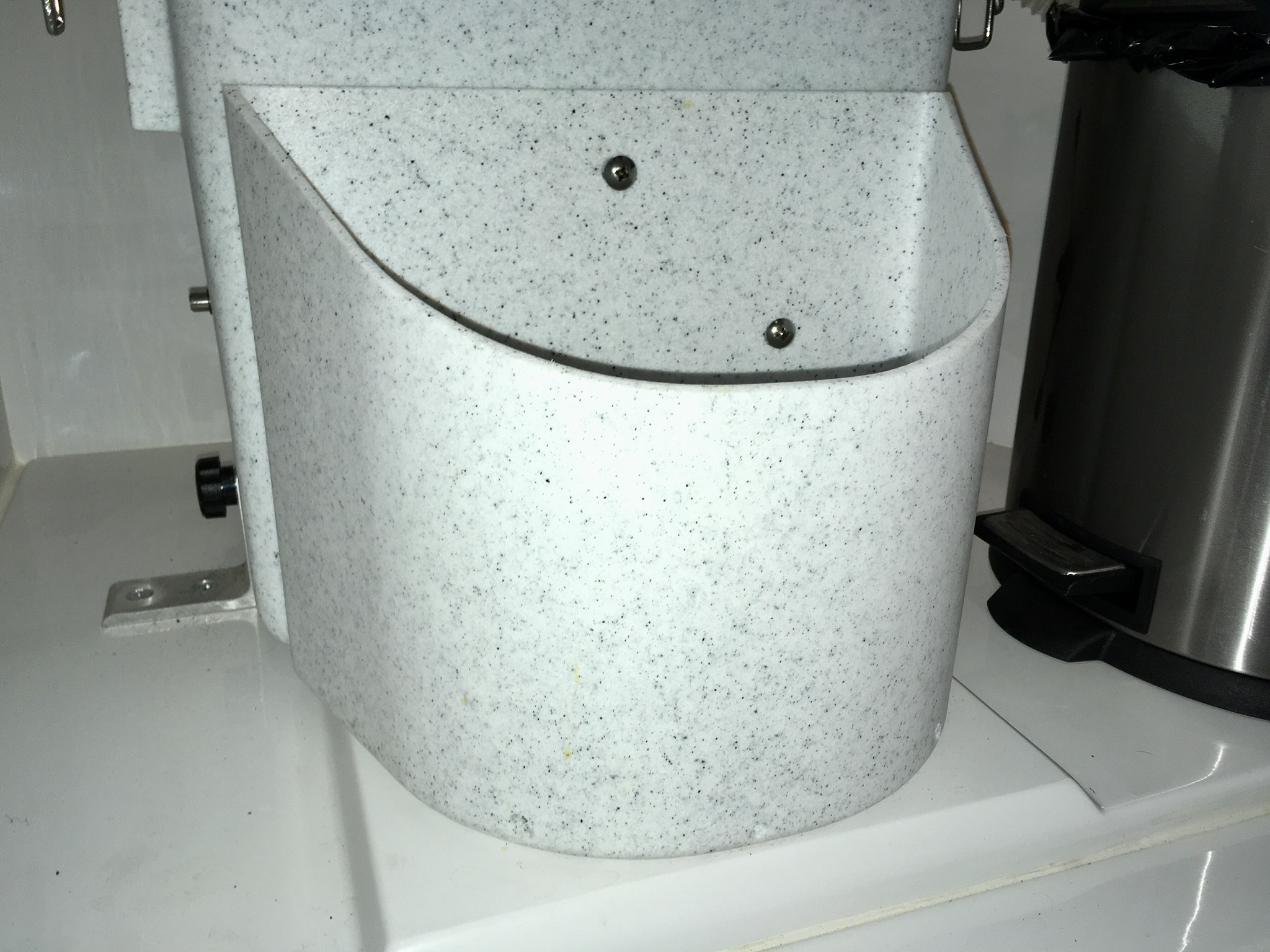
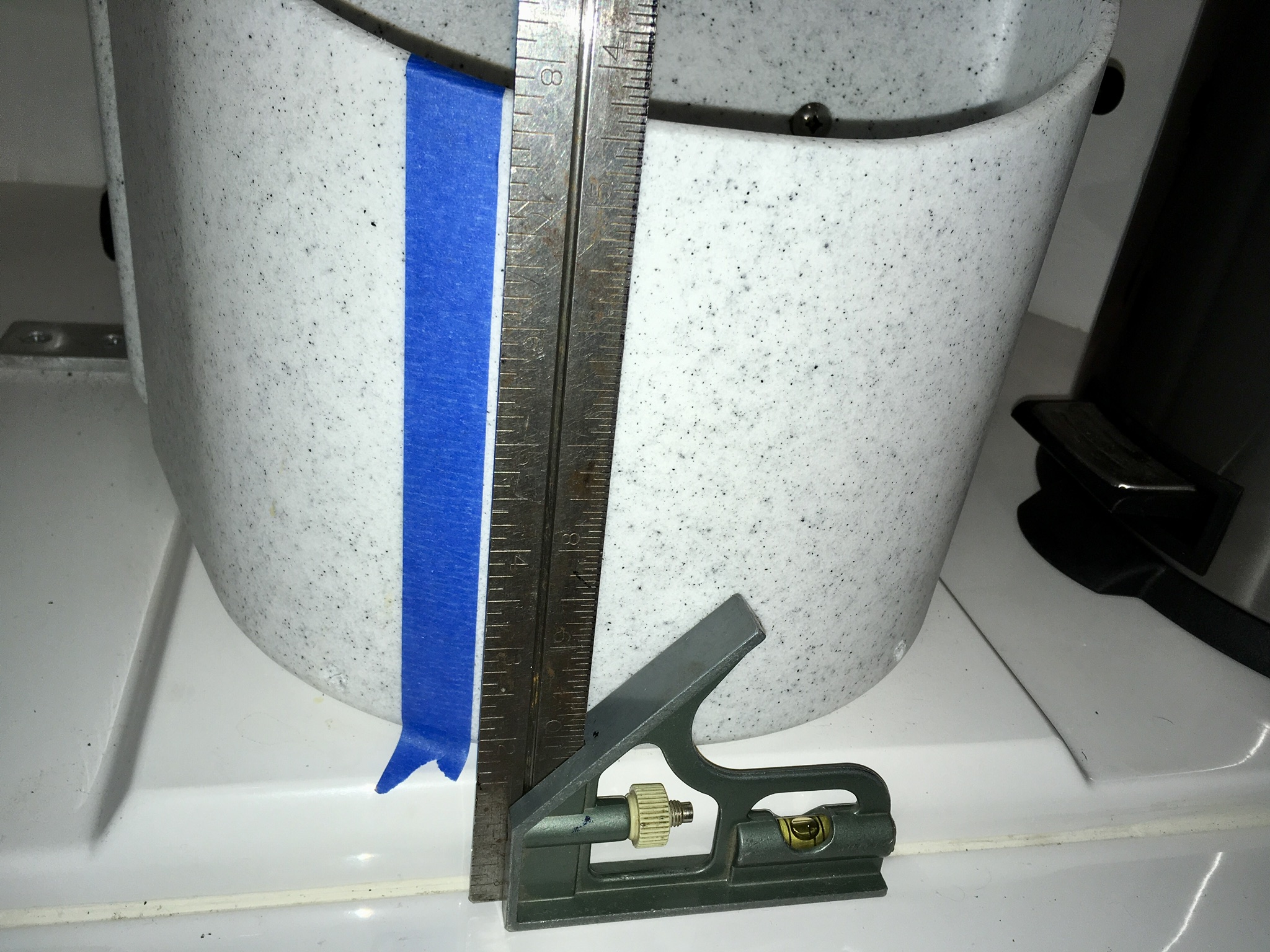
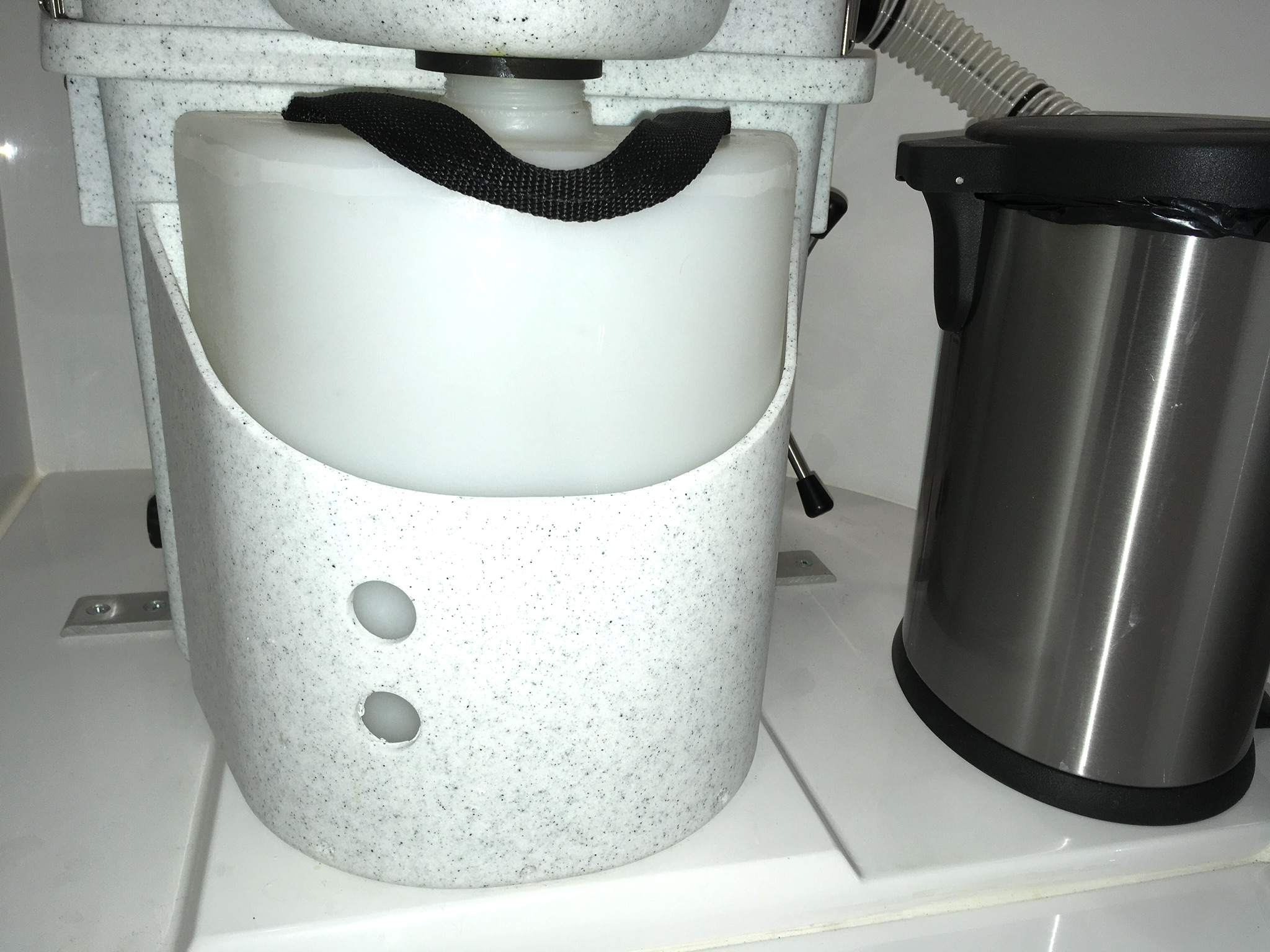
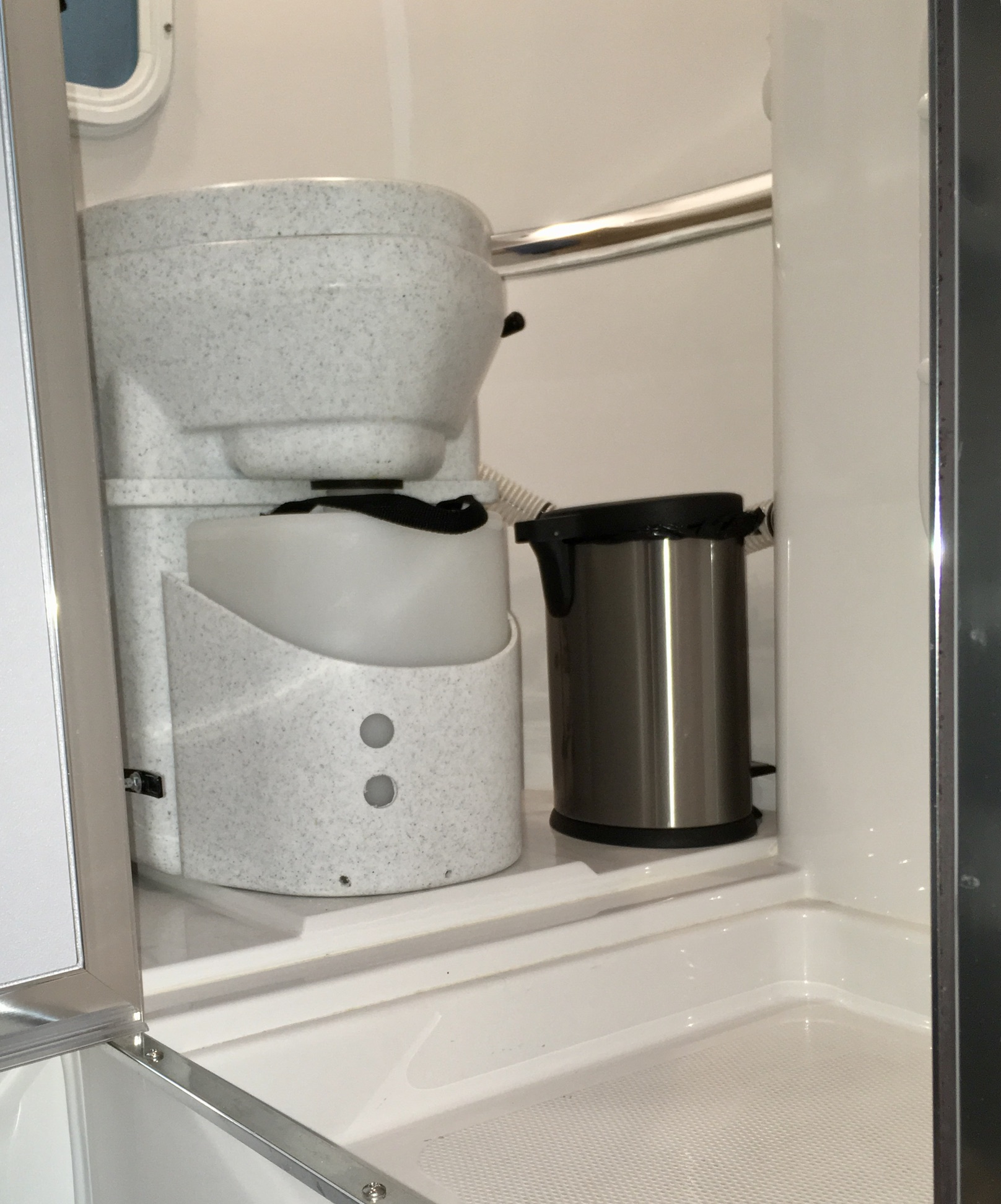
Update. Added large sight holes in the receptacle for the pee bottle, visible from standing outside the entry, so I do not get surprised. With two or three adults using it full time the level goes up pretty fast, full in maybe three days (depending on how hydrated your users are!) Set a vertical tape guideline, do not eyeball it or it will be crooked. Drill a couple of 1 inch holes evenly spaced. I used a step drill and it went through the plastic like butter and left pretty holes. View from outside (also notice the small weep holes at the bottom for shower water to drain): I will see how it works next trip and report back. Daylight should illuminate the transluscent pee tank and the “contents” should show up in the holes. Maybe.... I hope. John Davies SpokaneWA
 1 point
 -
The manufacturer of the on-board jacks does NOT recommend using the jacks to lift the weight of the trailer even as a temporary use for changing a tire. New model trailers have an extended steel sub-frame assembly that provides ample room for a jack point either in front or behind the tire that needs to be changed. Older models may not have enough room on the steel sub-frame to use a lifting jack(scissor jack or bottle jack). If this is the case you will simply locate the main frame rail point closest to the tire that needs to be lifted and use a lift pad that will help to distribute the weight. Owner’s manuals may state different things as changes occur every year in the RV industry. There are several reasons why these changes might occur from year to year or even in the middle of a production cycle. Sometimes new industry standards/codes are introduced and changes have to occur to meet these new standards. Sometimes components are discontinued and replaced with a new model that may not work just like the previous model. Sometimes companies simply make a decision change within the company to market their product differently. These are just a few of the reasons that change happens and why your owner’s manuals may be different. Product information is provided by the manufacturer of the component and is available online in the Oliver University section. Oliver strives to provide accurate information to every customer. The product information on components not manufactured by Oliver is dependent on the manufacturer or supplier supplying us with the correct information and as such may not always be 100% accurate.1 point






-
Recent Achievements
-