Leaderboard




Popular Content
Showing content with the highest reputation on 07/15/2022 in all areas
-
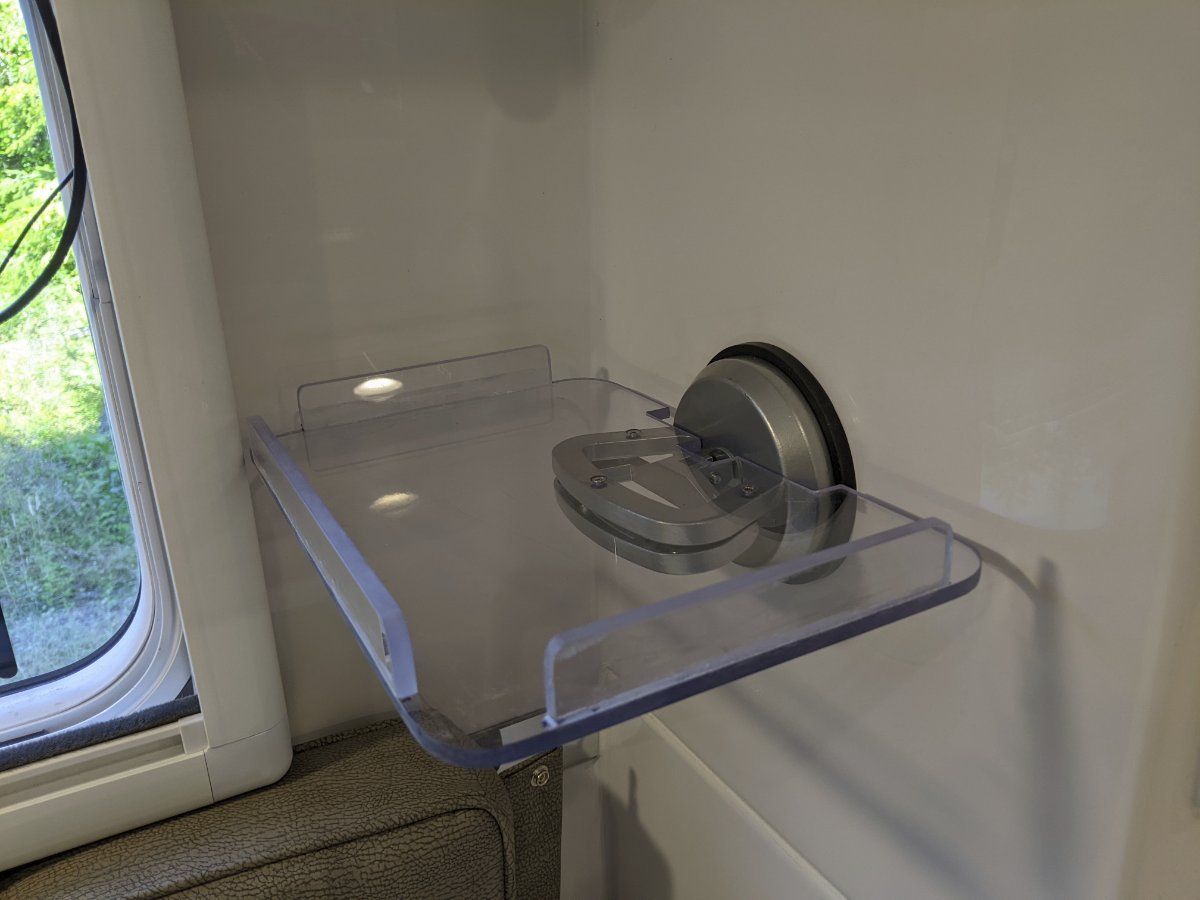
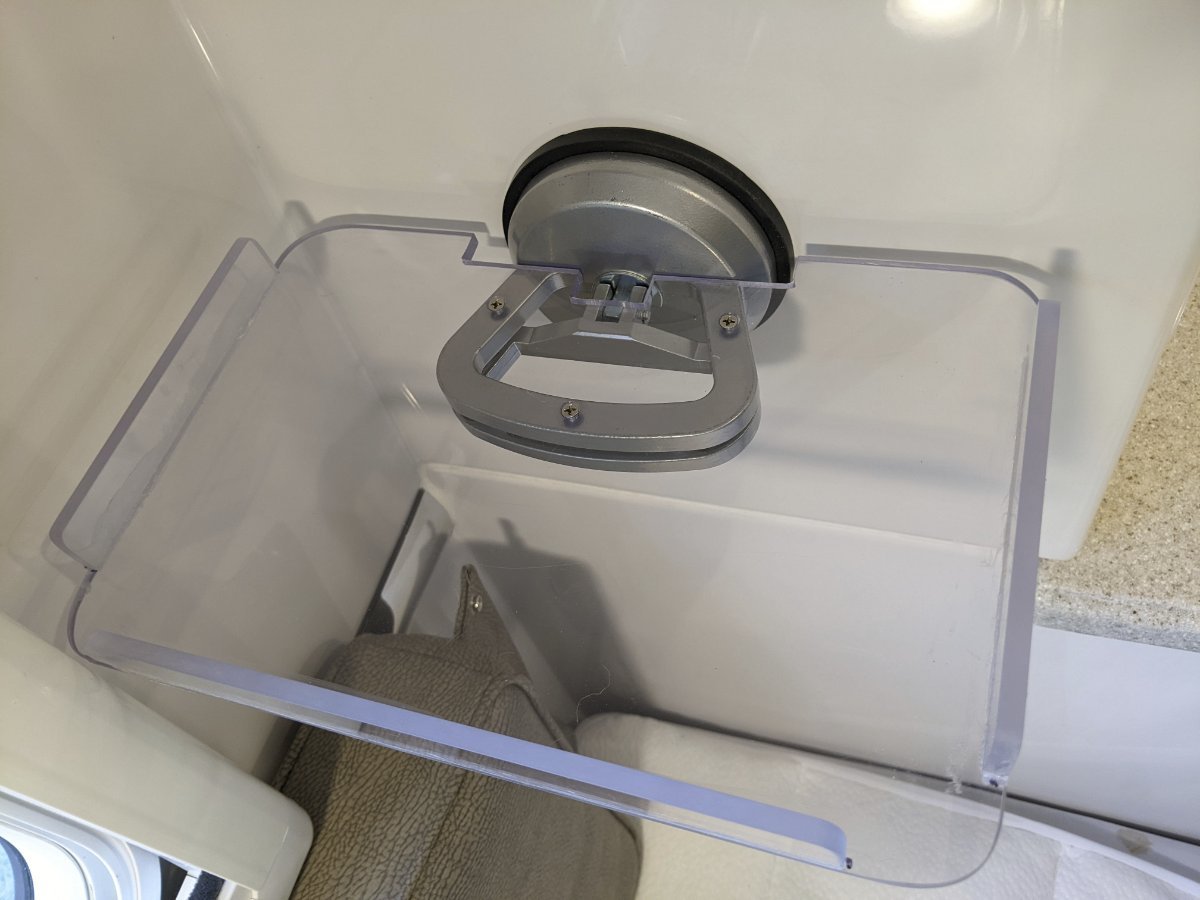
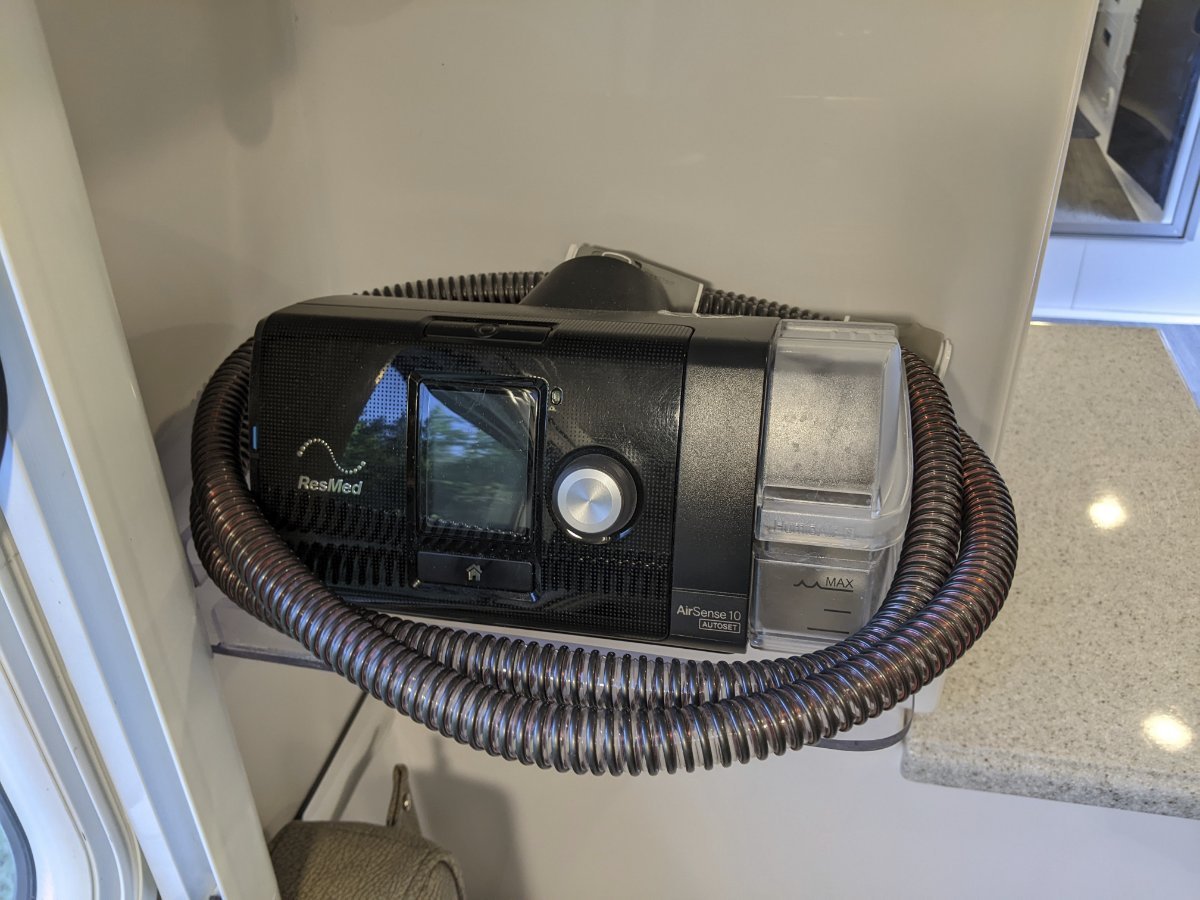
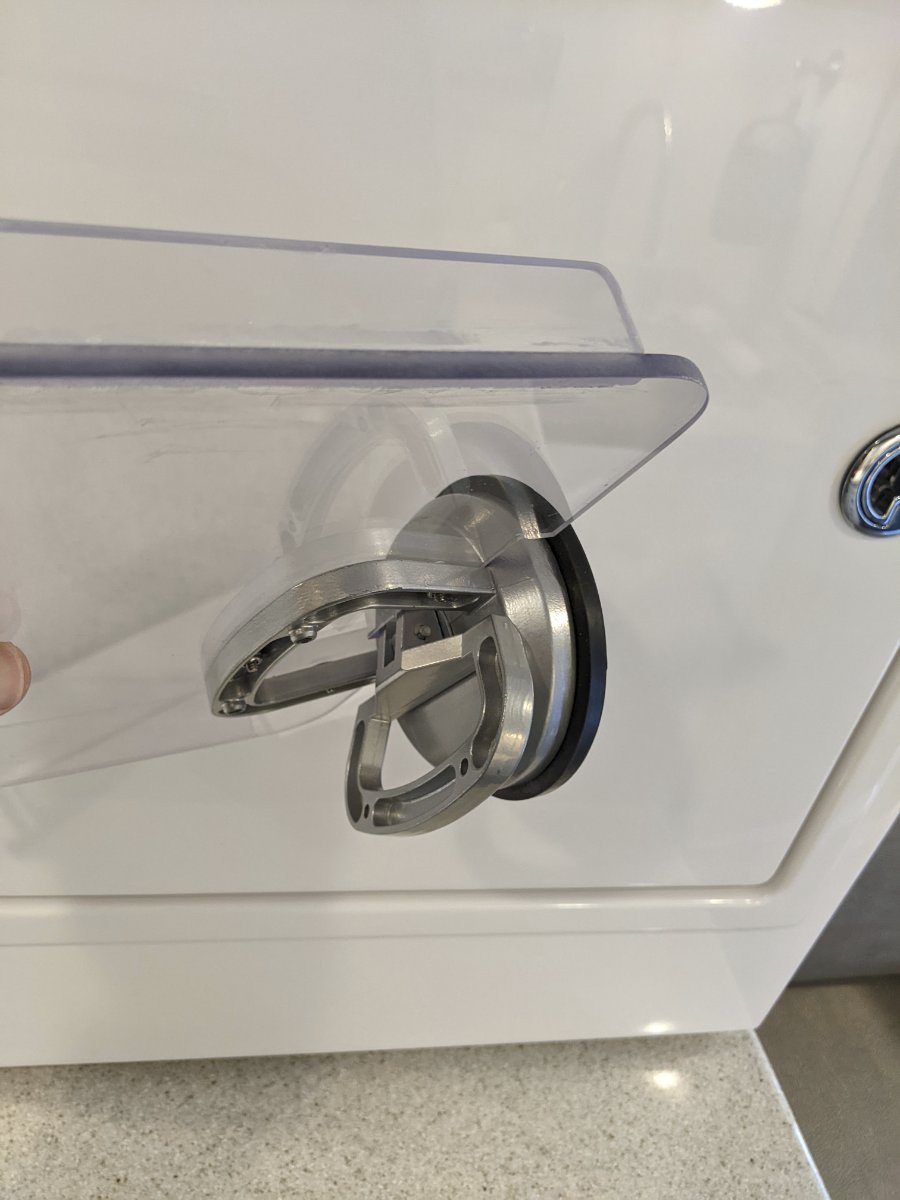
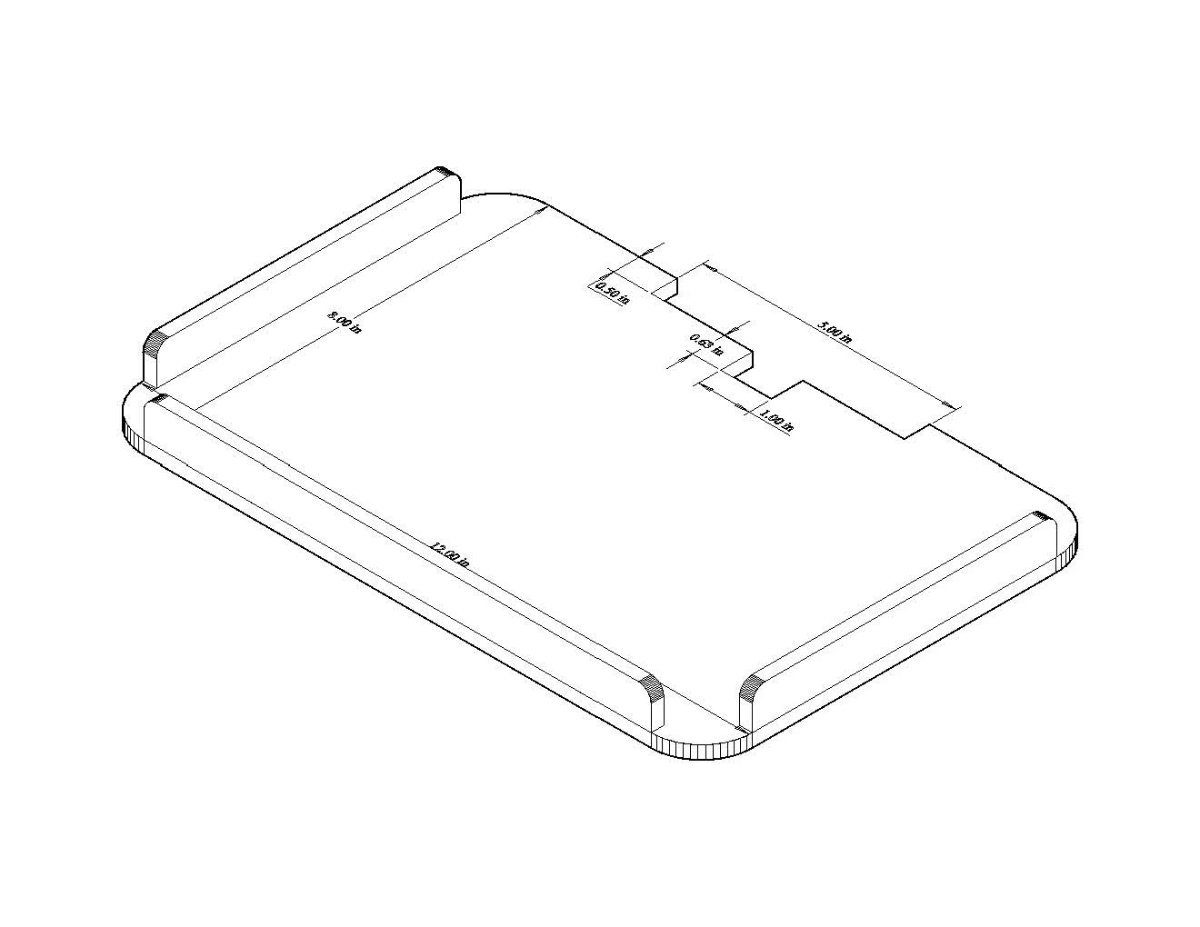
Inspired by dhaig's use of a Harbor Freight suction cup to make an external towel rack, I decided to use another Harbor Freight suction cup, https://www.harborfreight.com/4-58-in-aluminum-suction-cup-lifter-110-lb-57500.html, to make an interior shelf. I fabricated the shelf out of a 1/4" sheet of polycarbonate. I'm using the shelf to hold a CPAP machine on the back side of the pantry cabinet of our standard bed Elite 2 but the suction cup shelf could be adapted to a number of different applications depending on a person's need. The suction cup is rated for 110 Lbs. Of course this is a straight line pull and not side loaded like it is in this shelf application, but that said, the shelf is quite secure and can support quite a bit of weight.
 3 points
 -
When boondocking, we all manage our power carefully because we all know what happens if our batteries go dead - the trailer is unusable for the most part. How much capacity does one need? That's a huge variable obviously. Some folks need very little and some need a lot. We have found that we need enough to survive that common 10 hour quiet period during the night when there's no solar or generators to help out. Unfortunately, we have needed more than our 400Ah capacity that we have on several occasions this summer! I know - there's other owners rolling their eyes right now thinking I'm crazy. Needing more than 400Ah capacity doesn't happen often, but it has happened to us one too many times now. The scenario is a hot, humid summer night where you can't sleep because of the heat and humidity. In this case, we like to run our A/C occasionally to cool the cabin and our small dehumidifier constantly to keep the humidity / dewpoint around 60 (comfortable) - or just pack up and go home because sleep is pretty important. 🙂 In this situation we average around 40-45 Ah, so we need 400 - 450 available Ah. Close for our batteries, but not quite. I don't like to stay home just because it's too hot or too cold out... or come home early from a trip for the same reason... So I started pondering various solutions... I contemplated upgrading to the new Lithionics 600 Ah lithiums that Oliver is now using, but they still cost nearly $5K EACH!!! 😞 I ultimately decided to use another pair of cheaper 100Ah lithium batteries that I recently purchased for the trolling motors on my boats (Ampere Time is the brand and it's been super good to me so far). To do this I added a Renogy 20A DC to DC charger under my streetside bed right next to the batteries. If I need to put some Ah into my main batteries during quiet hours, I just bring my Ampere Time lithiums out of my truck, put them in my basement and hook them up to my DC to DC charger before bed. The Renogy delivers 150 out of 200 available Ah to my main batteries. The loss is due to the inefficiency of the charger (10% loss) and I'm also running the Renogy microprocessor and fan off of the Ampere Time batteries (15% loss). Eventually I'm going to upgrade my LifeBlue batteries to something with more capacity - but I have literally "bought" some time to wait for prices to fall and technology to provide more capacity in a smaller footprint. Of course one good thing may lead to another... I'm thinking of putting a 40A Renogy DC to DC charger in the back of my truck now so I can charge my spare batteries while driving! All of this makes me feel like I'm catching up to @ScubaRxwith extra tricks (and things) to pack in my truck for camping trips! 🙂3 points
-
We had AGMs for almost 6 years. Always had it plugged in to shore power when stored (covered spot). No issues. I now have lithiums and don’t plug into shore power but have a battery cut off switch that I turn off when in storage. Mike3 points
-
I installed the system last year as an extra measure of safety. Added benefit are the 2 fans that come with it , one mounted in upper and lower outside vents. I opted for 2 additional interior fans that help keep internal temperature uniform. So far, so good. Fridge has operated flawlessly even in very hot weather.2 points
-
Jim, I had tried the soft reset earlier but to no avail. Thanks on that. John, you are, as usual, spot on. Oliver should pay you to be an on-line consultant. I managed to brail my way through a "hard reset" and is holding so far. According to instructions, it can take 3-4 hours to work through process so may still fail. I think it's likely that the trailer was a tad too off angle and that caused the code. If so, lesson learned, as the angle was only modestly off level so now I know to be careful on that. Process was a tad convoluted. The link John sent above was for a pre 2006 Norcold so used a different board. This link is for the most recent models. John's older link is necessary as it's description of the process is more comprehensive and the late model link listed here is worthwhile as the photo is more accurate. Problem was that they instruct you to unplug a half dozen connections, none of which are labeled. Some simple work with a multi meter and sub-rudimentary understanding of electronics was what it took for me to stumble through. I sent a ticket to the shop at Oliver and shortly after coming in from doing the reset, got a call from Jason, the shop manager. Hats off to him for taking the time to follow up the same day. Super reassuring. Between the amazing resource of you folks at this forum and support from the shop, I can keep myself in a pre-hyperventilating state while on the road. Thanks to all.2 points
-
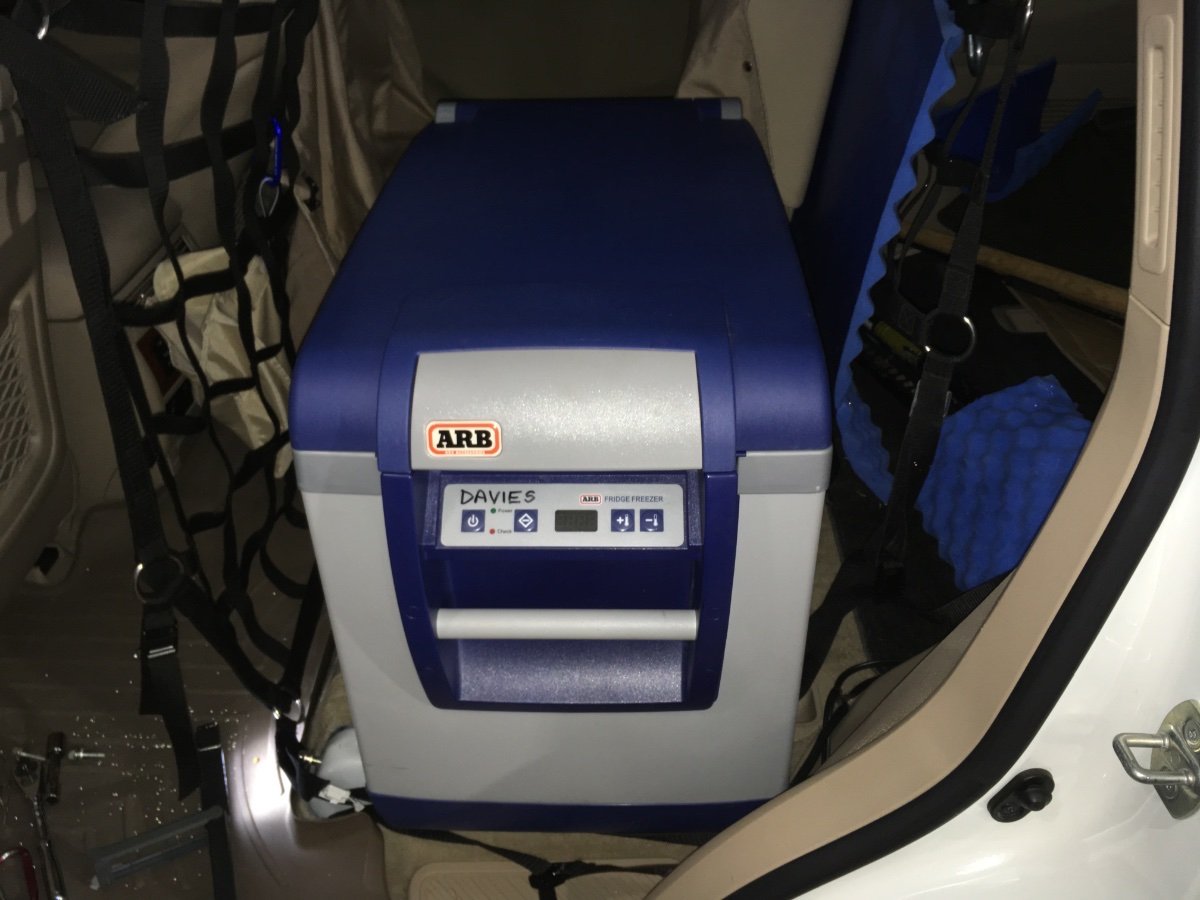
I don’t have direct knowledge, I ran across this document that might help. n/no co Fault Code – No cooling detected by the controls Board reset procedure. First step is to open up the outside compartment and look closely for some blockage, for example mud dauber nests. If you have never done so, blow out that area gently with compressed air, including the control board area. Watch your eyes! The gas jet in the burner section could be restricted, a crusty deposit gradually builds up around the hole, that is very common. I have a Dometic fridge, so I can’t be more specific. Good luck. Maybe consider buying a portable Danfoss compressor fridge/ cooler locally for backup in case it stays dead. At least that would not completely sabotage your vacation trip. You could always sell it when you get back, they are not cheap. Where do you live, please add that info to a Signature along with your hull number and model. If you were near me I would let you borrow my ARB one. John Davies Spokane Wa
2 points
-
Established primitive campgrounds that don't have electricity do have quiet hours like 10;00 PM to 8:00 AM. This is true of most National Parks in the West, they normally don't have any power available. When boondocking solo out in the woods or desert you can use a generator any time you like, even all night long. But if you have other campers close by, that isn't a good idea, or you might have somebody come visit for a heated debate, or to deliver a bullet to your generator 😉 Fortunately there are wide temperature swings where I camp and low humidity So a 100 degree day will probably get down into the 60s by the next morning. Irun the generator and AC all afternoon and into the evening long enough for the sun to drop or get shaded, then shut it off and open the windows in the middle of the night when the air has cooled a little. I would never want to boondock in sweltering humid weather. Running your batteries all the way down and recharging counts as a full cycle. That takes a toll on their longevity, but for most Ollie owners a 3000 cycle life expectancy doesn't mean very much. For a home solar setup with daily full cycles, that is very important. John Davies Spokane WA2 points
-
I have both my solar charger and my Xantrex inverter / charger set up to charge my lithiums to 13.2V and float them at 13.2V. That keeps them at right around 55% SoC, so pretty much perfect for storage when you want your systems operational and your batteries at a safe SoC (have to keep an eye on the power and make sure it's always on - not a problem for me since my Oliver is stored at home). I do fully charge my batteries about once a month or so as that is recommended by almost all lithium battery manufacturers. If you learn how to properly configure your lithium chargers (configurations change based on use cases), then you can manage your batteries to hopefully get the full potential out of your batteries. For what it's worth, my LifeBlue lithiums have the following SoC at the following voltages (I think all batteries will vary a bit so test your own), and I change the settings regularly based on my use cases: 13.1V = 25% SoC (not used, but nice to know - this is where I would like to recharge if possible) 13.2V = 55% SoC (I use this voltage when I'm storing our trailer at home) 13.3V = 67% SoC (I use this voltage when I'm camping with full power hookups) 13.4V = 98% SoC (I don't use this voltage much) 13.5V = 99% SoC (I use this voltage just before I leave on a trip if I want the most without fully topping off) 13.6V - 13.8V = 100% SoC (achieved with a setting of 14.4V on the charger until the amps drop to zero)2 points
-
UHMMMM, NO! If you did that, none of your 12 volt devices like lights and water pump would function. You only have to worry about long term storage, when everything else is shut down. While being used for normal camping, the lithiums are fine with full charge coming from solar and the converter. It is just that they are "happier" when stored at a partially discharged state. Maybe, it depends on the battery manufacturer. \What really stresses them is being constantly "topped up", charged those last percent from say 98 to 100%. Such as what happens when you are parked in winter while having them hooked up to shore power or the solar panels. Try to avoid that situation if you can. The solar controller voltage setting can be turned down a little, so it doesn't try charging them that last little bit, but the converter can't do that. That is the reason you should turn off the converter, or unhook the batteries to remove all phantom loads entirely during storage.. Look here: ... https://olivertraveltrailers.com/forums/topic/6629-how-to-find-happiness-with-lifepo4-lithium-ion-batteries-solacity-article/ John Davies Spokane WA2 points
-
@Wildbrew, imitation is the sincerest form of flattery. However, I cannot claim full credit for the external towel rack. I expanded on the idea from @Calypso, who made a single rod towel rack using a pair of suction cups. I see your idea as a general solution for mounting shelves inside an Oliver trailer, or outside. Your shelf caused me to think of making one for our 2 slice toaster oven, about which I posted recently. Or, an external shelf to hold my beer while grilling. What is the weight of your CPAP machine? Do you leave the shelf in place, unloaded, when underway? I had previously noticed the suction cups you used from HF and had wondered how one might be used. It had not occurred to me to fasten the fixed handle to a flat surface for a shelf. Obviously, if one suction cup is not sufficient, a second could easily be added. Well done!1 point
-
I had an error code on our Norcold (2020 Hull 688 so probably the same as yours) that I got rid of with a soft reset. To do that you hold the on/off switch for 3 seconds (or maybe just one), let the unit set for a few minutes, then hold the on/off again for 3 seconds. Check page 7-8 of the owners manual as there's a blurb in there about the n code. There is a way to do a "hard" reset apparently, but it involves disconnecting wires from the control board and likely would invalidate the warranty. Hopefully a soft reset works for you! 🤞1 point
-
I have mine in the attic compartment, with the hose coming through the gromet where the TV wires/cable came through. I have removed the TV so the gromet is free of wires. I run my APAP on 12v and have it plugged into the 12v cigarette plug. This has work great for me. Even with the humidifier set at four, it draws very little power. Andrew1 point
-
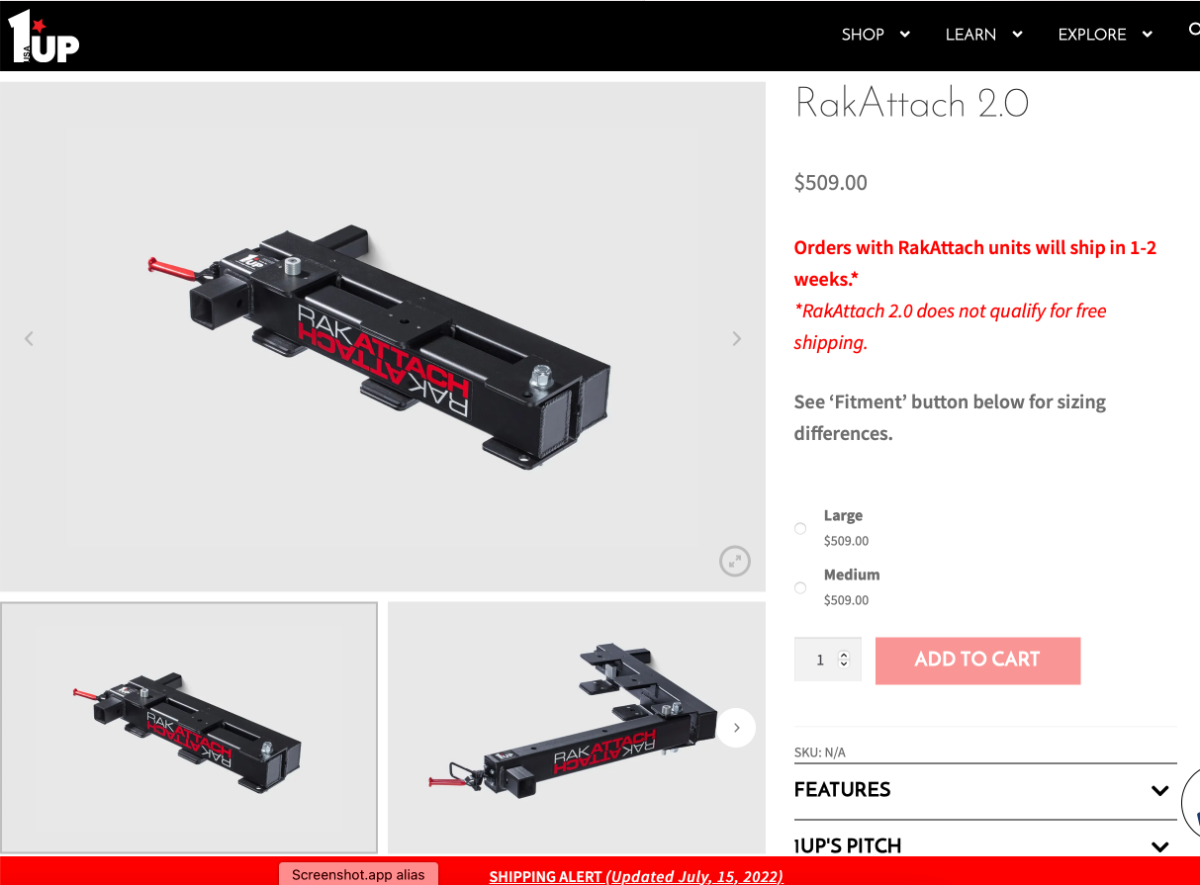
That is one big advantage of a HD pickup, you can get rid off the Andersen and use one of those.... Just make sure the ball and mount are both rated for at least 7500 pounds and keep the front of the Ollie light (no big generator in a cargo tray). The weight of the bikes and their rack and the ball mount all count toward the tongue weight. What is the max TW rating for that Curt ball mount? 750? Two typical 60 pound ebikes and an ebike rated rack with swing out adapter could use up 200+ pounds of TW (with the batteries removed). For a loaded LE2 (with a typical TW of 650) that is going to be way too much. For example, this swing-out mount weighs 58 pounds by itself, an aluminum Super Duty Double rack weighs 47 pounds. Steel racks are quite a bit heavier. John Davies Spokane WA
1 point
-
We do not have the solar system and only use the batteries that come from the factory. Since the batteries are always being charged and have found that the original battery only lasted 3 years before it would not charge anymore (ligiid in battery went dry) we now plug and unplug the trailer ever two weeks or so. This lets the batteries run on there own power and then plug the trailer back in for a day to recharge, this way our batteries are getting recycled as they should be. This was the way many on the forum said the way we should be doing it using Deep Cycle Batteries. We do not Boondock so battery power is used very little, if any 99% of the time. After two weeks with the trailer not being plugged in our meter will read right about 12.0V. trainman1 point
-
I think there's at least one other major change coming with the 2023 models. The fiber-granite counters are being replaced with solid surface acrylic countertops. I'm not sure if that's good or bad, but it is a change from all previous models.1 point
-
Agreed. We really liked how quiet the Truma AC was and I thought why not just call Oliver and ask? Let’s just hope that the supply chain keeps chugging along and Oliver receives plenty of Truma AC inventory. 👍🏻1 point
-
PapaBiker, We used our Calmark cover last winter and kept our Ollie plugged into 30 amp shore power here at our home from Oct to April and our solar panels were covered. We did not experience any issues with our AGM batteries. When not in use our Ollie always stays plugged into shore power. - Patriot1 point
-
This is a great point, not only is it not a good idea, it is very bad. A used race with a new bearing will probably cause failure in a short time because the used one has some wear, even if it isn’t visible... New Timkens are sold as matched sets, meaning the two parts were machined for a (nearly) perfect fit. Cheap poor quality no-name ones, especially counterfeits, most likely were not, even if they come packed in the same box or blister pack. It is definitely a buyer beware situation. Don’t be a cheapskate if you tow a lot of miles, and never be one if you tow in really remote locations. Also, keep the removed bearings separated, keep track of where they came from so you don’t accidentally install one into the the wrong wheel! That actually means you installed two wrong ones, with two possible failures! I put a blue paper shop towel on the ground at the axle and put the drum and the removed bearings on it, then I take the parts to my bench to clean, lube or replace one set at a time. That greatly reduces the chance that you will have a “senior moment”. But that can still happen, I recently drove in my last inner seal backwards. 😳 I caught my mistake right away but I had to drive to a bearing store for a replacement, and to buy a spare… John Davies Spokane WA1 point
-
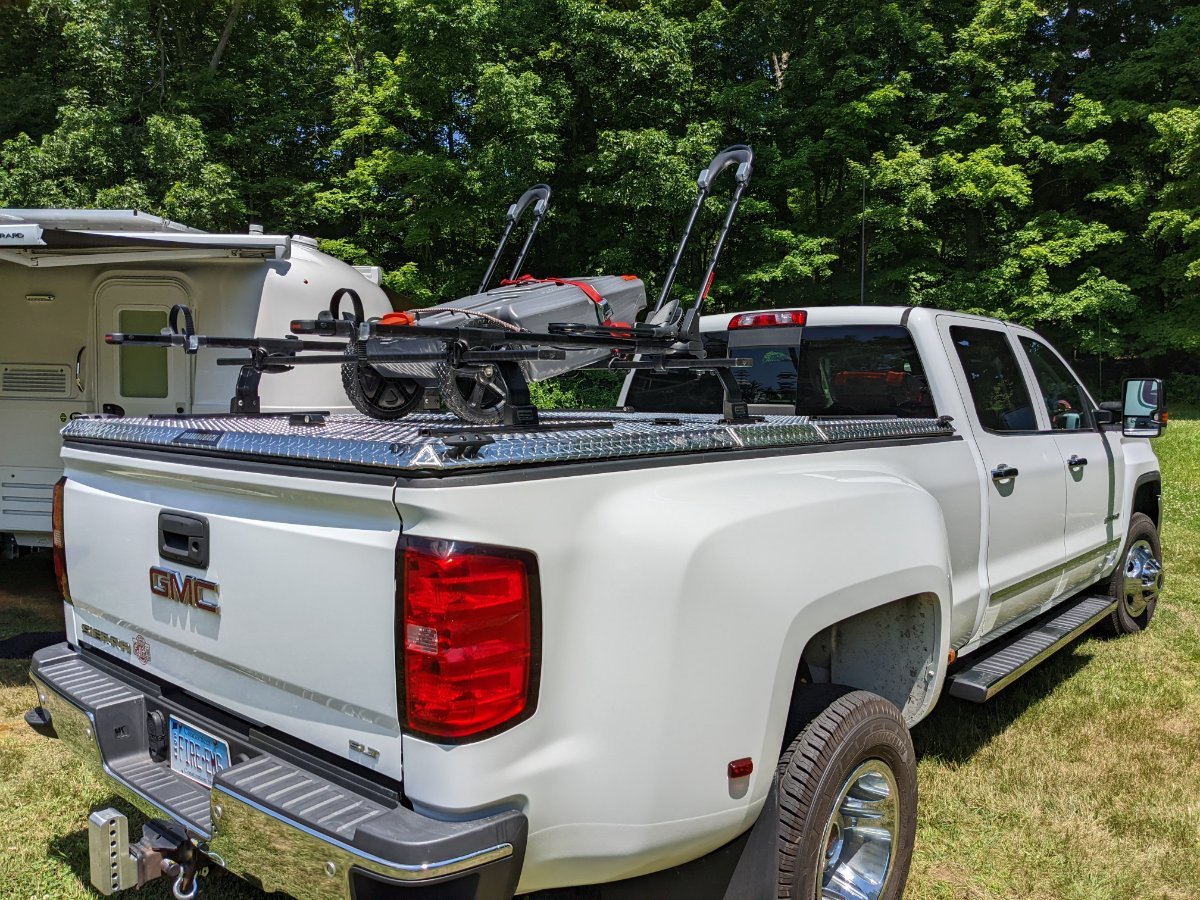
You can get crossbars for bike racks that fit over a tonneau cover on the truck. That way you still have the truck bed for other storage. This is our Diamondback cover, but there are others that basically work the same way.
1 point
-
Or get a tall canopy for great weather and theft protection, and a bed slide; https://www.bedslide.com/p-35835-bedslide-stories.html You can mount your bikes to trays or fork mounts, and slide the tray out for easy access, so you don’t have to crawl inside around other gear like a generator. And you could use a ramp. If your truck isn’t lifted with monster tires it will be a lot easier 😬 John Davies Spokane WA1 point
-
You guys are all GREAT! Thanks for all the advice! I am hoping to buy a truck with an open bed soon. I think I will use my feet this trip as I do not want to do any damage to the brand new Ollie!1 point
-
We have ebikes and they go in the bed of the pickup, they do fold, but we still couldn't get then through the camper door anyway. Personally I'm too picky to put something like that in the trailer, plus scratches would surely showup right quick in the fiberglass. If you tow vehicle does not have room for them then a carrier on the rear of the trailer is probably your best bet. These ebike weight around 60lbs. each so for me the rear rack is out, but I wouldn't carry them there anyway, not as secure as the pickup box. trainman
1 point
-
Another vote for bad idea. Early on I considered it with our road bikes but the chances of damage to both bike and Ollie interior were just too great. Think of emergency maneuvers, very rough back country roads or FS roads etc. As someone else pointed out there is nothing to tie the bikes down to unless you permanently mounted Yakima quick release clamps to the floor, but who wants to do that. This is another reason for owning a truck to carry bikes, either that or a heavy duty van with enough towing capability.1 point
-
Bringing the bikes into the trailer while towing the Ollie is a bad idea. Damage to the Ollie and/or the bike. Best to use a exterior bike rack on the Ollie or if you have a pickup truck put them in the back with a bike rack in the bed.1 point
-
My guess is that if you could bring them inside, that they would move around too much despite being bungee corded and mar surfaces. I think the forces exerted on the bikes due to trailer movements would damage the surfaces. Maybe if they're wrapped in blankets you might stand a chance, but how do you secure them inside? Where does the bungee attach in the trailer. Those same forces might pull the attachment in the trailer away and damage your trailer.1 point














-
Recent Achievements
-