Leaderboard



Popular Content
Showing content with the highest reputation on 11/06/2023 in Posts
-
There are many posts on our forum about our life safety detection systems and consequences of what can happen when things go badly. For this post, I am trying to highlight one simple step that each of us need to do when leaving our Oliver unoccupied and unattended for extended periods of time. But first, some info about propane. Both of the LPG gases, propane (C3H8) and butane (C4H10), are heavier than air. Propane is about 1.5 times heavier and butane is 2.1 times heavier than air. In a stagnant air situation, they will pool at the lowest level they can reach. Good news is that propane will only ignite within their upper and lower explosive limits (LEL). Said differently, the lower explosive limit is the lowest possible concentration of a gas that will burn or explode if ignited. The upper explosive limit, is the highest possible concentration of a gas in the air which will burn or explode if ignited. So, keeping your life safety detectors in good working order is an imperative. Doing so gives us great protection when using Ollie. However, the purpose of the below is to call your attention to a potential hazard that most of us have not likely considered…. What about when we are gone for months? BLUF (Bottom Line Up Front): It is imperative to shut off the propane tank valves and totally kill & secure the power to your trailer if it is left unattended for long periods of time. Scenario: You are going to be away from your Ollie for several weeks or months. Unknown to you, there is a super small propane leak in your Ollie. It is so insignificant that it does not set off your propane detector. For long duration storage, to minimize battery losses, you have turned your master 12V electrical switch to “OFF”. You have removed and secured the shore source and power cord. So electrically your trailer utility wise is dead. But, this time you forgot to turn off the propane tank valves and did not place the propane auto switch-over in the center position. In your absence, the small leak continues to leak. Eventually, it it pools in a low space and continues to grow. Eventually it exceeds the LEL for propane. For the fire/explosion triangle, you now have fuel and oxygen. But since there is no ignition source, no fire/boom. Weeks or months later you return to Ollie. You pull out your Arrival Check List and proceed to uncover and unlock Ollie. You carefully check for wasp/hornet nests as you carefully open the door. Then you open up the trailer windows. With your flashlight, you check all areas of Ollie for things that may have changed in your absence. Things like pest intrusions, leaks, spills, canned food or wine bottles that froze hard and then leaked, or any of a host of other things that can happen while you were away. Part of your Arrival Check List process is to open up the hatches and look there too. When all looks good and you do not smell any weird smells from the above sources, or the distinctive “rotten egg” smell of mercaptan (The propane mal-odorant), you turn on your 12 Volt master switch to power up the trailer lighting. Another quick look...all is good. Then you fire off the Max Fan for fresh air, and you can safely connect up to shore power. Next you turn on the refrigerator and A/C. Miller Time! But this year, a family member is the first to Ollie and they have just a bit of trailer experience. Their first mistake is not to follow your Arrival Check List, but instead they plug in Ollie to shore power. Boom. So, for long duration unattended time frames, please ensure that you make safe your propane system by isolation from the tanks and killing the 12 and 120 volt shore power systems by turning them off and locking up any means for them to be activated until you have inspected your trailer for unknown hazards. Mahalo, GJ4 points
-
My original bathroom door (Hull #050) was the same door that was on our previous Hull #026. They were hand crafted at the factory and had a full length magnetic strip along the leading edge to hold it shut. There was also the twist latch. At some time, they decided to have the doors made outside rather than in house. I would have suspected they were made the same way, with the magnetic strip. The main reasons for the manual latch were to keep the door from opening when you bump it with your butt while taking a shower and, of course, to keep the bears out.4 points
-
I'm going to disagree that the cracks are merely cosmetic. In the parts of the country where we get snow and rain, water and ice melting chemicals get between the steel core and the stainless steel covers. The steel core rusts and bulges the covers. Now a socket won't go over the stainless cover or fit correctly, even if you pick a bigger socket. Since the core can turn to a rusty mush, the cover falls off and you're left with a vaguely hex shaped nut that doesn't fit any tools in your box. Your best attack is taking an undersized impact socket and hammering in onto the rusted, undersized, nut. I've also used a pneumatic chisel and a plasma torch to cut them away. I hope you have a full set of tools on the side of the road if you have a flat tire and bulged lug nuts. Cracks in the stainless cover exacerbate this problem. My opinion is from 25 years of teaching high school shop, including auto mechanics. 16 year old kids that bring their cars into the shop are usually driving rusty hand-me-down cars. GM vehicles come to mind as consistently having an issue with these type of lug nuts. I think I had to replace all the nuts on my kids Honda Element for the same reason too. In the SW you'll probably never have an issue, but for anyplace with regular snow and moisture, in the long term they're a bad idea. It's not just a cosmetic problem for many of us.3 points
-
I ordered a set of parts from Formufit and I may assemble the frame with the materials as received and than make my cuts. If you cut the material first it collapses slightly and then probably wouldn't solvent weld very good. My first frame I built with screws only because I recognized the the changes after cutting as the joints fit very loose, requiring a few more screws than I had originally planned. Now that I know the precise dimensions for my tubes I could solvent weld up the frame, let it set a day or so and then add a couple flat head screws at each joint with the nylon locking nuts on the back side, then make all my cuts. I haven't determined in my mind if this is the best approach but may give it a go. If I do I'll post a more detailed account of the build and installation.3 points
-
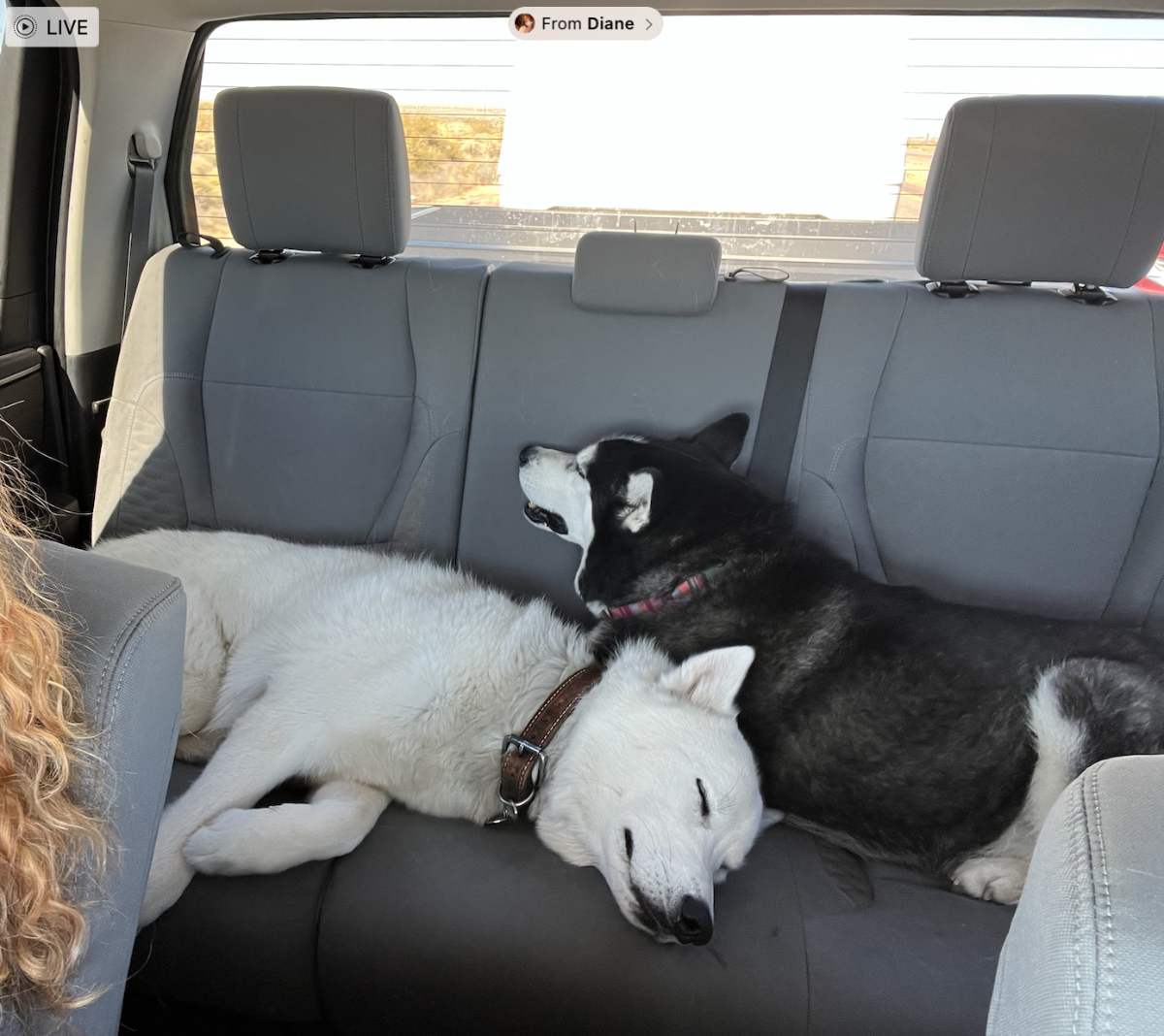
110# of Huskies in the back coming home from our first 2-dog adventure - they pretty much take up the entire back seat...
 3 points
 -
Ditto to this. I had this exact problem on one car that we owned. The stainless cover of the lug nuts split and the base metal underneath corroded and swelled to the point that a socket would not fit on properly. They were a huge pain the a** to remove. Several had to be cut off.2 points
-
I learned the 2024’s will not have touch lights they will have lights that use an on off switch to operate the light per OTT service. Patriot🇺🇸2 points
-
Our previous Dometic Noise Maker A/C, and current Houghton are both 13,500 BTU. Both were used over the past five years at Tinker AFB, OKC OK. in 108 degree full sun conditions. Both of these A/C's were cycling which tells me that they had a bit of spare capability in them. Note that I did keep the sun side window shades drawn, and had the awning extended about 3' for some wall shading. Did not go beyond this distance due to local thermals passing by occasionally. If you buy a used Ollie, plan on replacing the Dometic Penguin II A/C. New OTT offers a much better A/C now. GJ2 points
-
That looks great.1 point
-
I hope they are close to the same size as the touch lights. As our touch lights fail, I would love to replace them with switch-operated lights.1 point
-
For long term storage I follow the Lithionics battery maintenance procedure for 130Ah batteries. The choice I use is to leave the batteries on, turn on the heating pads, and connect an external (Lithionics) charger to the batteries. The shore power inlet remains disconnected. All major appliances, the solar panels, and the Xantrex are turned off but there are still some parasitic draws like smoke alarms that I do not stop. Although 20 miles away from home I visit Mojo at least once a month and usually more often. As part of my departure checklist I always make sure the propane cylinders are turned off (two pairs of eyes are on this), and I recheck the valves with each visit. The Mojo is stored in an enclosed unheated unit with a garage door. Although I do not currently do this, I could turn off the master 12V switch if there is one, but this would not prevent some electrical switching in the battery compartment. The batteries remain on for maintaining charge. Given that the tanks are off, propane leaks while in storage haven't concerned me until now. To properly maintain the batteries without a charger, they have to be removed if they would otherwise be exposed to freezing temperatures. Since we do have occasional freezing periods here, I purchased the charger so I could use the heating pads, preventing the batteries from freezing. So, GJ, given the storage procedure I use, is there anything else you can think of that I could do to increase propane safety?1 point
-
For about a year now, Oliver has been offering the Truma AC package on new units. Our Hull #1291 Elite II has the Truma air conditioner. It is much quieter than the standard Dometic. I don't know if it cools any better than the Dometic, but we used ours last August on a couple of 100 degree F days in direct sunlight at 4200 feet in Idaho. The Truma AC effectively cooled the cabin down to 75 degrees F, which is where we like it, and kept it there. I would not fear leaving pets in the trailer during ambient outside temps of 100 degrees F, with a Truma air conditioner running. Of course, you must have shore power or at least a 3KW generator to run the AC for more than an hour or two, even with the Lithionics batteries Oliver is now offering with new units.1 point
-
Thanks all. Yes, the plan is usually to be at higher elevation, but even then the poor insulation on the Tiger can't keep up if I'm in direct sunlight. But, we will be full timing at points, so we don't always get the luxury of getting high up. Geronimo John: good advice on replacing the A/C. We generally like buying used, then tinkering until we get it to where we want to be. So, for an Oliver it'll be Lithium, sounds like a new A/C, composting toilet, etc.1 point
-
For insulation, there is a layer of 1/4" thick (I think) reflectix installed between the hulls. Mostly installed, I should say, in that insulation has gaps in some corners (such as behind some cabinet areas. Layers of reflectix in our trailer are not taped together at seams, so there is room for air movement at corners and reflective joints. Theoretically, I would love to see more insulation between the hulls (reducing loads on the AC and furnace), but air and space between the hulls is what lets moisture (if present) seep toward the bottom of the hull and out one of the scupper drains. Reflectix helps reduce radiant heat transfer under a hot sun. It probably also helps with conductive heat transfer. There is still ample space between the hull walls, so I'm not sure how much it helps with convective heat transfer. I have found the combination of double hull walls, double-pane windows, and AC effective in hot western weather, at least into the low 100°F range. Our 2021 AC is noisy, but gets the job done. Battery compartment can get warm, especially at high charge rates in hot weather. All of that said, we prefer to seek out higher elevations and/or shade on hot days.1 point
-
Agree, had to configure the five dip switches to charge lithiums with the Renogys, the Victron may have something similar to set in the Smart app.1 point
-
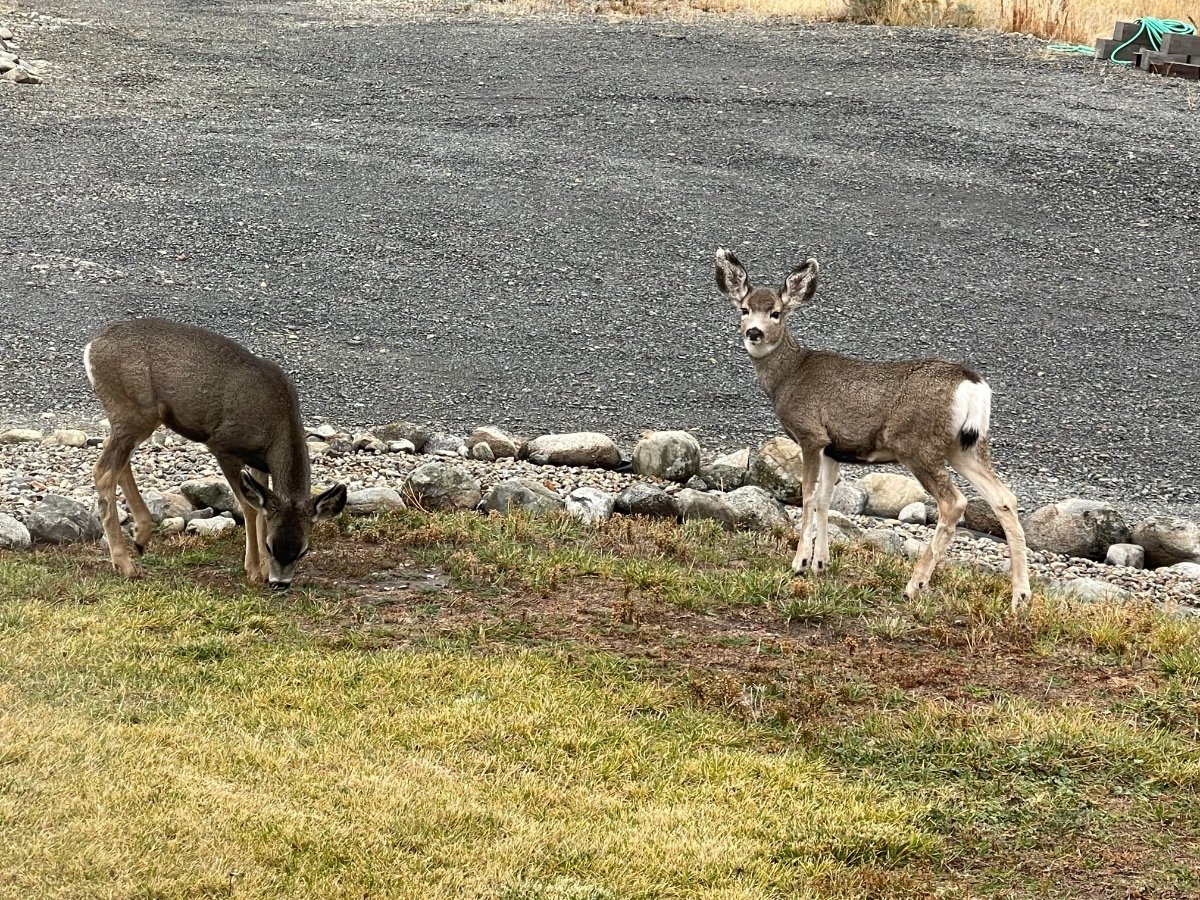
The young mule deer are out. There was one little buck and six does and fawns.
1 point
-
Although I use CV-2 grease on lots of things, I recommend staying with the Barker OEM grease (Mobil SHC Mobility SHC PM 460. I purchased it from Amazon. Reason is that to convert to CV-2 can be a true PITA to get it all.... and I do not recommend mixing greases. Here are items I recommend you have: Items Needed: · Cans of CRC Green (NOT RED) due to plastics · New Gaskets: Barker MFG Model Number 32453 https://www.barkermfg.com/ Gasket part # 29306 (3 Each). They sent me some at no charge. Be sure to tell them you are an Oliver owner! · Grease: Mobil SHC Mobilith SHC PM 460 (Amazon Prime). · Silver Paint Marker · Black Nylon Ties · 2 OZ Syringe (Optional) · 5/32” Allen Wrench · 5/16” and 3/8” sockets for ¼” Drive Ratchet While you are servicing the jacks, be sure to also check their mounting bolts. Attached are summaries on "how to" that I downloaded. Cuddo's to John Davies for the original posts, and others for some of the edits. GJ VIP 3000 Front Jack Service.docx VIP 3000 Rear Jack Mounting Bolts.docx VIP 3000 REAR Jack Service.docx1 point
-
Actually, I did have to replace a touch light for which I had installed a shade. I sprayed a little bit of rubbing alcohol around the base of the shade where it was stuck to the fiberglass, wiggled it a bit, and the shade came right off. I replaced the touch light, and reinstalled the shade.1 point
-
You tie. But you've had yours longer: 1958 MGA 1500 Roadster If I had a bigger barn, I could have won, though. But my younger brother ended up with my Dad's 1923 Ford Model T, which Dad had since the '50s. Now, if we go back to "What Was Your First Car?" though, I usually come out ahead in those. But that's a completely different thread than OTT Service. 😉
1 point
-
Doug, I bought the SS lug nuts that ScubaRx mentioned made of 304 SS. I was just in Hohenwald and had service and showed them what I bought. They said that they would work. They're not the bulged acorn. They did install them and I didn't ask what torque setting they used. I do have a torque wrench with me so will set it to 95 and see if any are less than that. Someone earlier posted that they torque higher than 95. We're in Kentucky heading to Oregon now. John1 point
-
Same here. I had a similar concern to what many have over the description given on the website when ordering. Upon receipt I was happy to see that the seat on the new solid SS nuts was that of the expanded, continuous style (like a bulge acorn) and not the scalloped style of a regular acorn. I see no reason why these lug nuts would not seat and perform the same as the OEM lug nuts. The only issue I had during installation was that the new nuts are larger, forcing me to buy a larger 6-pt socket for my torque wrench and breaker bar.1 point
-
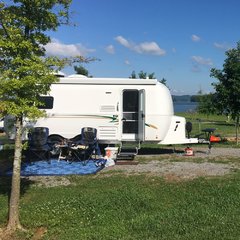
This is Dolly. She loves camping and knows how to relax after a day of camping!😂
1 point















-
Recent Achievements
-