Leaderboard



Popular Content
Showing content with the highest reputation on 04/02/2026 in all areas
-
My understanding is that it uses Blockchains.5 points
-
Well played, sir!3 points
-
As posted on the Scamp facebook page, but I see no reason why this would not work just as well when towing an Ollie. Available one day only (today, April 1). This bluetooth connectivity capability answers so many issues faced by the typical Oliver owner like tongue weight, having to use Andersen hitch with 1/2 ton pickups, tow chains, and the 2” vs. 2 5/16” ball dilemma. If anyone was successful in getting ahold of one of these during the tight window of availability today, please post your experience with this seemingly too good to be true answer to all issues related to having to physically connect our trailers to our tow vehicles.
 2 points
 -
Steve Landrum shared his sanitizing several years ago. Instead of changing the valves, add a 1/4 cup of bleach into the hose, connect your quick connect to the hose end and to the fresh water intake. Fill your fresh tank. Run all of the faucets to bring water/bleach through the lines. Empty the fresh tank. Refill and you are ready to go.2 points
-
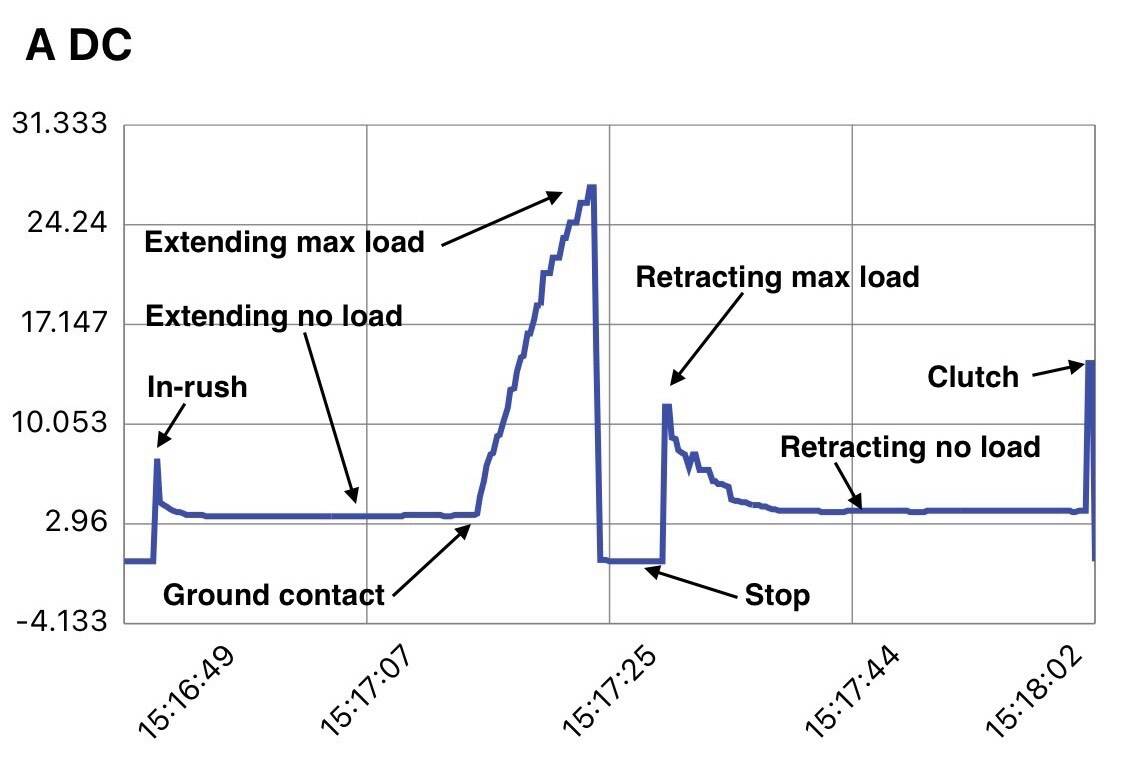
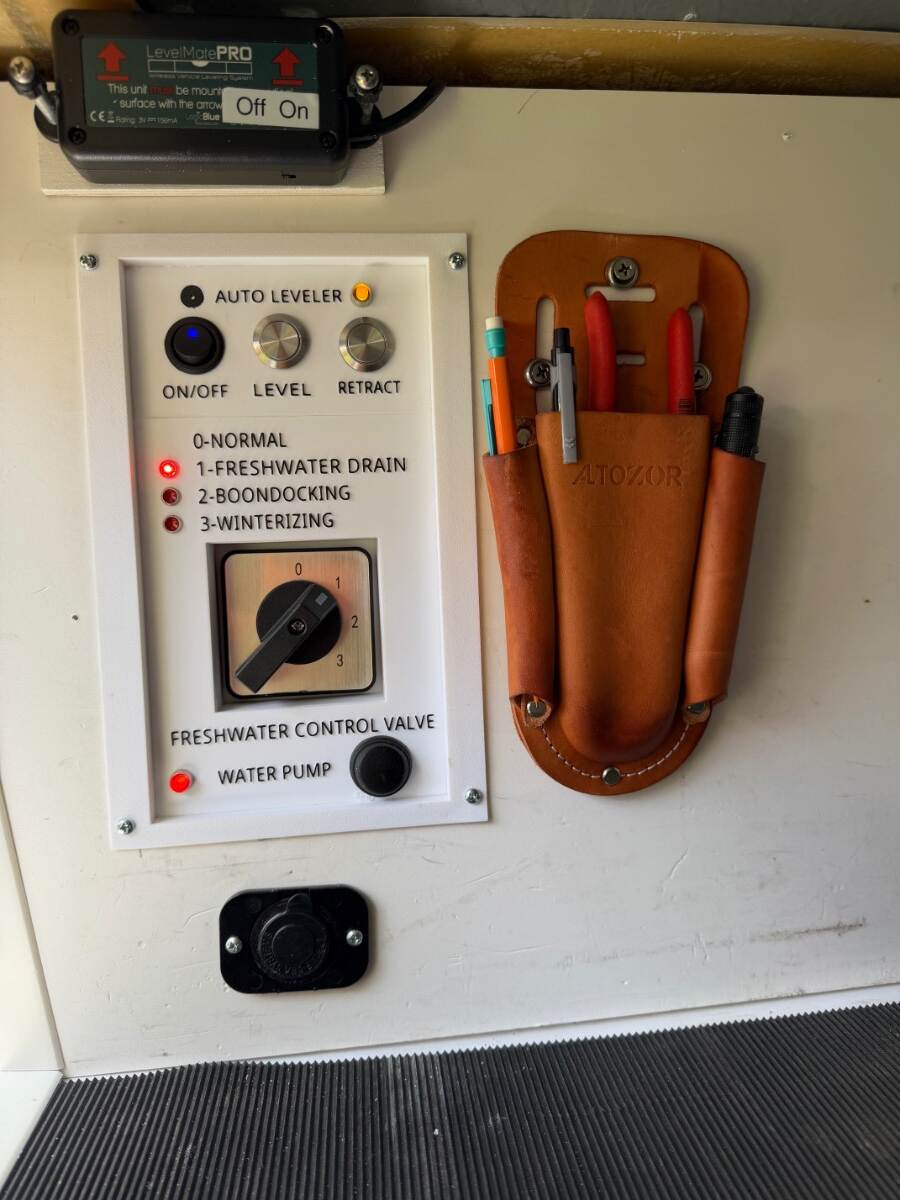
As far as I can tell, I’ve made the first automatic leveling system for the Oliver’s Barker stabilizing jacks! Maybe even the first 3-jack leveling system on a travel trailer! It’s simple to operate, safe, and works great! I built the leveling system as a novelty for my own entertainment, so I’m only posting it as a interest item not a recommended project. In reality, manually leveling with the electric jacks is already easy, particularly with a LevelMate, so automatic leveling isn’t really needed. There are even warnings that the jacks are stabilizers, not to be used for leveling. However, I believe the warnings are more about liability than capability, as long as the jacks are used within reasonable limits. I'd been thinking about an auto-leveling project for a long time, but was deterred by the thought of modifying the jacks with fiddly proximity sensors or revolution counters as used in conventional leveling systems. I didn't want to alter the jacks for a DIY project that might not even work. But then it dawned on me. The only time I really needed to know the position of the jacks, is when retracting them to their parked position. I wasn’t interested in returning the tongue jack to the truck hitch hight like some systems offer. So this led to a revelation that automatic leveling could be done with nothing more than current sensors mounted in a control box rather than on the jacks themselves. This was only possible because of the Barker jack’s mechanical clutch. When the jack reaches the end of its travel, the clutch activates with a distinct clack-clack sound. It was likely that clutch engagement would produce a unique current signature that could be used to detect when the jack is fully retracted. A plan was developing, but I needed actual amperage values for proof of concept. Fortunately I had a data logging ammeter, and the chart below illustrates the results for one of rear jacks starting from its fully retracted parked position. The jack was extended through free air until it touched ground and began picking up load, maxing out when the wheel lifted off the ground. Then it was retracted to the parked position until the clutch actuated: I didn’t include the tongue jack chart because it's far less dynamic — it's always under load, and the clutch doesn't normally actuate during leveling. The clutch only comes into play after trailer is hooked up to the TV and the tongue is manually retracted. The amperage results confirmed that current sensors could work, and beyond detecting the parked position, they could also be used to distinguish the different leveling phases: rear jack extension until firm ground contact for stabilizing, and then transition to "roll" leveling if needed. Completion of the rear jack phase could then trigger the tongue jack phase to handle "pitch" leveling. The amperage chart became the basis for the circuit and software design. No proximity sensors. No revolution counting. No permanent modifications — just two wires to each jack, a component box, and a control board. Sounds easy, but this was only just the start of a long process to perfect the system. I hope someone finds this interesting! Cheers! Geoff
1 point
-
I'm a bit like Bill, but certainly camp much more in the SW. With almost 3 years of ownership, 2 full years of travel, 17K miles and 150+ nights out, we've only used our entry awning 4 times. Mainly to check it out. I only remember one summer day in SD on the Missouri where it made a difference in temp camping on grass in high humidity. It felt like a 20 degree drop! We do not have a streetside awning. Though if we had dual power awnings, I would likely use them often. But we would not spend $,$$$ on them! 🤣 We live in the SW and still rarely use our entry awning. Though we do not summer camp and prefer to camp at elevation. The Oliver dual-hulls and dual-pain windows (are they still?) are very well insulated, so keeping sun off the body doesn't help much. You likely not sitting on that side. If you plan to summer camp often, that could make a difference. Also, some Oliver owners I know park at the same campsite for 1-2 months (I would have to shoot myself after a week!). We move every few days and erecting the manual awning is a bit of a pain. Dual power awnings? If money is easy for you, then why not! Trying to trim total cost, this should be the first to go IMO, The symmetry must look cool! 😎1 point
-
Please let us know what you did to resolve your issue when it's corrected. Thanks. 😎1 point
-
We also have just 1 awning. True we don't use it very often but are happy we have it. We probably would use it a little more if the fabric was not black. BTW...I recently (2 weeks ago) got a quote from Mike at Oliver and at $4600 for adding another, we will be happy with just the 1 we have. Congrats on your future new Oliver John1 point
-
We did not get the second awning either and have not regretted it - in fact happy we didn't. We travel out of Wisconsin so shading the "other side" of the trailer is rarely important to us where if you are always in full sun in hotter climates then maybe it is worth it. We use the curbside awning about half the time and often extended only about halfway. I am glad we have the curbside awning but also glad we don't have the streetside awning.1 point
-
Are "blockchains" similar to "flat spotted tires"? 😇1 point
-
In my 11th year of Ollie ownership I doubt that I've used the single awning more than 10 times TOTAL. Yes, there was one time when I could have used both awnings - if I actually had them, but, certainly that one time is not worth the cost. For what its worth - I generally camp high in the mountains. Good news is that at elevation (usually above 7500 feet) it always cools way down when the sun goes over the mountains. Bad news is that the wind is very unpredictable in the mountains and I don't want to have that wind damage a fairly expensive "sail". If there is a fairly good chance that you will spend a fair amount of time in the southwest - think about a lack of trees and a reasonably fierce sun - then I'd suggest giving that second awning serious thought. Or, if you are the type to set up camp and then sit under the awning for considerable periods of time, you might want to consider that second awning. Other than that - spend the money on something that you will use more often. Bill p.s. welcome to the Forum and soon to the Family.1 point
-
We used AC heat trace and just turn on the inverter..we have the premium solar package. Used about 3 percent SOC to run 45 feet of tracing overnite at 20 degrees outside temps. We split the tracing into four runs for max flexibility. Using AC was less expensive and less amps.1 point
-
Yes we made advanced reservations but we found many campgrounds less than 50% occupied by mid September. Probably the best to book in advance at the “National Parks “ as they are the busiest. We were in Canada Sept 5-Oct 1 Weather was very mild , in 55-65F range most days . Nights in 40’s. There were 3 rainy days, but some campgrounds are on bluffs so pretty windy.1 point
-
Greetings, All! Well D and I went over to the "dark side" and sold Casa Blanca to a great guy from near Kerrville, TX, David Knight. Please welcome aboard @Kpaladin David into the Oliver family. We're now into our next chapter of RV'ing and starting new adventures with our 2026 Brinkley I 235. It's totally "Victron'ed" out and includes 600A-Hrs of Epoch LiFePO4s and 800W of solar modules. We'll stay in touch! MAX Burner
1 point
-
Art, Best of Luck. Been lucky to camp next to 3 Brinkley's over the past couple years. They all spoke highly of their trailers. So happy camping. Safe travels on your adventures.1 point
-
Great talking with you last night, David! Your new Victron upgrades look flawlessly integrated into EXPLOR -- they will serve you and Kathy well as y'all continue making future OTT adventures. Very impressive. As goes with all in the OTT community -- please reach out to us here in NM, as @Geronimo John and others can attest, we've got a nice flat area with 30Amps/fresh well water/and dump station for over-nighting in the Great Southwest USA! Nothing like burning game meat on the Green Egg and quaffing a few cold ones with friends. Safe travels, all and Happy (early) Thanksgiving to all y'all!1 point
-
MAX - please do not be a stranger (well, at least any "stranger" than you already are 😇). I'm sure that you didn't let the pups go with that fine Ollie of yours! DAVID - you've got a really nice Oliver there. We'd be happy to help in any way we can. Bill1 point
-
What is Galvanic Reaction? - When two dissimilar metals are in contact and exposed to an electrolyte substance it causes one of the metals to lose ions and slowly consumes that metal. - It works much like a battery. One of the metals will become and act like an Anode(Negative) and the other a Cathode(Positive). This process will slowly consume the Anode and actually strengthen the Cathode. - Galvanic reaction occurs when an electrolyte combines with water. Depending on which electrolyte is present, it will completely(strong) or partially (weak) ionize with the water to form a strong or weak electrolyte substance. What is an electrolyte substance? Strong Acids Examples: Hydrochloric Acid, Sulfuric Acid, and other Acids Strong Bases Examples: Sodium Hydroxide, Calcium Hydroxide, and other Hydroxides. Salts Sodium Chloride Winter Road Treatment: - Different cities utilize a handful of different chemicals to treat roadways for ice. Most of these are from a form of chloride which does become an electrolyte once dissolved with water. TIP: It is always a good idea to clean these chemicals from any vehicle and/or camper when possible. What type of impact does this play on Aluminum? - When oxygen is present (in water), aluminum naturally reacts to form aluminum oxide and this is the key to its ability to resist corrosion. Unless exposed to a substance or condition in which destroys the protective layer, aluminum will remain resistant to corrosion. - When aluminum contacts another metal(steel for example), it sets in place the possibility of a galvanic reaction if an electrolyte substance comes in contact with the metals. What does Oliver do to prevent this natural process? A protective layer, cavity spray, is placed between the two metals. Zinc anodes are attached to the aluminum frame The Zinc becomes the anode part of the equation and if the galvanic reaction process takes place, it will consume the Zinc anode instead of the aluminum frame. How often should I check my Anodes? - Depending on where you live or where you travel you may or may not even have a galvanic reaction but it is still a good idea to inspect your anodes at least once a year and more if you start to notice that the anode is deteriorating.1 point










-
Recent Achievements
-