
Geronimo John
-
Posts
2,393 -
Joined
-
Last visited
-
Days Won
67
Everything posted by Geronimo John
-

Made in USA leaf springs
Geronimo John replied to Mountainman198's topic in Mechanical & Technical Tips
Yes to the first part..... I would think "not" for the second part. Lots of steel there. -
Made in USA leaf springs
Geronimo John replied to Mountainman198's topic in Mechanical & Technical Tips
Per the video, the Zone 19 footer checks in loaded at 7,000 pounds. Our OE2's typically are about 6,000 pounds. I bet much of the Zone's extra weight is the suspension. Somehow could we get air bags under our's? That alone would make a huge difference. Has OTT considered such an option? is it even possible with the small space we have between the frame and the Dexter axle system? -
Made in USA leaf springs
Geronimo John replied to Mountainman198's topic in Mechanical & Technical Tips
I recall from a relatively recent post that the spring length's are not one of the common standardly stocked kind. Something about Mr. Oliver wanted to shrink the distance between axles to reduce tire scrubbing during maneuvers or something like that..... GJ -
Problem with city water connection
Geronimo John replied to Ospreybob's topic in Mechanical & Technical Tips
A bolt head of the right size is a suitable substitute for a very large Allen Wrench. GJ -
For the negative terminal to the Shunt, many of use 1" copper bus bar. Cheap at Amazon.
-
Made in USA leaf springs
Geronimo John replied to Mountainman198's topic in Mechanical & Technical Tips
They would make height adjustments to gain more spring travel a lot easier! -
Made in USA leaf springs
Geronimo John replied to Mountainman198's topic in Mechanical & Technical Tips
Suggest starting a list of hull numbers, Month & Year MFG, trailer miles, and predominant use type (RV Parks, Boondocking, Off Road). GJ -
And the Stick Built Owners that like to boondock off hard surface roads become Ollie Owners as a result of their stick builts falling apart. Love my OE2! GJ
-
I really like your hard top rain and wind shielding "Guest House". Safe for Alaska and Canada (Generally speaking). And will encourage guests not to stay more than a few days. Sweet build for sure! GJ

-
I pre freeze at the Ranch ten small water bottles. Then put them into the freezer and refrig compartment they aid in the cool down process GREATLY! GJ
-
Amen to that! GJ
-
Yea I saw that. My slide rule must have needed some grease for that calculation! 🙂 GJ
-
Starlink dish mount on Dometic awning brackets
Geronimo John replied to RoadKingsofGA's topic in Ollie Modifications
Personally I prefer Art's (MaxBurner) security plan: + + + + + + + + ARFF WOFFFF Chomp. Problem gone. 🙂 GJ -
Truma Varioheat furnance not working with error code
Geronimo John replied to Mike and Jill's topic in General Discussion
If you have children or curious pets, an oil filled space heater is much safer to wandering hands or tongues. But they do weigh a bunch more than the typical 2 pound space heaters sole at Walmart. GJ -
More than a few of us, myself included, have found that our trailers look just fine with the eight FOUR center hub caps and their supporting "Cones ???" removed. This is especially true of owners that routinely shoot their hubs with an IR temperature sensor. With the cones and caps installed, it is difficult to get a good bearing/hub temperature readings. This is the topic of several members here on the forum. GJ
-
Progressive Dynamics PD4045 LiCSV Upgrade.docxProgressive Dynamics PD4045 LiCSV Upgrade.docx Some of the 2018 OE2's PD Converters have a LI switch that allows use with Litho's. Below is a picture of the LI/LA switch and a hard copy of John Davies procedure to upgrade the PD if you don't have the switch as well.
-
You are correct. However fiberglass has the advantage of being cast in many ways. From many perspectives we would want the top mold to be very aero efficient. But the bottom could be squared off some with much less impact from an aero perspective. This is exactly what most vehicle shapes at the rear are. Squarish low for trunk space and aero above for efficiency. The auto mfg's figured out how to do this with sheet metal, and the boat mfg's are doing it in fiberglass. That said, I'm not suggesting Ollie bottom be a cube. Just moderate it a bit to square up a tad the sleeping corners. Just a that. GJ
-
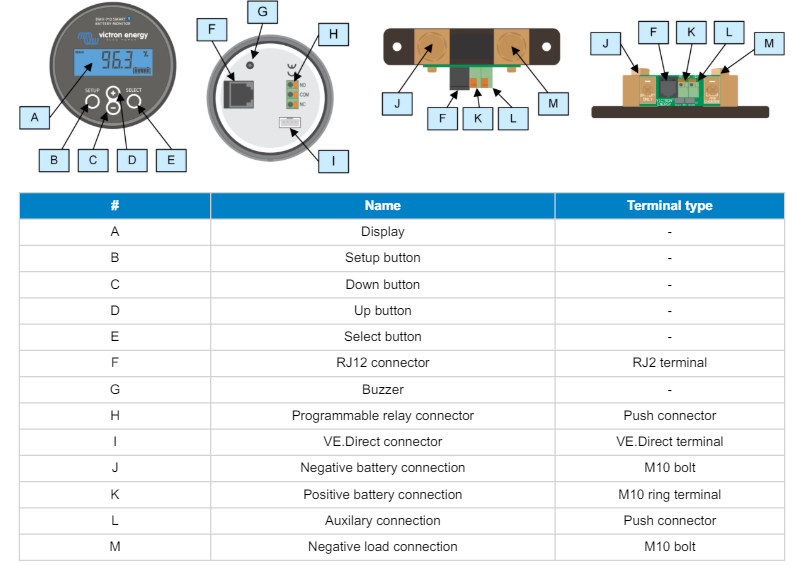
No, it works great, just not to the TV. Weak signal as we all know. My Ollie not in Hawaii, so I am at a disadvantage of not being able to run out and take a peek. But I do not recall seeing a 4-wire flat style connection on our Victron Orion 12/12 DC to DC unit. Hence, it appears the only way will be to connect the to the 712 Smart Display. I have as well, but from downloaded pictures from the web, our 712 Shunt does not have a connection for a 4 wire flat style Dongle plug. It has a RG45, and a NO, a NC, and a Common port. Hence the only option I can research find is to the 712 display. JPR
-
From the Victron 712 Smart manual, below are the connections. I assume that the VE.Direct (Terminal I) is where I could plug in the dongle which appears to also have a 4 wire flat "VE Direct" connector. Being higher in the trailer than below the dinette seat (Where my Victron Orion 12/12-30 resides, it would seem that the 712 monitor would be a more optimal location.... "Higher is better than closer" info from JD1923. Sadly the 712 monitor is installed in the fiberglass and rotation is not an option.
-
Thank you for "The Rest of the Story"! It is a great team at OTT, one I call "World Class". Keep up the great work, Geronimo John
-
The tanks are only ones that were used in the propane exchange program. If our tanks in our trailers have not been exchanged, this is a non issue. Below if from the CPC. GJ +++++++++++++++++++++++++++++++++++++++++++++++++++++++++++++++++++++ Recall Details Description: This recall involves EVAS 20 lb. propane exchange cylinders with model number EVAS – M0859, a serial number beginning with a “W,” and a date code of either “06-23” or “07-23.” The model number, serial number, and date code are stamped on the collar of the cylinder. While the cylinders were initially sold with an AmeriGas label, consumers could have exchanged these cylinders with other propane distributors who would have then placed their own branded sleeve/label on them. Remedy: Consumers should stop using the recalled EVAS 20 lb. propane cylinders immediately, close the top valve completely and return them to any AmeriGas Propane Exchange retail location for a free replacement. Consumers can find exchange retail locations at https://www.amerigas.com/locations/find-propane. Worthington advises consumers to close the valve on top of the cylinder completely when returning them.
-
AMEN!!!!!! Got my vote for a mold mod. Hopefully it does not cost over a million dollars! 🙂
-
Mike: What's a BLuetooth Radio? Were you using a dongle or just the 712 Smart (Shunt and Display Combo)? If not using a dongle, does the 712 Smart System broadcast the Bluetooth "signal" from the shunt or the display? Thanks, I really don't know much about how these type of systems really work. GJ
-
The picture was snipped from the Oliver Operations Mgr stating they had just finished loading out the first shipment to a dealership. This one: From his and your statements, and this video, it is apparent that the trailers likely were wrapped while on the truck bed. That has good and bad considerations. The good is a pretty picture of our beautiful OTT machine. One of the bads is pondering how much of a PITA it must have been to wrap these trailers with them on the truck bed hopefully using ladders and fall safety equipment. Maybe a smarter "consideration" would be to have the video show a shot of the the beautifully prepared OE2 being wrapped under cover at the factory. That's how the vast majority of shrink wrapping is done in the industry... not being done outside in an elevated position obviously working from ladders.... Or maybe ship them with a nice tight fitting cover instead of shrink wrap. Even better would be having the cover printed with huge letters "Oliver Travel Trailers. 🙂 GJ
-
Simple AGM to Lithium Conversion question(s)
Geronimo John replied to Danno and Donna's topic in Mechanical & Technical Tips
I would love to see pic's of that. One low and one high would facilitate natural convection. GJ