
Geronimo John
-
Posts
2,373 -
Joined
-
Last visited
-
Days Won
67
Everything posted by Geronimo John
-

Who has upgraded their Andersen to the latest version?
Geronimo John replied to John E Davies's topic in Ollie Modifications
For my 2005 Sequoia TV, I used seven threads as I needed to toss weight forward to reduce excessive squat as much as possible. For my 2019 F-150 Super crew, I only need three threads and my axles TV axles are weights are good, and squat with the Anderson at three threads reduces squat from 2 1/2" to just 1 1/4". With the Beast (F-150) and Ollie fully loaded for boon docking (Full fresh water), full 36 gallons of fuel, one driver, and connected with Anderson in play at three threads, here is what the truck scales say for each axle(s): The BEAST OLLIE Front 3,000 Axles 5,350 (Ollie tongue weight included in truck numbers.) Rear 3,550 Truck 6,650 Truck 6,650 Actual GCW 12,000 Max GCW 16,200 Under GCW 4,200 POUNDS UNDER MAX -
Our Team’s Favorite 2022 Oliver's Features
Geronimo John replied to JWalmsley's topic in Oliver Blogs
Outside noise is pretty much eliminated! GJ -
I'm in the final stages of designing my upgrade from 12 volt Duralast Marine L/A Deep Cycle batteries (OTT Base Battery Package) to three Dragonfly Energy Battleborn 100 Ah lithiums. Doing this while almost 4,000 miles from our Ollie has created some challenges. I would greatly appreciate your assistance with the following: Pictures of the OEM Duralast battery cables in the battery box area. (My hope is to clear out all the battery clutter, an re-use as much of the 4/0 cables as possible) Close up pictures of the Positive and Negative Buss fixtures. Needed to connect the DC to DC charger, solar suitcase panes, and 350 amp master cutoff switch (Battery + Home Run) What are the + and - buss terminal diameters for the 4/0 (3/8"?) and terminals for the smaller cables? Upon completion of the effort next summer, I'll post a materials list of the effort. Thank you, GJ
-
Heat Management of Lithium/Solar/Charging Upgrades
Geronimo John replied to Geronimo John's topic in Ollie Modifications
Would love to see your fix for the 712 bad install. -
ADVENTURES Begin AFTER Leaving Home!
Geronimo John replied to BoondockingAirstream's topic in Ollie Boondocking
In addition to JD's sage advice, I would not recommend 65 - 70 PSI in our OEII E-rated tires. YES, they are rated for 80 PSI, and you yes you could use this high PSI. In fact it was as recent as 2019 that many of us were using pressures in the 55+/- range. I liked that higher pressure for on road and high speed freeway use only. But as has JD and others, we have taken it down to the 45 to 50 psi range to soften the otherwise harsh ride that we were causing our Oliver's (Bouncing cushions and kitchen ware). More importantly, off road you really need to consider a much lower pressure to avoid rock punctures. Suggest searching tire pressure threads and take note the date of posts and recommended pressures. You'll find that over the past 4 years or so, both the on-road and off-road recommendations have come down quite a bit. Mahalo, -
Not trying to be Oliver R&D (Who ever that is at Oliver per Topgun2), but the engineer in me thinks from a structural perspective, HDPE would be perfect. However, from a vibration perspective something softer would be preferred. Sort like a rubber composite with some give to absorb vibration, but also enough dimensional stability to keep its' height. That would take some research, but such materials do exist. For example the large diameter Concrete Sewer Lines, or Blue Brute both use a "Rubberish" gasket that has bulk, some compressibility, but dimensionally stable when compressed to the desired thickness. Lets say for talking purposes, that we wanted to use a 1/2" OD tube, then the spacer/gasket may be 3/4" think and compresses down to just almost a half an inch for tube passage. Would have some sponginess for vibration, but still give the anchor bolts resistance. REALITY CHECK: All that neat engineering overkill may be needed, but then if the Houghton does not have any vibration then HDPE would be a lot easier. 🙂
-
Having lived with the current OEM "Hammer Mill" A/C, if I had known then what we all know now, I would have insisted that Oliver keep their A/C and take the full list price credit. Then buy a good quiet Houghton and install it myself. Oliver has known that this unit is a major customer issue for a lot of years. In fairness thought, there were no great options available back then. There are now options, and they need to wake up and smell the roses. Again in fairness, thinking it can happen for the 2022 model year is most likely wishful thinking. GJ EDIT: DELETED TEXT ABOVE: Per Katanapilot: "I'll respectively disagree. The Atwood Air Command unit that John Davies has in his Oliver was factory installed some number of years ago."
-
The stumbling block will be for R&D to figure out a way for the evap coil condensate to the existing internal drain tube. Some time ago, I postulated that if the Houghton were elevated a bit (Spacer, rubber mat?) that it could provide for a flow line (down hill path) for the condensate to get back into the unit and out the existing drain. Considering that the distance is only about a 18 inches, and at an optimal flow grade of 1/4" per foot, the elevation of the spacer could be as little as3/8" for flow. Likely thought the tube would be a 1/2" tube from the Houghton exit back through the spacer . That would require a about a 5/8" spacer. Certainly worth R&D doing a layout and plan drawing just to check it out! However, my comment didn't attract any responses from anybody..... 😞 None the less it appears to be an option for R&D to look into. MODERATOR: Would you please forward this to our R&D Team? Thanks, Geronimo John
-
That's a lot of Ollie's lined up. What's with that?
-
Heat Management of Lithium/Solar/Charging Upgrades
Geronimo John replied to Geronimo John's topic in Ollie Modifications
CnC and JD: I extensively researched many Lithiums, and as other Oliver owners, narrowed the field to BB's and Lithionics. My factors in doing so were their USA mfg, warranty, reputation, reviews, quality and warranty considerations. In a previous thread, when JD called to our attention that the BB's were on sale ...at a great price... that pushed me over the line to purchase BB's. My trailer electrical loads during travel are to resupply the power used by trailer brakes, DC refrigerator, and to recharge of lithiums for power used overnight. These estimated suggested that for my use, a 30 amp DC to DC charger is optimal. Anything larger would be unnecessary. The 30 Amp Victron Orion cost me $220 with Military Discount and free shipping from BB. The 25 amp Redarc lists as $389, and the 40 amp at $452. +1 for VO. As importantly, BB highly recommends the Victron gear. For similar reasons, I chose the Victron 712 Smart and Victron Orion (VO) 12|12 - 30 DC to DC Charging System. +1 for VO FULL DISCLOSURE: I grease my Anderson Ball for friction reduction. My rig is tongue heavy, and I have never experienced any trailer sway even under extreme crosswinds, grades and trucks blowing by out west. My choice, but greasing the ball "could" be contributing to a restricted return ground path. My F-150 Lariat, SCrew, 3.5 EB, FX4, MTTP comes with fuse #43 that is a 25 amp slotted M-Class fuse. Unfortunately, when Ford went to the aluminum body, the wire size to the 7 pin was reduced. Granted fuse #43 will protect the wire, but it's voltage drop is significant enough that I do not believe it could also feed a 30 amp load to the Lithiums. I have noticed that during the past four seasons using L/A batteries, the 7-Pin trailer connection has significant heat generated discoloration for both the Charge Wire and Ground Wire connections. (And yes I do use di-electric grease to control corrosion). My opinion is that the existing Ford and Oliver electrical wires (Out and Back) are undersized. As does several other Ford and Oliver owners. Research into this lead me to use a "Non-Isolated" DC to DC which requires running both a + and - cable to the trailer systems. It's wiring diagram is slightly different than the one you posted. Good news is it will also significantly improve the return ground path between TV and Ollie. My measured distance for running these electrical home runs approaches 50 feet out and 50 feet back. Although 6 AWG stranded copper could be used, I, BatteryCables USA, and the Victron Forum felt that using the larger 4 AWG was the proper choice. (Not to mention that's what Galway Girl determined as well.) I think we can agree that all DC to DC chargers require careful attention as to how their "waste heat" is dissipated. After all, this WAS the point of my creating this thread. For the VO at least I could find published specifications that quantified the input power and output power needs. The difference between the two is waste heat that must be dealt with. For the Redarc I was not able to locate such data. My experience is that when a manufacture does not want such a comparison to be made, they don't provide the specification data to do so. -1 for Redarc. Regardless, as a PE with extensive heat transfer professional experience, I prefer the fact that the VO is addressing the heat build up issue front on. Large heat sinks and their optimal vertical placement of heat sink cooling fins for heat dissipation was noted. +2 for VO. However, as you indicated, this negatively impacts the number of suitable locations for installation. So, - 1for VO. I am sure your hole in the plate is a good idea to help out the Redarc in this regard, but where are it's external heat sinks? Or do they need a supplemental cooling fan or artificial airstream to keep their cool? Not evident from what I can see from their limited pictures or descriptions that I could find. -1 Redarc. In summary, I thought that since about the only time I will be using my VO will be when I am traveling, why not put it vertically in the front dinette under seat area. With the cushion and hatch cover removed there appears to be space for heat flows up and out of the under-seat area without providing any additional heat to the OEM street-side bunk area. So, maybe a +1 for Geronimo for creativity. This effort has a nice but steep learning curve. Getting my arms around it has been a fun challenge, but doing so would certainly not be possible without the expert inputs that you both, and others have and are providing. They are much appreciated and I look forward to every response. GJ -
Heat Management of Lithium/Solar/Charging Upgrades
Geronimo John replied to Geronimo John's topic in Ollie Modifications
Mossey: Thanks. Yes, I am aware of the PD 4045 having/not having the switch/pins (depends on year) for LI compatibility. I have the JD recommended electrical meter for checking the actual loads on the component feeds. In fact, both of my son's and my brother last Christmas got one I liked it SOOOOO much. If any of the lines show any heat or are amp max even close, I have a hydraulic crimper and can upgrade those at easily. Knowing the lug to lug distance makes the process a no brainer. For all new stuff, I am very conservative on cable selections and lugs. All good there. For the DC to DC under the street side bed, more than one owner has mentioned excessive buildup there as a result of the converter and inverter both feeding heat below th aft dinette seat and street side bed. Although my wife LIKES it as she tends to get chilled, I did not want to add any there if possible. Hence I discounted that location. I'm 6'3 and 240 with size 15 feet.... so foot space under the dinette table eliminated that as an option. I looked at under the propane area, but fire/explosion eliminated that site. Pantry and front main closet space is too valuable for those spaces. That's how I got to the front dinette storage space concept for the DC - DC unit. I had forgotten about Overland's solution. If I recall he just took the miscellaneous feeds from the batteries, over to the + and - Buss Bars. Good suggestion reminder - 🙂 Appreciate the thoughts. GJ -
Need advice on portable solar charge controller
Geronimo John replied to johnwen's topic in Mechanical & Technical Tips
Should I find that I really like the solar gig and wanted more power, the same Voyager 20A SCC is used on both their 100 and 200 watt suitcase kits. No need for a second SCC just to get 100 more watts. So get the kit without the SCC. Also, Renogy also makes the Ellipse versions. For the 200 watt, it is 18% smaller, 7.2 pounds lighter, and 26% more expensive than the regular model. Note: The cost increase would likely be off set some by the federal solar benefit. EDIT: Last night I pulled the trigger on the 200w Eclipse solar suitcase. It is on sale for 20% off. Add to that the RENOGYSOLAR10 coupon for an additional 10% off. = 30% off with free shipping too! -
Need advice on portable solar charge controller
Geronimo John replied to johnwen's topic in Mechanical & Technical Tips
You are correct on the 40 pounds. I too have "plenty" of tongue weight as loaded. If I find that I like the 100 watt, I could always just order out a second one without controller. Changing subjects, did you get their Ellipse versions? -
We purchased our 2018 Oliver LE2 (Hull 342) with basic batteries, 2,000 watt inverter, 45 amp converter. At the time, Lithium's were prohibitively expensive and I figured that by the time my Duralast LA's were getting long in the tooth, less expensive options would be available. We now see many options for advance power systems, and my Duralast batteries likely will not last a 5th year. Time to upgrade. So, for the past month or so I have been researching, reading, purchasing, and gathering tools, supplies and materials for the modernization of our power systems. As Galway Girl I am phasing the effort: Phase one is lithiums, initial solar capability, and DC to DC charging. Phase II will be to upgrade my Inverter to a 3,000 watt version and possible roof mounted additional solar to support limited duration boondocking no generator Air Conditioning. For Phase one, here are the major components I have purchased, or are planning to purchase: 3 each 100 Ah Battleborn Lithiums Victron 712 Smart Battery Management System Victron Orion 12|12 -30 DC to DC Charger (Power from F-150 alternator/battery PD 4060 (60 Amp) Converter with Lithium Capability ( 😊 Andrew Kesner! ) Pending purchase of Renogy 100 or maybe 200 watt solar suitcase kit After next summer's installation effort, I'll post a report with lists of materials and my thoughts. My trailer almost never will to be used in freezing conditions. It is almost always used in hot mountain or desert conditions. As such, for Phase 1, heat management of the Orion and Renogy Voyager Solar Charge Controller are the subjects for which I am seeking your thoughts and suggestions: I will be using the Orion only when traveling. As such, I am considering mounting it in the storage area that is under the dinette front seat (Not the footwell). When traveling, I would remove the seat cushion and storage hatch cover to vent heat. This heat would be dissipated into the cabin, where it could be managed at stops by using the MaxFan. I will be using the Voyager 20 amp Solar Charge Controller only when boondocking. I would like to mount the Voyager in the battery bay. Will this unit produce enough waste heat to be of concern to the three Battleborns? Would it require supplemental ventilation as a result? Thank you, GJ
-
Need advice on portable solar charge controller
Geronimo John replied to johnwen's topic in Mechanical & Technical Tips
Mossey: I corrected my earlier post. The ZAMP double has #10 wiring. Each plug-in can handle 20 amps for sure. Their note seems to indicate higher. I am now on the fence as to get the 100 Amp or the 200 Amp suitcase systems. Either way, the current will be less than rating for a single Zamp port. I do like you idea of having a solar port on both sides of the trailer. I also like John Davie's idea of mounting one on the battery box door. May put a second one as you suggested on the curb side. Maybe inline with the basement storage area. An easy path back to the street side electrical. Thanks for the ideas! GJ -
I was on the phone with Renogy today exploring home made extension cords for my suitcase next summer project. I asked what the maximum distance I could run my extension from the Solar Charge Controller to the panels was? Answer Given: 40 feet using #10 AWG wire. For #12 AWG it was 15 to 20 feet. I like your idea as it means I can get double duty from my existing #10 AWG and #12 AWG Generator extension cords!
-
Need advice on portable solar charge controller
Geronimo John replied to johnwen's topic in Mechanical & Technical Tips
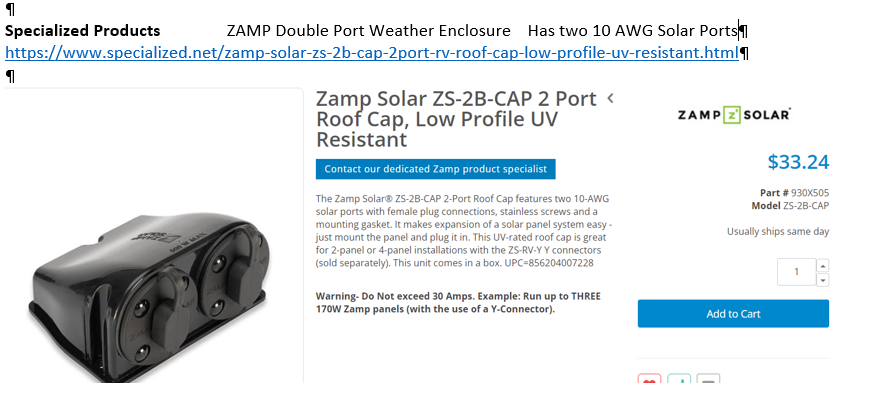
JPR HUGE TYPO CORRECTED BELOW! Ride and Fly and friends: Doing planning for a suitcase portable solar panel upgrade and also ran into the 10 Amp Furion Solar Port issue. If I'm going to do this, I prefer to have reserve capability for future expansion. My starter may be the Renogy 100 watt suitcase panel with their 20 amp solar charge controller (SCC). Puts out 6+ amps as others have indicated above and elsewhere. My expansion would be a second suitcase panel without the SCC. As such the 10 amp solar port is inadequate. I ran across the ZAMP double solar port, each rated at 10 20 amps (SAE Connections) served by two sets of 10 AWG wired. They also make a triple version. For me the double will be more than sufficient. I like this weather protected version more than just using the pigtail and exposed cap that I believe Oliver is using. Although it is designed as aero smooth for rain protection I am thinking of mounting it with the plug side down vs. airstream while moving back. For the street side wall, would you mount it Aero (Horizontal, Plugs facing aft) or Self-Draining (Plugs down)? One mounting option is where Oliver is mounting the pigtail solar port. Where would you recommend mounting this? Is this overkill vs. two naked capped pigtails? What say ye Oliver Pro's? GJ
-
Gravel roads & protecting the front of the Oliver
Geronimo John replied to dstr8's topic in Towing an Oliver
Looks interesting, but it is designed for only one year. Then requires removal and recoat. -
I think Oliver got this winterization thing right. 2+ gallons of $3/gallon antifreeze (Super Walmart RV Section Before Fall) and we are done. No worries. Or, the cost of an air compressor that may or may not get the job done for sure. = worries to me. I like no worries better.
-
Battery Box Support Bolts Missing
Geronimo John replied to Ralph Mawyer's topic in Mechanical & Technical Tips
I learned the hard way about the amount of power a small hydraulic jack can put out. Where as a mechanical jack at least gives the operator some feedback as to the force being provided to the load. Another advantage is that they are not going to "blead down" when you have fingers in tight spaces. Glad you "got-er-done". -
Seelevel tank monitor mystery ( to me) error code
Geronimo John replied to Mcb's topic in General Discussion
My spouse is a major University Department IT Supervisor. Her troubleshooting skills are amazing. So when I am having a problem for anything that even looks at all close to being computer based, I employ a four phased approach: First, I do a hard reboot. Then I drag out the owners manuals and search the Oliver University and hopefully the answer if there. If not, I check the Oliver Owner's Forum. When all else fails, I don't mention my first three approaches and pretend that the issue just happened, and call out to my wife "Honey can you look at this please". Over time, I have found that the odds of success are about 25% for each approach! Now for the married owners, it may, or may not be wise to mention the first three approaches to your spouse. 🙂 -
Propane tanks, 20 or 30 pound
Geronimo John replied to John and Debbie's topic in General Discussion
I like the less tongue weight of the 20 pounders. -
George: I started towing my 2018 OE2 with a 2005 Toyota Sequoia. Before my egg hatched, I reached out to the owners, just as you have. It was John Davies that responded back with the very excellent and PROVED to be spot on responses. The Sequoia I had was with their "New" 4.7L engine. My 2018 Summer Voyage was TX to OK to Oregon to NC and back to Texas; just over 8100 trailer miles. When JD responded, he intonated that mine would be underpowered out west, and would take a lot of energy on my part for long trips. I found that it was actually adequate for flat land use, it was not adequate for towing my Oliver out west in the mountains. Flat lands, it did much better so long as I kept mindful of brake heating and stopping distances. The MPG was pretty dismal though as I was always hard riding those ponies. Just north of the Denver area, I was crawling up a four lane highway, down shifting as my rig slowed until I was in first gear crawling up the mountain. I was actually passed by the US Cycling Team. I caught them and passed them on the down hill, and the process repeated itself several times. At one point we opened our front doors and were doing the "Fred Flintstone" one legged push off''s as they went by. We had plenty of water and passed it out to each rider as they passed by us on the next hill, and collected the empties as we passed them on the flats to the northwest. My passenger stated: "I think it is time for a new TV". I had to agree as I was a hazard on long climbs. For our Summer 2019 voyage, 7000 Miles, I had purchased new F-150 3.5L SuperCrew. That's when I finally figured out what Mr. Davies meant by my having to invest a lot of my energy into driving my Sequoia TV with an Ollie OE2. Having a very capable TV is MUCH easier on the driver. The Sequoia's are one of the most reliable vehicles on the road. (Shameless Plug Follows) Except for the Toyota Land Cruiser that is better in every way (Except Cost of course). Their relatively small fuel tank was found to be a time and energy sucker from "Low Fuel Shortage Syndrome". If you have the 5.7 L engine, 4 X 4 Sequoia, I would suggest that you give it a shot for a year. Then consider what YOUR needs are. In my case, that process worked well. Good luck, GJ
-
Oliver can't fix STUPID. So why treat all of as if we are? I'm with you JD!
-
Bill: My goal is to protect the lines to and the valve at the exit of the tank. Not the tank itself. For the tank, you are of course spot on. Since the valve is elevated slightly from the tank, is there some potential for it to be cracked with freezing water? However, if you are saying this has never happened... then I'll change my procedure. On the other hand, I figure what the heck.... if I have some anti-freeze harvested during the winterizing process, may as well put it to some good use somewhere. Please do advise. Thanks GJ