Leaderboard




Popular Content
Showing content with the highest reputation on 11/05/2021 in Posts
-
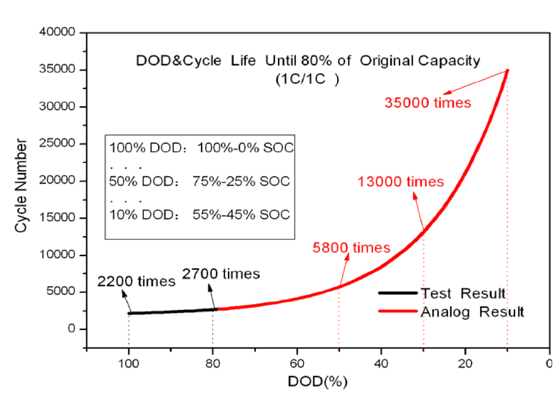
There have been numerous posts in this forum about Oliver’s lithium battery systems—about their usefulness, limitations, and value with respect to cost. Despite reasonable arguments against it, a number of us have purchased the lithium package. Reasons for purchasing the option have included the ability to run the air conditioner (A/C) for short durations (like at highway rest stops), greater usable energy (more boondocking in cloudy weather without needing a generator), faster charging, and longer battery life. This post summarizes things I’ve learned over the last 6 months about the Xantrex/Lithium/Zamp system. This post might also be titled “Things I Wish I’d Known from the Start.” This summary is a work in progress. Hopefully, with your corrections and additions, this thread will be of use to others that have purchased the Lithionics option or are considering doing so. At the time of this writing, manuals and other information for the Lithionics batteries are in the Service Center Knowledge Base — see links at the end of this post. I assume at some point Lithionics information will be compiled with all of the other trailer manuals in Oliver University. Battery State of Charge A key component of the Lithionics system is the app that lets users monitor State of Charge (SOC) and voltage (see links below). The reliability of the SOC values (which describes the amount of energy remaining in the battery) depends on (1) maintaining SOC calibration and having (2) up-to-date Lithionics firmware. The SOC should be near 100% at 13.6 volts, and about 50% (+/- about 10%) at 13.2 volts. If this is not what you’re seeing on the Zamp controller, Xantrex remote, or Lithionics battery app, then something’s wrong. By way of example, a couple times we’ve experienced the SOC readings of 60% when the batteries were dead -- not good. Note that the voltage reading on the app while there is a load on the system (e.g., electric heater) is different than when there is no load; the “resting” voltage may be higher. SOC Calibration The SOC requires periodic calibration. According to the manual for the 130 Ah batteries, the SOC can be calibrated simply by charging the batteries to 14.4 volts. The manual also states that fully charging the batteries to 14.4 volts should be done at least once every two weeks for battery life. Get the 130-Ah battery manual from Lithionics using the links below; at the time of this writing, Oliver has the incorrect manual posted in the Knowledge Base). When charging with shore power, it is not always apparent that the batteries have reached 14.4 volts, because when charging, the batteries only stay at ~14.4 volts for a short while before dropping back to about 13.6 volts. You can verify that batteries have reached 14.4 volts by monitoring battery voltage using the Lithionics app during a charging event. If you are unsure that the batteries are reaching 14.4 volts, you can at least confirm that the Xantrex charger/inverter is set to charge to at least 14.4 volts in the Xantrex app (https://support.olivertraveltrailers.com/portal/en/kb/articles/xantrex-remote-bluetooth-pair-operation) and, under Settings, check the custom absorption voltage. Ours came from the factory set at 14.6 volts, which is sufficiently high to get the batteries to 14.4 volts. Lithionics Firmware At least some of us that picked up our trailers in spring or early summer have batteries with outdated firmware. As I understand from Lithionics, more recent firmware versions have an improved SOC algorithm (our initial SOC readings were unreliable). You can check firmware version with the Lithionics app by clicking on a battery, then clicking on the settings “sprocket” in the upper right side, and then clicking on firmware. Our battery came with firmware version 1.0.05; I’ve recently updated to 1.0.07 by clicking on flash firmware. This has to be done with your phone in close proximity to the battery, and has to be done separately for each battery. Updating firmware comes with a “…this is a critical operation…” warning; you might want to check with Oliver or Lithionics if you have any questions about doing this. Has updating firmware improved our SOC readings? I’m not sure yet, but I think so. So far, the readings seem more reliable, but I’m still testing. SOC Calibration by Cycling A Lithionics rep told me that the SOC can be calibrated by “cycling” the batteries, and that this should be done every two months. Cycling consists of discharging the batteries to reserve voltage (e.g., ~12.1 volts) and then charging to 14.4 volts. However, the rep could not point to written documentation supporting this form of calibration. As the batteries support more partial cycles than full cycles (see graph below), calibrating by simply charging to 14.4 volts (assuming this effectively calibrates the SOC) seems better for battery life. Lithionics batteries will not charge from tow vehicle The standard 7-pin connection from tow vehicle to trailer cannot be used for charging the Lithionics batteries. Charging the batteries from the TV requires a DC to DC charger, which is an aftermarket installation. For more discussion on this, search for John Davies’ Redarc DC-to-DC charger installation description. Batteries Turn Off Twice now one or two of the three 130-Ah batteries have turned off when reaching low voltage (which happened because we were relying on incorrect SOC values). The SOC readings themselves looked OK, but the voltage did not correspond with SOC. The battery State in the Lithionics app reads “Off” for each battery when it is off. There is no flag on the Zamp or Xantrex control panel that alert the user to one or two batteries being off. The lesson (at least for me): monitor all three batteries, not just one, and note the Current, Power, State, and Status Code settings. If one or more batteries are off, turn the battery(ies) back on, and fully charge to 14.4 volts. Inverter Noise The Xantrex charger/inverter can be noisy charging the batteries with shore power (I’ve measured 60-64 decibels in the cabin when batteries are charging, and about 72 decibels adjacent to the inverter). The noise comes from (1) the charger/inverter fan and (2) the way in which the inverter is mounted (the fiberglass wall to which the inverter is mounted propagates noise into the cabin). The noise can be masked by turning on the A/C. Alternatively, the noise level can be reduced somewhat by lowering the charger current. In the Xantrex app, go to settings, and change the Charger Current from, for example, 100 amps to 30 amps. This will reduce fan noise. It will obviously take longer to charge the batteries with lower current. If you would like to be connected to shore power (to run an electric heater or the A/C, for example), but not charge the batteries (to avoid keeping them fully charged for long periods of time, or to reduce inverter noise) you can set the charger ignition control in the Xantrex app settings to “auto-on” (thanks to NCEagle for figuring this one out). In this mode shore power energizes the 110 outlets, the A/C, and the fridge, but does not charge the batteries. Turn the charger ignition control “off” to resume charging batteries with shore power. There are likely ways of re-mounting the inverter so that noise does not propagate into the cabin, with either a different mounting location or perhaps mounts using rubber bushings. Has anyone tried this yet? Xantrex Communication Errors Too often, I’ve gotten “Code 20” communication errors on the Xantrex remote panel. This can be resolved by pushing the red button on the 300A breaker under the streetside bed, waiting for at least 30 minutes, and then pressing in the little red flag on the breaker. Yes, this is a pain (I wish this breaker were more accessible), but it usually resolves the issue. Leaving the Xantrex inverter on battery mode for 25 hours or more will result in the Code 20 communication error. The time limit can be changed in the Xantrex app, but cannot be lengthened to more than 25 hours. As long as the inverter has not timed out, turning the inverter off and then on again at the remote panel resets the 25-hour time-limit clock. Battery Storage Lithionics provides guidance for storing the lithium batteries (see link below). Long term storage can include lowering the SOC to about 50%. Discharging to the appropriate SOC can be accomplished by turning on an electrical load (e.g., A/C or space heater) while in battery mode and monitoring frequently. Theoretically one could set the inverter cutoff voltage (in the inverter app, under settings), to something like 13.2 volts, but the highest cutoff-voltage option is 12.8 volts. Lithionics recommends keeping a log of SOC and voltage readings prior to and after storage for warranty purposes. ------------------------ Hope this helps. Again, please correct any errors that you see, and please add your observations and tips. Fritz ------------------------------------------ Relevant Links Lithionics battery app: https://support.olivertraveltrailers.com/portal/api/kbArticles/386680000012415191/locale/en/attachments/lpqvx861bbc9c842d48f7995281b07d0a193d/content?portalId=edbsnfe5dceb1ade7571879ff200cb63e14a94b62f48e3338c31a6401acd00130b0bc&inline=true). Lithionics battery manual: At the time of this writing, the Oliver Knowledge Base has links to Lithionics manuals for 125 Ah and 320 Ah batteries. However, our LE2 has three 130 Ah batteries as part of the 390-Ah package, and the manuals for the 125-AH batteries and the 130-Ah batteries are not the same. A manual for the 130 Ah battery can be found on the Lithionics website: https://lithionicsbattery.com/wp-content/uploads/2018/12/12V130-G31LRBM8-Battery-User-Guide-R1.pdf. Lithionics Storage Procedure https://support.olivertraveltrailers.com/portal/api/kbArticles/386680000012415191/locale/en/attachments/lrotz3ebee5a7020f42a58eb0d4db18a41356/content?portalId=edbsnfe5dceb1ade7571879ff200cb63e14a94b62f48e3338c31a6401acd00130b0bc&inline=true Lithionics FAQs https://support.olivertraveltrailers.com/portal/api/kbArticles/386680000012415191/locale/en/attachments/lrotz0edc34bc92ef4dce941bbb7f3f2d89db/content?portalId=edbsnfe5dceb1ade7571879ff200cb63e14a94b62f48e3338c31a6401acd00130b0bc&inline=true Xantrex Remote Bluetooth Pairing and Operation https://support.olivertraveltrailers.com/portal/en/kb/articles/xantrex-remote-bluetooth-pair-operation
 2 points
 -
I blow out "Mouse" for indoor storage, but I do not winter camp in extreme cold. I would not trust the method to be 100% effective. If you do want to try it, I suggest that you do it twice, with an hour between blows to get out stuff that might drain to the low spots. Installing winterization (isolation) valves for the outside shower would help, a three way selector placed close to the furnace, with a drain out the belly for the "trapped" water, would allow you to forget about that circuit entirely, once it was either blown out or "anti-frozen"... I just made up that word. overland rerouted all the rear water lines to just behind the tanks, so they are better heated, and that might be prudent, you could do it at the same time as installing the shower bypass stuff. Is your trailer stored outdoors when not in use? Be aware that even though you completely blow out the lines, you must always add a few ounces of antifreeze to the three waste traps afterwards, or they could freeze and crack. John Davies Spokane WA2 points
-
Glad you're ok. You might want to report this to the NHTSA so they can follow up as well: https://www.nhtsa.gov/report-a-safety-problem#index History shows you can't always rely on the manufacturers to promptly report vehicle defects and initiate a recall.2 points
-
My trailer weighed right at 5100 lbs with full 30lb propane tanks but empty water tanks when it came off the factory floor. Add water and our stuff and we’re close to 6000 lbs. If you are getting a new truck I would look larger than a Ranger. It’s a nice truck but you’d be at the towing limits and would not be enjoying the ride while towing, especially in areas that aren’t level. I started with a Tacoma and quickly upgraded to a half ton. Now I’m in a 2500. The difference? Towing is much less work, driving range is increased and what I carry in the truck (payload) is not a concern. Gas tank size and payload capacity should be major factors in your decision. Mike1 point
-
That 4900 is fluff, it represents a completely stripped dry model with no options at all, perhaps that includes the 20 pound bottles' propane contents, I do not recall. Figure about 5300, depending on how many check marks you add to the build sheet. Lead acid batteries are especially heavy, as are solar panels. A big generator up front and two e-bikes in back could contribute another 300. The Andersen hitch weighs 50 (it not needed with a HD truck)..... So that combination would put the trailer at 5650, and that is before you filled the water tanks or added your personal stuff. Completely filling the fresh water tank adds another 250 pounds. I have never come close to maxing out the trailer, you could do it if you had lots of cast iron pots, or were into Cowboy Action Shooting and had lots of firearms and ammo. It really is a very healthy payload for such a small little "tank". Many people do not understand how heavy these are compared to a typical Casita, and usually underestimate the size TV that is required. The Ranger is NOT enough truck, especially when you reach the Western mountains. No way. You must consider the TV payload as well as its tow rating. "Payload up to 1900 pounds" means 2wd stripped (no options). You will not often find those vehicles sitting on the lot, nor are they a good choice for towing the LE2. Then you must also add the weight of the aftermarket stuff you attach to the truck, like a bed liner and canopy, that might be 300+ pounds. See where this is heading? As Roy Sheider said in Jaws, "You're going to need a bigger boat!" John Davies Spokane WA
1 point
-
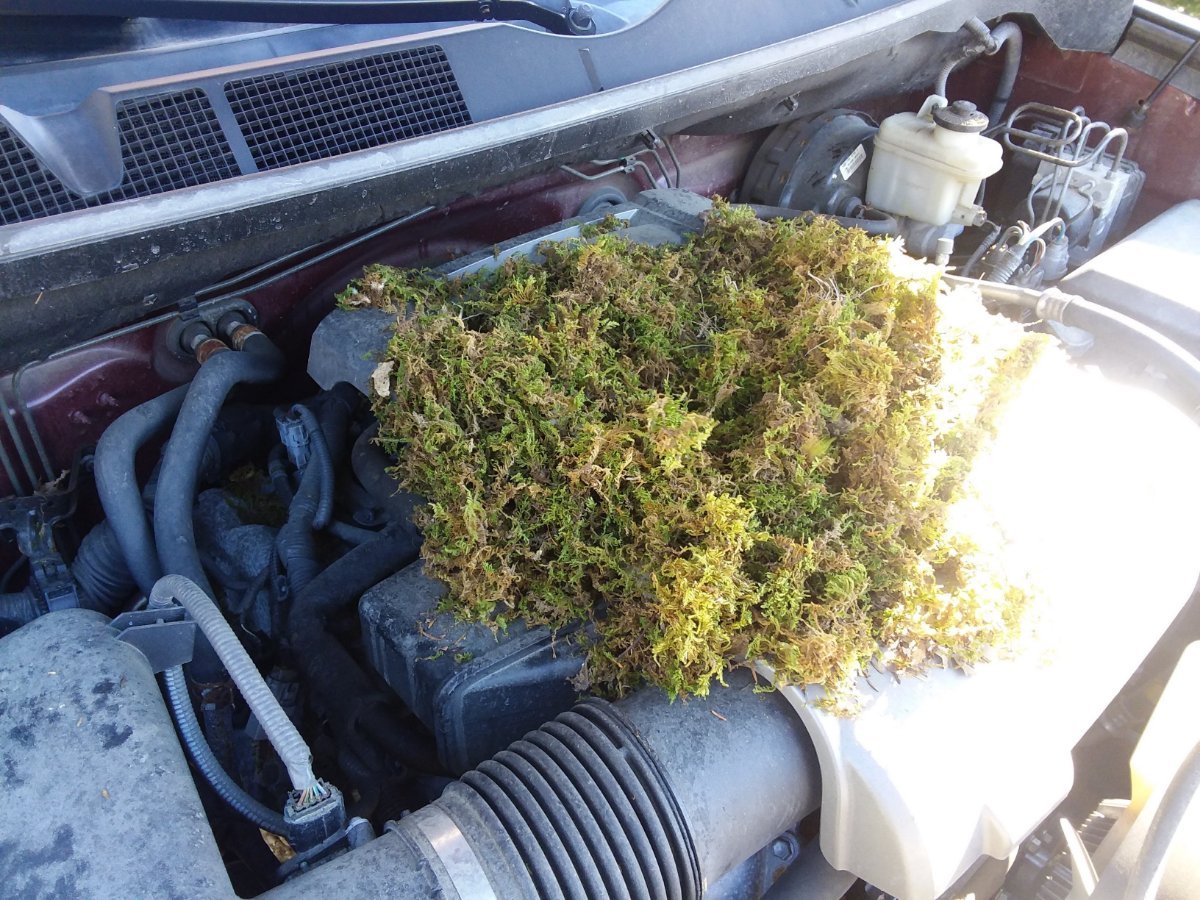
I had to replace the wiring harness on my (no longer owned) 2002 Tacoma due to rodent damage. My comprehensive insurance covered it. I then had to replace the fuel lines on my wife's Corolla also due to rodent damage. I now enlist traps and plastic snakes and it seems to be effective. I have fire extinguishers everywhere. Glad to hear OP was on his toes during that event.1 point
-
I'm glad you're both physically ok. Pretty scary! I would also be interested in the findings. We live about 15 miles from Mcb. Here is what I found under the hood of my 2008 Tundra in October of 2018. Good luck settling things.
1 point
-
There are so many YouTube videos on this subject certainly covering all of the major brands. If I were buying a new system - that is where I'd start my research. Having said this - I've been using the EEZTire system "for 5 years or so and have been happy with it". " No repeater necessary." 😃. Seriously, any of the major brands will do the job. And, with most, you don't need a repeater. Bill1 point
-
One way to isolate the inverter when connected to shore power should be to trip the 300 amp breaker that is near the inverter under the streetside bed (press in the button; you can start it up again by pressing in the little flag). To keep the batteries from charging from shore power is to set the charger ignition control in the Xantrex app settings to “auto-on”). In this mode shore power energizes the 110 outlets, the A/C, and the fridge, but does not charge the batteries. Turn the charger ignition control “off” to resume charging batteries with shore power.1 point
-
Looking forward to knowing the cause as I too have a '20 Tundra. Glad to know you're safe!1 point
-
I also use the TST tpms system on my 2021 E II . Easy to set up and and no communication issues without using the repeater. Satisfied customer!1 point
-
We use the TST tpms system as well and were told by a TST technician that the repeater is actually required to maintain the warranty of the TPMS system. The company and their customer service is excellent. https://tsttruck.com - Patriot1 point
-
We’ve been using the TST TPMS for 5 years or so and have been happy with it. No repeater necessary. Mike1 point
-
We have a 2018 Toyota Tundra and just got a preliminary service bulletin on potential fires related to the wiring harness connected to the high beam head lights. No remedy yet. No idea if there’s any connection to your truck. Glad you and your wife are okay. Quick thinking with the fire extinguisher.1 point
-
Nice to know, thanks...1 point
-
Life’s too short for me to wait for the conditions to be perfect….1 point
-
I have bought three vehicles from Autonation dealers, and they have always been fairly priced with no sales pressure. One was my used Land Cruiser, We wanted to see if they would give us an acceptable deal on our ram 5.9 Cummins trade, and when they offered $22k we were gob smacked, because we expected $17k. That was long before those pre emission trucks started going up in value. We are looking at the Acura RDX, if we decide, we will buy from Autonation at MSRP, no worries. One other vehicle we looked at is the new Santa Fe Plug-In Hybrid, some Hyundai dealers sell at close to MSRP but others are marking that $40k car up by $15k. Probably because there are pretty much zero to be found, with orders extending into 2023….. I think Toyota may be shooting itself in the foot by not offering a non-turbo engine in the new Tundra. There are legions of fan boys who simply do not want complicated twin turbos, intercooler, and extra pipes in a full sized gas truck. John Davies Spokane WA1 point
-
The Nissan XD 5.0 diesel was a truck in search of a market. Not enough torque to match the bigger engines for towing, and not especially fuel efficient. And much harder for service access than the inline engines. It died after four years and if you own one, good luck finding parts in the future, once the supply chain dries up. And good luck finding a Nissan dealer with a diesel certified technician….. https://www.titanxdforum.com/threads/cummins-isv5-0l-v8-status.43238/ John Davies Spokane WA1 point
-
That is a pretty harsh statement, but I happen to agree with you 100%. Stickers can easily be removed in a few minutes, Oliver should instead provide a proper heavy wall 2” receiver, and STAMP or LASER ETCH DEEPLY the weight and use limitations into the top surface of the receiver. Then let the user decide what to plug in there. An owner may say, “Oh, the label came off, I did not know!” It is pretty hard to say that with deep cut letters, you would literally have to grind them off….. Let the customer accept all liability for what gets plugged in…. just like this coupler. I personally think that the receiver part should be stainless steel, but at this point in the discussion, that is splitting hairs. As a side note, IMHO somebody stupid enough to tow a car or trailer behind an Ollie will just add an extra step down adapter anyway, regardless of the receiver hole size. Making an engineering change like this one based on one fantastically dangerous customer makes no sense to me at all. John Davies Spokane WA
1 point
-
One oil change every four years is risking internal corrosion. If the machine is parked in a dry environment that may be OK but if you run it even one short time, you should consider changing it more often. A full synthetic is better. An inductive hour meter/ tachometer is a super easy mod to monitor use and engine performance. I change the oil in my Yamaha every 50 hrs or at the end of every camping season. When parking your machine every time, pull the cord slowly until you feel resistance (compression) and then stop. This places both valves fully closed so moist ambient air cannot get into the cylinder and possibly cause rust. John Davies Spokane WA1 point
-
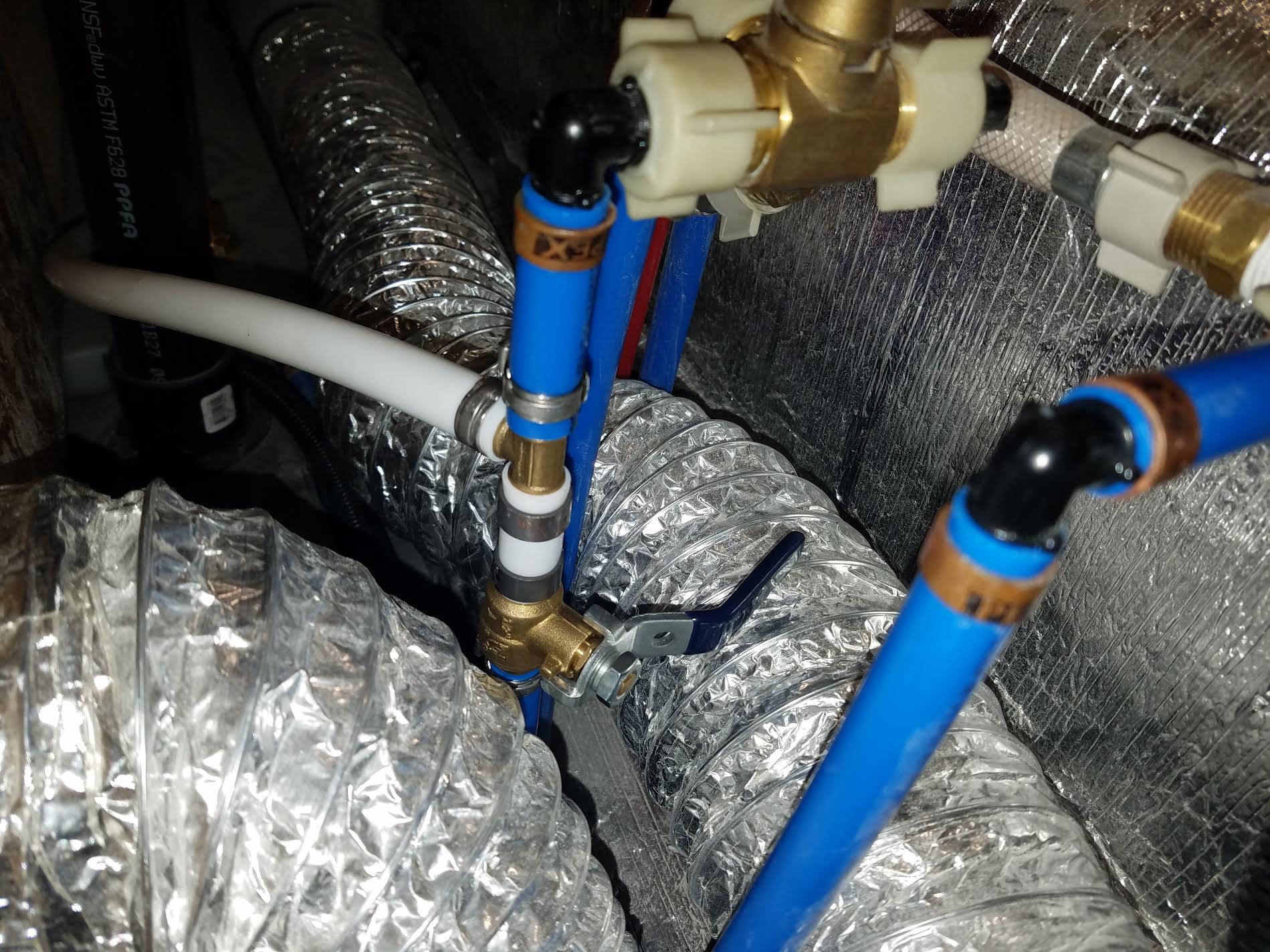
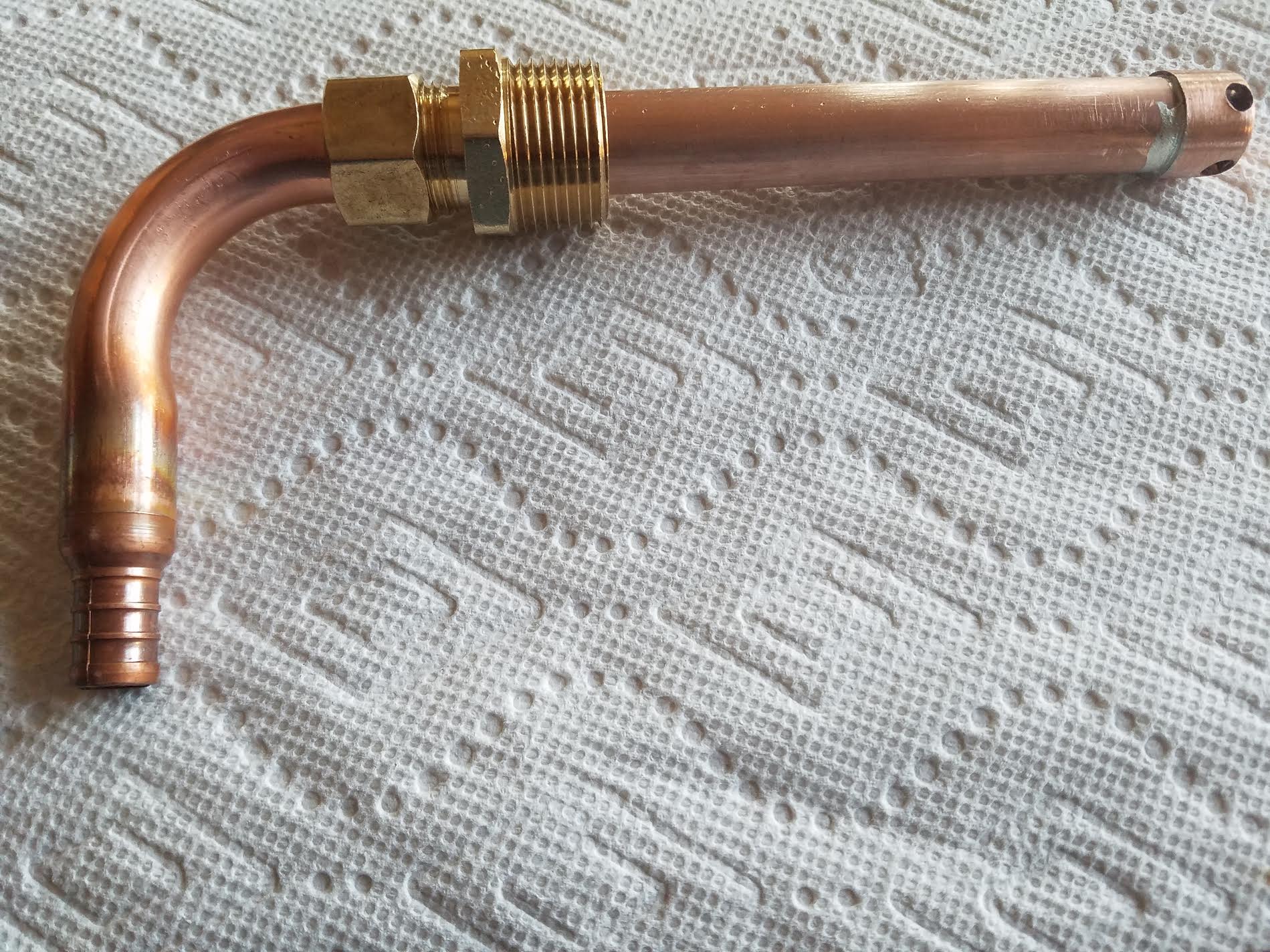
With all the talk lately about not being able to access all of the fresh water in the tank, I decided to make a new suction line and improve the situation. The stock line on mine will only draw water down to about 1 1/2" deep before it begins to suck air. In a 35 gallon tank that is only about 4" deep, this means about 1/3 of the water is not available, or about 11 or more gallons left in the tank. The stock pickup is on the side of the tank and cannot get all the water. So I made a top fitting that goes down and picks up the water at or below 1/4" from the bottom. When I started the installation I leveled the trailer and ran the water until it began to suck air. Mine did that at a reading of 25% on the gauge. If the front of the trailer is raised some, which I did not do, the reading would still be the same when the pump sucked air because the gauge reads right next to the pickup. You could get more water out of the tank with a raised tongue, but the gauge reading would be the same when it sucked air. After I installed the new dip tube, I continued to draw water and it began to suck some air at 6%. So, mine went from 25% (approx. 8 gallons left) down to 6% (approx 2 gallons left) when it began to get some air. Others have reported as much as 38% remaining which would be over 12 gallons. At a 6% reading I began getting aerated water, but a steady flow. Finally, the gauge went to 0% left. At that point is was about 1/2 water and 1/2 air at the faucet, but still flowing, or spitting. But even with a zero on the gauge it continued to pump out another gallon or so before I shut it off. All of this with cold only, not water drawn from the water heater. So, the volume from 6% to 0% was totally useable, probably not for a shower, but certainly for drinking. This is a prototype that works well, but it might still improve a bit with the next one. The pickup touches the bottom of the tank, but draws radially from below 1/4". It adjusts to any small differences in various tanks. It can be pulled out and cleaned easily if debris ever clogs it. All plumbing connections, where the new line ties in, are easily accessible and the existing tank fittings are not touched. The stock tank drain is retained. The area of the tank where the new fitting is installed is easily reached and the tools to do it all fit in the available space. After clearing all of this with Oliver to make sure there is no conflict with forum rules or warrantee issues with them, I can send anyone that wants to do this, a kit with the following: the pre-made dip tube fitting, a Polyethylene tank fitting, the special spin weld fitting driver, a 1 1/2" hole saw (if needed), the pinch ring tool and a PEX cutter. I'll also provide step by step directions for anyone who is interested. You'll have to have a powerful router with a 1/2" collet and a drill to drive the hole saw. Or, I can help you with a set of directions here on-line and you can assemble the parts yourself. The parts required are: (1) dip tube assembly, (1) 3/4" spin weld fitting, (6) 1/2" PEX pinch rings, 24" 1/2" PEX, (1) 1/2" PEX ball valve, (1) 1/2" PEX tee, a small container of Rectorseal 5. The only real tricky part is the spin weld. Besides the special procedure for spin welding itself, you have to make a new hole in the tank and vacuum out the chips. Here are some pictures:
1 point
-
Hopped into the truck yesterday afternoon to go to the market and it burst into flames. When I started it, smoke started rolling out from under the hood. I told my wife to get out, move away from the truck and call 911. When I got out of the truck there were flames in the drivers side wheel well and my driveway was on fire under the engine bay. I ran to the house and grabbed a fire extinguisher. I killed the flames under the truck and then the flames in the wheel well. I stepped back and it burst into flames again. I gave it another shot and put it out (or so I thought). I opened the hood and there were still flames so I attacked it from above and finally extinguished it. Fire dept. showed up and made certain that the fire was out. My truck is a 2020 with less than 8,000 miles on it. Not happy. Not a good time to buy a new truck if they total it. Even if they can repair it I don't think I want to keep it after it suffered a fire like that. Who knows what hidden damage it caused in addition to the obvious.0 points
-
Yep - you missed the 2021 version. Stay tuned for details on the 2022 edition - it is a good rally. Bill0 points














-
Recent Achievements
-