Leaderboard



Popular Content
Showing content with the highest reputation on 03/14/2025 in Posts
-
Like @jd1923 I went with the 2 - 300AH Epoch, I did need new cables for the parallel connections. My cables from my old lead acid batteries were too short. Like you I did not have the tools to crimp the big lugs and didn’t want to purchase for one job. Look up batterycablesusa.com, they will make cables in any length and gauge you want. I did a few different orders during mods for solar, adding shunt, and batteries and every order shipped within a day of me placing it.5 points
-
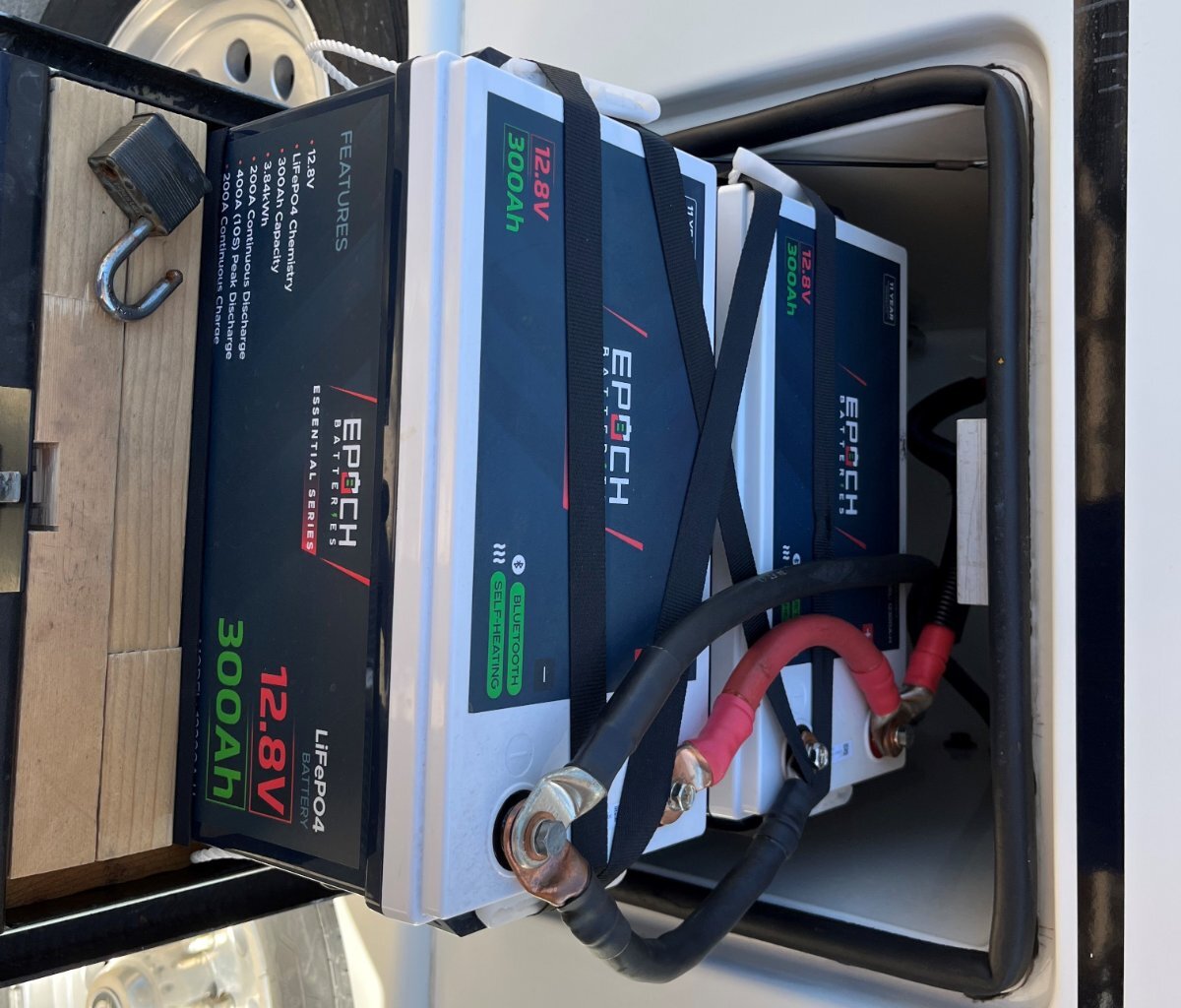
Good thought to buy now. This sale will likely repeat, but most often it is 10% OFF. I have worked a complete upgrade of our Oliver to Victron but will keep this simple. Two 300AH Epoch Essentials fit nicely fit (see pic). Only one 460AH will fit so upgrade possibilities are limited. Unless you're ever considering an inverter upgrade to run A/C for a few hours on inverter, you are correct in thinking 460AH is all you need and double the usable AH in what you have presently in lead acid batteries. All you need to do is: 1) Install the new batteries in the battery bay. A cut-off switch is preferred by some who park their Oliver in covered storage. I prefer to not add extra connections. I go without and merely remove the negative battery cable when necessary. 2) You need to reconfigure (software setup) both your Xantrex and Zamp SC for LiFePO4 batteries. This is usually simple yet tedious. There are others here who have done so. I have not owned either product but worked the same for our Victron and Blue Sky chargers. 3) I was not aware that the "460aH V2 battery comes with a nice wired remote state-of-charge display monitor." My Epoch Essentials 300AH batteries did not. I can see battery State-of-Charge (SOC) % and +/- Amp usage in both my Victron and Epoch Bluetooth Apps. I use no displays, so nothing is installed into the walls of our inner hull. Hope this helps! Best wishes, JD
 5 points
 -
The Ramcharger appears to be a series hybrid which means that the onboard gas generator provides electricity to the batteries to drive the wheels when the drive battery charge goes below the predetermined lower threshold and stops discharging. This feature is great when you deplete your battery and then the generator kicks on to provide electricity. From what I understand the generator can only provide a diminished, set amount of electric to run the drivetrain. This is all fine for driving on flat land at moderate speed and not towing. But what about when you are towing up a significant incline and the battery has gone below its lower limit and the electricity output from the onboard generator is not enough to meet the heavy power demands of towing uphill? It appears the Ram engineers have thought of this and included a “Tow” mode which reserves a preset amount of battery reserve to be engaged along with the generator output in high demand situations. Good thinking. This is very similar to the “Mountain”mode in my Chevrolet Volt (which reserves electric for climbing when using the onboard gas generator. But, what if someone forgets to engage towing mode and depletes their battery before starting to climb a long steep grade while towing? If the Ramcharger behaves like my Volt in similar conditions, you can quickly reach a point where energy demand outpaces the capability of the onboard gas generator, forcing the vehicle into reduced propulsion mode. I know with my volt the accelerator response and power is greatly diminished, placing the car into a sort of enhanced limp mode. Will the Ramcharger do the same? Will the reduced propulsion mode on the Ram be enough energy to tow a heavy trailer up a grade slowly or at all? Will the tow vehicle come to a stop leaving you stranded on incline? Who will be first to test this out and report back? my point above is stated perhaps more clearly in this article, however it is still not clear whether the enhanced battery reserve is available in standard drive mode or only when the driver manually engages tow mode before heading out with a fully charged battery. https://insideevs.com/news/751670/ramcharger-battery-size-usa-towing/3 points
-
You’re welcome Dan. Not much of a free monitor, nice promo, the app shows much more info. An Automatic Transfer Switch (ATS) can be added to run the A/C via your 2KW Xantrex, given when not running anything else large. There are posts on that upgrade here. Likely the extra 140AH going to 600AH gives you another hour to 1 1/2 hours. I’m guesstimating the amperage draw of your 11K Dometic. We have the larger 13.5K model. They are as inefficient as they are noisy! The other thing about going to the 300 AH model, is 2 fit in the tray and 3 for 900AH total fits in the battery bay with the slide out tray removed. You cannot get 2x the 460 AH Essentials no matter what. Going to keep your Oliver for a lot of years, the 300s are a better future-proof upgrade. You should have all the 4/0 battery cables you need. Attach a picture if you want me to verify. I needed slightly longer bolts than what Epoch included where the cables were doubled up. Simple HW store item. Finished cables can also be purchased on Amazon and companies like Powerwerx and others.3 points
-
As I mentioned, I prefer not to add displays where unnecessary. This is the readout on my Epoch app today. The app is free to download. I’m presently using 1.8A as she sits. It’s snowing this afternoon, and I rarely plug into shore power, so no sun no charging. Our Victron inverter/charger takes 1A on standby which I leave on 24x7. We also keep outside Courtesy Lights on (0.3A) and parasitic draw another 0.5A. This app is all you really need and perhaps Xantrex and/or Zamp apps. Love the apps! You cannot read a mounted display while towing or sitting at home.
3 points
-
With the 15% off sale that just started on Epoc lithium batteries, I'm considering upgrading my AGMs in my 2020 LEII now rather than waiting on their inevitible decline. I'm not an engineer or and electrician so I'd like to follow the "keep it simple" principle and do it myself. I know there have been several threads here about lithium upgrades and most seem to be extensive with new Victron equipment. It seems I could keep all of my current system and simply replace the batteries and reprogram my inverter and solar charger...I think... I have the Xantrex Freedom XC 2000W and Zamp ZS-30A solar controller I'm considering either a single 460aH V2 or two of the 300aH Essential batteries from Epoch. So can I ask the advice of the incredible brain-trust here --? I think 460aH seems enough for what we do but would the two 300aH be worth the extra cost and still be easy to install/manage without additional equipment? I don't have a battery disconnect switch in my 2020 LEII so the built-in on/off switch on the 460aH battery is appealing and I wouldn't need a smart shunt...is that correct? The 460aH V2 battery comes with a nice wired remote state-of-charge display monitor. Has anyone installed this in your Oliver and where/how did you do it? Any other considerations or modifications that I would/should consider still under the "keep it simple" principle? Appologize for yet another lithium upgrade post - but I thought this may be valuable to many other owners with aging AGMs like me. Thanks in advance for your advice!2 points
-
ASSUMPTION: From the internet,: Swamp coolers are primarily used in the dry, hot climates of the Southwest United States, such as Arizona, New Mexico, and parts of Utah and California, and are less common in areas with higher humidity." Keeping in mind that not all occupants in these states use them, as is evident the number of AC in those states. For this post, I'm saying I think that in the USA, for mechanical cooling in the USA, let's estimate that 5% of USA cooling units are Swamp Coolers. And the other 95% use regular refrigerant A/C's and/or Heat Pumps for mechanical cooling (AC). Now to your above thoughts: The AC evaporator coil has the capacity to store well over a quart of water on its very large amount of heat transfer surface. You turn on the AC and it is dry. As humid air passes over the coil, it condenses water from the air and it stays on the coil. Eventually the coil is saturated, and it begins to drain water out of the AC unit. As it continues to run the process continues and water flows out of the unit. This is true for all AC units. For the Houghton Set1, and most USA air conditioning units, the fan and compressor units cycle together. This keeps the condensate on the coil between runs. The humidity in the cabin is lowest just as the unit shut off the compressor. The humidity will then rise naturally due to occupants and their activities. But this typically is a slow process and before it gets out of comfort range, the control system cycles the compressor back on. Comfort is assured for 95% of USA applications. But for Houghton's Set 2 units and similar designed units, when unit Thermistor/T-stat reaches set point, they shut off the compressor but not the fan. The condensate then gets evaporated into the cabin. For 95% of US applications this is not good. This can be demonstrated with any heat pump. Just turn the heat pump on in "Cool" mode, and run the unit until you see condensate exiting the unit. Then switch the Heat Pump to heat and FEEL the humidity as the heat pump inside coil heats and evaporates that entrained condensate. You will be amazed. And can then fully understand one of the problems with Houghton Set 2. Your scenario in AZ is very much like what the AU Houghton typical customer wants. You are spot on. BUT most OTT owners are FAR more concerned with too much humidity and heat. As such, you likely would LOVE the Houghton Set 2 units....Until you took a vacation to most other USA locations. So, as you mentioned 🙂 This is why I have made the case for Houghton to provide a selector switch serving the supply air fan and compressors so as to allow the occupant to switch them accordingly to their needs. This would greatly benefit the vast majority of USA users and the bottom line for RECPRO and HOUGHTON. Combine this with a remote thermistor/T-stat and it would fix the cycling issue as well. Doing so would make it easy for all of the USA Market to use their product out of the box. And if they really really wanted the Air Stream and OTT customers to smile big, redesign the lower pan of the unit to allow for gravity drain of the condensate without needing an electric condensate pump like they have now added to the 15K BTU unit. Again they took the wrong design path....... Until such design improvements are made, their amazingly wonderful unit would not seem to be suitable to those chose not to execute Mod 1 and 2. But for those that can, it is a GREAT unit. GJ Sorry for the above response from deep inside the rabbit hole.2 points
-
Yep, we weren't going to wait in line at Q for a dump station. We dropped some gray when boondocking afterwards (legal in FS and BLM when 500 ft from others and water sources which is easy enough in Arizona). We carried 2 days of gray and a 3/4 full black tank back to the dump station in our neighborhood, carried it up 4500 net in elevation, up the Bradshaw Mountains, but negligible additional weight considering our rig and available GVW. On another trip after 3 nights boondocking at Parowan Gap, there was a free dump at the Sunoco in Cedar City UT. Not a good design for the Oliver as we had to back in uphill and over a driveway hump! You do what you gotta do. The portable ramps help and I've used them many times in similar situations. 🤣
2 points
-
I would NOT suggest using measurements from other installations. Each OEM installation is different and each new installation is different. Measure your specific needs. I noticed in one installation, the same two Epoch 300s that I purchased but in that installation they put the batteries with posts on opposite sides, which required longer cables. I put the terminal sides of the batteries both on the right side. I added a 2x4 in-between the two batteries. The Epoch 300s are 7.6" wide and with the 2x4 made the terminals 9.1" apart. My OEM installation included 2 shorty cables that I gave to the guy that bought my LA batteries AND two cables were just under a foot, long enough to reuse. I cleaned them up and applied new heat shrink and did not have to buy any new 4/0 cable for my battery installation. Before and after pics below. You can barely see the original red cable I reused which is far right off the picture. The black one I reused is shown on the left. I the new installation they actually fit better, less arced. I also added a picture of my tray design. The wood 2x4s made it easy. Notice the rubber toolbox liner underneath. I also used the same rubber to surround each battery so that the batteries would not rub on the wood.
2 points
-
I know this is the 4/0 cable I used, very flexible. I can’t seem to find my order in my email. When I get a chance will take some measurements and post.
2 points
-
I installed a 460Ah LFP battery bank (SOB) and the ATS @jd1923 mentioned to enable use of my Xantrex Freedom XC 2000W inverter to run the former DPll 11K; a three hour run time would drop the SOC to 50%. I have since replaced the DPll with an Atmos 4.4 15K, but have not had much experience regarding inverter run times, but hopeful the higher efficiency of the upgrade will provide an increase.2 points
-
I believe what he stated in the video is out of the 90 kWh battery only 69.7 kWh is available to maintain a huge buffer for those times when it is needed for increased demand when towing uphill, etc. The example he gave for testing was Davis Dam. The truck towing 14, 000 lbs (2,650 lbs payload) could go up 3000 feet over 11 miles on a depleted battery. But I agree, what is the range difference in a variety of real world applications. So interesting, having a Pentastar V6 for generator only. 7.2 kW available to power your house if needed!2 points
-
2 points
-
Turns out the 2026 Ramcharger is more interesting than I originally thought… range is not cut in half like a 100% EV truck and when at the end of the 690 mile range you can fill up with gas and continue on your way. Even if the battery was depleted as well, at the time of fill-up. Pretty interesting.2 points
-
We use The LevelMatePRO app while backing into a campsite! Can't live without our LevelMatePRO, VictronConnect, Epoch Batteries, Ruuvi Station and Mopeka LP tank sensors and Apps!2 points
-
Scott, happy to chip in for the hall. How is the best way to do that? Gary, Anita, and Ranger in the Range Rover, Hull 2922 points
-
All good information! Thanks! And thanks @Derek B for the link on the cable supplier. I have not ordered lithium’s yet, but this will be helpful when I do!1 point
-
True. The pentastar engine is tried and true, but not as an "onboard generator. " I do think it's an interesting concept. Most pickup trucks really don't do a lot of long haul. My Silverado hasn't left the county in over a year, though it has been to Canada a few times. The pentastar as generator definitely should reduce range anxiety. Or, if you really use your truck "mostly" locally, like many of us, you can charge at home or at a station, and run on electric most of the time. I'm looking forward to seeing one later this year.1 point
-
Something important to me in determining this layout was an easy disconnect. I did not want a kill switch. Instead I needed the main B- cable, the long run back to the inverter, to be at the outer edge of the battery bay. With this layout, I can just open the battery tray to remove the closest bolt, hence removing the system ground. The B+ terminals are further in so there is little chance of me hitting them with the 1/2" wrench required to disconnect the batteries (see pic above).1 point
-
On 3/13/2025 at 9:15 AM, Galileo said: IF we have full hookups, I dump before leaving the site - because I like the nose of the trailer as high as possible to get good drainage. But we never use the site sewer “real-time”. If no sewer connection, we hit the dump station before hitting the road. (That’s the way turkey vultures do it - vomit before departure to reduce takeoff weight!) There are plenty of campgrounds and open camping areas with no dump. Leaving the Dome Rock BLM area at Quartzsite is a common example of having to tow with some amount of fill in the black and gray tanks. You could detour into Quartzsite to one of the commercial dump facilities if weight is a concern, but we’ve always just hit the road to dump at our next location. Even then, we’ve had camping spells where we did 2 or 3 locations with no dump. As Steve explains, these trailers are pretty robust, and if you are towing with a 3/4 or one ton truck, weight control does not have to be a primary concern. Mike1 point
-
@Derek B any chance you could post up what cable lengths and gauge you ordered from batterycablesusa.com? It would be nice to have the right length cables prior to ordering the batteries. Like you I see no need to make my own. This sounds like a solid company to order from. Thanks!1 point
-
That is my practice; the sewer part, not the vomiting!1 point
-
Good question, John. Tires is another consideration and I will explain this is not the limiting factor in this situation. We have the Michelin Agilis 225/75R16 Load Range E tire on our Oliver which I believe is the OEM standard. And any LT E-rated tire of same size, from any manufacturer, would have the same load specs. Looking at the first row of this table, ONLY 40 PSI is required for the Oliver GTWR of 7,000 LBS (4 x 1,795 = 7,180 LBS). Truly this is all the pressure you need. I run anywhere between 42-46 PSI, thus adding a small safety factor. Any number in that range that I can set all 4 tires to without getting out my air compressor is good enough for me! If any of the four tires are under 42 PSI then I'll air up to 45 PSI on all fours. You can also see that at 65 PSI you can run a load of 10.480 LBS (4 x 2,620). This says it all. So, if you have 5,200 axles with 12" brakes and HD leaf springs, the 12.5K Bulldog, just raise tire pressure to 65 PSI and everything will be in balance to run the 10K LB trailer. This size LT tire can handle over 12K LBS at 80 PSI.
1 point
-
The Atmos does this too, but sitting in Ron’s Oliver at the Texas Rally, where temps were mid 80s, not summer humid, his A/C dropped temp from OFF to very comfortable and humidity dropped by 11% at the same time! (In 20-30 minutes) I remember numbers and our friend @Ronbrink has all the temp sensors and gadgets, an extremely well-equipped Oliver! So why does one create humidity and the other does not? Kevin at SDG told me it’s cause the condensate is expelled to the exterior. They both do that. If Australia is hot and dry, same here in Arizona. I want the humidity but NOT fan noise. I figure when it’s cooled off and the fan is running, I’ll be in bed and hit the remote to power off the system! 🤣1 point
-
Thanks @jd1923 for the info and sharing your upgrade. Two 300aH do fit nicely in the slide out tray. I'm having a difficult time deciding between the single 460aH vs two 300aH. Here is a picture of the new remote monitor that only comes with the 460aH. The physical on/off button is also only on the 460aH and seems great as I could just conveniently turn it off comletely during storage under cover. I agree that the Epoc app seems to be everything I would need for monitoring but I thought maybe I would locate this remote SOC meter inside the pantry or in an upper cabinet with some kind of surface mount to avoid drilling any holes in the fiberglass. You mention the consideration of upgrading my inverter down the road, allowing it to run the A/C. I have the Dometic Penguin II 11,000 BTU with soft-start installed. Do you know what the estimated run time difference would be between having 460aH vs 600aH? Also, were you able to use existing battery cables with your set-up? I don't have the tools to make those big connectors. Thanks, Dan
1 point
-
Yes and YES. The key to your, mine, and a boat load of owners is the ABILITY to choose Off or On of the fan. The Houghton Set 2 units do not so provide. Hence serious humidity issues caused by this AND the fact that on the Set 2 they mount the thermistor (that controls the compressor on/off) is mounted inside the unit and does not very well reflect the cabin temperature in the middle of the cabin. Such a huge mistake for likely 90% of the US market. But it is just fine for 90% of the AU market there it is hot and dry.... They chose, and continue it appears to not give a hoot about the USA 90%. At least not yet I hope. Why? Their unit is a really great unit otherwise. GJ1 point
-
I was conservatively using the 300 horsepower rating of our Tesla verses the Honda generator at 2.5 hp. It's actually way less than 1% because the Cyber truck is rated 600 to 800 hp. They say that regenerative braking re-captures about 20% charge, and that's already factored into the range estimates. Our Tesla has never registered an increase of charge even on the longest downhill grades. It sure registers discharge going up them through. 🫢 I see this technology working well for long haulers where they can stop for hours at charging stations. But I think there is still a ways to go before it's practical for campers.1 point
-
Very slick! With Apps - you don’t have to cut new holes! Only one I’m using so far is the LevelMate Pro+ - but it’s a huge timesaver while setting up!1 point
-
Dunno why the mfrs of RV air conditioners haven’t included the features that even cheapo window units have. Though sometimes I like a fan running all the time just for circulation sake, most of the time I want the fan to shut off. That said, I want the fan to run until the evaporator coils have equalized in temperature before the fan shuts down. I forget what they called that setting on my last window units, but it was nice. If/when the fan and compressor shut down at the same time, you have all that nice cold just wasted there in the housing. May as well blow it out into the area you’re trying to cool, right? I think a lot of folks buy too many BTUs and it’s counterproductive from what I’ve read. If you cool the room (trailer) too quickly, you don’t move enough if the room air across the evaporator coils to adequately dehumidify the air. That’s (more than) half the battle in making interiors comfortable when it’s hot and humid. As I understand it, there’s a new generation of high efficiency a/c’s that use another method of reducing humidity.1 point
-
@Galileo, you may want to see the new 2026 ramcharger when it (finally) goes on sale later this year. It's a phev, but the gasser 3.6 pentastar V6 engine is strictly an onboard generator, not part of the drivetrain. Although it is gas vs diesel, it's a bit like what you described, and makes a lot of sense, to me. Charge while driving from the fossil fuel motor, and reduce the range anxiety. I'll be interested in seeing talks towing test when they finally get their hands on one. Even if range is cut in half by towing, you'd still get 300 miles or so between charging (or, just filling the gas tank). Best of both worlds, if it works as stated. https://www.ramtrucks.com/electric/ram-1500-ramcharger.html#overview1 point
-
The houghton IS a great unit. But if they have not gone back to their SET 1 configuration with a remote thermostat and where the fan shuts down when the compressor shuts off then that is a significant concern for most owners. WHY? Most owners will not want to risk making the two mods to fix these SET 2 issues. Once the mods are made, then I still feel that the HOUGHTON 13.5 k unit is GREAT. It however does not have a condensate drain system as of last week when I I checked. But the larger 15K does. That said, I think the 15K unit is oversized for even hot weather use and would not recommend it as such. Also check the height difference. The 13,5 is a reduction over the Dometic OEM on most OE2's.1 point
-
No, sloshing “water” around in the black tank is probably a good thing. But as I mentioned, we rarely put anything that needs sloshing in our black tank. Just how we roll. I try to baby our systems as much as possible. Aside from not caring to tote around water to get stale and start growing things, my major reason is the 600 plus pounds you’re starting, stopping, and supporting with your RV and TV suspension. The Oliver is heavy enough without having water taking up half the carrying capacity of the trailer. Yeah, I -suppose- if we got to a campground that was supposed to have potable water, but didn’t, we’d be unable to flush the toilet or wash dishes, but we always have drinking water. That, and I keep a lightweight, collapsible 5 gallon water “jug” handy. I was only tempted to use it once. Opted instead for a l-o-n-g potable water hose to squirt a few gallons into the FWT. IF we have full hookups, I dump before leaving the site - because I like the nose of the trailer as high as possible to get good drainage. But we never use the site sewer “real-time”. If no sewer connection, we hit the dump station before hitting the road. (That’s the way turkey vultures do it - vomit before departure to reduce takeoff weight!)1 point
-
With the Atmos, the foam strip supplied to support/level the aft is the same density as that used around the roof cutout, which supports the weight of the unit.1 point
-
I guess I was thinking some kind of durable plastic material (HDPE, LDPE?) cut or milled to shape and “glued” to the room with RTV or some other sealant would be required. “Foam” is a kind of vague term. Could be squishy, compressible foam, or could be rigid. (I’d assume rigid would make more sense.)1 point
-
So is the “fiberglass landing” actually part of the roof construction or is it an additional molded fiberglass piece bonded/glued to the roof? The reason I ask is if it is a separate piece we could purchase it from Oliver and glue it in place to support the air conditioner. If it’s part of the roof on the newer models……well I’d have to use part of a new roof gasket for support. Thanks1 point
-
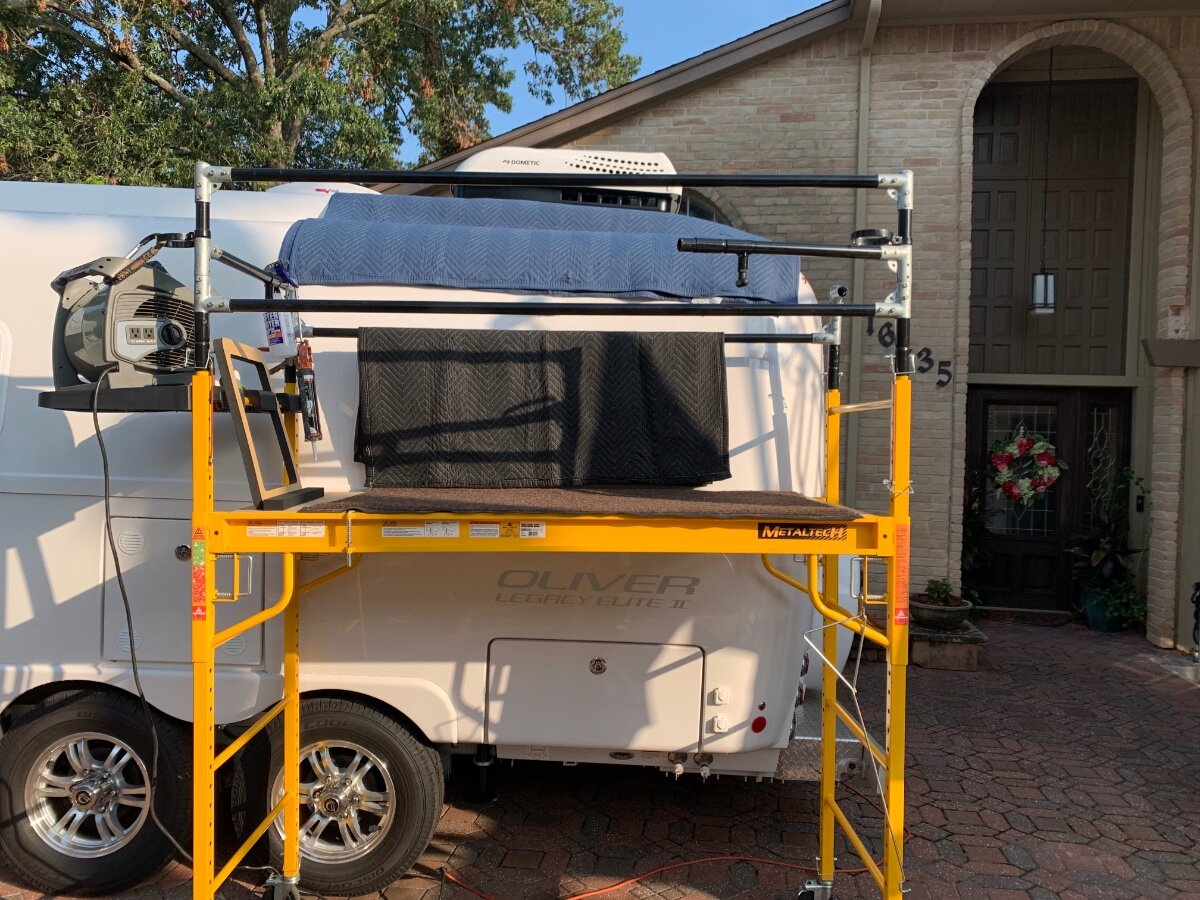
Great for the upper reaches and roof areas/components; whether washing, waxing, maintenance or repairs. I custom made the black guardrail with swing/locking end rails for access/fall protection. Shown here when staging for an a/c swap. And here when waxing in summer heat.
1 point
-
I use Adams Mega Foam with an MTM Hydro foam cannon and a CarCarez Long Handle Feathered Bristle Angled Scrub Brush for a quick and easy clean!
1 point
-
Choose marine products, rated for fiberglass. 17 years outdoors, our Ollie still looks good. 2x year, marine wax (3m, now collonade). Marine boat soap, etc. Welcome to the family!1 point
-
We Meguiars soap and Ceramic Coating. Jolli Olli gets a good wash and spray coating of Meguiars Ceramic coating after each trip.1 point
-
Hey Felix, congrats on the new Oliver and welcome to the group. Any good product should be fine to use to clean. Chemical Guys sells good stuff. I’ve used Griots and Meguiars with good results. Lately I’ve been using the stuff from the CGI team that did our ceramic coating a couple of years ago. Mike1 point
-
We've been using Meguiar's Marine/RV Gel Wash on the Oliver. If you prefer a wash and wax product, I've had good luck with Meguiar's Ultimate Wash and Wax on cars and trucks.1 point
-
Welsome to the forum and congrad's on your Ollie purchase. I would stay away from any chemicals on the firerglass. I use Star brite boat soap and Meguiars Flagshio Premium Marine wax. There is a lot of discussion on this frum about what people like for fiberglass wax. Use the Search bar in the upper right of the forum to locate those posts. If you have not already use, Oliver's University page to learn more about your Ollie and all of its equipment.1 point
-
I received a response from Lippert (Girard Awnings). Here is a copy of the response. "Thank you for your response. We have taken note of your selections and confirmed your rally on our calendar. We are excited to kick off a successful rally season together! Here's what you can expect from Lippert this year: Rally Coupon Code: This will be a discount code provided to all rally goers to use at our online store. This coupon code will be for 20% off any items on our online store. Door Prize/Giveaway: This will be an item selected and donated by Lippert for you to use as a door prize or giveaway for your rally. Welcome Bag Kit: This will include items for attendees with information about Lippert plus a few SWAG items." I was specific that it was for Oliver Trailers, so hopefully it is items we can use.1 point
-
We've been very pleased with the basket and boxes. Now that we've had them for almost 6 months we can give more feedback. First, many have asked about their weight limit. As @Patriot mentions, this is a question better answered by Oliver. Sea Biscuit doesn't provide a weight limit, but the basket and boxes are very robust. Oliver has a 150 lb limit on their optional bumper receiver. Our unladen receiver weighs 26 lb, so we're looking at a maximum of about 176 lb hanging on the rear bumper. The Oliver receiver could probably handle more weight, but you also have to consider front/rear weight balance. Our Sea Biscuit basket and empty boxes combined weigh 74 lb. If we observe the Oliver weight limit, we can carry 102 lb maximum in the boxes. We only carry about 30 lb of bulky/dirty items in the boxes: chocks and blocks in one rear box and a (very) small grill in the other. We also have the Oliver front basket, sometimes loaded with 70-80 lb of gear (e.g. generator and fuel) which helps offset the weight on the rear. Access to the dump hoses stored in the bumper is a minor inconvenience, but less so if you keep the hoses attached. Since we have the Nature's Head, we only have to deal with gray water. If we had a black tank, then we wouldn't want to troubleshoot a leaky hose or connection while the basket is attached. That brings us to another access issue. The basket must be pulled out about 4-5 inches to remove the spare tire cover. This isn't a big issue though. We can just pull the pins holding the basket on the bumper and slide it back a little without removing it from the mounts. No tools required. Fortunately, we haven't had to use the spare, but the basket won't be a problem if we do. Besides the convenient storage, especially the easy access to the chocks and blocks, an unexpected big benefit is that the boxes are at countertop height when parked on level ground. We always have an outdoor table set up. The boxes are also strong enough for a 225 lb person to stand on, making it easy to visually check things on the roof. Steve1 point
-
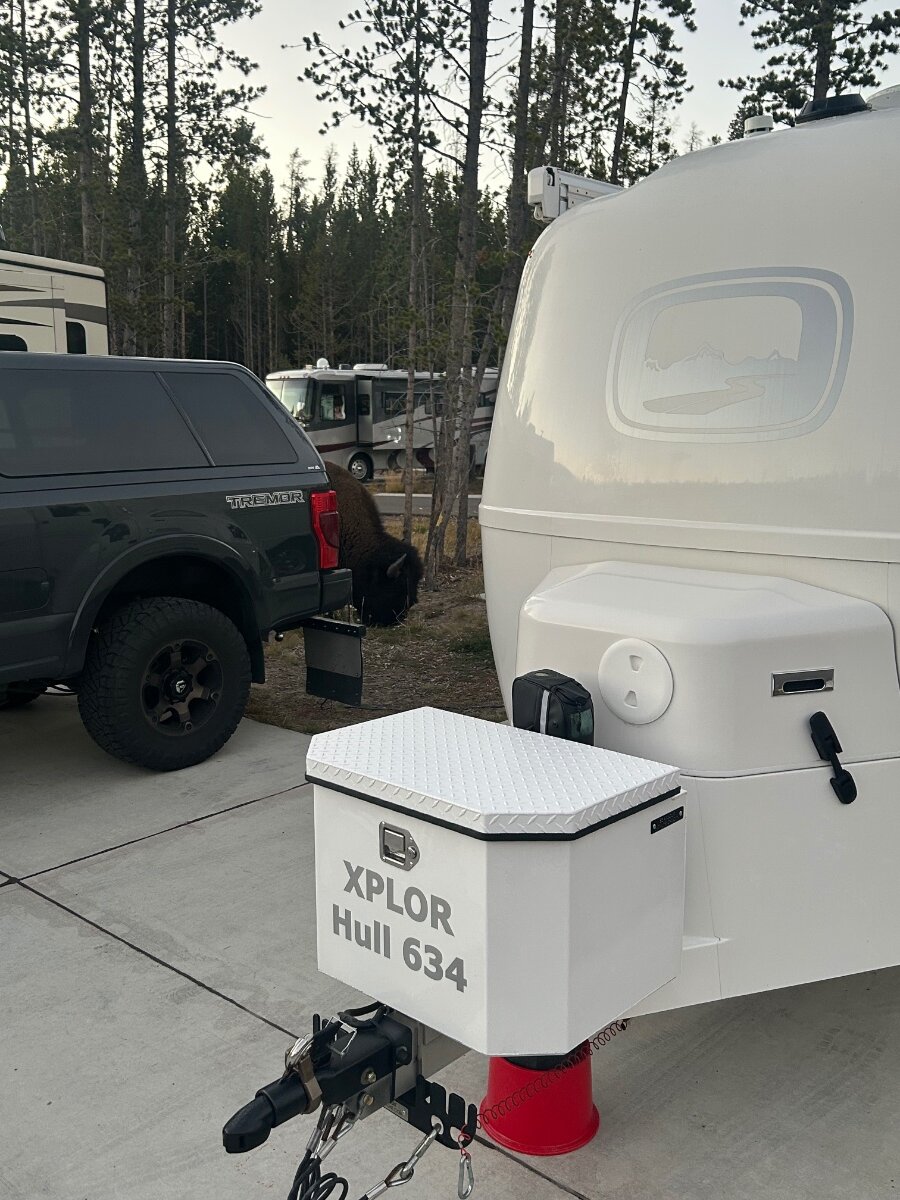
Hey Jim, My input- We are one of the first owners of many to install the SB cargo box. We absolutely love the amount of room it has, and it suits our set up gear with quick access perfectly. I use to secure our generator in the OEM Cargo box. After our 6000 mile trip out west last year and never using the generator, we reevaluated keeping the generator on the tongue and decided to just carry our Honda 3200i in the bed of our TV. The room in the SB cargo box allows me to keep all my immediate set up gear ready to deploy - 30 amp cord, chocks, Andersen blocks and levelers, 4 rubber chocks with lots of room for other miscellaneous items. Before the SB box install I was storing these items in the bed of our TV in an Action Packer box. The SB cargo box has made life easier just keeping everything right where I can get to it quickly vs unloading gear out of the bed. This box has continued to serve us very well even right now as we are out west again. We have not had any issues with water getting into the interior of the cargo box and we have been through some heavy rains on past trips. We always try and support USA made 🇺🇸 products and I think you will find David and Kristine Hess the owners of SeaBiscuit some of the finest people you will ever meet. David and his team take pride in what they craft and produce. I would also suggest you consider the moose rack he makes (pic below the hitch). It will keep your safety chains or cables stowed and off the ground. For what it’s worth, that is my input all the way from Cody, Wyoming now slowly headed home the long way round to North Carolina. 🇺🇸 Cheers and Happy Trails! Patriot🇺🇸
1 point



















-
Recent Achievements
-