
topgun2
-
Posts
7,789 -
Joined
-
Last visited
-
Days Won
467
Everything posted by topgun2
-
I assume that the areas shown on the right side of the drawing are the extensions for the twin bed model? Bill
-
Shear pins? I'm not aware of any shear pins on or in our Olivers. I can't even think of where they might be useful. Bill
-
Brad - Matteo no longer works for Micro-air and PM's to his old contact on this Forum are not monitored with any great frequency. I would suggest an email or call to the company for assistance. Bill
-

any one use Fastway Flip Jack Foot on an Oliver II
topgun2 replied to ScentFreeInSC's topic in Mechanical & Technical Tips
Another (potential) downside is when you would need to lower the front of the camper as far as you can get it. This device would add another couple of inches - the device plus a wood block to rest the device on as per the picture in step 9 of the owner's manual. However, if you always camp on relatively level sites, this should not be much of a problem. Bill -
Nan - Ever thought about renting an RV for a few days? Certainly it would be a way for you to "test the waters" without the financial commitment. I'm not aware of anyone or place that would rent an Oliver. But, at least you would be able to get an idea of both the reality of your dream and most of what is required of you to reach that dream. Bill
-
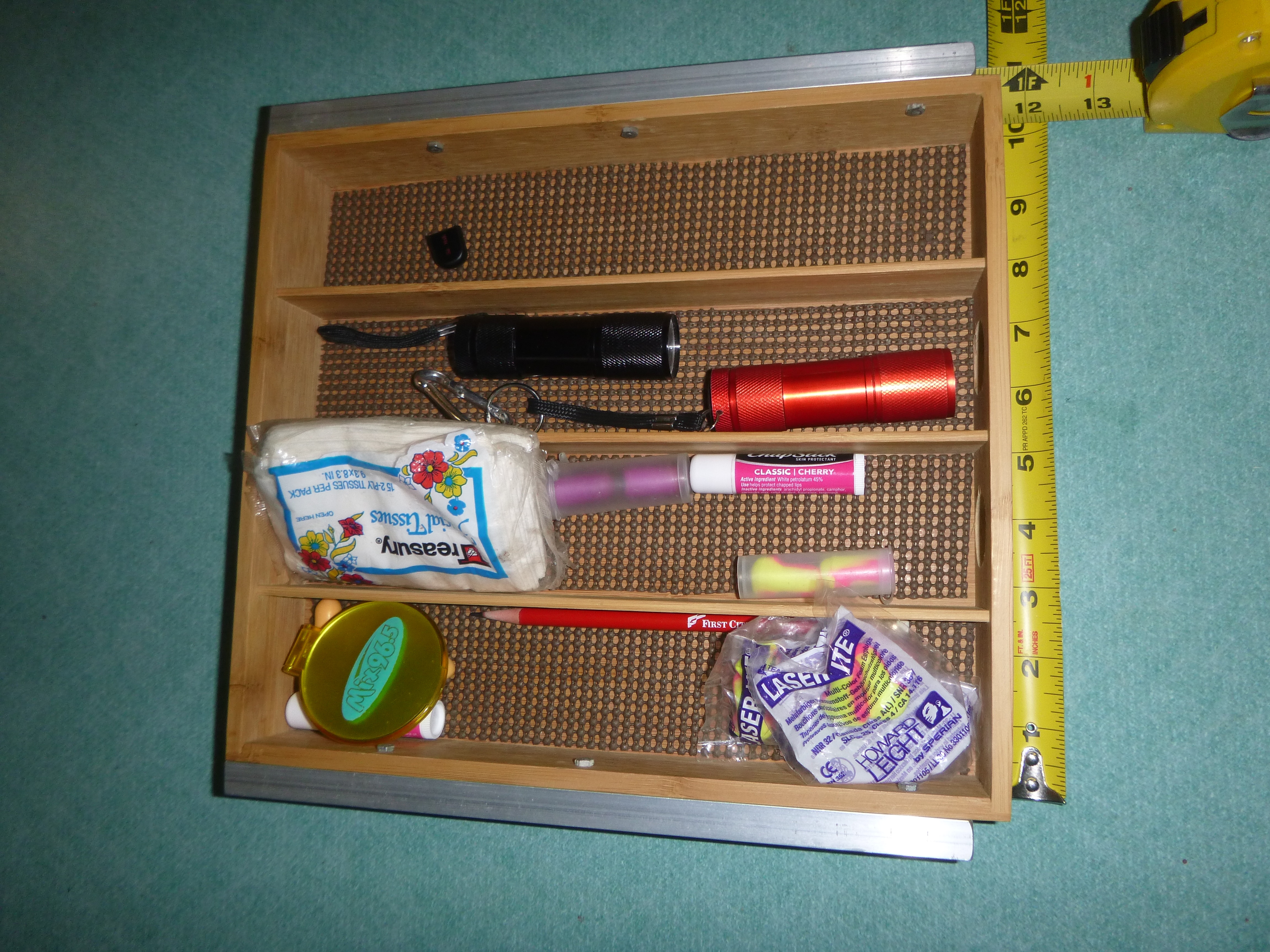
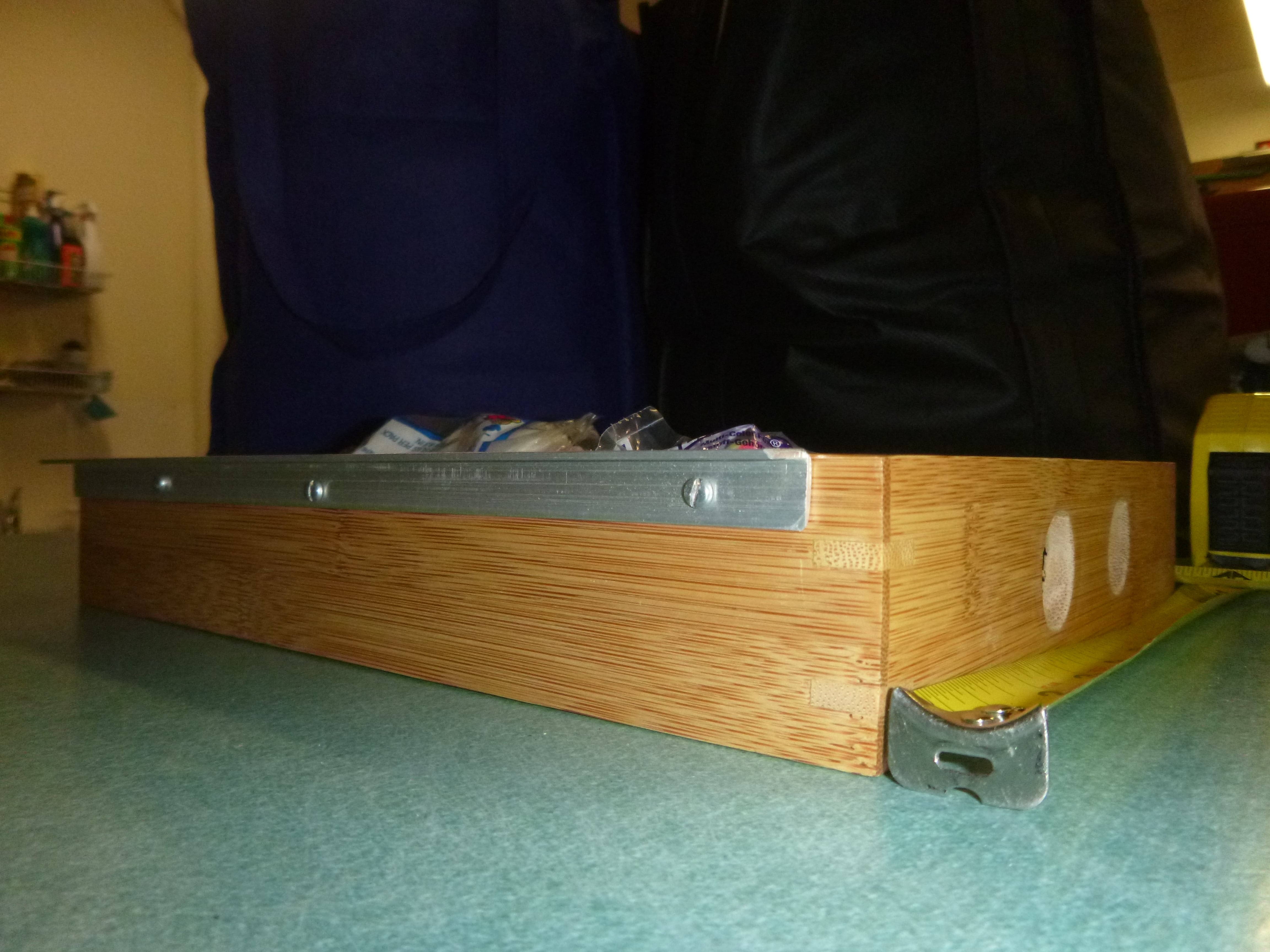
Kathyrn - As I recall, I paid right at $10 for the one at Target. The critical measurement is the width - the tray obviously has to fit inside the nightstand drawer. As can be seen in the photo on my original post, the width of mine is right at 10 inches. Perhaps, depending on what is used to suspend the tray on the sides of the drawer, the width of the tray could be as much as 10 1/4 inches. Contrary to Overland's tray, the one I bought at Target is constructed entirely out of Bamboo. But, frankly, I really didn't care about the construction materials and would probably have preferred plastic from a cleaning perspective. Again, as Overland says, I'd simply look for a tray with the proper width, and cheapest cost as long as it has enough structural stability to handle the kinds of things that you wish to store in it. Bill
-
I am now the proud owner of a Legacy Elite!
topgun2 replied to cmdmom286's topic in Introduce Yourself
Yes - you have met them. A very interesting couple with a number of mods to the Oliver. Bill -
I am now the proud owner of a Legacy Elite!
topgun2 replied to cmdmom286's topic in Introduce Yourself
Tom & Cheryl - Actually, Bruce and Cheryl Norton (fellow Oliver owners) demonstrated Duragloss products for me at last year's Owner's Rally. Cheryl is the one that recommended using that mixture. Using a microfiber cloth you spray this mixture on, wipe with one side of the cloth and then give the area another wipe with the other side and you are done. No streaks - just sparkle! I've used so many different "wax" products in my life that all the claims of "easy", "best ever", "no streaks", "like new", etc. have created so many callouses that just leave me numb. But, when someone actually shows you - on your Oliver - how this stuff works, it is difficult to not become interested. No, neither the Norton's nor myself get a penny or anything else from Duragloss for saying these things. Bill -
I am now the proud owner of a Legacy Elite!
topgun2 replied to cmdmom286's topic in Introduce Yourself
Celia - While there ae many good waxes on the market, I believe that you will hear the most about either 3M products and/or a wax called Rejex. I used Rejex until a year ago when I tried Duragloss products. I use a 4 to one mix of their product 923 (4 parts) and 952 (1 part) on everything inside the Oliver. Yes, this includes the counters, mirrors and fiberglass. I simply can't say enough good things about it. On the exterior I use Duragloss product number 501 (Marine & RV Polish & Cleaner). Duragloss lasts as long as Rejex but is easier to apply and remove and leaves a "slicker" finish - in my opinion. Bill edit: John is correct - an enclosed storage facility certainly is much easier and one should be sure to only cover a clean surface. The CalMark cover has three straps that go all around the Oliver plus a "rope" in the hem that allows one to tighten the cover around the bottom. I've never had any of these straps loosen while in storage - but, I do check on them every 6 weeks or so just in case. -
I am now the proud owner of a Legacy Elite!
topgun2 replied to cmdmom286's topic in Introduce Yourself
Yes, the CalMark is a cloth cover. But, as Overland states, this and similar covers are a bit of a chore to put on. The taking them off is a bit easier, but it still involves a ladder and a bit of a reach at times. The "old" part is not that big a deal, but, the "short" part certainly will not help you in getting any cover on and/or off. Sounds to me like a storage facility that is either fully enclosed or with just a roof over your Oliver would be a good bet. On the other hand, a good wax job a couple of times a year will mostly protect it from the elements. Of course, you should also cover your tires when in storage - particularly at higher altitudes. Welcome and congrates on your new Ollie. It really is a fly fisherpersons dream. If you would ever like to compare notes on places to fish - just shoot me a PM. Bill -
Another thing you could try - assuming that the problem is really a frozen line and you are at a place where there are full facilities - slowly run the hot water. Since the cold and hot are very close to each other for a fair amount of the run, the warmth from the hot water line could help thaw the cold. However, it is curious that the problem is only with the cold water line. Bill
-
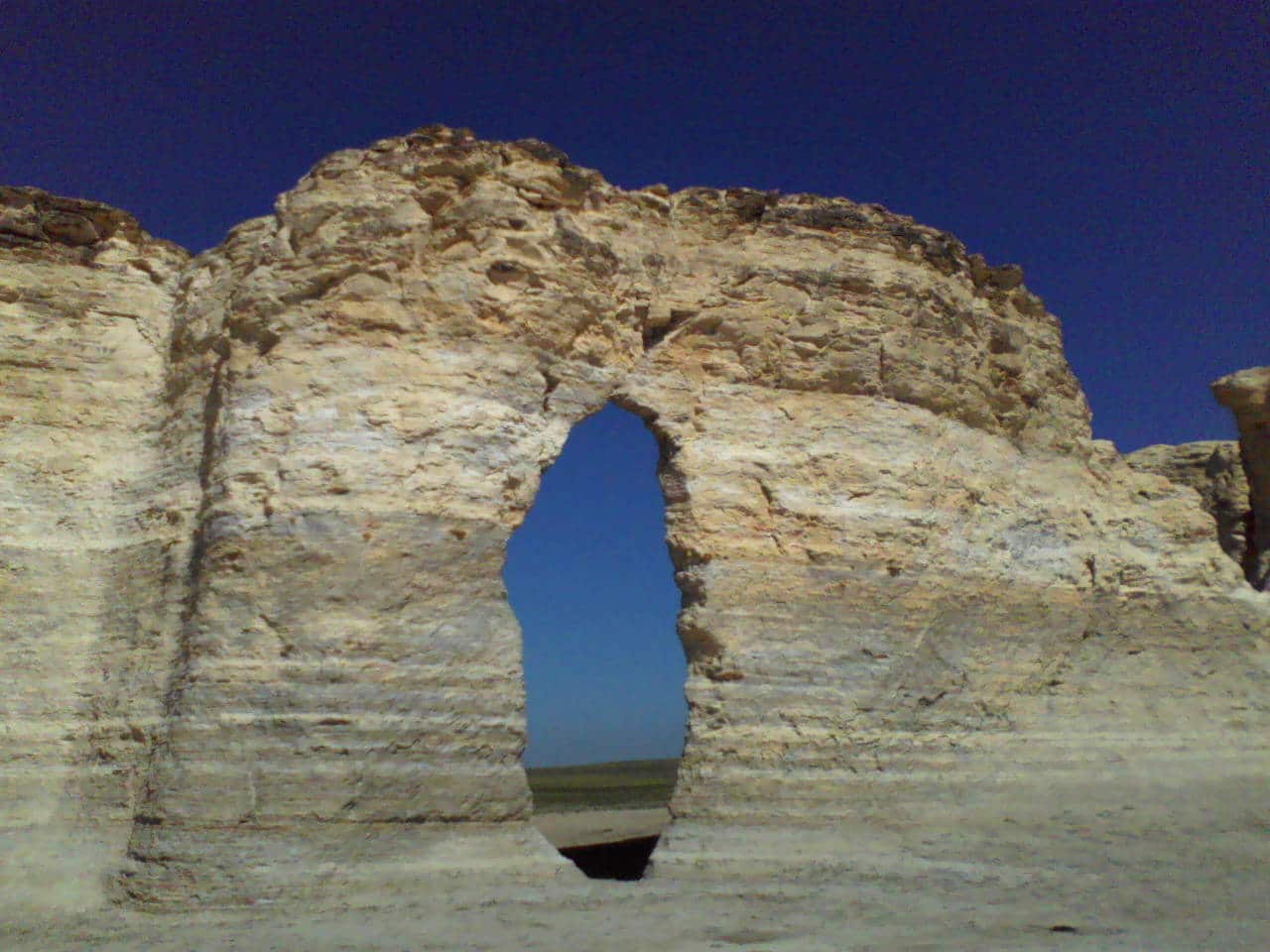
RB - My major trip of the year is fly fishing out West. Usually I set off about the 1st of July and return to western North Carolina on or about September 1st. This is all about fly fishing. I will do some back packing to high streams and/or lakes but usually I'll fish three or four days in one spot and then move to another spot. On days when I get tired I restock, do laundry and hike a little. Other than that, I try to ask "locals" what there is to do in the area. I prefer something that is a bit off the normal radar. For instance - as a result of asking - I was directed to a wonderful Buffalo Bill Statue that is located just to the north, northwest of Oakley, KS. Its only about four miles south of Interstate 70, but, if I had never asked I would have never known it was there. On my shorter trips I usually have a main theme in mind - State Park for hiking, waterfall searching, bike riding, winery tour, museum tour and the like. It seems that there is always something to do and not enough time to do it all! Bill

-
Good news! Instead of buying 4 or 5 stick built campers like I did and putting up with the horrid depreciation, leaking rubber roofs, lack of cargo capacity, lack of insulation, lack of towing stability, lack of ground clearance, lack of ….. you chose wisely. A week or so around Hohenwald after delivery will serve you well. However, even Olivers (more importantly it is the stuff in Olivers that this happens to) break. Being a first time RV owner it will serve you well to get as much knowledge about RV systems as you can prior to taking delivery. John's suggestion is a good one, but, it is even better if you can simply borrow a camper for a long weekend or two so that you have time to "poke around" getting a bit of hands-on with these systems. Like "BackofBeyond" says - experience is the best teacher. Heck, after more than 20 years of owning various RV's I'm still learning. Good luck - don't over stress about this - it is not brain surgery. Stay calm, think about how systems should work and explore the reasons as to why they are not working. Usually you can figure it out on your own. But, certainly do not be afraid to ask for help! Bill
-
I carry two even though I travel alone 80% of the time. I wouldn't worry about "people stopping over" in that there is usually somewhere to sit or they can bring over a chair of their own. Most camping people understand that we all have limited space and therefore do not expect seating to be supplied. Bill
-
All are welcome - glad you like it. I should have been a bit more clear about the part I cut off. Originally, the tray looked like a regular silverware tray with an additional storage area running perpendicular to the ones shown - like most of the silverware drawers available. That was the part that I cut off thus leaving the three shown in the photos. The only thing that I dislike about this mod is that the aluminum angle leaves a dark mark on the tops of the sides of the nightstand drawer. Obviously that could be remedied with a clear coat spray or reduced with the application of a bit of wax. Or, simply keep the drawer shut and do not worry about it. Bill
-
While I have a "junk" drawer, there are items that I wanted to store in the nightstand but would get lost if just tossed into that large drawer. So, I took measurements of the existing nightstand drawer and went on a search for a "tray" that I could place on the top of the sides. I did go to various "office supply" stores looking for a tray that had "rails" already built in but I simply could not find what I was looking for and the only "tray" that I could find that was about the right size to fit between the sides of the existing drawer was available at Target. I cut two lengths of aluminum 1/2 inch angle and bolted these to the sides of the tray. It now rides nicely on top to the sides of the nightstand drawer and still allows easy access to the main area of the drawer below. After a season of use, I did cut off part of the tray - about 2 inches - so as to allow easier access to the main drawer below. This shorter tray is also easier to remove from the drawer making the two "finger" holes that I drilled in the front of the tray redundant. Bill
-
Sure does look like it was nice and quiet at Franklin Mountain. Hope that it is nice and warm for you guys in Quartzsite even though it is going to be 60 degrees in Western NC today. Bill
-
I found and bought a hitch that measures tongue weight wanted to share.
topgun2 replied to MrBig1's topic in Towing an Oliver
Doug - I'd contact Rock Tamers directly with pictures of your hitch setup and ask this question since it is fairly unlikely that many other people have the exact setup that you do with the same truck, hitch, etc. Bill -
Steph - Relax! Primarily, the basis of this discussion has to do with those people that tend to carry a BUNCH or stuff with them (i.e. a lot of tools, extra propane, extra kitchen sinks, etc.). If you are not full time living in the Oliver, are not pack rats and/or do not carry a bunch of extra stuff all the time, I would not worry about it. The basic issue is the payload. Since you have stated that you have 1450 pounds of payload to work with then simply add the weight of the passengers (people and animals) plus all of the other "stuff" that you are carrying around in the truck and if it is below that figure - you are good to go. If it is above that figure then look for "stuff" that you really don't need to carry. For most of us this is not a problem. Bill
-
I'd venture to say that for the majority of Elite II owners, 1/2 ton trucks are the way to go for towing. I've never had an once of problem with either of the two that I've used to tow my Oliver. No brake issues in the Rockies, no power issues there either or even getting onto Interstates when more acceleration is needed - that 3.5 Ecoboost engine is really surprising. The ride, quiet, amenities are all super. However, I should noted that 90% of the time I travel alone. I also travel fair light - rarely do I have the fresh water tank, grey water or black tanks filled. I only carry three cooking pots, have paper plates and plastic utensils. No pets either and music, books, and most videos are all on digital media. My BBQ grill is of the old fashion variety - light and with charcoal. Fishing gear is light weight. Bear spray, side arms and ammo are fairly heavy but I don't carry a bunch of that either. I guess that I'm fortunate in that my overall size is what many would consider (at least these days) to be on the smaller side and I marvel at those that say total human weight is upwards of 500 pounds. But, I also understand that if you are going to be towing the Elite II for months at a time with a heavy cargo load (to include human weight) a towing vehicle larger than a 1/2 ton is not only numerically required, but, is probably more comfortable and safer too (i.e. cargo capacity is either at or too close to the vehicle limit for comfort). As has been said many time before - each of us should get informed as to what is required (with a nice safety margin build in), what our intended usage is going to be and what we must/should do in order to satisfy these demands. Certainly - one size does not fit all. Bill
-
Who hates those @#$&*! chip sealed highways?
topgun2 replied to John E Davies's topic in Towing an Oliver
I'll give you another reason to not like the chip sealing method of repairing roads. As a road goes from good to worse cracks form and potholes appear. Chip sealing fills in those cracks and potholes making for a nice looking surface - for a time. However, those cracks and potholes develop for a number of reasons to include improper road bed construction. Obviously, if nothing is done to repair the base of the road then many of these cracks and/or potholes will simply reappear in fairly short order. Perhaps if one does a proper cost analysis it just still might be cheaper to use this chip/seal method. But if you consider the costs of higher frequency maintenance, total traffic delays (i.e. several short term delays versus one long delay), repair costs for bodies and windshields, and vehicle cleanup time, I'm guessing that at best the cost is a wash. Besides, like Grandpa used to say, "if you're going to do a job, do it right the first time". Another thought - it would seem that there are a fair number of us that like to keep our Olivers clean and with as few chips in the gelcoat as possible. However, I know of a good number of people that actually like things like chip/seal. They even seem to seek it out! Apparently the objective is to see just how much of that "stuff" they can collect so that it holds that rusted bucket of bolts together. Kind of like a spray in liner for the entire underside and sides of the vehicle. Heck - if you find a nice dirt road shortly after doing 20 miles of chip/seal - the vehicle will look exactly the same from top to bottom and it will be somewhat protected from even more rust. Bill -
Split: Black valve hard to move
topgun2 replied to TexasMarshall's topic in Mechanical & Technical Tips
TM - I assume that when you disconnect the cable from the valve that you mean the valve is easy to open and close. If that is the case then there is either a restriction of some sort in the cable or that it needs to be lubed. Can you move the cable easily when it is disconnected? If yes then it is probably not kinked. You could try to lube the cable. Many motorcycle shops sell a cable lube device that allows you to spray lube into the cable without getting it all over everything else around it - https://www.amazon.com/dp/B0012TYX9W/ref=sxts_kp_bs_1?pf_rd_p=8778bc68-27e7-403f-8460-de48b6e788fb&pd_rd_wg=7vePz&pf_rd_r=YB2HKWM8F2WKRMZM2N71&pd_rd_i=B0012TYX9W&pd_rd_w=H9li1&pd_rd_r=7c2de4b4-5464-4daf-bd26-11cccac0e5d6&ie=UTF8&qid=1548855765&sr=1 Even if your valve operates smoothly when the cable is disconnected you might want to try this - https://www.amazon.com/Thetford-Drain-Valve-Lubricant-15843/dp/B000BGK2L0/ref=sr_1_1?s=automotive&ie=UTF8&qid=1548855846&sr=1-1&keywords=rv+valve+lubricant Hope it helps! And now - back to protecting the front of the Oliver? Bill EDIT: (Since Bill's sage advice was not taken, this departure from the OP's subject has been split off into it's own topic . . . Bugeyedriver) -
Watching the 24 hours of Daytona and a bit of football from Orlando this afternoon - I'm not so sure that western North Carolina's weather was all that bad. With temps in the low 50's and no rain, I'll take it. Of course that was only for today in that Tuesday is expected to bring light snow and plunging temps with lows on Wednesday/Thursday getting down into the low double digits. Bill
-
Welcome and glad you're here. Ask away! Bill
-
Consider it deleted - Bill