Leaderboard



Popular Content
Showing content with the highest reputation on 10/21/2019 in all areas
-
Even with the heat on, the most vulnerable areas will still tend to frieze - particularly the hose inlets. The best thing to do for short stints in the cold is to carry a compressor or air tank and blow out the lines prior to travel. It doesn't take much time and gets you 90% winterized.2 points
-
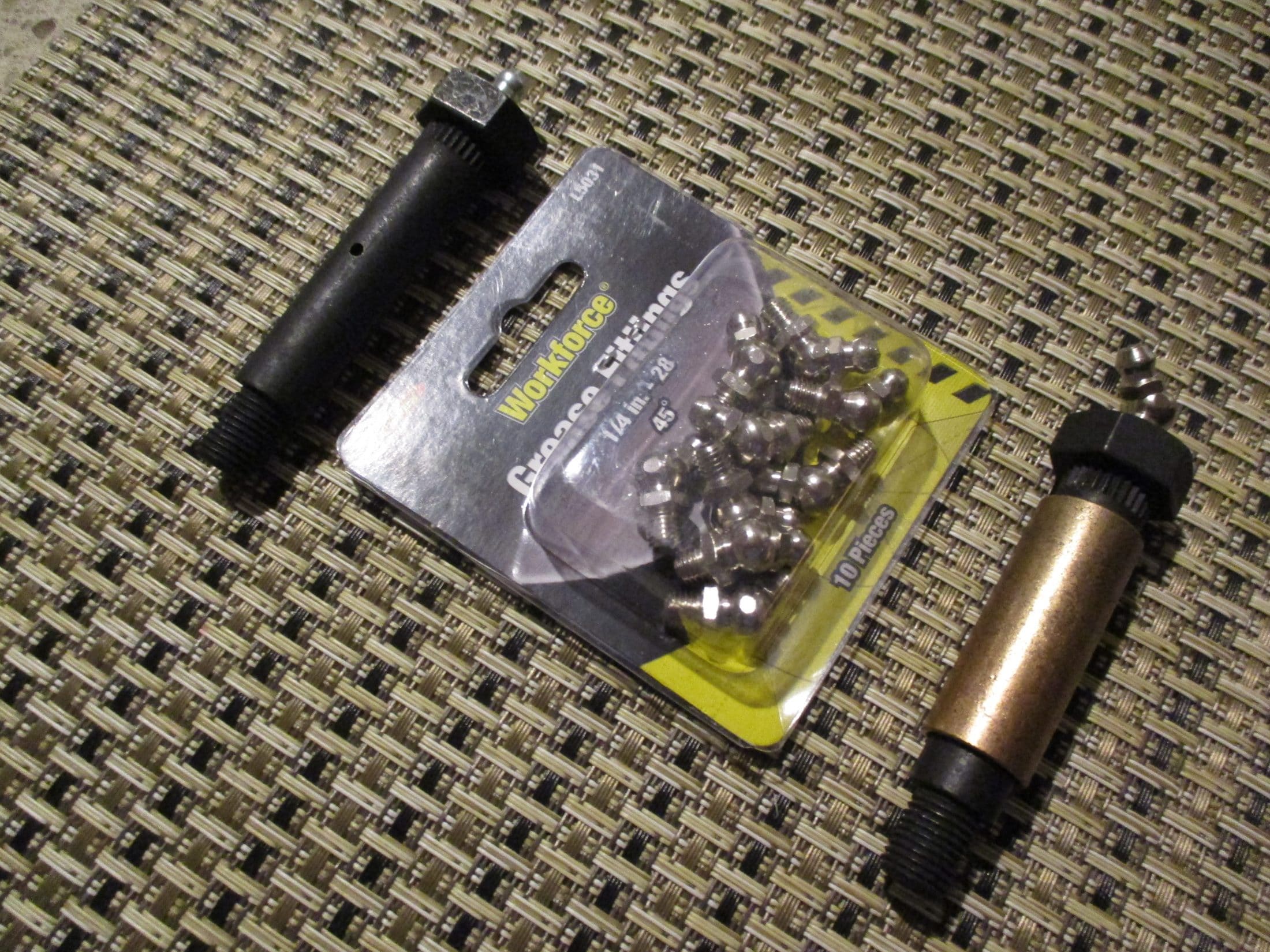
Choied, Have some Dexter pins, Dexter bushings and 45 degree fittings on the shelf to look at. The Dexter pin takes 1/4"-28 thread grease fitting. Ours came with straight fittings, but 45s could be used, too. Hope this helps.
 2 points
 -
I agree about blowing out the outside lines and shower head, a small compressor like this one - which puts out nearly 6 cfm - would work fine, and as a bonus you can air up your TV or trailer tires with it. Or an air mattress or inflatable boat. https://www.4wd.com/p/smittybilt-5-65-cfm-air-compressor-2781/_/R-DSBP-2781 I tend to shy away from inexpensive pumps but I have had one of these for several years and it is fine for occasional use. The tiny glovebox sized “high pressure” pumps are to be avoided at all cost. Most are less than worthless.... John Davies Spokane WA1 point
-
Oliver designed in two perfectly good freeze protection systems, and they are great features. One is to run the propane heater, which ducts the warm air between the hulls, and adds a lot of energy to the area. The other is too winterize. "Lo amperage" means low energy. You either need a lot of energy, or you need to remove the chance of freezing what is there. To remove the chance of freezing what is there, you need to drain it out, or add anti-freeze to it.1 point
-
12 volt heaters big enough to do any good would use a ton of current, especially if you are also using the fridge that way! Why don’t you want to use propane while traveling? Fire risk? John Davies Spokane WA1 point
-
Perhaps this is not what you want to hear, but, given the your constraints of not using propane - I simply leave my Ollie winterized during such travel. I do carry a couple of gallons of water in milk jugs in the bath for flushing the toilet. And, I carry other water in my truck for drinking, bathing and food prep. Once I get to warmer climates, I flush the lines and proceed normally. Since winterizing the Ollie is so easy, I then re-winterize once I get back to the chilly north. Bill1 point
-
I would use my furnace at a low setting. You will use some propane, but won’t have any battery drain the TV should keep the battery’s charged while traveling and you’ll have a warm cabin when you arrive at your destination.1 point
-
One of my fondest childhood memories is living in California and taking a month long vacation to see National Parks that my father helped to build when he was in the Civilian Conversation Corps (CCC) before WWII. Later, when I was first married, my wife, daughter and I took vacations every year to visit national parks. I was appaled to hear low flying airplanes and helicopters overhead. The noise was more irritating than a swarm of mosquitos. I just returned from a Fall Break with with my daughter/husband, grandchildren and my wife. We visited the national parks in AZ and it was evident the areas of the parks that were run by concessionaires. The cost was significantly more, the service was significantly less and the crowds were ever more present. At Grand Canyon, we did not see one park ranger, not one. Congress is slashing the federal budget and many things are being privatized. There are federal lands and national parks around Las Vegas. The National Park campground cost is $8.00 per night. You can walk 25 feet next door and a concessionaire park is $40.00. It is not just about costs. We are facing admission restrictions, access restrictions (must ride mass transit buses) to see beautiful scenery. I do not like seeing large commercial facilities, hotels and chain restaurants in the National Parks. If it is commercialized, I will visit but not financially support the concessionaires. Read the story of Fred Harvey and the Harvey Girls. It was about quality service offered in support of educating the US traveling population to learn about the beauty given to us. I have stayed in several Harvey Houses over the years, the El Tovar in the Grand Canyon being one. They complemented the surroundings, and taught visitors to appreciate Mother Nature, no chrome and glass frontage with bright neon lights. Yes, I am upset with this effort to privitize our national parks !!! Coy Gayle1 point
-
MaryRn I see where no one has responded to your request so I’ll post this to hopefully stir up some more responses. I have the Dometic Atwood furnace in Hull 313 but I remember reading this thread about the Suburban furnace that made me glad I had the Dometic Atwood https://olivertraveltrailers.com/topic/suburban-furnace-acting-very-erratic/#post-190686 From this thread it sounds like the Suburban is a bear to get to. I have had the sail switch out on my Dometic Atwood and it was no problem. Edit: Well I just looked and I have an Atwood furnace but I think Atwood is part of Dometic now.1 point
-
Glad to hear that. For future readers, eco mode only works well for us ( honda 1000) under light load. It will surge and hunt when under heavy load, under 50 per cent of rated load. Say, 500 watts. Last week, we charged two olivers from a single honda 1000, with over 100 ft of good heavy cord, but still a lot of resistance. We didn't use eco. Worked great. At the beginning, might have to use the choke a few times. We're only charging batteries, not trying to run ac. Not possible with a honda 1000. Sherry1 point
-
Mirna, many of us who have (or had) sailboats are familiar with eutectic plates, but they're usually called cold plate or holding plate systems. We've used holding plate refrigeration on our boat for 40 years, on the 2nd set now. On the boat, they're like big blocks of metal, filled with coils of solution. The plates are attached to the side of our heavily insulated icebox bins. A compressor runs off the engine, cooling the solution in the plates when the engine runs. The solution absorbs heat during the day, keeping food at a fairly consistent safe temp if we run the engine an hour or two a day. With good insulation in the box, it's very efficient. There are newer systems out that can chill the plates with a danfoss compressor when we don't want to run the engine. Our newer plates can use both types of compressor. Recommendations we've received are to cool the box initially with the big engine driven compressor. Use the 24v danfoss to maintain, and then maintain the batteries with solar. The 12v danfoss compressor Isotherm that Overland bought has the option of adding a small holding plate, (ASU). I don't remember if he opted for it, or not. I kind of think he did. Holding plate technology is proven, efficient, and highly dependent on great insulation. It's also kind of bulky, heavy, and can be tough to get cold enough when air cooled in hot weather. Many boats use keel cooling ( water cooled) systems to transfer waste heat, like frigoboat. That said, if you plug in every night to cool the plates, like some refrigerated trucks, it could be a great solution. I don't know of any holding plate systems designed for rvs, other than the assistance of the isotherm asu. Doesn't mean they don't exist...I just haven't seen any. That said,along those lines, I keep a freezer pack or two in our dc fridge. If I have room, I freeze it during the day when I have good solar production. If not, just the cold pack and thermal mass of the beer probably helps keep the fridge cooler...? Sherry1 point





-
Recent Achievements
-