Leaderboard



Popular Content
Showing content with the highest reputation on 03/14/2019 in all areas
-
Well thanks for the info, after reading what you'all have said I will go with the Anderson. We just got lucky yesterday and there became an open spot for a trailer to be built with a July 8th delivery date, so guess what, we got it, just finished up with Heather on all the details and were set to go. Mike (Lone Star Oliver #135) hope to meet you and Carol someday, rally, of just camping. John and Susan trainman3 points
-
Nan - I split this discussion off from your original post because it doesn't specifically have to do with a truck in and of itself. First of all - congrates on your participation in the 401K program of your company. As you are now finding out - these tax advantaged programs can mean a great deal to you in your retirement. When you say that you moved your 401K to Wells Fargo, I assume that you moved it into another tax advantaged account (i.e. IRA or Roth IRA). If you moved it into a Roth IRA then you have already paid taxes on this amount and no further taxes are due (this is most likely NOT the case though). Given your questions, there are a number of things that should be considered: 1. Your age, health and overall financial standing. 2. Your overall tax status (both Federal and State) 3. Going into debt is "usually" not good, but, could be OK in certain circumstances (see number 2 above particularly in regards to any current stock holdings that may be at a loss from your original "basis" (the price you originally paid) or other losses that you may have recently incurred. 4. Selling your house? What is your "equity" position in the house? What other financial resources might you have? If you are not sure about this decision then I would say a big NO. 5. Throwing caution to the wind is not a very good idea since (depending on number one above) you probably do not have time to recover in the event something should go wrong. It appears to me that what you could use is a good financial advisor - someone that is certified as a financial planner. If you are not familiar with investments and general financial matters then a visit to your bank can serve as a starting place. They should be able to direct you to a number of certified financial planners in your area. Sometimes your insurance company can also get you this type of information. But, please, do not be afraid to ask for proof of certification AND how they will get paid for the service that they will give you. If at any time you do not feel comfortable - leave and seek someone that you DO feel comfortable with that can explain exactly what they are talking about to you in language that YOU understand. Bill2 points
-
Someone just shared this on airforums and I thought I'd pass it along here too. "Victron has just released a new book called "Wiring Unlimited". I hate to use the term "ultimate", but this is the ultimate reference book for anyone wanting to do electrical work on their RV. You can download a copy at:" https://www.dropbox.com/s/pdkngditufe0zfb/Wiring%20Unlimited.pdf?dl=12 points
-
https://money.cnn.com/2018/09/07/news/companies/wells-fargo-scandal-two-years/index.html I was a WF customer for a few years, I never felt that they cared an iota about me as a person and the customer service was dismal. In 2004 in a face to face meeting I was promised a great deal for a home mortgage, for new construction, with no points and a competetive interest rate. It sounded wonderful and I was immediately a little suspicious. I demanded a signed letter stating the terms with the company letterhead as insurance. Sure enough, the loan officer was fired, his replacement told me he was going to have to charge points and that the guy had made a bunch of “verbal promises he should not have made”. I waved the letter in the new guy’s face and told him he had better honor those written promises. He looked pretty depressed, but he did it. Always get it in writing. A good local credit union for banking, credit card and personal loans, and a good broker like Vanguard for investments, makes way more sense. I joined BECU right after the Wells Fargo mortgage incident and never looked back. These newest scandals you read about? Old news to me. John Davies Spokane WA1 point
-
One interesting thing about an Oliver that sets it apart from all other (mass produced) RVs is the resale value. In the current economy their values are holding very high, they hardly depreciate at all, so if you needed to sell yours, it would not be a huge financial loss like for a Thor-built plywood junker. HOWEVER, when the US economy tanks again, in a year or two or five, the artificially booming RV market will definitely collapse with it and it will be much harder to sell your Ollie, and the price will inevitably be lower. Because the production numbers are so low, there is no real way to know a used one’s true Blue Book value and RV dealers are reluctant to buy and sell them. So you have to sell privately. When the economy tanks your financial investments will too. Especially if they are based on the stock market. Not good. The point is that it is a real gamble if your finances are shaky in any way, and as we turn grey you never know when a medical emergency might happen. Some of the trailers listed here have been due to unexpected medical bills. It is unfortunate but a fact of life. In your shoes instead of raiding my money reserves I probably would be shopping for an older easy to handle self contained Class B motorhome like a Roadtrek that has already depreciated, to buy outright and use for a year or more. The shorter ones can even be used as a daily driver. If you like the lifestyle you can sell the house while living in the RV, order an Ollie and look for a low miles Certified Used truck, or a new heavily discounted one, and then sell the current RV for a minimal loss. Don’t liquidate your retirement savings unless you have a very dependable second income. I am not a financial advisor, nor do I play one on the Internet, so don’t believe me or anyone here. Talk with a trustworthy one who charges for his services and who is NOT trying to sell you something on commission. This is my own advisor, look at her description, and try to find somebody close by who is similar. Or give her a call, I highly recommend her and she might be able to offer a referral, or she can do everything for you remotely. If you hire her, she is not cheap but you won’t end up with some weird annuity you don’t need and you can trust her to be completely working for your best interests. .... https://www.financialtrex.com/faq/ https://www.financialtrex.com/blog/how-to-choose-a-financial-planner/ Get your investments “tuned up” for a coming downturn. Change banks (Wells Fargo is plain BAD - Google “Wells Fargo problems”.) Don’t make any major moves before confirming that they are good moves. Remember - I said to don’t trust me! ;) Good luck. John Davies Spokane1 point
-
Hi Nan, you need to do a cost benefit analysis between borrowing the money and withdrawing the money from your brokerage acct. If you borrow all, or part of the money you need to figure the amount you’ll pay yearly in finance charges and compare that to the additional taxes you have to pay by moving up to a different tax bracket. A good “fee”based financial advisor can help you with this, if you can’t figure it out on your own. Actually using credit can make sense if you use it wisely. Goodluck, Steve1 point
-
Most owners will run into a situation where they need to repair a broken wire or faulty circuit, or want to add a completely new one, for a pantry light, a backup camera or perhaps a charging port. Being able to make electrical connections in a safe and secure way is critical. If you understand the fundamentals, it is easy to select the correct tools and supplies to do the job the right way. This is a fine reference for low voltage automotive wiring ..... It is NOT AT ALL appropriate for 120 volt ac residential type wiring. I selected Reader View on my iPad, which neatens up the formatting and removes ads, then saved it as a pdf. http://www.musclecardiy.com/automotive-wiring/fundamentals-of-automotive-electrical-connections-and-connectors/ This applies to homebuilt aircraft, but it does provide some good insight into what works and what doesn't I hope this proves useful. John Davies Spokane WA1 point
-
Several years ago, one of our single axle Elite owners, JR Birdman / Aubrey, traveled through Mexico with a well organized, large caravan. He said it was a wonderful trip that went down the eastern states of Mexico all the way to Belize and then returned on a more central Mexico route. Aubrey said the numerous large speed bumps were brutal on some of the caravaners' equipment. His Ollie stayed together much better than most of the larger units he travelled with. He was also very happy to have his sophisticated water filtration system along. I believe the key to a trip like that is joining a well established RV caravan group that has experienced leaders who have made the trip before. It may be expensive, but you get the benefit of their in-depth planning and knowledge of how to "grease the system" when needed. Safety-in-numbers is a real benefit should you decide to go there. It would not be advisable to embark on a solo journey through much of that area.1 point
-
If it were my choice, I would take the truck. It's winter. You have a towing package, 4 x 4, and, well, it's a truck. :) and, that's my favorite vehicle, towing or not, but especially towing. The volvo was 4950 towing capacity. It did ok, but we definitely could feel the trailer in the hills. Not so much with either of our trucks. Yeah, definitely. Take the truck. It's made for the journey. Enjoy your trip! Sherry1 point
-
Gentlemen, Thank you for bringing this topic to light. I apologize if you have written emails to our Sales Staff that have remained unanswered. I have spoken to our General Manager and he has spoken to one of our attorneys and is waiting to hear back from another attorney that specializes in this area of the law. In the meantime, we would like to thank you for bringing this to our attention and for all of your efforts. We will post updates here when more information becomes available.1 point
-
Mike, you’re fine. The neutral to ground bonding is happening in the house.1 point
-
Darrel: You mentioned your "Generator Ground Plug". My assumption is that your plug is to bond the neutral and ground at your generator. I suspect that some new owners may not be aware of this issue. I have cut and pasted an article from Fiberglass RV Forum that describes the problem and a simple fix. It is a good read for those not familiar with the electrical grounding requirements of code and how/why some generators give our Progressive Industries surge and monitoring system fits. Thanks for the reminder, Geronimo John FROM: FIBERGLASS RV FORUM – 7 DEC 2018 03:15 PM, Mr. Casita Greg, Senior Member This is a description of the N-G bond plug that I wrote some time back which I posted on some forums: Portable Inverter Generators and Neutral-Ground Jumper for RV Use Only While we're on the subject of portable generators, all RV electrical systems are wired with their Ground and Neutral buses floated, (un-bonded from each other.) There’s lots of good reasons for this, most specifically it’s an NEC and RVIA code requirement that the safety ground wire never carries any load current, and there can be only one Ground-To-Neutral bonding point in any distributed electrical system in the USA. Now, when you’re plugging your RV into power from a building, such as your garage outlet or a campground pedestal outlet, your RV has its Ground and Neutral buses “bonded” (connected) together externally as part of the service panel’s earthed safety ground system. Again, lots of reasons for this, but the fact is you can only have a single G-N bonding point according to the National Electrical Code and RVIA building codes. So when your RV is powered by a portable generator, and if you have an inline voltage monitor system from a manufacturer such as TRC or Progressive Industries, (like the EMS-30 that I installed in my trailer,) your voltage monitor is checking for the Neutral and Ground voltages to be very close to each other, probably within 3 volts or so. This works well if you’re plugged into shore power that’s properly grounded and bonded, but this voltage protector can be tripped off by plugging your RV shore power plug into a portable generator without an internal Ground-Neutral bond. If you don’t have a voltage protection device on your RV, then you may never know that your generator has a floated neutral (un-bonded G-N bus). Contractor-type generators, such as a Coleman 5000 for example, are generally G-N bonded internally, which is why it runs your RV just fine. However, many portable inverter generators from companies such as Yamaha and Honda (such as a Honda 2000i or EU3000 for example) have floated Neutrals (i.e. no internal Ground-Neutral Bond) since they expect an external G-N bond to happen somewhere else. And while RV-approved generators may have an internal G-N bond, it seems that many of the most popular portable inverter generators from Honda and Yamaha have floating neutrals. So your 2000i or your EU3000 isn’t providing the Ground-Neutral Bond that your RV requires to think it’s getting properly grounded power, while a Coleman 5000 has a Ground-Neutral bond already so it operates your RV properly. Seems crazy, but that appears to be the scenario. It’s pretty simple to wire a special “Ground-Neutral Bond” jumper cable for your Honda or Yamaha generator which will allow you to power your RV through its voltage protection device. You can obtain or make a dummy 15 or 20 amp “Edison” plug with the Neutral (white) and Ground (green) screws jumpered together with a piece of 12 or 14 gauge wire. This G-N jumper plug can be plugged into one of the generator’s unused 20-amp outlets, and the entire generator’s electrical system will be N-G bonded. You can then use the other 20-amp Edison outlet or the 30-amp outlet to power the RV. Just be sure to mark this plug specifically for its intended purpose. It won’t really hurt anything if it’s plugged into a correctly wired home outlet, but it will create a secondary G-N bonding point that could induce ground loop currents and create hum or buzz in a sound system. So this is a generator-only G-N bonding plug which should be only plugged into a portable generator while powering your RV. What's going on inside the plug? Jumper wire between the silver screw terminal and the ground screw terminal. Be careful not to hook to the gold terminal screw. (Which is the "hot" prong and can be easily determined by looking at the two power prongs. The "hot" prong (usually the black wire,) will be the smaller of the two blades on the plug and is the power supply. Do not connect to this one.1 point
-
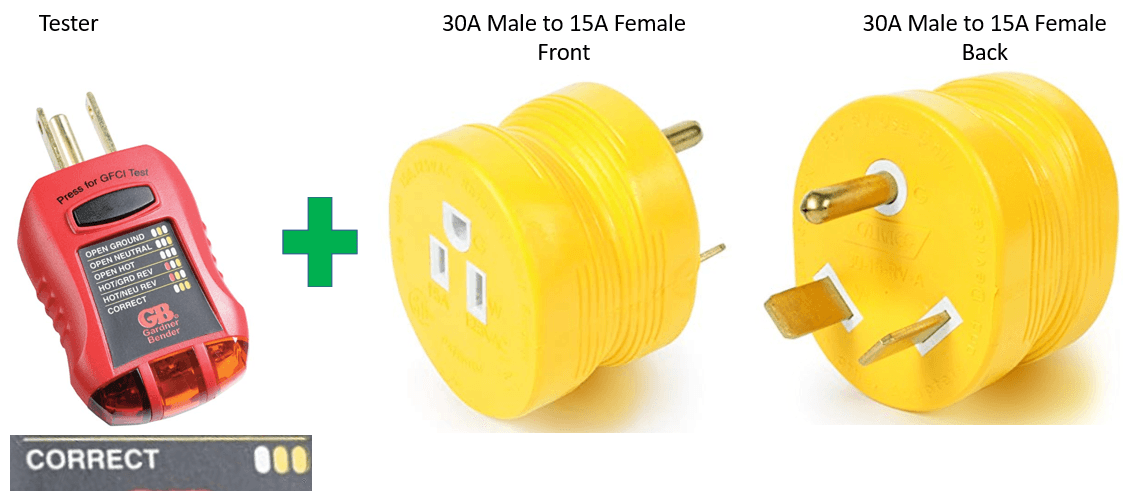
To clarify the testers use for a 30A setup, I also keep a 30A to 15A converter with it so that I can use the tester on the power source before plugging into the RV. If you don't see the correct output (off, amber, amber lights), you will likely have an issue with the power surge suppressor. The 30A converter is also $5 at amazon - Link
 1 point





-
Recent Achievements
-