Leaderboard

.thumb.JPG.dd838cdb3df463dab6a16861fa23a319.JPG)


Popular Content
Showing content with the highest reputation on 10/10/2021 in all areas
-
One additional step that may possibly be needed is flipping a breaker that's off (on my 2021 this was off when I took delivery - a breaker under the dinette, on the wall of one of the seats). There is also an inline breaker on the power line going into the inverter. These may be on but if those other steps don't work this may also be at issue3 points
-
Do you have a microwave? If it is powered up then it could be the GFCI is faulty or needs to be reset. If the microwave is not powered up with inverter switched ON, the inverter is not putting out power or the GFCI internal to the inverter has failed, (not good). If the microwave has power you can use its outlet until you get the other outlets powered, it is not on the GFCI circuit, (2017 Oliver Hull 178). The other possibility is that your battery voltage is below the threshold that will let the inverter come on. I have seen all 4 failure modes on our Oliver, well 3 actually. The GFCI on the inverter failed and the inverter had to be replaced, out of warranty of course.3 points
-
GJ and topgun2, I would suggest you re-think you F150 safety chain connection. The quick links you are using are rated at 3300 lbs. WLL and I believe a single trailer safety chain should be rated for the weight of the entire trailer. I am sure you have seen postings here on the forum about the Anderson WDH's with chain extensions connected with 3/8” quick links failing. Have you explored hammer links? If not take a look below to see an example and compare the safe WLL. They would solve your F150 safety chain connection safely. Mossey
 2 points
 -
Hello. I have been researching the forum and I am sorry to ask a probably not so smart question and one that’s been answered but I have no power to my outlets. I have the inverter and solar package and I am not plugged into shore power. I have no Internet at my site so I was hoping to get a quick answer for troubleshooting so that I can fix it when I get back to the campsite. This is our first time boondocking so I am sure I am missing a simple step that was already explained in the delivery walk-through, but….Any answers or links to previous posts or info would be appreciated.1 point
-
Yes, that’s why the sensors on the east side of my trailer have higher pressure and temperature readings when I’m heading north in the morning and then it’s the west side in the afternoon and they are pretty even during the middle of the day. The spare tire always reads cooler than the east or west side of the trailer, it’s always in the shade. And I know that tire pressure goes up when the tires are warmer, thus the advice to check tire pressure when the tires are cold. Of course that advice predates TPMS's, but now you can see it real-time as the tires heat up and the monitor displays the results. As far as the lack of information goes, that applies to anything I purchase these days. I don’t believe it’s an entirely new condition. I think you worked in a technical or engineering world if I remember correctly and if so, you would know about documentation evolving from hard to soft copies. I believe that change was driven by costs initially, but also believe the rapid changes in everything made currently, make it impossible for paper information to stay up to date. I just bought a new Apple Mac mini and the box included the computer, power, HDMI and USB-C cables as well as a 4 page booklet and an Apple sticker. The LG monitor I also purchased included a power cable, similar paperwork and a CD. If you don’t know anything about the Mac mini, you wouldn’t know that it doesn’t have a CD drive. So it’s off to google world. I will add that I have a TST system and their technical support is excellent and it was certainly worth the phone call. Mossey1 point
-
It would appear that there is not much definitive manufacturer information available regarding the behavior of tpms sensors while they are at rest. I keep waiting for someone to say "My owners manual says..." and no one has come forth. Perhaps all of you have user guides that are as crappy as mine. My sensors provide a reading while static that changes with atmospheric conditions. Our Elite sits in a north/south orientation when at home. There is a noticeable difference in tire pressures on sunny days. Particularly early morning when the east tire warms in the sun. My sensors are without question sending a signal while static. I believe that without motion the sensors go into sleep mode and immediately awaken when they detect a change and only then do they send a signal. That makes sense from a design perspective. You can monitor them while the trailer is not moving and you will always get the last recorded change. It is doubtful that any of the sensors on the market emit signals on a constant or even on a timed basis irrespective of a pressure or temperature change. In fact, the signal that wakes up the sensors while static is likely just pressure variation. That would be the simplest method of waking the sensors based on a change. That's my take on it anyway. As far as the lack of useful literature on the sensors themselves... Whiskey Tango Foxtrot (that's for you JD) why? I'm sure the technology is widely known in the industry. I felt the same way, albeit with more despair, when Oliver stopped providing wiring diagrams.1 point
-
Did you "push the power button on the inverter" or the power button on the REMOTE for the inverter? Obviously, these two are not the same and if the button you pushed is on the remote you may have an issue with the remote not talking/communicating to the inverter. Bill1 point
-
Based on my “experiment” yesterday it’s clear to me that my TST sensors were sending the current pressure and temperatures not having moved for several days. Mike1 point
-
I use 3/8” safety chains with a 24,000 lb. breaking strength with hooks that fit my Toyota so I don’t need hammer links, but if I did need either of them, I would buy the size that my hooks would fit in as either size would meet my safety requirements. For the Andersen chain extensions, I used 3/8” heavy duty twin link clevis repair links with a working load limit of 6600 lbs. Maybe Patriot will chime in with the size he is using with his F250 Tremor that topgun2 referenced above. This LINK will take you a different brand, but it does provide size information for your reference. Mossey1 point
-
Correct. That's exactly what my last sentence hinted at. I had not seen the Hammer or Dura Links. I loved the review comment from Amazon Qwork links: "Perfect for Ford owners and those with a hitch developed by a desk jockey." That reviewer hit the nail on the head. Do you use the 7100 WLL or 12,000? I assume both would work with our safety cable hooks?1 point
-
Ditto this. I have discovered that raising the connected coupler above normal connection level will unseat the ball wedge making the triangle plate easy to turn by hand when reconnecting.1 point
-
GJ - Yes, I too added a couple of those links for the safety cables on my F-150. Indeed, they certainly do make attaching those cable and even the safety brake cable much easier on the Ford - I never even really think about that step anymore. Bill1 point
-
Steve and a lot of other newer owners: PLEASE PLEASE go to your account and enter you trailer type, hull number, and tow vehicle info. This info is very helpful for assisting others with problems they may have. Steve: Assuming your Anderson was set up properly, needing 8 threads is pretty extreme. What is your Anderson ball drop (Height above ground unhitched less hitched height? GJ1 point
-
Is the inverter turned on, and if so, have you checked to make sure the GFCI isn’t tripped at the outlet?1 point
-
I don’t pay too much attention to the temperature or pressure readings while the trailer is parked because I usually turn the monitor off shortly after arriving at a campsite. I really don’t think it matters as long as they were within the target parameters when I turn it off. I do know that the monitor reads each sensor in 5 second intervals and any changes are updated within a short distance of travel. If I drove 5 miles at 60 mph and didn’t see any change in temperature or pressure, I would be concerned. And I really think I need a TPMS when the trailer is moving. Mossey1 point
-
Sure, it will tow the bigger Oliver but you won’t be happy. Payload and fuel tank size are marginal. If you plan on visiting mountains you will be at your limits going uphill and downhill. Mike1 point
-
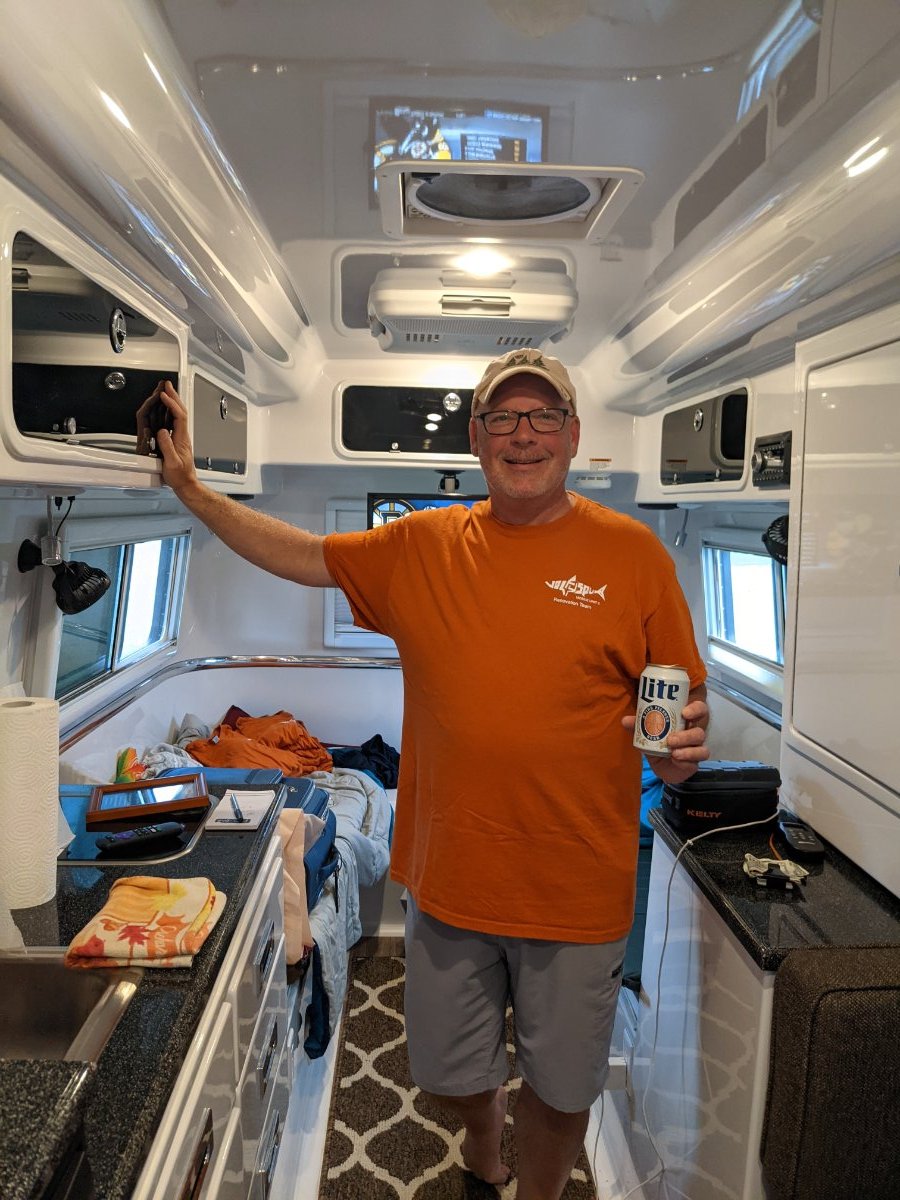
We even had UT orange shirts made for everyone who helps us with our renovation.
1 point
-
GAP, curious whether the Xantrex techs that said it wasn't suggested gave any reasons (I'm assuming they know it works). The one's that said it doesn't work should actually get some hands on experience with the devices as opposed to thinking they understand everything just from manuals - IMHO of course! 😉 I've used this software switch (off is really on wrt the charger btw) literally dozens of times since I discovered it and it works every time without throwing any error codes. If I trip the breaker like I used to, I get the infamous Xantrex [20] lost communication error code - per design if you throw the breaker rather than a bug. So, I respectfully disagree with the Xantrex tech(s) that said it doesn't work. I think if it's bad for anything it's not the batteries - so I'd much rather replace the cheap Inverter than the Lithiums. I also appreciate the savings I'm getting avoiding rotator cuff surgery if I had to continuously reach under the bed for that breaker like I used to. 🙂1 point
-
Corrections: The shackle size that I used as pictured in my original post is 1/4" made by National Hardware #N100-278. I apologize for any confusion. - Brian1 point
-
Actually, Patriot put me on to the "hammer links" several months ago. Unfortunately, I've still not done anything about it. My bad! Bill0 points










-
Recent Achievements
-