Leaderboard



Popular Content
Showing content with the highest reputation on 02/21/2024 in Posts
-
Yep, if we press slightly on the black lead wire at the connection/solder point it causes the tank reading at the monitor to jump numbers. So this may be the culprit! We are going to monitor on our upcoming trip and may end up trying to put a daub of solder back on to "tighten" that connection, if possible.4 points
-
It’s the plugs that cost the money. The ones for the LEII were $1M each x four. The bigger plugs for a larger trailer would probably cost even more. From the plugs they make a mold. Each mold is good for just so many hull pulls. After each mold’s useful life is gone, it is scraped and another one built. As new exterior or interior changes are made to the hulls, the plugs are modified to include these changes in future builds. They could build a trailer as big as they deem practical.3 points
-
I caught this on FB today. Oliver crew is celebrating the 1500th Ollie to roll off the line. I'm very happy for everyone at Oliver. I wonder who will get this hull #?
 2 points
 -
I'll second THAT promotion! Bill2 points
-
Will Prowse has some great videos on his YouTube channel on the Epochs. This, from a week ago, compares features, and costs, of LiTime and Epoch. I think I've posted this one before in another thread, but it's an interesting teardown of the Epoch 460. He's been very impressed with the case and components. Good luck with your install. That's a whopping amount of amphours!2 points
-
@Snackchaser WOW! Great write up and execution. Thank you! Mossey2 points
-
I just completed installation of a Victron Smart Orion 30 amp isolated DC to DC charger after reading all the great information provided in this forum by MAX Burner, and others. I really appreciated all their groundwork and details, so I wanted to share some of my experiences in the hope that others will find it useful. I used #4 AWG wire for ease of installation and for better termination options. BatteryCablesUSA recommended their “Jumper Cable” wire and it was the best deal I found at $197 for 55’ x 2. It consists of a black and red cable joined together like zip cord, and it’s flexible enough to lay flat under it’s own weight. Their lugs and heat shrink were also reasonably priced. I sheathed the full length of the cable with 3/4” braided cable sheath for extra protection and good looks (Amazon Keko 100’ roll for $21.) I seized the ends with Amazon XFasten fabric Wire Harness Tape (5 rolls for $14.) BatteryCablesUSA also recommended Anderson SB50 connectors, instead of the larger #4 AWG rated SB120 connectors that I originally planned. They said that #4 AWG wire would fit in the SB50 #6 AWG contact pins, which it did. I used Trailer Vision covers for the Anderson SB50 connectors. A TV-201426-50 surface mount receptacle with hinged cover plate was installed under the truck bumper. It has a red LED power indicator that I discourage from connecting because it’s on all the time and annoyingly bright. They also offer a flush panel style mounting. The sheathed cord on the trailer side got the Trailer Vision TV-328993-50 plug cover. It has a protrusion that catches on the mating receptacle’s hinged cover to stop it from pulling out. It’s similar to how the 7-pin connector ports hold the plug in. It also has a LED power indicator that’s more useful because it’s only on when connected. It uses a compression gland for the cable that I filled with black RTV. Powerwerx company sells Trailer Vision parts, Anderson connectors, and other accessories for reasonable prices. Get at least 4 extra #6 Anderson pins for connecting to the Victron compression terminals as explained later. Powerwerx also sells the “PanelpodSB,” which is a surface panel mount Anderson SB50 housing for $11.99. I mounted one on the Oliver’s cargo box for “parking” the Anderson connector when it’s not plugged into the truck. It keeps with my existing theme of parking places for the 7-pin cable and RAM rear view camera cable. They also sell a tethered cap to keep it clean when traveling. The engine compartment wiring was straight forward. I connected the cable’s red wire to a 60 amp terminal post fuse on the battery positive. The black wire terminated to the battery negative. The trailer half of the sheathed cable went through a penetration behind the LP tanks. A hole was drilled through the trailer wall next to the existing penetrations with a 1-1/8” step bit. The sheathed cable passed though an Amazon PA66 1” nylon cable gland ($7.99 for two.) I used a short piece of heat shrink over the sheathing where it passed through the gland and filled the gaps with black RTV. The shelf under the bathroom sink has to be removed for access to the inside cable penetrations. From there the cable can be simply pushed under the floor to the rear dinette seat where the Victron was mounted. The Victron has some great safety features that will automatically reduce, or shutdown, the output if it gets too hot or the input voltage drops too low. It’s important to take this into consideration because it would likely happen while driving, and you wouldn’t know it without constant monitoring. Voltage drop especially comes into play with the new smart alternators that lower voltage output to save energy. The Victron’s default voltage settings account for this. However, due to the longer run of cable needed with travel trailer installations, the cable resistance can cause enough voltage drop where it can go below the default settings and cause the Victron to derate it’s output. I calculated the voltage drop for different wire gauges at 35 amps (nominal input current) and a cable distance of 53’ x 2. The results don’t include the connector and termination losses: 1.46 volt drop for #6 AWG 0.92 volt drop for #4 AWG 0.58 volt drop for #2 AWG Per Victron’s instructions, a 0.6 voltage drop can cause a “Voltage Lockout” with the default settings. There are many factors that can affect this, and fortunately the Victron defaults can be adjusted. To account for my voltage drop, I decreased the “Start Voltage” from 14 to 13 volts, and the “Shutdown Voltage” from 13.1 to 12.8 volts. These setting were recommended by “Offgrid Power Solutions,” on a You Tube video called “Victron Orion-Tr Smart DC-DC Charger settings.” Cooling is also an important consideration for the Victron because they create a lot of heat, and they derate charging current 3% for every degree above 1040 F. That’s almost 50% performance loss at only 1200. Maximum operating temperature is 1310, where I believe it shuts down completely. This is why I installed cooling fans (but also for the fun of it.) Amazon’s ”Sound Original” low profile blower fans (two for $9.99) were the right size, they had bearings, brushless motors, and a good mounting configuration for this application. The Victron was mounted on 1/4” standoffs to keep its cooling fins off the mounting surface, and it also helps the fans to distribute air more evenly. I used a Normally Open, 1040, 5 amp, thermostat switch to control the fans (Amazon Uxcell KSD9700 (2 for $5.49). The fans get power from the input terminals on the Victron so they can only come on if the truck is connected, and the temperature is over 1040. The thermostat switch resets at 860. The Victron was mounted on a painted plywood board that was attached to the forward battery compartment wall. It’s an easy to reach, out of the way location. I used 4 rubber well nuts that stay in place by themselves, but regular nuts and bolts could be used. The sheathed #4 cable was terminated to the Victron’s input compression terminals, with the fans power leads. I struggled at first with the Victron’s compression terminations, the wire wouldn’t fit, and I couldn’t find #4 square ferrels. So I was pretty pleased to discover that Anderson pins can be filed down to fit perfectly. Just be sure to cover the exposed barrels with heat shrink. The negative output of the Victron went to the main chassis ground post under the rear dinette seat where there is a 2/0 cable going directly to the battery negative. The positive output was connected to the line side of a Blue Seas 60 amp fuse block, from there it went to the line side of the existing inverter’s DC circuit breaker, which is jumpered to the battery positive with a 2/0 cable. With the TV at idle and the lithium batteries around 60%, the Victron output was 35.8 amps as measured by a clamp-on amp meter. The TV input was 42.5 amps. This calculated to 84% efficiency, which is close to Victron’s 87% claim, which I assume is under perfect conditions. I really liked the looks of the sheathed cable and Trailer Vision plug and receptacle,. The hinged receptacle cover will keep the dirt out when not towing. The plug and receptacle are locked together more securely with the Trailer Vision covers, otherwise the Anderson connectors can be fairly easily pulled apart and they might not stay together on a bumpy road. Cheers, Geoff
1 point
-
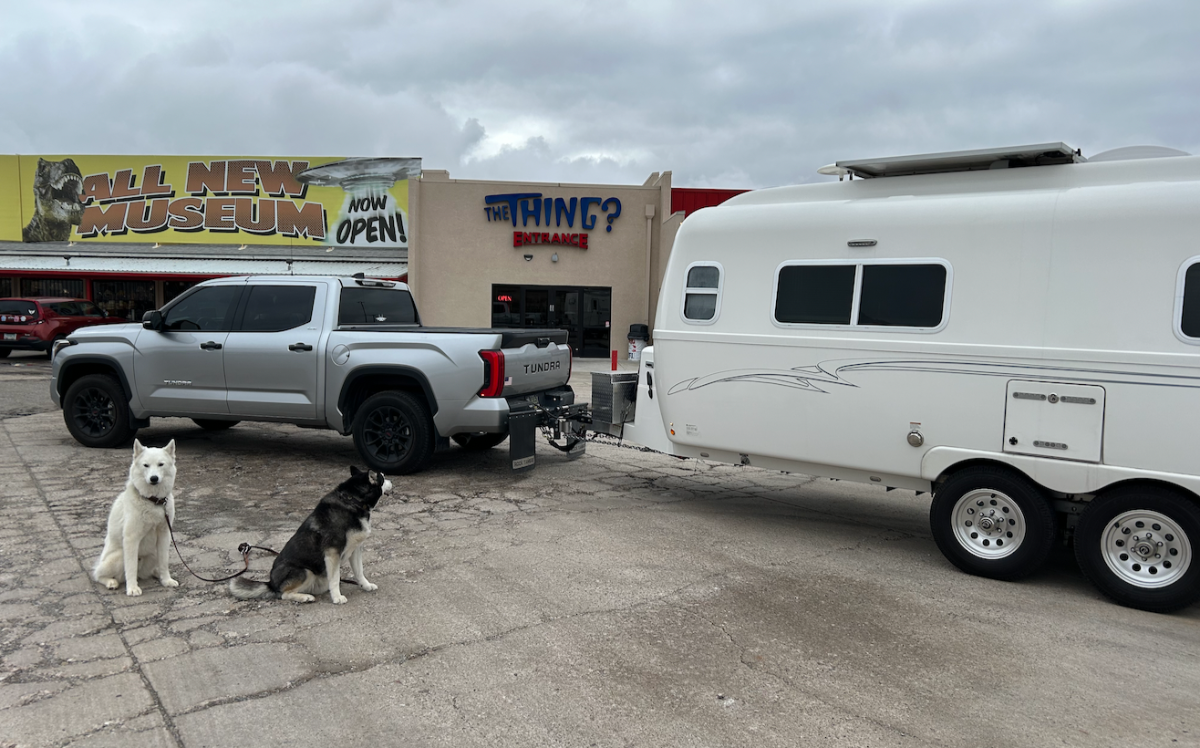
OK, for decades we've been seeing those billboard advertisements across the southwest from California to TX, maybe even further, that show a weird image of what appears almost alien - and in huge capital letters, "VISIT THE THING?".... Or, only 974 miles to "THE THING?"... whatever. Traveling back from the Q a few weeks ago, it was just me and the two knuckleheads in the back. We were eastbound on I-10 between Willcox and Benson, near Dragoon - with nothing better to do, we pulled in to the "All New THING Museum" for grins. So, has anyone, except me, actually stopped at "THE THING" to check it out? Just curious...
1 point
-
@Ronbrink, that's a marvelous solution to clean drinking water and some winter camping situations. It looks really pricey, at first, at roughly $300 for the can and replacement filters, but 500 gallons of clean water for $300 is less than you'd pay in the grocery store, and no wasteful packaging. After the first round, replacement filters were 5 for $40 on their website. Now, 6 cents a gallon. Smart improvement. Cpuld be very useful for some folks. Thanks for sharing.1 point
-
There is a hand pump (black cap nearest doorway), it twists to ‘lock’ and ‘unlock’ a pump mechanism. Generally takes 10-12 strokes when using the shower handle.
1 point
-
Cool. Cuz I'm 1504. Can't wait.1 point
-
Just an FYI for those with older Ollie's like mine. Check to see if your door frame has the hinges built into it. If so, these won't work.. Maybe not a Lippert door, or maybe just a different model?1 point
-
We have the Progressive Industries EMS-PT30X which is supposed to protect against high and low voltage and surges. Is there something about the Hughes Autoformer that I should know about that is better? I understand it can be mounted inside for theft protection but I am more concerned about damaging the electronics, appliances, and equipment.1 point
-
I once heard that partially filling the tank and then dumping a fair amount of ice into it before taking the trailer for a ride helps. Apparently the ice "scrubs" the tank, melts, and can easily be drained upon destination.1 point
-
HDR- "Google", "does roadpass own compendium" and you will get the answers to most of your questions. Bill1 point
-
@Tom and Doreen, that's basically what I suspected. Energy in a campground can't be magically created, only redistributed. Those with autotransformers will be able to use more during a low voltage event than those without, until the load exceeds the overall capacity of the grid.1 point
-
The use of an autotransformer during periods of low line voltage will increase line current which could under certain circumstances stress components such as circuit breakers and cause additional heating of connectors and junctions especially those which may be oxidized. Not much of a problem in modern well maintained campgrounds but could be a problem in lesser capacity, poorly maintained / engineered campgrounds. Another explanation is here.1 point
-
Regarding the wet bath/dry bath perspective, we quickly came to the same conclusion as others have. And It's the first thing I bring up when someone says, "I won't have a wet bath". I point out that I don't camp out in the bath, or use it for a library. Ninety-nine percent of our day is spent someplace other than the bathroom. The fact that it's called a wet bath really doesn't change much about the way I use it compared to a similar dry bath. For us it was a non-conversation, just something to be aware of. On the note of how much RV real estate is valued at, I think Oliver knocked it out of the park with how efficiently they met all the needs in such a compact camper. Like someone pointed out, everything has trade-offs, and I think the design of the Oliver campers makes the most gain possible for the trade-offs they chose to work with.1 point
-
Nope! Not because I don't want to - but - because I simply don't know - sorry. Bill1 point
-
I fill the LifeSaver Jerrycan and the Oliver’s freshwater tank with ‘home’ water prior to a trip departure; LSJ for consumption, freshwater tank for everything else. When the LSJ runs low it is refilled from the freshwater tank. This current system replaced having to bring a 3-gallon spout container of filtered water for initial countertop use, and the Travel Berkey for refilling, which is time consuming and cumbersome! In doing so, the footprint/stowage of the water management system is greatly reduced with an increase in onboard water supply. I too do not like change, unless for the betterment, all part of my Oliver Evolution!1 point
-
I replaced the vanity towel bar/access cover with a marine hatch as several others have done. I used screws and nylon insert lock nuts to mount my hatch. If you follow @Frank C's installation and reuse the original vanity towel bar/access cover, I don't think you can beat his use of U nuts. I wish he had completed his version before I did mine, because I prefer his method! Mossey1 point
-
Although the Litho's are pretty much "Maintenance Free", having the battery tray sure is handy. Especially if you mount a master switch, shunt, load terminal blocks and tie down straps in the battery bay as many of us have done. Hope it works out well for you. GJ1 point
-
There are times when purchasing a quality item just doesn't make any sense. Several years ago I was talking to a friend of mine about buying one of his sets of "Snap-On" tools from him. He said that given the amount of time that I would use this combined with the type of work that I do (hobby and repair) my purchase simply would not make any economic sense - his recommendation was to just buy the same set in a Craftsman or Kobalt or Ridgid/Huskey brand instead and pocket the extra money. However, there are certainly other times when plunking down that extra money makes perfect economic sense. And, can actually save money over the longer term. Having said this - in the case of RV's, hopefully buyers get a good handle on what their camping needs and wants are prior to buying anything. This is easier said than done though. It sure is awful nice to have all that room of a big 5th wheel until you find out that it is a big PITA to travel with let alone get into and out of many camping spots in more remote places. Knowing now that I really could sell my Oliver for (at least) what I paid for it 8 years ago pales in comparison to the joy I get when people can't believe that it is going into its 9th year and still looks new. Add this to the enjoyment I've had with Twist over the 8 years, I'm absolutely certain that this was the correct choice for me. But, if I only wanted to go to the local RV park for the weekend or had a bunch of kids, I understand that my decision could have been different. Bill1 point
-
Of course you can, Bill! HA! 😆1 point
-
When it comes to the inductive loads, there shouldn't be any difference in the load on the campground since the watt draw at the pedestal is the same with or without an autoformer. This would change if everyone was running their electric water heaters or other resistive loads at the same time. By how much and to what effect is highly variable and would depend on the campgrounds electrical system. In the end, the same amount of watt hours would be used by each camper had the power been at the correct voltage to begin with. Also, the autoformer shuts down at 104 volts so they won't be drawing power at all if the campground system dropped that low. I'm guessing a campground's grid would probably be more protected if everyone was using an autoformer than if nobody was. You'd have more angry people though since the power would be cutting off inside their campers instead of continuing to operate at that dangerously low voltage. In that situation I'd certainly rather loose power completely than destroy my ac or refrigerator.1 point
-
When running any inductive loads with motors such as AC or compressor fridge, you will be using the same amount of watts as someone who isn't using an autoformer whether it's in a low voltage situation or not. When running resistive loads such as a water heater you *will* draw more watts but you will be doing so for a shorter amount of time than someone who is using the same water heater in a low voltage situation. In the end you'll both consume the same amount of watt hours to heat the water and not be costing the campground any additional money. What you will be doing by using an autoformer if the campgrounds voltage is low is protecting those inductive appliances from premature failure due to running them at a lower voltage and higher amperage than they were designed for.1 point
-
I experimented with these on a scrape of OTT fiberglass for a mod I had in mind. I used a long bolt a couple of nuts and a pair of wrenches to crush them. I believe they are a worthy product for an anchor/mounting point in or outside of an Ollie. I still haven’t completed it, but it’s still on the list Mossey
1 point
-
First check the connections. If they are firm, then dusting likely will not make any difference other than it will be cleaner.1 point
-
Per your reference, I checked Splendiday.com and order out a set of them. Their design uses four "Petals" vs. most others that have just three. I like that. I've used rivet (Blind Flush Nuts as my GrandPa called them) nuts for many decades and they can be a PITA for fiberglass just as you stated. Also for plastic IMHO. Thanks for the suggestion. GJ
1 point
-
This was exactly what went through my mind before buying the Oliver. My wife and I went back and forth on it for a month before deciding that we just don't spend that much time in the bathroom. Sure, a dry bath, and one I can actually stand up in, would be great, but the differences in quality between the Oliver and the only other contender out there in my opinion, the AS, was like night and day. The AS I was looking at was the 27-foot Globetrotter. It marked all the items on the list, but the build quality was suspect and the hull, although pretty, seemed like something out of nightmares for those parked under tree limbs and suffering the occasional hailstorm. I honestly think the Oliver already is in Airstream territory, if not in fact beyond it. A 27-foot dry bath Oliver would be so far beyond AS, they couldn't catch up.1 point
-
Having pulled an 8’ 6” wide Airstream across the Columbia River via the 9’ 4.75” wide lanes of the Hood River bridge, a trailer that size is something I don’t ever want to own again. The pucker factor of the experience is one I don’t want to re-experience. Even my 9’ 6” wide barn doors were enough to terrify me when there was snow on the ground. All that said, a slightly larger Oliver would be appealing. Something roughly 7’ 6” wide, and 25’ long. I don’t need a dry bath, but would like a bit more storage, a longer bunk, and most of all, a wider aisle.1 point
-
I too was not happy with the "wet bath". It was probably Anita, but early on someone mentioned to me just how "expensive" RV real estate is. They went on to explain by asking me just how much actual time I spent in the bath each day versus virtually any other part of the trailer. Good point I thought and then they mentioned the virtual "automatic cleaning" of the bath that occurs each time I used it for a shower. As it turns out - I was concerned over basically nothing - it really isn't any big deal and certainly I do use the other real estate more than I would use that same square footage in a dry bath. Another related thought - Oliver could (fairly easily) actually make a dry bath in the Elite II. Simply eliminate the closet and then extend the bath area into that "old" closet area - easy. I'm not giving up that closet space though! Bill1 point
-
I've been told these are in our Owners Manuals, but mine is a 2016 and I do not see any schematic drawings in the manual for 2016. You have a 2023 and perhaps they would be in the PDF version of your manual online. What I've done is collect drawings other members have posted in this forum, every time I see one! When I copy a drawing of a newer OTT, I'm never sure the systems in my Oliver will be exactly the same, but they help. Hopefully others in the know will chime in.1 point
-
I read a post on one of the RV forums that claimed they got pulled over by a trooper while draining their fresh water on the road. The trooper said police had received calls that a trailer was dumping something on the highway. The OP said he was ticketed for "failure to secure a load." (BTW, you don't need to open your faucets to drain the fresh tank, but it does help if you want to drain all the lines, too.)1 point
-
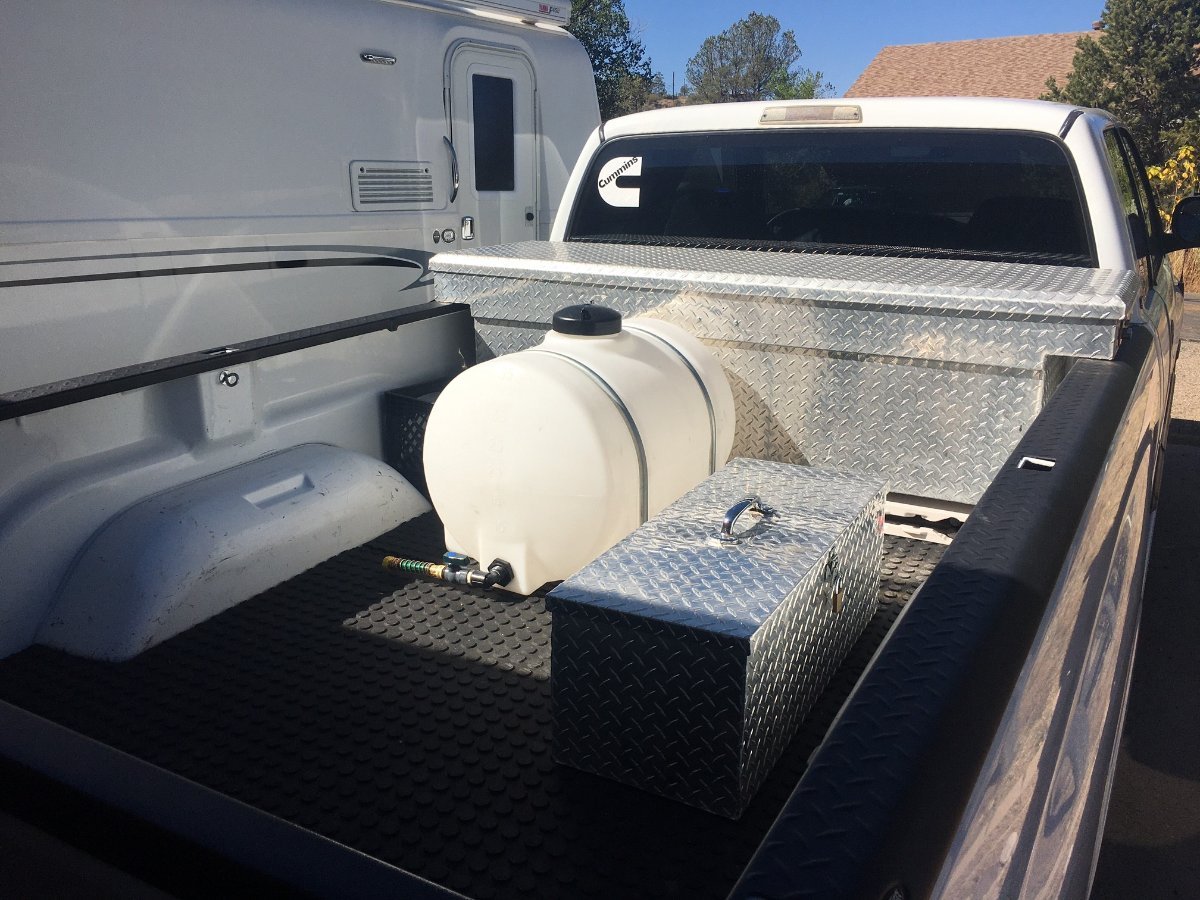
This is our emergency water!
1 point
-
I was able to read battery data while driving all the way back from our trip. It was of greater interest, since the batteries had less charge and this was the first time I ever ran a DC fridge while driving (LP off). We only have lead-acid although a decent 450AH. We ran our inverter most of the time, played DVDs, the TV and soundbar, the furnace overnight, an electric tea kettle the first morning, a little microwave and batteries were down to 79%. The next day was cloudy, only got up to 85%. Next day boiled water with LP instead, down to 75% and back to 85% on a sunny day. The sun is really low during winter, isn't it? Seemed like it hardly came over the deep canyon walls where we camped. Ran the fridge on DC today, 3 hours back with a lunch stop, batteries got down to 67%. Plugged into shore power and back to 100% in a little more than an hour. At least that's what Victronconnect reported. It should really take longer, as the charger kept giving lesser amperage all night. BTW, now that we're back home, Oliver parked behind our shed, the dongle is performing better than ever! Before we left, I had to be near our LR window. Now anywhere in the living room it connects instantly. So as a test, I walked past the LR, behind our double-sided real granite stone fireplace and it connected. It took 3-4 seconds longer to connect but did so without timing out as it had before.1 point
-
I ended up taking the rails and nightstand off. I ordered a custom mattress from Tochta to fit the space. Made a wood platform to span the middle and use the area underneath for storage and the dog bed. John
1 point
-
For me cooking/camping is all about being outside. If rain is in the forecast, I set up a tarp over the outside kitchen. I do love using an oven and especially creating delicious pizza. With a good pizza oven and a handy laser thermometer, a whole world of outdoor oven creations is possible. I have good luck using the Camp Chef line of products. I own their pizza oven attachment as part of the modular system. I simply use the propane quick connects on Ollie and I am cooking with gas and a happy Ollie camper. The Camp Chef website has great cooking ideas, such as the buffalo chicken nachos utilizing a cast iron skillet and the pizza oven. Catch the drools! ???? Buzzy https://www.campchef.com/camp-stoves/14-cooking-systems/pro-60-deluxe-two-burner-stove.html https://www.campchef.com/stove-accessories/outdoor-ovens/artisan-outdoor-oven-accessory.html https://www.campchef.com/recipes/buffalo-chicken-nachos/1 point







.thumb.jpg.e34bf01ef7f7d5e99ad31856d45afbeb.jpg)













-
Recent Achievements
-