
jd1923
-
Posts
3,844 -
Joined
-
Last visited
-
Days Won
312
Everything posted by jd1923
-

Main battery switching, a different approach
jd1923 replied to Snackchaser's topic in Ollie Modifications
🤣 -
Main battery switching, a different approach
jd1923 replied to Snackchaser's topic in Ollie Modifications
I'm assuming you mean the cutoff switches. That's cool and quite an improvement. I had to move everything out from under the beds! -
Cabinet instead of Stock Convection Microwave
jd1923 replied to HDRider's topic in General Discussion
Hey if Lance's idea works and OTT has such parts at a reasonable price, then cool! In my experience, after entering six (6) service tickets, I strike out every time! I stopped even thinking to ask and channel my efforts into DIY! 😎 This is not a difficult project to custom build yourself! I removed the original microwave for an oven, so check my mod thread below to see what you'd be getting into (when you see my first picture, I added the 2x4s to provide a base for the oven). I see 3 steps in creating a custom cabinet: 1) Remove microwave, fill screws holes on face, file smooth the rough cut opening 2) Clean and line the internal cavity with poly sheeting 3) Ordering and installing new cabinet doors The microwave bezel comes out with 4 corner screws. Our microwave (not that OTT installed yours the same way) had a bracket above it that was screwed in from the upper cabinet. Empty the cabinet and the mat liner and you may see 2-3 screw heads. I lined ours with fire resistant insulation for an oven. You could line yours with any thin PVC sheeting or the like, cut the five sheets to size and glue in place. If you want to get fancy, you could add a molding to hide the cut edges. Also, use Marine-Tex to fill the screw holes in the face. That's step #2 above, now for the finale. Measure the opening for cabinet doors. You must order cabinets somewhat larger than the opening. Go to Depot/Lowes or a cabinet shop to select your cabinets of choice. Get your wife involved in this step of course. Your options are endless! Also think about the hinges. I'm not a woodworker or cabinet guy, but purchase hidden hinges that mount to the interior walls vs. anything that would screw into the face. Then you want a good latching device for both cabinet doors so they stay shut while towing. Staff at the cabinet shop could advise on proper hardware. Can't wait to see your mod post, if you go this direction, take the plunge! It's a good project that you can personalize and when finished have pride in your work every time you use it or look at it! 😎 -
I used a standard 1/2" wrench and made them hand tight. With a short wrench you cannot over-tighten it like with a socket and longer ratchet. Looking at your numbers, you want the 15-25 range, and I'd go with 25 ft-lb. There is no way 6-9 ft-lb would hold an 8mm bolt on a 4/0 lug! The cables would be lose in a few miles. Epoch has a history of numbers being different on data sheets vs. user manuals.
-
I thought that when I reviewed the catalog link Rob provided. I'm the oddball here re taste in windows (and certainly other things 🤣). I'm happy we have the sliders and very happy after 10 years that ours are in excellent condition after replacing the white rubber seals with new black rubber. I like the one-hand operation whether standing, sitting, or laying in bed. I open/close the one by my bed every night and morning. Sliders may be better for security too, when left open while away for the day. Every time I pressure wash the Oliver, I hit the windows dead on and a little dirt and a lot of water comes out of every weep hole while staying dry inside. No similar tracks or weep holes in the awning windows, so likely a benefit of being low maintenance. I know some of you have leaks in your original windows and many of you want awning windows for better air flow and other reasons. I hope for you that these windows fit into the roughout openings of your hull with an easy installation! I'm looking forward to reading the first window mod thread on our great Forum! 😂
-
Main battery switching, a different approach
jd1923 replied to Snackchaser's topic in Ollie Modifications
Are they still mounting them under the streetside bed? -
True Induction Stove Top will not turn on
jd1923 replied to Lamar's topic in Mechanical & Technical Tips
You know, I've been worried about RV battery SOC ever since our first in 2018. But the Class A and then the Class C both had generators. I was adamant from day 1 with the Oliver that we would not run a generator. Battery and inverter/charger technology is here! You even got me thinking in a new way that an EV truck can be a proper TV! 😎 (Though no way we could afford one, and the old Dodge now with upgrades including exhaust brake is a joy!) I pulled out lead acid and a 2KW Xantrex, 2 years ago, and upgraded to the 3KW inverter/charger and 600 Ah LiFePO4. It took me a while to know what I can run and how long the SOC will last. Then last Black Friday we up'd to 900 Ah. In all our winter travels, I finally stopped worrying and I learned to use 3KW and 900 Ah to the fullest. Chris still worries some. After a week of travel, I remembered seeing 67% SOC and Chris asked could she use the Emeril (replaced the microwave with an air fryer). My reply was 67% of 900 Ah is equal to 100% of 600 Ah! Sure bake all afternoon of you need to! Love it. Our Chill Cube runs on ridiculous low power, consuming <30% of what the old Dometic pulled, and I estimate <50% of the power requirements of the Truma, Tosot, or any ON/OFF compressor model! This is amazing and sure helps the worry factor. We had 450 Ah in LA and that means 225 usable which would be our current battery bank at 25% SOC. I don't worry anymore! 😎 (When under 20% SOC, Victron and Epoch apps will warn us.) I believe that many of you with 600 - 640 Ah and 3KW inverter should think to worry less. Run your A/C and that Induction cooker, at least one burner! 🤣 -
True Induction Stove Top will not turn on
jd1923 replied to Lamar's topic in Mechanical & Technical Tips
What I mean is as follows... We run our appliances on battery/inverter just as we would on shore power. I don't even like to hookup when hookups are available, not pulling out cables and hoses unless truly needed. I'll charge batteries, fill fresh water and dump tanks when leaving a campsite, given we are boondocking next. Often, I do not charge at all since as we drive away we average +40 Ah per hour towing with the Victron Orion 50A DC-DC charger! 😎 Our system can handle running our Chill Cube A/C, plus the induction cooktop at the #10 setting, while watching TV with soundbar, and if I wanted to push the system I could boil water with our 1100W tea kettle! Although running ALL of these appliances does add up to 3,000W! The Victron Multiplus II can handle it at default settings. It's rated at 3KVA and can run that in continuous mode. One time, I had our hot water heater running on AC, TV and normal stuff running and forgetting the HWH was heating I turned on the old dog Dometic P2 A/C (TG that beast is gone)! In a few minutes after the Easy Start got done with it's lame on-n-off routine, full power to the compressor, the Victron sounded an alarm! When I checked the app it was providing over 280A (3400W). But it didn't shut down, it just warned us, and it ran at that level for a few minutes. Looking at the amperage numbers, I remembered I had the HWH on electric (vs. propane). I hit the breaker to turn off the HWH and the Victron alarm stopped sounding. We did not lose our TV streaming, not even a hiccup in Internet connection of any other electrical need. Sorry, the Xantrex product will not do this. You can search for keyword 'Xantrex' on this forum to find dozens of posts re Xantrex inverters failing, or at least shutting down, error codes present. Yes, perhaps the default low voltage cutoff is set too high, but that's not all of it. The Victron MP2 also has the PowerAssist mode where if connected to 15A source, it will use that and add inverted battery power to carry higher loads like an inefficient A/C unit. So consider this. When connected to 30A shore power (3600W) the Victron can pass through that power and add another 3000W for 6600W total. Of course nobody would need that or do that, but you could run 3 of the worse A/C systems, like the Dometic P2 on that power. We run our Victron inverter 24x7x360! We run 5 Victron devices in the Oliver (MPPT SC, DC-DC, Shunts, etc.) and two more in the truck which can read from the VictronConnect app. BTW, most of us state battery capacity in Ah units vs KWH. Your batteries are 9KWH (750 Ah)? I thought the max OTT Lithionics installation is 640 Ah. It is standard to use Watts for appliance specs, like the 1800W (150A DC) induction cooktop. I'm always translating into 12VDC Amps since the Victron and Epoch apps show +/- Amps. -
Main battery switching, a different approach
jd1923 replied to Snackchaser's topic in Ollie Modifications
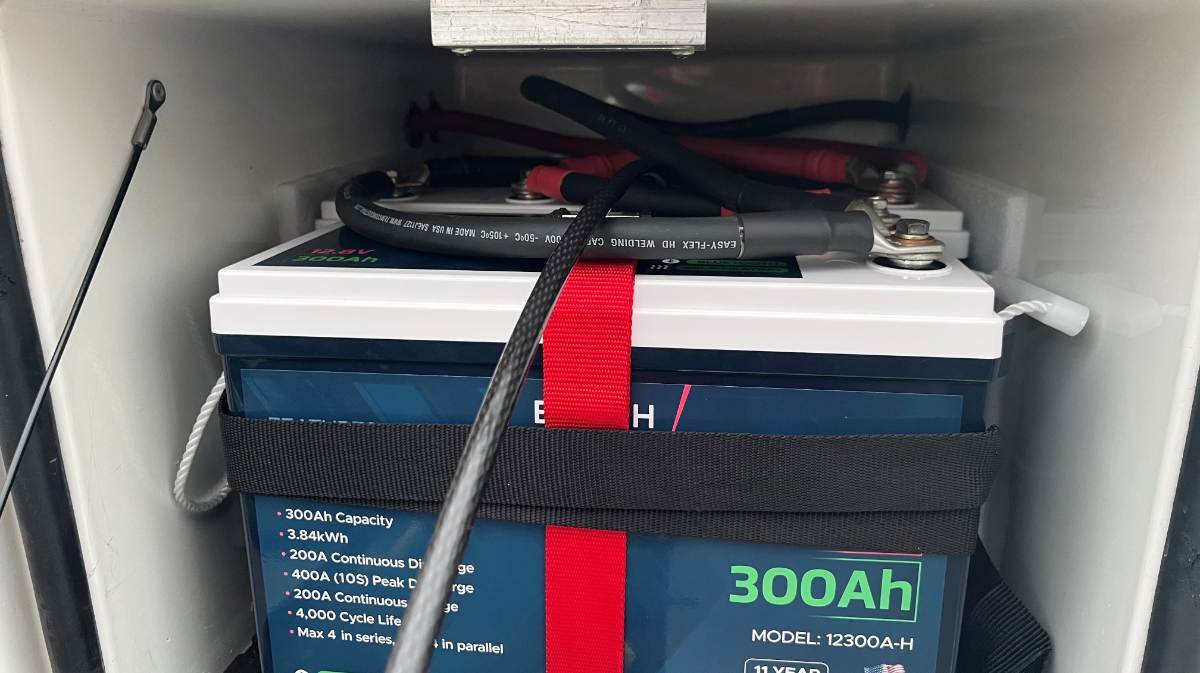
Geoff adds some new thinking here and a clever solid approach! Using relays/solenoids for high amp connections is a good approach! We keep our our Oliver outdoors, never winterized, parked often but never "in storage." She's been parked a few weeks now and our batteries with rooftop solar are currently at 99% SOC. Needles to say, parasitic draw is not a concern of ours. I believe that adding a cut-off switch to the main 4/0 cabling, adds a point of resistance and possible point of failure. Geoff's solution does not interfere with the main power connection. Just 4/0 hardwired straight to the inverter is a good thing! Yet our friend GJ garages his Oliver for 8-9 months on the mainland while he enjoys Aloha-land! Extra precautions must be made if you're out-of-sight of your Oliver for this duration. Both solutions fit the differing needs of 2 Oliver owners! 😂 I'm old-school in that when servicing any vehicle, the first step in the service manual is "disconnect the ground." This is more trusting than any switched solution! I installed the 4/0 wire with the main ground connection closest to the opening. I can disconnect it in just a minute with only a 1/2" wrench, without rolling out a tray (ours was deleted) or removing the locking cover plate I installed (not shown in picture). Very safe too, since there is really no way to touch the positive lead which is 6" further into the bay. I disconnect rarely, haven't done so since I added the 3rd battery last year. The main ground is right there when needed! Call this the #1 most basic option, no switch required! 😎
-
I'd like to install a Mini Split A/C at home. Looking for my technical friends here who have researched models or installed one in your home. Our home, built in 1980, is still on the original HVAC system (with a few repairs I've made). It's a combined unit up on stilts, attached to one end of our long 4100 SF home. The other end of the home doesn't get much airflow and neither do the bedrooms. I'd like to install a dual-head mini split, one head in our bedroom and the other in my office where I train via Zoom in the afternoons. Both rooms get hot in the summer and it's a waste cooling the entire home low enough to cool these two small rooms (only 180 SF each). It would be OK if cool air flowed out in the hallway too to give the old system some help. Likely the smallest dual unit at 9,000 + 9,000 BTU is enough, or maybe 12 + 12. I see brands that are familiar like Tosot, Turbro and Pioneer, since they make RV units. I also see Senville, Cooper & Hunter, Daiken, Della and others. Any brand preference? I see Senville has good reviews with a 5/10 yr warranty. I'd like to buy from an HVAC distributor vs. Amazon, but each time I find a link the $2K dual unit on Amazon goes for over $3K elsewhere! Definitely need a dual head unit and the 2 rooms are side-by-side on one exterior wall which should make for a tidy installation. Time to drill into our home instead of the Oliver! 🤣 115V would be a close run. I could tap into a bedroom outlet which only has a nightstand lamp on the circuit. For 230V I can add a breaker and run wire from the garage along the soffit. Thinking 230V is more efficient, but not sure. Is R32 the best refrigerant or another kind? Lots of Qs! Any installation or use experience out there? Thanks
-
True Induction Stove Top will not turn on
jd1923 replied to Lamar's topic in Mechanical & Technical Tips
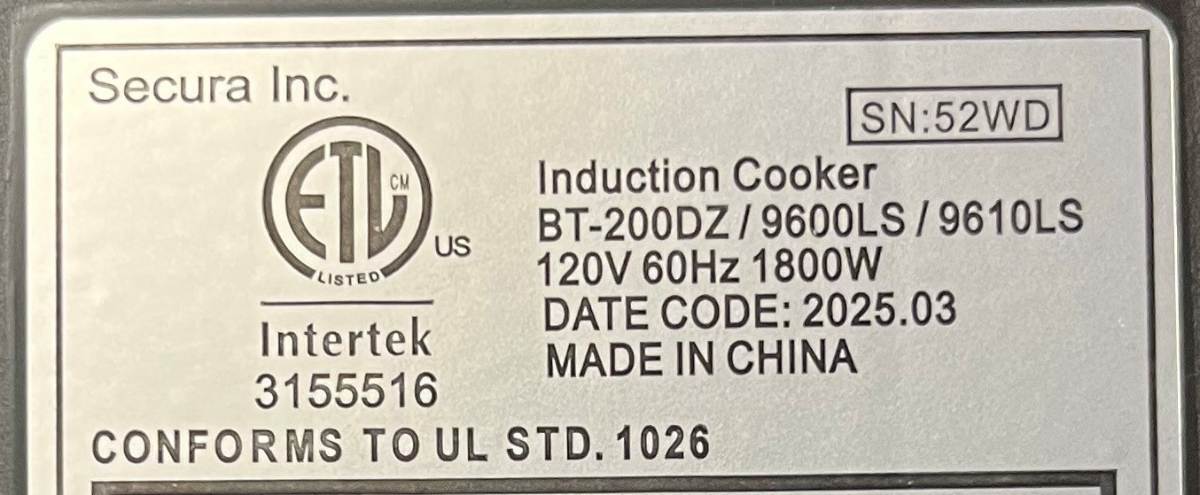
Regardless of usage, there is a wattage spec listed on electrical appliances sold in the USA. Pretty sure it's code, so that electricians know how to size wiring and fuses/breakers. Also, part of RV solar planning is to add up the wattage of each appliance and to estimate how many hours per day of usage, and so forth. We use the induction cooktop that @Ollie-Haus made us aware of in an older post. My wife likes it so much that after she was using at home too often, I purchased a 2nd one for the Oliver only (I like our Oliver always ready to go, fully equipped). It's rated at 1800W which is listed on the Amazon title and on the product label underneath. Wattage spec should also be listed in product literature and user manuals. https://www.amazon.com/dp/B07KSNTSVR/?th=1 I do not get this statement either, "the stove itself." How can an appliance possibly know what it's wired to, or know whether you're on inverter or shore power? We run our induction cooktop often at the full #10 setting, for example to boil water for pasta. Everything always on our Victron Multiplus II, no problem. 😎
-
As I said, from page 2
-
Yes, though every Oliver is packed differently! We always have a full FWT. The bottom of our closet is also wall-to-wall drinking water, wine, soft drinks. Very full pantry and Fridge. Back cabinets full of clothes, Attic rather Full, try to keep the rear basement light. Not sure if you have D52 axles and Alcans, but that’s a bit of weight too that is exactly centered! The 580 Lb tongue weight was one measurement taken on the same scale. You can add 600 lbs to the trailer and if centered add little to tongue weight. Tongue weight is light on the Oliver. Reason for WDH on half-ton trucks. Should be 10-15% of trailer weight.
-
Your answer is on page 2 of this thread.
-
True Induction Stove Top will not turn on
jd1923 replied to Lamar's topic in Mechanical & Technical Tips
How many watts is the cooktop rated? The rating should assume full ON. -
Main battery switching, a different approach
jd1923 replied to Snackchaser's topic in Ollie Modifications
If only half of degreed EEs had your practical knowledge… Excellent work Geoff! Appreciate your design philosophy too! 😎 -
Thanks Bill, I'm sure many of us are interested! 😎 No CAT Scales in our county (50 miles to the nearest Interstate), so I take advantage of the simple scale at our Prescott Solid Waste Division (the city dump). I did not get separate TV axle weights. I go one day with TV plus TT and weigh the truck wheels on the scale, then all, then Oliver only. The next day I go back, Oliver detached and I add 220 LBS for Chris and her front seat stuff and our 65 LB Springer! I also used a Sherline tongue scale and measured the same 580 LBS. Your TV is a bit heavier than ours. The Duramax and Allison are certainly heavier than our 5.9 Cummins and Dodge 47RE trans, but the real difference comes from the weight of your truck bed cap that we do not have. You can see how our weights have increased in a couple years, getting closer on TV GVWR. We always have 35+ gallons fresh water in the truck bed and have accumulated more tools and camping gear, even spare hubs for TT and TV! The increased weight comes some from more gear but mainly the many mods and additions I've made in the last 2 years. D52 Axles and Alcan Springs is a good portion of the net increase. I'm getting closer on TV GVWR and not concerned re Oliver GVWR since we now have a 10K suspension on Hull #113! Love your old-school spreadsheet! I cannot write a simple to-do list without my favorite app Excel! 🤣
-
Main battery switching, a different approach
jd1923 replied to Snackchaser's topic in Ollie Modifications
If Geoff ever sells their Oliver, the buyer will have to be another EE! 😎 -
Awesome, now 37 pages in a dead heat with “Where’s Ollie!” 🤣
-
Not, something miscommunicated! Your D52 axles are labeled 3500 only due to the OEM installation of 1750 LB springs. They are the same D52 axles. With an Alcan upgrade you’ll have a 10K LB suspension, but 3500 axle labels and 7,000 GVWR legally per the DOT sticker on the body.
-
Wow, all day long and no replies here on our 36-page Alcan thread! 🤣 Robert, you have a newer hull, so I assume you have D52 axles. Those with D35 axles should upgrade at the same time (my build thread below). You want to install everything NEW; D52 axles, Alcan 5-pack leaf springs, a new EZ Flex kit and new shocks. I had installed new shocks the year before, so after they tested good, I reinstalled them. I wish somebody would come up with a HD replacement shock (I've looked)! The Bulldog shocks are likely better than the OEM Monroe 555001 shocks, but they are both light duty shocks designed for 1750 LB springs. I wonder if the Oliver would tow any different without these shocks, given the HD Alcan springs. I'd like new HD shocks with similar min/max length specs but heavier, larger diameter shaft, piston and casing. Do differently? I would purchase the full Dexter EZ-Flex kit with HD shackles and wet bolts. I purchased the wet bolts from Alcan and new EZ-Flex center links only. I do love Alcan Springs, but their shackles and wet bolts are not splined so do slip, so not as good as the Dexter wet-bolts that come with the EZ Flex kit. Another route would be to look at a MORryde substitute for the entire EZ Flex kit. That's all I see, more info here =>
-
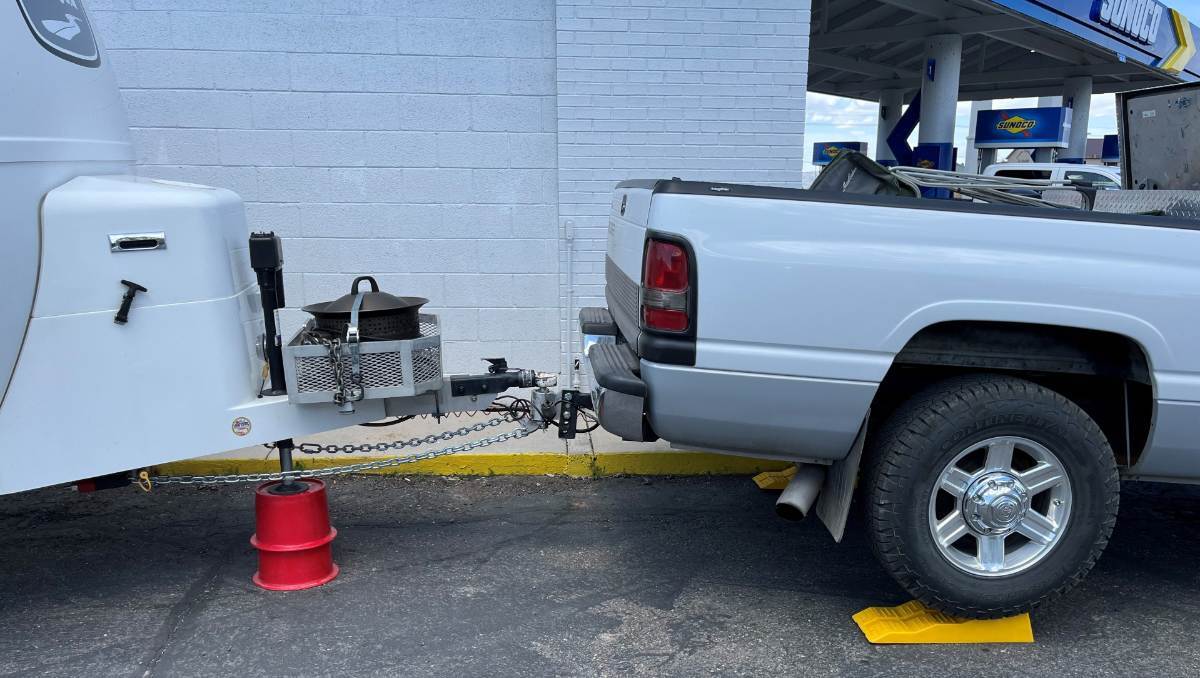
We don’t setup a waste line at campsites. We're never in one place for more than 5 nights and I don't deal with those fancy waste ladders which I associate with Class A RVers, who stay long with full hookups! 🤣 Instead we dump on arrival (often coming from boondocking) and on departure. When dumping, you must have the Oliver up in the front AND on the curbside. I use the LevelMate at the dump station to bring the front up a good +2" over level. Some may not know, the gray tank is on the curbside, with its outlet drain facing the streetside. If your Oliver is any lower on the curbside, your gray tank can be quite full after you thought you dumped tanks! I use an 8" Anderson block to lift the curbside jack so that it is at least +1" above level. Tanks are then fully emptied. This picture was taken at a dump station in Cedar City UT. I had to back in, so there was no other approach. You can see all what I had to do to lift the front! What's not pictured is the curbside jack is also lifted. Isn't RV life wonderful?! 😎
-
Our 2016, about the same thing. I reinstalled a replacement cable, but to do it properly I would have to reroute the waste drain plumbing. More here =>
-
Missing screws on cabinet cabinet drawers
jd1923 replied to Gliddenwoods's topic in Mechanical & Technical Tips
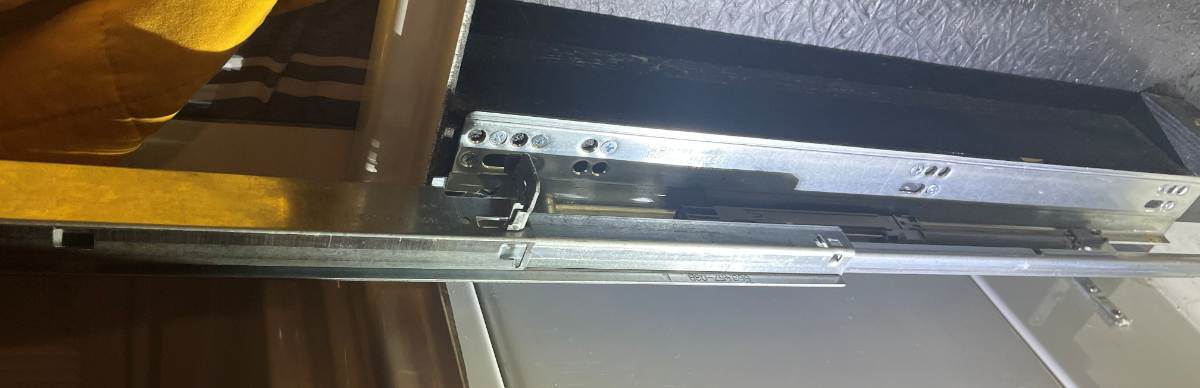
Just replaced the Blum slide on our nightstand drawer. This item is the OEM part replacement. Maybe I should have bought the 6-pack, LOL! The nightstand drawer and 5 kitchen drawers all use the 18" length, the short drawer uses the 12" Blum slide. https://www.amazon.com/dp/B0G7LQ3PQ4/?th=1 Lately, the drawer would open during travel so I suspected something was wrong. After removing the drawer (squeeze two orange levers underneath), I found the old slide was truly worn out. When fully extended the end would drop a couple inches. Not good! The new slide is in and now again it works great. But per the subject of this thread, OTT installed these slides with only three screws per slide! 😒 The slides are rated to carry 100 LBS, but three short #6 screws are certainly NOT! A couple year backs, working on a kitchen sink leak, I doubled all the screws on the kitchen drawers and went up one size. At the time, I forgot to do the nightstand drawer. The slides all wobbled a bit when unloaded with only 3 screws and I now contend it was the lazy installation that allowed this drawer to shake and eventually wear out the slides. These slides are substantial but need to be installed properly! BTW, Blum supplies 20 wood screws in these kits! 20 screws for 2 slides and 2 brackets not used for our application. I installed 8 screws on each slide! Why not? Blum certainly intends more than 3 should be used! I put 3 in the same holes to hold each slide in place and then drilled small pilot holes and screwed in 5 more (see pic)! Now this should last my lifetime. 😎 I suggest removing all your Oliver drawers, having at least 6 mounting screws per slide, 12 per drawer minimum.
-
True Induction Stove Top will not turn on
jd1923 replied to Lamar's topic in Mechanical & Technical Tips
Not powering up is NOT the same thing as it taking too many watts overloading an inverter! Given it "does not come on" (at all), it's simply not wired to a circuit supplied by the inverter. If an appliance wired to the inverter pulls too much amperage, your inverter will start making noise and will shut down when overloaded, but it certainly will "come on." What were they thinking at OTT! And BTW, a 2000W inverter by definition will run an 1800W appliance! Given the True Induction cooktop is rated at 1800W, and it's a 2-burner cooktop, then each burner is rated at 900W. If OTT had wired the cooktop properly, you could certainly heat up water for coffee on one (1) burner and run the fridge at the same time! You will be well under 2000W! 🤣 Get OTT to wire this properly! I would just DIY, as I suggested in an earlier post, but you have to be concerned of warranty issues. We have the LP cooktop of course, but like Bill mentioned also have an induction cooktop that we plug in indoors or out. We also do not use our LP stove stove to heat coffee water (unless battery SOC is LOW). We love these products! 😎 https://www.amazon.com/dp/B07KSNTSVR/?th=1 https://www.amazon.com/Aigostar-Eve-Electric-Cordless-Boiling/dp/B07D3R7RZT/ https://www.amazon.com/Melitta-Pour-Over-Coffee-Stainless-Filters/dp/B0CSQLHFW9/