Leaderboard



Popular Content
Showing content with the highest reputation on 10/16/2022 in Posts
-
I offer a contrary view to those expressed above. The Oliver we examined before placing an order was the twin bed configuration. With the permission of the owner, I spent a few minutes lying on one of her twin beds. I did not like having my inside shoulder hang off the side of the bed when on my back. I concluded that the 30" width of the Elite II twin bed is not enough for me to comfortably sleep. I am 6'0", 225 lbs. We take delivery on a standard (king-size bed) Elite II in November. The availability of the king bed option was a significant selling point for us. I strongly recommend that you actually lie down on an Elite II twin bed before deciding which layout to buy. That is what sold me on the king bed.6 points
-
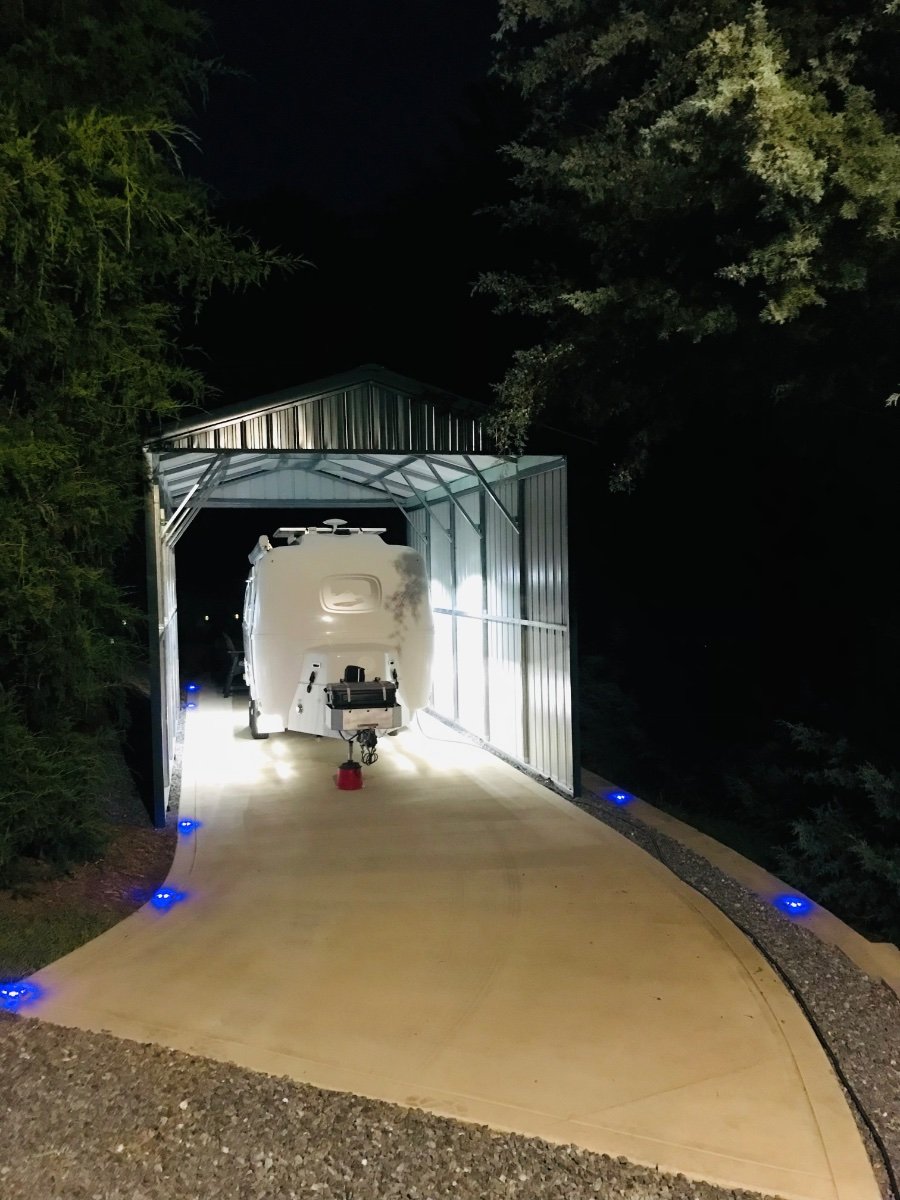
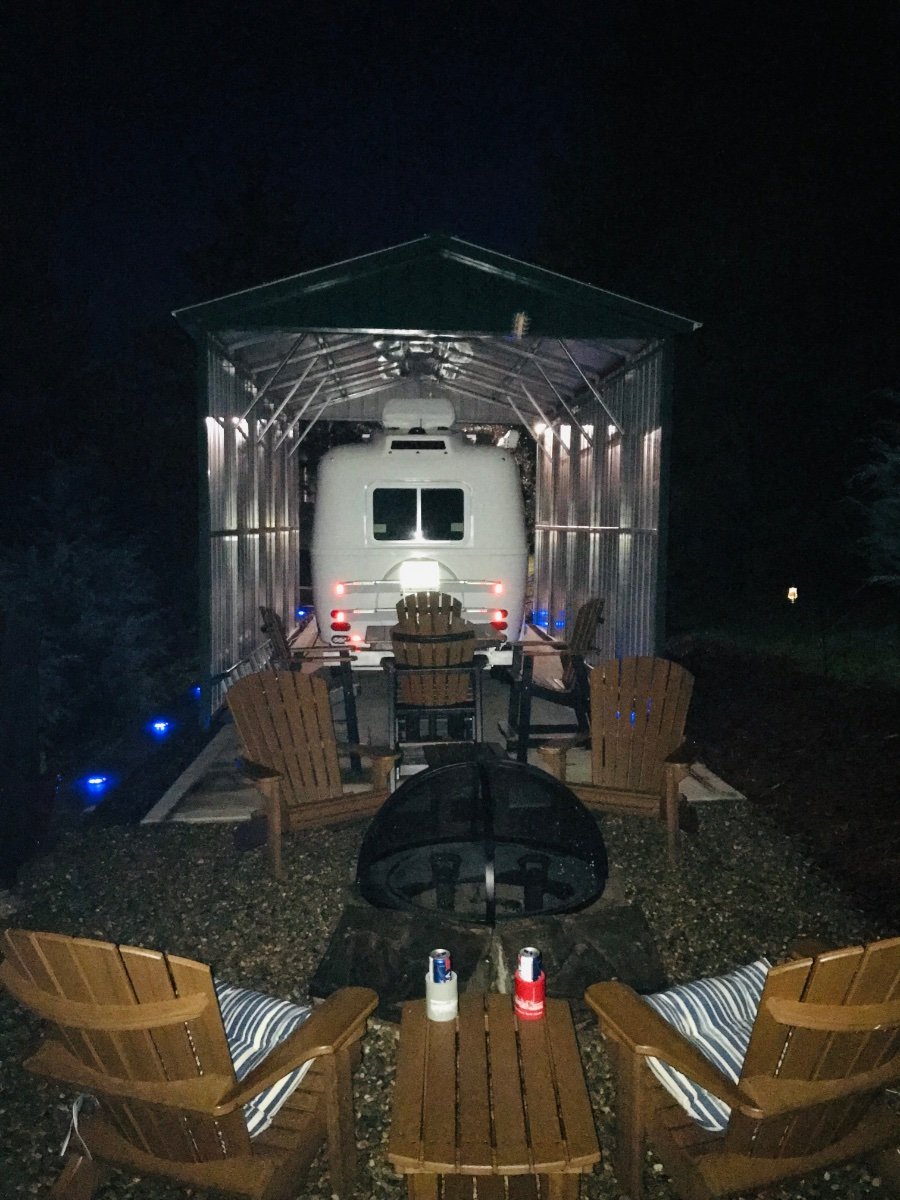
Hi Darrell, We used a Calmark cover the first winter of storage and it worked well. As others may have mentioned your solar panels will not be working if you choose to cover your Ollie. Last July we had a steel building aka “Ollie Hangar” built at our home to help keep our Ollie looking new. We have 30 amp service so keeping our Ollie charged is not an issue. We could not be happier with our Ollie parked right here at home vs storage fees and security concerns. We also really like not having to cover our Ollie with our Calmark cover as it makes it so much easier load up and take off south for warmer weather this winter. We choose not to have our stabilizers down when it’s parked in the hangar. Happy Camping! Patriot 🇺🇸 The hangar structure dimensions are 13’Wx25’Lx11’H allowing for plenty of room for washing and waxing. The actual slab is 12’x55’. Also no need for lighting in the hangar as the Oliver lights are more than adequate for any work I need to do.😎 Blueberry Hill where true camping tales and funny stories are told. 😂 I had the 12x55 slab poured with just enough fall that even in the hardest rain water does not run under the Ollie.
 5 points
 -
In older trailers, we don't have that facility. Great that the newer trailers do. I'm happy for you.3 points
-
I'm just 6'3 an now only 220 pounds. The "twin beds" work fine. I keep the nose of Ollie a bit high to keep the refrigerator from swinging too far towards the entrance door and to better drain the shower. I sleep feet aft. Like JD, I usually keep the feet in the nightstand corner of the aft end of the mattress. We cut and tailored with a butcher knife a queen six inch foam pad to place over the stock OTT mattress. It was a ton less expensive than mattress upgrade and we really like them. When they wear out, I'll get the 4" version for reasons hinted below. For special events, 🙂 we take the dinette area fiberglass storage covers, wrap each of them in a towel and place them upside down on the two bed rails between the two twin sleeping areas. Then use some of the cushions for padding and elevation leveling. Results in a suitable larger area for "fun".3 points
-
In San Antonio we get into the 20s for a few days several times a year. I’ve never winterized. On those occasions I turn on the hot water tank, set the furnace at 55, open all the hull openings and turn on our electric space heater. No problems coming up on our 7th winter. We’re currently at Cumberland Mountain State Park outside of Crossville and the temps are supposed to get into the mid to low 20s at night starting Monday. All I need to do is disconnect the water hose and we’ll be fine. Mike3 points
-
Hey Thank you for the kind words Katjo! 😊 We have AGMs and we keep it plugged in all the time. We have met a few folks that full time in there Ollie and they have no issues with being plugged in 24/7. We also run a neat little dehumidifier when the weather is above 41 degrees. -Patriot🇺🇸2 points
-
I currently have Michelin Defender LTX M/S 225/75/16 tires on the ground and an old Goodyear ST 225/75/15 (because 16" tires don't fit well under the 2008 Elite spare tire cover) The Wonder Egg already sits up high, due to its spring over axle arrangement and 16" tires puts it even higher. This week, I will be getting 3 new LT 225/75/15s for the trailer. It will lower the center of gravity just a bit and all tires will be new with a compatible spare on the back. With a single axle trailer I don't have the sidewall strain when doing a tight, slow speed hard turns, so beefed up ST sidewall is not required. Although my highway speed is in the 60-65 MPH range, there was a time where I needed to push it hard for three days at 75MPH in order to make it to a rally on time. I prefer using LT tires when going that fast and hard. The Wonder Egg, loaded for travel, tips the scale at 3900 pounds. I plan to run 60psi cold tire pressure and monitor them with a TPMS system going down the road. They will usually increase pressure about 5psi during travel.2 points
-
These are made in MT. I am a huge Red Oxx fan but their larger items are $$$$. The smaller ones are made from remnants and are cheaper, like the wallet or small “possibles” bag, and make great Christmas presents. Red Oxx Travel Tray These are especially cool and handy: … https://www.redoxx.com/monkey-s-fist-zip-knot-92009/p They have a wonderful retail store in Billings. Do not enter unless you are prepared to lose some money! 😀 John Davies Spokane WA
2 points
-
I'm 6', 175# and sleep with my head aft. Have hit my elbows a couple of times but prefer to have the nightstand near my head and a view of the trailer interior. Situational awareness.2 points
-
When I first got my Ollie I slept with my head at the nightstand (I'm 6', 165 pounds). But after a couple of night of my elbows hitting either the nightstand or the curved wall, I did a 180 and now sleep with feet at the nightstand. Much more room for the elbows. If you are not convinced by the posts above or feel you need more information then you might want to PM (private message) Patriot since he is reasonably tall. At 6' I can stand up straight in the shower - barely. Shortly after buying my Ollie I spend hours building a shower mat - similar to Foy's mat but not as nice as his. Unfortunately, I never thought about the reduction of vertical room and sure enough the day I finished and proudly took it out to the Ollie I realized that either I would now have to shower while bending over or give it away. Needless to say - it belongs to someone else now.😥 Bill2 points
-
Welcome to the forum! FYI these are actually bunk sized mattresses, 8 inches narrower than an actual twin. If you can find a kids bunk mattress to try out, that would give you both an idea of how little room there is…. this is a pet peeve of mine, I ordered all new Twin linens before delivery and they were WAY to big. I think it is highly deceptive that Oliver does not mention this. I am 5’10” and 165, I fit fine but I was always waking up when my feet or elbow bumped the unyielding walls or the nightstand. I now use high density foam (camping pad) there. It is much nicer to bump into that than into a rock hard chilly sidewall. I also sleep better without the cold infiltration in the shoulder camping season, and the foam keeps the covers tucked in and you don’t lose your phone or glasses down in the crack. I do put my feet into the inside corner rather than into the shorter curved part. I once showed my Ollie to a couple, the man was large and 6’4”. He found the low bath ceiling to be unacceptable, they decided to not buy one. You both need to see an Ollie in person to check the dimensions. If I were 6’2” I would have the big mattress! Who can identify the little tray on the nightstand?😬 John Davies Spokane WA
2 points
-
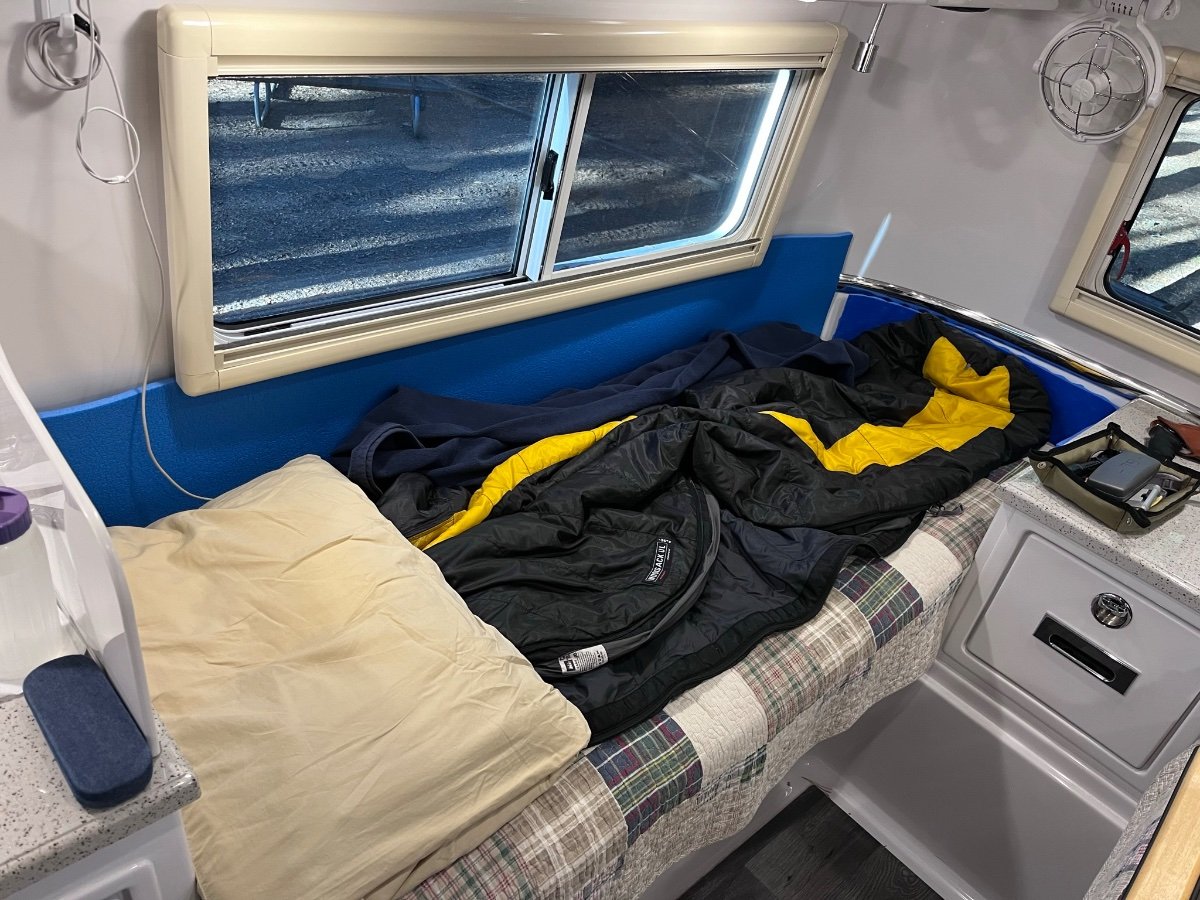
I’m 6’3”, was 245lbs. Depending on your pillow his feet will likely touch the rear wall periodically. Nightstand not issue if feet at that end. Width isn’t too bad, but there is a wall on one side. 🙂 Works for me and I tend to rotate a lot at night. In photo, head propped up reading at the moment. About 6” to rear wall
2 points
-
@Dorrie Hall They are small twins at 30 X 75 but we find them still quite adequate and comfortable and I share my 30” with my dog! Many people sleep with their head towards the door with feet next to the nightstand to avoid hitting the nightstand as well as to be facing the TV for watching. We sleep with our head next to the nightstand with no issues.2 points
-
Understood. But, Lithionics advises in its Rev. 7 Storage Procedure that their batteries with internal heaters will be fine (with no State-of-Charge concerns) if left connected to shore power during winter storage. The Rev. 7 Storage Procedure document states: "If your battery has the Lithionics Internal Heater, and you are subject to winter conditions, keep the battery ON, solar ON and plugged into shore power...This will keep the heater running and protect your battery. Doing this will eliminate the procedures below." The "procedures below" include the discharge/recharge protocol, which is required when the batteries with internal heaters are removed for storage, but not when left connected to shore power.2 points
-
I would doubt that the battery heater is run via the inverter - but - I really don't know. Don't forget that there are other considerations such as state of charge to be concerned with. Bill2 points
-
That is my impression as well, but it may not be that simple. Reuben from Lithionics asked if the external battery heater runs through the inverter. If it runs through the inverter, you would have to leave the inverter on all winter. That could prematurely wear it out, and it's expensive to replace. The right battery charger would be much cheaper in the long run. When I told him I don't know how the the external battery heater is wired, he suggested asking Oliver. I did so by submitting a service ticket. An Oliver service tech left a voice message for me late yesterday, which I plan to return on Monday. I will report what I learn.2 points
-
I will be keenly interested in the results of your test. My wife and I take delivery of our Elite II with the Lithium Pro Package on November 10. We plan to winterize and store it in an outbuilding when we get back to Idaho in late November. Like you, we have shore power available in the storage shed. I would love to be able to do what the Lithionics Rev. 7 Storage Procedure instructs for their batteries with internal heaters: leave the trailer connected to shore power and walk away for the winter. I do not yet know if that is recommended for Lithionics batteries with external battery heaters. If so, why does Lithionics limit their Rev. 7 winterizing instructions to batteries with internal heaters? For what it's worth, this is what Oliver says about the external battery heater in the Knowledge Base under the topic Electrical Systems: "The heating pad is powered by the on board battery bank in the camper. It is controlled by the lighted switch and an ambient temperature sensor which measures the internal temperature of the battery box, not the batteries. When the switch is turned on and the internal ambient temperature falls to 35 degrees the heating pad will come on and heat up to 135 degrees until the ambient temperature reaches 45 degrees and then the pad will shut off. Once the switch is turned on the light should come on to let you know the system is on. The power passes through the switch and into the temperature sensor that then controls when the heating pad turns on and off." I infer from this language that the external battery heater is 12V, since it is powered by the "on board battery bank." It is my understanding (and someone please correct me if I am wrong), that the Xantrex inverter/charger transforms incoming 120V shore power (or solar power) to the proper voltage to charge the batteries, depending on what the battery "needs" at the time--something in the 13-14+V range. It seems intuitive to me that in cold weather, the shore power connection should keep the batteries charged if they are left on, so the batteries, in turn, can power the external battery heater, which should keep the Lithionics G31 batteries above freezing, enabling them to receive a charge. Logically, that should be how the Lithionics 315 Ah batteries with internal heaters are kept safe, per the Lithionics Rev.7 Storage Procedure. But, I know just enough about electrical systems, particularly the combined 120V/12V systems in an RV, to be dangerous. So, I hope one or more of the electrically-savvy Oliver owners out there will weigh in, and correct what I have said here if I am wrong. I offer one other significant datum. I emailed Lithionics yesterday asking if the external battery heater Oliver installs with the Lithium Pro Package will enable me to safely leave the three G31 batteries in the Elite II battery box connected to shore power over the winter. Reuben, the helpful gentleman from Lithionics who called me in response to my email message, was not sure. But he did advise that one of the KF series chargers Lithionics sells would keep the G31 batteries safe over the winter, in conjunction with the external battery heater installed by Oliver. He recommended the KF12V20DL, which is a 20A, 12V Lithium battery charger. I would really like to avoid removing the batteries from the trailer every year, storing them in a temperature-controlled building and running periodic charge/discharge cycles while the trailer is in winter storage. If just connecting the trailer to shore power is not recommended, then I may buy a KF series charger from Lithionics so I can avoid having to follow the protocol detailed in the Lithionics Rev. 7 Storage Procedure.2 points
-
The Lithionics manual is in Oliver University and contains instructions for winter storage. Make sure you're referencing the correct model batteries. The larger batteries have internal heaters and different winter storage procedures. Current model trailers have a solar panel cutoff switch. Don't know about the older models.2 points
-
This is most excellent, if you want to understand why lithium batteries are so cool. "You have just sold your first-born into slavery, remortgaged the house, and bought yourself a lithium-ion battery! Now you want to know how to take care of your precious new purchase: How to best charge lithium-iron batteries, how to discharge them, and how to get the maximum life out of your lithium-ion batteries. This article will explain the do’s and don’ts." How to Find Happiness With LiFePO4 (Lithium-Ion) Batteries John Davies Spokane WA EDIT: That is a pdf that doesn't print well. I made a Pages doc out of it, that can be printed and added to your Ollie records, if you like. JD How to Find Happiness With LiFePO4 (Lithium-Ion) Batteries - Solacity .pages EDIT 05/16/23. Thanks to Jim and Francis for converting the article to a PDF: How to Find Happiness With LiFePO4 (Lithium-Ion) Batteries1 point
-
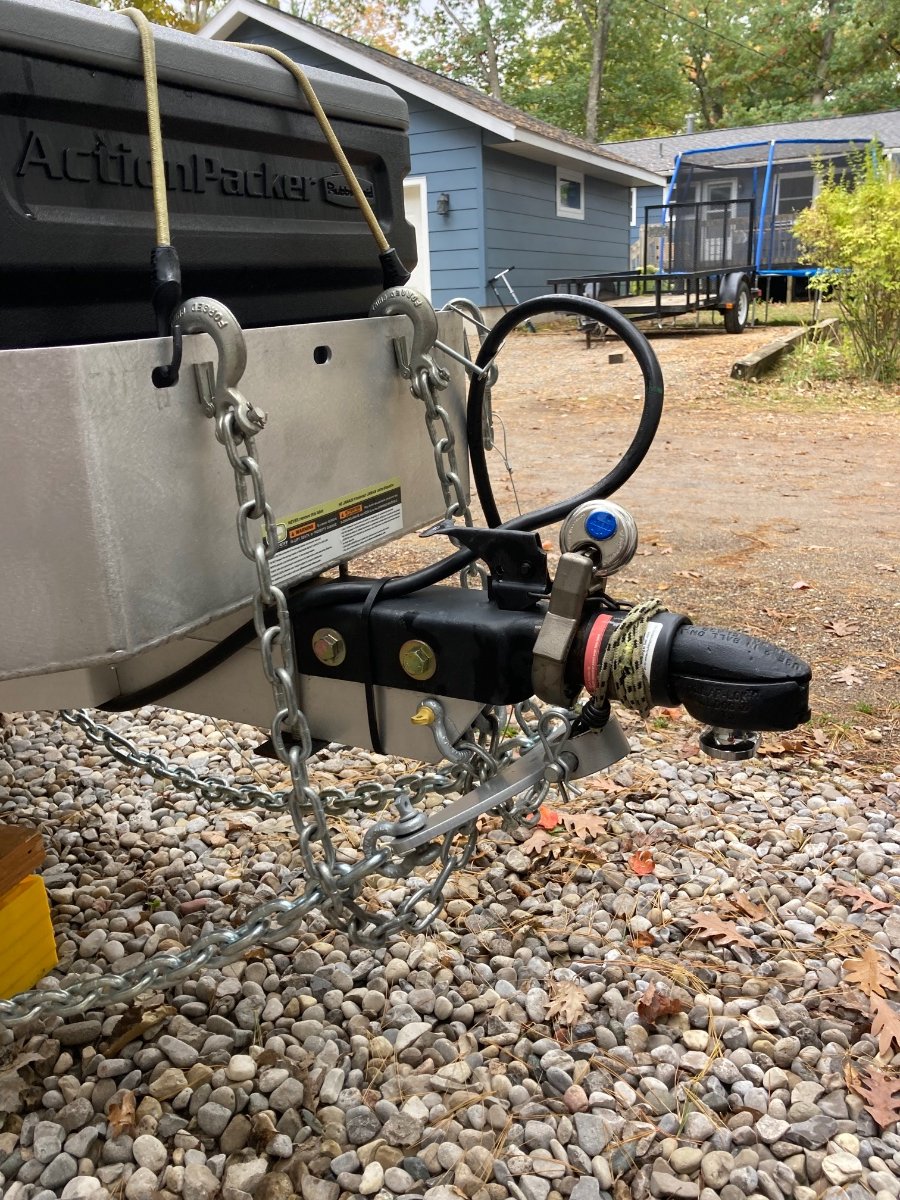
Hi all, do I need to bring a jack along for the unlikely, but still possible, flat tire. My 2017 Ford Expedition has a jack. As I understand it, the stabilizer legs aren't meant for lifting the trailer, but only to stabilize it. I assume on a 2022 LE2 if I was to ride one tire up on an Andersen leveler that the other tire would remain on the ground. I am getting a few items in preparation for pick up in less than a month. I did buy a Proven Lock, yoke and Abus lock because I don't want to have this trailer stolen! John1 point
-
In case you are visual, like me.
1 point
-
I have LT tires on our Elite I, and run at 70psi. I've got no deep knowledge on the tires, I run at 70psi based on past info from this forum. We've only owned ours for 1 1/2 years so we're running on the tires put on by the previous owner (Michelin LTX). We've had no problems at all, but no rough road traveling (lots of back highways if possible). And we're still weekend only unfortunately, looking forward to some longer trips. Might consider the ST tires when we have to change, but that'll be another year or more I think. And @Ron and Phyllis, glad to have some other Elite I owners around.1 point
-
Absolutely - for that and so many more reasons. Yes, if it wasn't for the "elbow issue" I too would prefer to have the nightstand near my head. But, having my glasses, flashlight, alarm clock and one or two other items near the stove at night isn't really an issue for me. While I've seen other owners place netting or shelves either under the bed or right above the bed to hold these items I haven't found a system (yet) that works better than simply moving these small items each night/morning. Bill1 point
-
"When I first got my Ollie I slept with my head at the nightstand (I'm 6', 165 pounds). But after a couple of night of my elbows hitting either the nightstand or the curved wall, I did a 180 and now sleep with feet at the nightstand. Much more room for the elbows." I plan to take the curb side bed as I sleep on my right side and putting my feet at the rear will work great. Having a night stand near my head is appealing, but for the reasons you mentioned, I will just use the stove area for my glasses. John1 point
-
Just another thought on the pipe insulation. I put it on also, not as much for insulation as for sound. At least in my trailer the water pump creates vibration and putting on the pipe insulation helps with the noise. One other thing I do is remove the plastic outside shower head make sure the metal hose is drained and shove it back inside the trailer. Even when I have winterized. I have heard people say that shower head is prone to cracking if it freezes.1 point
-
I would winterize it and take zero chance. It’s so fast and easy to winterize, odds are you’ll be fine but I’d rather sway on the side of certainty instead of odds.1 point
-
We only store ours for a month or two at a time and I never put down the stabilizer jacks. Mike1 point
-
6’6”. 250 lbs. I make it work. At 6’2” he should fit just right.1 point
-
Absolutely! Please look me up and/or stop me. I don't remember my site number off hand but I'm down by the lake and my "Oliver" sign on the rear says "Twist" Bill1 point
-
That's and easy one - it depends.😁 Seriously, there are those that like to take some of the weight off the suspension and/or tires during storage and others that simply leave things alone. I'm in the leave it alone camp. Any "flat spots" in good tires will work themselves out once the tires are warm and rolling down the road. I'm not convinced that either the shocks or the leaf springs will "set" in a certain spot due to not flexing over the winter. But, I do store my Ollie in a fairly protected - from wind - and the winters we have here in western North Carolina are really not very bad. Bill1 point
-
Will your Ollie be connected to shore power? The internal battery heaters consume power, so the batteries need a means of recharge to keep the heater working. I recommend you ask Battleborn if, given your storage conditions, the "system" will "take care of itself."1 point
-
I’m interested in this as well, we too would prefer not to remove the batteries and just stay connected to shore power with the battery heater on. I don’t understand why you would need an external charger if you can connect to shore power. Why is staying connected to shore power not recommended? If you can plug into shore power you don’t need an external charger. Last winter the previous owner had the Oliver stored outside not connected to shore power with battery heater on, I’m guessing the solar kept the battery heater charged? There has been so many different answers about this including from lithionics I’m not sure what to do. It’s unsettling that the person from lithionics you spoke to didn’t know if keeping it plugged into shore power was ok but then tried to sell you a portable lithium charger! Wouldn’t shore power charge it just the same?1 point
-
Thank you! That is correct ThanPro Package with three Lithionics 130Ah G31 batteries. I have shore power so I might leave a space heater inside the E2. I could also put a 120V heat pad in the battery compartment. I was told when I picked up the Oliver that all power including shore power goes through the batteries and inverter. I haven't tried running on shore power with the batteries turned off yet that's tomorrows test1 point
-
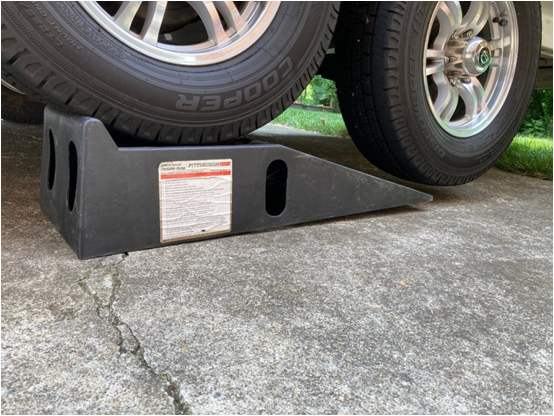
Sold by HF as a set.....made of polypropylene...each ramp weighs about 9 pounds. Yes, I take it on all trips...its about 3 feet long and fits neatly on top of my truck's wheel well. https://www.harborfreight.com/13000-lb-gvwr-portable-vehicle-ramp-set-63956.html1 point
-
LE2 2022 Hull 806 here, I utilize a HFreight ramp I already had on hand....it works great to lift either tire off the ground. It has 6.5" of lift and is as simple as it looks. I use the ramp to take tires off when I grease the zerks. I hope I never have to use it on the side of the road, but I have complete confidence if I need to do so.
1 point
-
Since we have a long, multi-day trip home to Idaho after we take delivery on November 10, I purchased (at John Davies' suggestion) a Safe Jack 6-ton RV Jack. It includes extenders that should enable it to reach the jacking points on the 2022 Elite II, from the ground. The kit includes a u-shaped frame adapter that I hope will fit the Elite II frame and enable a more secure connection with the trailer. https://www.4wheelparts.com/p/safe-jack-6-ton-rv-jack-kit-37m-rv6/_/R-SAJK-37M-RV6?ppcfon=1&gp=1&ecmp=s:google_15843829820___&utm_source=google&utm_medium=cpc&utm_campaign=SC Shopping - Tires & Wheels - Performance Max&gclid=Cj0KCQjwhY-aBhCUARIsALNIC06UbEzgITJgaGQn_rPib0QBhxX7NiH5oVwxeWUM_qjnkqbeLh5T-FgaAsOiEALw_wcB Not cheap, but worth the peace of mind to me. I also have a set of the Camco Large Stabilizing Jack Pads, to provide a solid base for the Safe Jack, if needed. https://www.amazon.com/Camco-Large-44541-Stabilizing-Jack/dp/B005BNZ9UM/ref=asc_df_B005BNZ9UM/?tag=hyprod-20&linkCode=df0&hvadid=198056825273&hvpos=&hvnetw=g&hvrand=9575626206363820960&hvpone=&hvptwo=&hvqmt=&hvdev=c&hvdvcmdl=&hvlocint=&hvlocphy=9029558&hvtargid=pla-438289870527&psc=1 If I have to change a tire, I plan chock the wheels on the side opposite the flat, jack up the side with the flat using the Safe Jack on a Stabilizing Jack Pad, then lower the stabilizers to provide additional support and stability.1 point
-
John, I applaud your approach to purchases. I don’t think we’ve yet had the pleasure of actually meeting each other. But those that know me and have seen our truck, probably recognized the tongue in cheek sarcasm of my post. When we meet, you’ll see what I mean.1 point
-
Two big thumbs up on that TPMS! Good for you! Bill1 point
-
I am focusing on safety and trailer protection. There's always the must haves and the wants. TPMS was expensive but I felt it was a necessity. That's my approach. The forum has been great for ideas of those must haves.1 point
-
I never buy anything that I don’t absolutely, positively think that I MAY use one of these days.1 point
-
Most of these things are really not "necessary" for you to enjoy your Oliver. However, they do make the experience more relaxing and or easier or safer than it would be without them. They tend to save you time, energy, worry and simply make the whole camping/traveling experience more enjoyable because you spend less time working, thinking, worrying and more time doing what you really want to do. It will not be long now and your delivery will pass you by as if being played in triple fast speed. Try to resist buying anything but what you feel is necessary and then add later depending on your style of travel and camping. Bill1 point
-
Bill, I ordered the Camco stacking jack stands as it seems it makes more sense to not extend the stabilizer jacks so far for reasons of less wear and distance to the ground. Not so much flex pressure on the mount. My wife is rolling her eyes when another box is delivered to the house. It's all necessary though. TPMS, water pressure gauge, Proven lock, surge protection, etc. John1 point
-
Just goes to show how lazy I really am! My six inch by 11 inch wood blocks are either placed on their sides (6 inches) on on their ends (11 inches) depending on how much room I have. Certainly as Mike points out - the less you have to extend the on-board jacks , the better - whether that be for leveling or for changing a tire. Bill1 point
-
Actually it was JED above that suggested the Lego blocks and they are good to have on board. Having said this - I've only actually used my legos one time in the last seven years! Bill1 point
-
There is a lot of past discussion about this. I’ve used the on board jack a number of times to raise tires off the ground for various reasons. I won’t get under the trailer with just the onboard jack but will change a tire. YMMV. Mike1 point
-
Most travel trailers do not have disk brakes. There are several members of this Forum that consider our drum style brakes to be "garbage". However, over the years these drums and brakes have done the job in a simple, cost effective manner without major difficulty. If one keeps them clean and in good repair they should give you years of trouble free service. Having said this - there is little question that disk brakes perform better over a higher range of conditions as opposed to drum brakes. But, RV's are not sport cars or airplanes. Nor are they normally subjected to the same kinds of wear and tear as even our daily drivers. Bill1 point
-
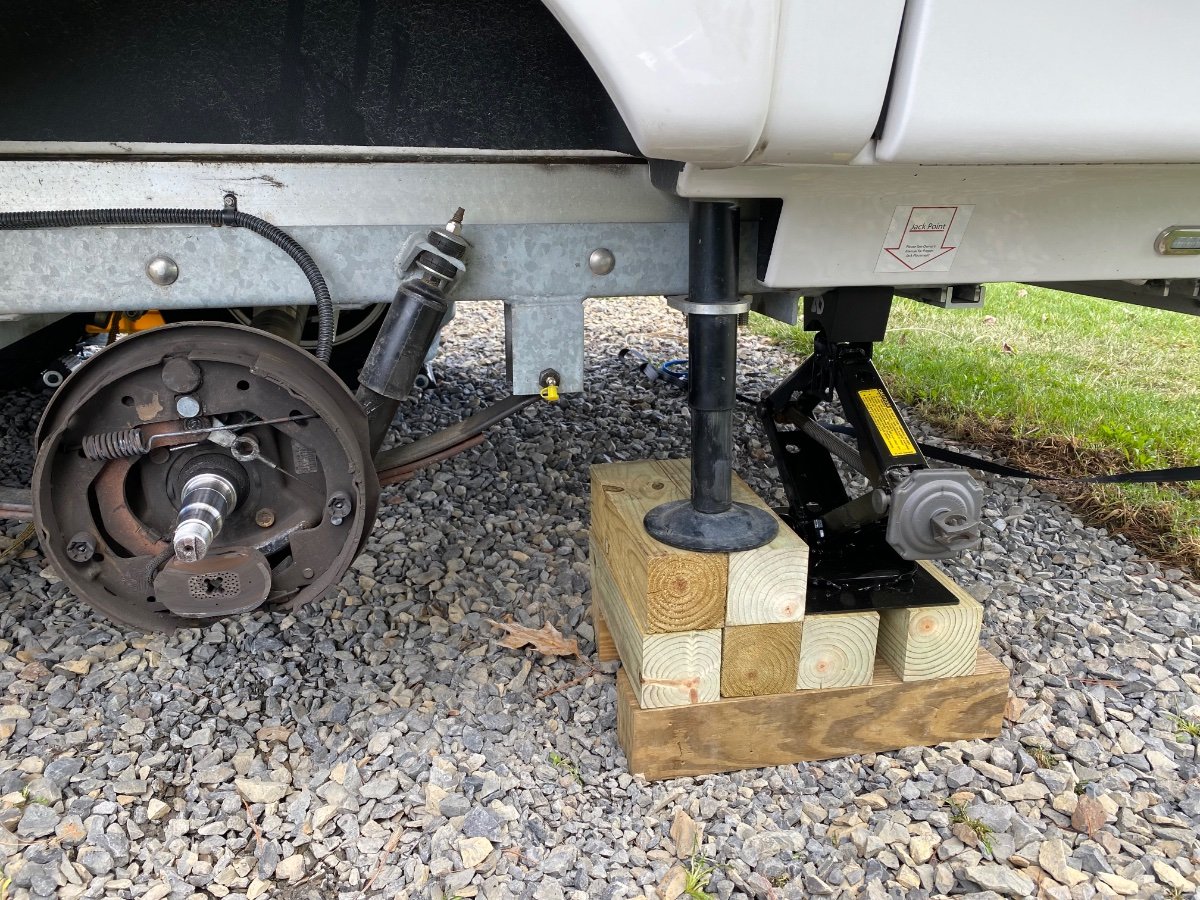
Depending on the situation - a single Andersen leveler may or may not be enough to get that tire off the ground. Therefore, Frank C's suggestion of carrying some form of "blocks"* (certainly these can be "lego" style that JD mentions)** in order to take lateral "pressure" off the onboard jack is worth considering. Also, as per Frank C - keep the Ollie attached to your tow vehicle and clock the opposite side. Try to find as level a spot to do the repair as possible - most roads and their shoulders are sloped such that if the flat tire is on the curbside it will require you to lift more weight than necessary. Finally, if there is any doubt then call for help. The couple of hours that you might save by doing the job yourself is simply not worth the possible negative outcomes. Bill *I carry both wood blocks and lego style blocks. The wood blocks can be had free either around your own workshop or by "scrounging". ** note - these lego style blocks can also be used for help in leveling the tongue when the throw of that jack is simply not long enough to get your Ollie level from front to back. Or when the Andersen's need a bit of extra help. Or when your outside grill can't find a level spot. Or when .....1 point
-
I carry a large scissor jack (a military surplus HUMVEE jack with frame adapter, referenced in the other thread link that John posted above) and some pieces of 4”x4” lumber for raising the trailer for tire changes and wheel bearing maintenance. I lift the trailer with the scissor jack and then put the stabilizer down as a safety backup just in case. Tire chocks on the trailer wheels on the opposite side, and the trailer still hitched to my truck, so the trailer won’t shift at all while lifting. This setup has worked well and is very stable and safe when I have to work on the trailer. I prefer overkill when it comes to safety 🙂. And I don’t trust just using the stabilizers only to lift the trailer for tire changes after seeing how small the welds are on the stabilizer mounting brackets.
1 point
-
You need to have blocks, either wood or the yellow Camco lego style, You can raise one side up with the stabilizer enough for the tire to rotate and block the underside of the axle on that side if you feel like it. I don’t ever bother unless I am about to crawl underneath the trailer. I really doubt that your truck jack has enough lift without using blocks under it. FYI: https://olivertraveltrailers.com/forums/topic/6549-recommend-a-heavy-duty-mechanical-scissor-jack/ John Davies Spokane WA1 point
-
We towed our 2008 Elite 60-70K miles. We always ran our tires at 80 psi because that’s what Jim Oliver told me to do. I now know a hell of a lot more about towing. The tires on our Elite II are 12 ply all steel belted and have a maximum tire inflation rating of 95 psi to 110 psi and that would be fine if our Oliver weighed 12,000 pounds. Fortunately, despite the fact that she’s a big ole gal, at “only” about 7000 pounds I can safely run them at 60-65psi, which I do. Now, that’s for highway use. Only. If you head up something like a rough forest service road or, heaven forbid, decide to drive the 70 miles of washboard into Chaco Canyon or the 27 miles of very bad road out to the Racetrack Playa in Death Valley then please stop and air down. Obviously, you’ll need the ability to re-inflate when you get back to the pavement, so a good compressor and tire gauge is imperative. If you are unable or unwilling to do this, then just don’t go. Ignore this at your own peril. If you do, you’ll be tightening, repairing and replacing plumbing, electrical and mechanical stuff for a while. And some of this will be before you even get home. I’ll leave it to your imagination to figure out why I mention these things.1 point
















-
Recent Achievements
-